INKWON Tag 2026 — First 4‑in‑1 Pocket Printer

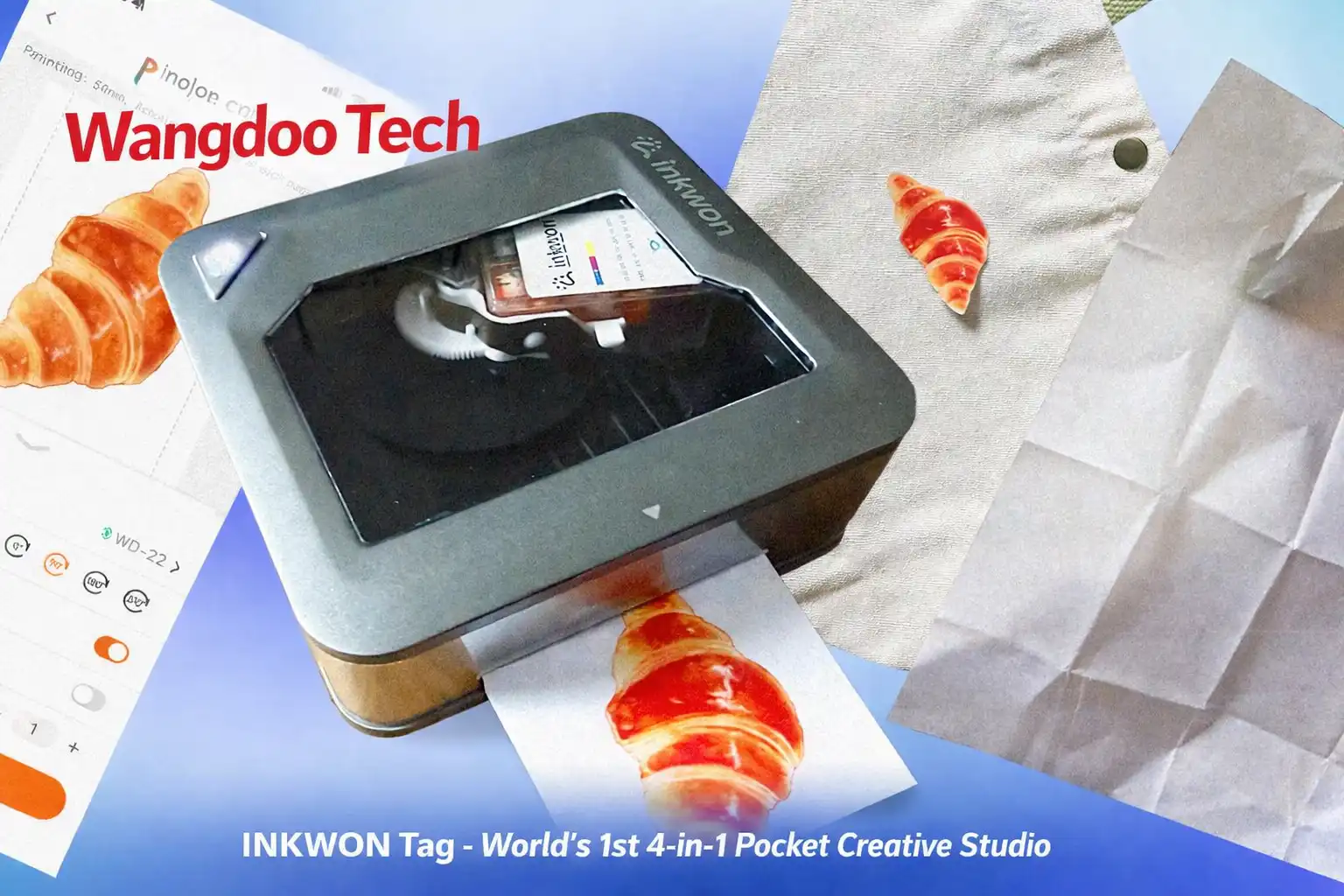
What Is the INKWON Tag? The 4-in-1 Pocket Printer That Does Tattoos, Stickers, Heat Transfers and Photos From One Device
Pocket printers have always specialised in one output type. The INKWON Tag is designed to cover four — temporary tattoos, custom stickers, fabric heat transfers, and HD photo prints — using a single CMY inkjet cartridge in a device the size of a large wallet. Here is what it actually is, how the technology works, and what an independent hands-on reviewer found when testing a production unit.
Portable printers have always had an identity problem. Polaroid prints photos. Phomemo prints labels. ZINK-based devices make small sticky prints. Every device picks a lane and stays there — partly because the dominant thermal printing technology used in most pocket printers is inherently limited to one output type.
The INKWON Tag is built on a different premise. Using a CMY dye-based inkjet system — the same underlying technology used in desktop inkjet printers, miniaturised into a 235-gram handheld device — it is designed to produce four genuinely different output types from one machine and one cartridge. Launched on Kickstarter on April 28, 2026 by INKWON Printing, a Kowloon, Hong Kong studio, the campaign raised over $5.9 million from thousands of backers — nearly 6,000% of its funding goal. The Gadgeteer’s Vincent Nguyen received and tested a production unit before the campaign launched and confirmed all four modes work as described.
The INKWON Tag is a pocket-sized 4-in-1 colour inkjet printer measuring 105 × 97 × 45 mm and weighing 235 grams. It prints temporary tattoos, custom stickers, fabric heat transfers, and HD photos at 600 DPI from a single tri-colour CMY ink cartridge — approximately 60 sheets per cartridge. It connects via Bluetooth 5.4 to iOS and Android devices and is charged via USB-C. Kickstarter early bird pricing starts at $169 (MSRP $299) for the Basic Pack. The campaign runs until June 22, 2026, with shipping estimated for August 2026. INKWON Printing is a first-time Kickstarter creator with no prior campaign track record — this is relevant context for prospective backers.
INKWON Tag official Kickstarter campaign video — April 2026. All rights respective owner.
Why Inkjet Matters in a Pocket Printer
Understanding what makes the INKWON Tag technically different from other portable printers requires understanding why most portable printers use thermal printing — and what that limits them to.
Thermal printing works by heating special paper to produce an image — no ink involved. It is simple, reliable, and requires no cartridges. The limitation is that thermal paper is a fixed medium. It produces one type of output — a print on that specific paper — and the colour range is limited by the paper’s chemistry. ZINK (Zero Ink) thermal technology, used by Polaroid and others, can produce colour but with reduced accuracy and no ability to adapt the output chemistry for different applications. You cannot produce a safe skin-contact temporary tattoo from a thermal printer because the paper chemistry is wrong. You cannot produce a proper heat transfer because thermal images do not bond with fabric fibres correctly.
Think of a thermal printer as a photocopier that only works with one specific type of paper. Change the paper and nothing happens correctly. An inkjet printer is different — it deposits actual ink onto whatever surface is loaded, and the chemistry of that ink can be formulated to work with different paper types. The INKWON Tag’s CMY dye system uses ink specifically formulated to be skin-safe for tattoo paper, heat-reactive for transfer paper, and colour-accurate for photo paper — all from the same cartridge. The paper type determines the end result, not the printer mechanism.
The INKWON Tag uses CMY (Cyan, Magenta, Yellow) dye-based inkjet printing with 8-picoliter drop control — a measure of how precisely the ink is deposited. At 600 DPI, it produces output comparable to entry-level desktop inkjet photo printers. The ink is certified to EN71-3 toy-grade safety standards, REACH, RoHS, and MSDS compliance — meaning the chemical formulation has been independently verified as safe for skin contact, which is the minimum requirement for a device claiming to print temporary tattoos.
What the Four Modes Actually Produce
Mode 1 — Temporary Tattoos
Temporary tattoo printing uses a two-component paper system — an A-paper and a B-film — producing a finished design at 54 × 89 mm. Application follows a standard temporary tattoo process: print the design, peel the protective film, place the printed side against clean dry skin, apply a damp cloth to the backing for ten to fifteen seconds, and peel away. According to INKWON’s official materials, the resulting tattoo is designed to be waterproof for everyday activity and last several days before fading. Independent long-term wear data has not been published at time of writing.
The EN71-3 certification is the relevant safety credential here. It is the same standard applied to children’s art materials and confirms that the ink formulation has passed toy-grade toxicological testing. INKWON also lists REACH and MSDS compliance for the ink. These are meaningful certifications for a product making skin-contact claims — not simply marketing language.
Mode 2 — Custom Stickers
Using 200g RC adhesive photo paper, the INKWON Tag produces glossy stickers at 600 DPI. The Gadgeteer’s reviewer described the output as “sharp enough for laptops and planners” — a useful benchmark given that sticker quality from thermal portable printers is often noticeably soft at close range. RC (resin-coated) paper is a standard photographic paper base that produces a professional glossy finish rather than the matte output common in thermal sticker printers.
Mode 3 — Fabric Heat Transfers
Heat transfer paper rated for 180–190°C application allows the INKWON Tag to produce iron-on designs for T-shirts, tote bags, and light cotton fabric. The print process takes 25–35 seconds on the device. Transfer to fabric then requires 3–5 minutes of iron application at the appropriate temperature. The Gadgeteer’s review confirmed that heat transfers survived washing — this is the critical real-world test for heat transfer quality, as many cheaper transfer solutions fail it. Standard wash care applies: inside-out, cool cycle, no tumble drying.
The INKWON Tag’s heat transfer mode works on light-coloured fabric only. There is no white underbase ink in the cartridge system — meaning designs printed on dark fabric will not show correctly, as the coloured ink is semi-transparent and relies on a light background. This is a standard limitation of CMY-only inkjet heat transfer systems and is confirmed in INKWON’s official campaign materials. It is not a defect — it is a design constraint to be aware of before purchasing.
Mode 4 — HD Photo Prints
On 200g RC photo paper, the INKWON Tag produces standard-format photo prints at 600 DPI. The combination of CMY dye ink, RC-coated paper, and 8-picoliter drop control produces colour accuracy and sharpness that thermal alternatives cannot match at equivalent DPI. The Gadgeteer described the photo output as comparable to desktop inkjet photo quality — a meaningful claim for a pocket device, though one that merits independent confirmation when more reviewers receive units.
A single tri-colour cartridge contains 1.2ml per colour channel and yields approximately 60 sheets across all four paper types, calculated at a 60×45mm pattern at 40% ink coverage. At $0.50 per sticker or photo print and approximately $0.72 per tattoo sheet (GizmoCrowd estimate), consumable costs are in line with desktop inkjet photo printing. The 1,000mAh battery supports 90 minutes of continuous printing — designed to match the cartridge yield so both run out together. The cartridge uses a magnetic lid for tool-free replacement.
Full Technical Specifications
| Specification | Detail |
|---|---|
| Dimensions | 105 × 97 × 45 mm |
| Weight | 235g |
| Print Resolution | 600 DPI |
| Print Mechanism | CMY dye-based inkjet · 8-picoliter drop control · sweeping arc motion |
| Ink Safety | EN71-3 toy-grade certified · REACH · RoHS · MSDS compliant · 100% water-based · skin-safe |
| Print Modes | Temporary tattoo · Custom sticker · Fabric heat transfer · HD photo print |
| Max Print Size | 54 × 89 mm (all modes) |
| Tattoo Paper | A + B film two-component process |
| Sticker / Photo Paper | 200g RC (resin-coated) adhesive photo paper |
| Heat Transfer Temp | 180–190°C · light-coloured fabric only |
| Cartridge Yield | ~60 sheets per cartridge (60×45mm at 40% coverage) |
| Estimated Per-Print Cost | ~$0.50 stickers/photos · ~$0.72 tattoos (GizmoCrowd estimate) |
| Battery | 1,000mAh · 90 minutes continuous printing · USB-C charging (~2.5 hours from empty at 5V 1A) |
| Connectivity | Bluetooth 5.4 |
| App Compatibility | iOS 12.0+ · Android 5.0+ · no PC or desktop support |
| App Features | Design editing · one-click cleaning cycle |
| Manufacturer | INKWON Printing · Kowloon, Hong Kong |
| Parent Company | EOM GROUP (claimed) — 46 global patents · $80M+ annual revenue · 5.8M products shipped globally |
| Kickstarter Launch | April 28, 2026 |
| Campaign End | June 22, 2026 |
| Estimated Shipping | August 2026 |
| Basic Pack | $169 early bird · $189 standard backer · MSRP $299 |
| Mega DIY Pack | $199 early bird · MSRP $349 |
| Warranty | 1 year |
What Each Pack Includes
Two tiers are available, both at significant discounts to stated MSRP:
Basic Pack ($169 early bird / $189 standard / MSRP $299) — INKWON Tag device, tri-colour CMY ink cartridge, USB-C cable, starter assortment of paper types including tattoo, adhesive sticker, heat transfer, and photo sheets, mini tote bag, and one T-shirt.
Mega DIY Pack ($199 early bird / MSRP $349) — Everything in the Basic Pack plus doubled consumables, additional T-shirt, tote bag, and photo frame. Recommended for anyone planning to use heat transfer or tattoo mode at significant volume.
Three limitations confirmed in INKWON’s official campaign materials and independent coverage. First — maximum print size is 54 × 89 mm across all modes. This is wallet-sized. There is no large-format option. Second — no PC or desktop app support. The INKWON app runs on Android 5.0+ and iOS 12.0+ only. Third — heat transfers work on light-coloured fabric only due to the absence of white underbase ink. All three are manufacturer-confirmed design constraints, not defects.
How It Compares to Other Portable Printers
| Feature | INKWON Tag | Polaroid Hi-Print | Phomemo M02 |
|---|---|---|---|
| Print technology | CMY dye inkjet | ZINK thermal | Thermal monochrome |
| Resolution | 600 DPI | 314 DPI | 203 DPI |
| Output types | 4 — tattoo, sticker, heat transfer, photo | Photos only | Stickers/labels only |
| Temporary tattoos | ✓ Yes — EN71-3 certified ink | ✗ No | ✗ No |
| Fabric heat transfers | ✓ Yes — wash-proof confirmed | ✗ No | ✗ No |
| Max print size | 54 × 89 mm | 54 × 86 mm | 57 mm width roll |
| Dark fabric support | ✗ No — light fabric only | ✗ No | ✗ No |
| Connectivity | Bluetooth 5.4 | Bluetooth | Bluetooth |
| Available now | ⚠ Ships August 2026 | ✓ Yes | ✓ Yes |
| Price | $169–$189 backer · $299 MSRP | ~$100 retail | ~$40–60 retail |
The honest comparison: the Polaroid Hi-Print and Phomemo M02 are available now and cost less. For buyers who only need photos or labels respectively, they are simpler and more immediately accessible. The INKWON Tag’s value case is specifically for buyers who want multiple output types from one device — the four-in-one capability is not available from any current shipping competitor.
Who Is the INKWON Tag Designed For?
The Credibility Question — Is INKWON a First-Time Creator?
The original version of this article stated that INKWON Printing operates as the creative division of EOM GROUP, citing $80M+ annual revenue and 5.8 million products shipped globally. This claim originates from INKWON’s own campaign materials and has not been independently verified by third-party sources.
The Gadgeteer’s reviewer — who tested a production unit — noted specifically that “INKWON Printing is a Kowloon, Hong Kong studio with no prior crowdfunding campaigns.” This is the more conservative and independently sourced characterisation. The EOM GROUP parent company relationship may be accurate — but it is INKWON’s own claim, not an independently confirmed fact.
What is confirmed: trial production began in January 2026, three months before the campaign launched. The Gadgeteer tested a working production unit and confirmed all four modes function as claimed. The campaign has raised over $5.9 million. The product physically exists and works. For a prospective backer, the relevant risks are standard first-time Kickstarter creator risks — shipping timeline delays and long-term after-sales support — rather than a concern about whether the product itself works.
“The INKWON TAG is the most ambitious pocket printer in years, and every feature works the way the brand promises. Photos print like real inkjet photos. Stickers come out sharp enough for laptops and planners. Heat transfers survive the wash. Temporary tattoos hold for days on skin. No shipping competitor delivers all four jobs in one pocket-sized device.”
My Take — Mr Wangdoo
Wangdoo has not tested this product. That is the starting point for anything that follows.
What the INKWON Tag does differently from a design perspective is use a print technology that most portable printer manufacturers have avoided — inkjet — specifically because it enables output chemistry that thermal printing cannot replicate. The four-in-one claim is not marketing padding. Thermal printing genuinely cannot produce skin-safe temporary tattoos or wash-proof fabric transfers. The choice of inkjet is what makes the multi-mode claim technically credible, not just aspirational.
The one detail that changes the risk calculus for prospective backers is The Gadgeteer’s production unit review. That is a named reviewer, a named publication, a specific date, and a specific finding: all four modes work. That is the strongest available independent signal for a product that has not yet shipped at consumer scale. It does not eliminate first-time creator risk on timelines and support — but it does address the most important question, which is whether the product works at all.
The constraints are worth restating plainly: 54 × 89 mm maximum size across all modes, light fabric only for heat transfers, no desktop app, and a 2.5-hour charge time. None of these are surprising given the device’s size and price point. They are design trade-offs, not hidden problems — and INKWON’s campaign materials disclose them rather than obscure them.
Frequently Asked Questions
What is the INKWON Tag and what makes it different from other portable printers?
The INKWON Tag is a pocket-sized colour inkjet printer that produces four different output types from one device — temporary tattoos, custom stickers, fabric heat transfers, and HD photo prints. Unlike most portable printers, which use ZINK thermal technology and are limited to one output format, the INKWON Tag uses CMY dye-based inkjet printing at 600 DPI. The inkjet technology allows the same ink to adapt to different paper chemistries, which is what makes the four-mode claim technically possible. No current shipping competitor combines all four output types in a pocket-sized device.
Is the ink safe for skin contact?
INKWON’s ink is certified to EN71-3 toy-grade safety standards — the same certification required for children’s art materials and colouring products. The ink is 100% water-based and certified to REACH, RoHS, and MSDS compliance. These are independent safety certifications, not simply marketing claims. As with any product applied to skin, individuals with known ink sensitivities or skin conditions should perform a patch test before full application.
Have the heat transfers been tested to survive washing?
Yes — The Gadgeteer’s Vincent Nguyen tested a production unit and specifically confirmed that heat transfers survive washing. The heat transfer paper is rated for 180–190°C application. Standard wash care extends transfer longevity: inside-out wash, cool cycle, no tumble drying. Note that heat transfers only work on light-coloured fabric — there is no white underbase ink in the system.
What is the maximum print size?
54 × 89 mm across all four modes. This is approximately the size of a standard wallet photo or business card. There is no large-format option. This is a confirmed design constraint, not a specification that varies by mode or paper type.
Does it work with a desktop or laptop computer?
No. The INKWON Tag connects via Bluetooth 5.4 to the INKWON companion app on iOS 12.0+ or Android 5.0+ only. There is no PC, Mac, or desktop application. All design editing and print management is handled through the mobile app.
When does it ship and what does it cost?
Kickstarter estimated shipping is August 2026. The campaign runs until June 22, 2026. Early bird pricing is $169 for the Basic Pack (MSRP $299) and $199 for the Mega DIY Pack (MSRP $349). Standard backer pricing after early bird tiers close is $189 for the Basic Pack. After the campaign closes, the product will sell at full MSRP through INKWON’s retail channels. Always verify current tier availability on the official Kickstarter page before pledging.
Is INKWON Printing a credible company to back?
INKWON Printing is a first-time Kickstarter creator — The Gadgeteer confirmed this directly in their review. The company claims to operate as the creative division of EOM GROUP, a Hong Kong manufacturer with 46 global patents and $80M+ annual revenue, though this relationship has not been independently verified by third-party sources. What is independently confirmed: trial production began January 2026, The Gadgeteer tested a working production unit and confirmed all four modes function as claimed, and the campaign has raised over $5.9 million. The standard risks of a first-time crowdfunding creator — potential shipping delays and uncertainty around long-term support — apply. The product itself has been independently verified to work.
Why does it use inkjet rather than thermal printing?
Thermal printing cannot produce skin-safe temporary tattoos or wash-proof fabric heat transfers because the paper chemistry required for those applications is incompatible with thermal mechanisms. Thermal printing works by heating special pre-treated paper — the output is dependent on the paper’s fixed chemistry. Inkjet printing deposits actual dye ink onto the paper surface, which means the ink formulation can be designed to work with different paper chemistries — tattoo transfer paper, heat transfer paper, RC photo paper, and adhesive sticker paper — from the same cartridge. The use of inkjet is what makes the four-mode claim technically achievable, not just marketable.
- INKWON Kickstarter — INKWON Tag official campaign — specifications, pricing, and campaign updates (April 2026)
- PR Newswire — INKWON official launch announcement — full specifications and company background (April 28, 2026)
- The Gadgeteer — INKWON TAG — hands-on production unit review by Vincent Nguyen (April 28, 2026)
- GizmoCrowd — INKWON Tag — detailed technical breakdown including per-print cost estimates
- Phandroid — INKWON Tag launch coverage and specifications (April 27, 2026)
- MacSources — INKWON Tag Kickstarter overview