A Brazilian Answer to the Flipper Zero — and Then Some
The pocket pentesting tool market got its defining product in 2020 when the Flipper Zero launched on Kickstarter and raised $4.8 million — introducing millions of people to the idea that powerful wireless security research could fit in a dolphin-shaped gadget. But the Flipper Zero has limitations. Wi-Fi, critically, is an afterthought that requires a separate module and firmware workarounds. Enter HIGH BOY: a device that was designed from day one to treat wireless capability as a first-class feature, not an expensive bolt-on.
HIGH BOY is a real, Kickstarter-funded product developed by High Code, a Brazilian hardware security research company. The campaign raised over $600,000 from 4,589 backers across 80+ countries. The device is scheduled to ship in 2026.
Source: high-code.com · Hackaday.io project page, originally published April 2025HIGH BOY was conceived and first published on Hackaday.io in April 2025. In the year since, it has evolved significantly — most notably with a community-driven upgrade from a single ESP32-S3 microcontroller to a dual-MCU architecture combining the ESP32-P4 and ESP32-C5. That change, made in direct response to backer demand, added dual-band Wi-Fi 6 (2.4GHz and 5GHz) and positioned HIGH BOY substantially above any competitor in its price range.
The Flipper Zero — HIGH BOY’s most direct comparison point — retails for approximately $169 USD and supports Sub-GHz RF, NFC, infrared, and Bluetooth, but requires a separate Wi-Fi devboard module for wireless network analysis. HIGH BOY ships with native dual-band Wi-Fi 6 built in, requiring no additional hardware or firmware gymnastics.
Source: GizmoCrowd, February 2026 · ShiftDeleteDual-MCU Architecture: Why It Matters
The decision to move to a dual-MCU setup is the most technically significant thing about HIGH BOY and the one detail most casual coverage glosses over. Running two microcontrollers simultaneously — the ESP32-P4 handling primary processing and the ESP32-C5 managing connectivity — allows HIGH BOY to offload wireless workloads without bottlenecking the main processor. In practical terms, this means you can run a Wi-Fi scan while simultaneously analysing a Sub-GHz signal, without the device slowing down or dropping data.
HIGH BOY’s final production version uses a dual-MCU architecture: ESP32-P4 (main processor) + ESP32-C5 (connectivity co-processor). This was an upgrade from the original ESP32-S3 single-chip design, implemented in direct response to community feedback requesting 5GHz Wi-Fi support. Full hardware documentation and schematics are publicly available as part of the open-source release.
Source: High Code official product pageThe ESP32-P4 is Espressif’s latest high-performance application processor, built for demanding embedded applications. Pairing it with the ESP32-C5 — which natively supports 2.4GHz and 5GHz Wi-Fi 6 — gives HIGH BOY a technical foundation that no pocket pentesting device before it has matched.
Full-Spectrum Wireless: The Core Selling Point
What separates HIGH BOY from its competition isn’t any single feature — it’s the combination of everything in one device with no missing pieces. Every wireless protocol a security researcher is likely to encounter in the field is covered by the base unit, with no additional modules required for the core use cases.
HIGH BOY’s confirmed wireless capabilities include: dual-band Wi-Fi 6 (2.4GHz and 5GHz), Bluetooth 5.0 LE, Sub-GHz RF via CC1101 radio modem, LoRa for long-range experimentation, NFC, RFID, and infrared transmit/receive. All of these are integrated into the base device — not sold as separate add-ons.
Source: High Code product page · The Gadget Trend, November 2025For Wi-Fi specifically, HIGH BOY offers native 2.4GHz network scanning, signal strength visualisation, channel usage mapping, and encryption type identification. These capabilities are built into the firmware — there is no external dongle required, no compatibility headache, and no firmware gymnastics. This is the architectural difference that makes HIGH BOY genuinely more useful in a real engagement than the Flipper Zero for anything involving wireless networks.
HIGH BOY addresses the frustrations that held back an entire generation of pocket pentesting tools — primarily the absurd reality that Wi-Fi remained a second-class feature requiring external dongles and workarounds.
GizmoCrowd, February 2026
Open Source, Open Hardware — And Why That’s Rare
High Code has made a commitment that is genuinely uncommon in the hardware space: both the firmware and the hardware schematics of HIGH BOY are fully open-source. This is not a marketing statement — the full codebase and hardware documentation are publicly accessible and community-extensible from day one.
HIGH BOY is confirmed to be 100% open-source hardware and firmware. Users can inspect, audit, modify, and build their own features on the platform. The High Code team has also published independent security research — including a forensic analysis of a counterfeit Ledger Nano S Plus supply-chain attack — covered by 20+ international outlets, establishing their credibility as a legitimate hardware security research company.
Source: High Code official page · Hackaday.ioOpen hardware matters for a security research tool in a way it does not for, say, a pair of headphones. When you use a tool to test the security of networks and systems, you want to be able to verify that the tool itself is not doing something unexpected. With HIGH BOY, you can audit every line of firmware code. That transparency is a feature, not a footnote.
Build and Design: Retro By Choice
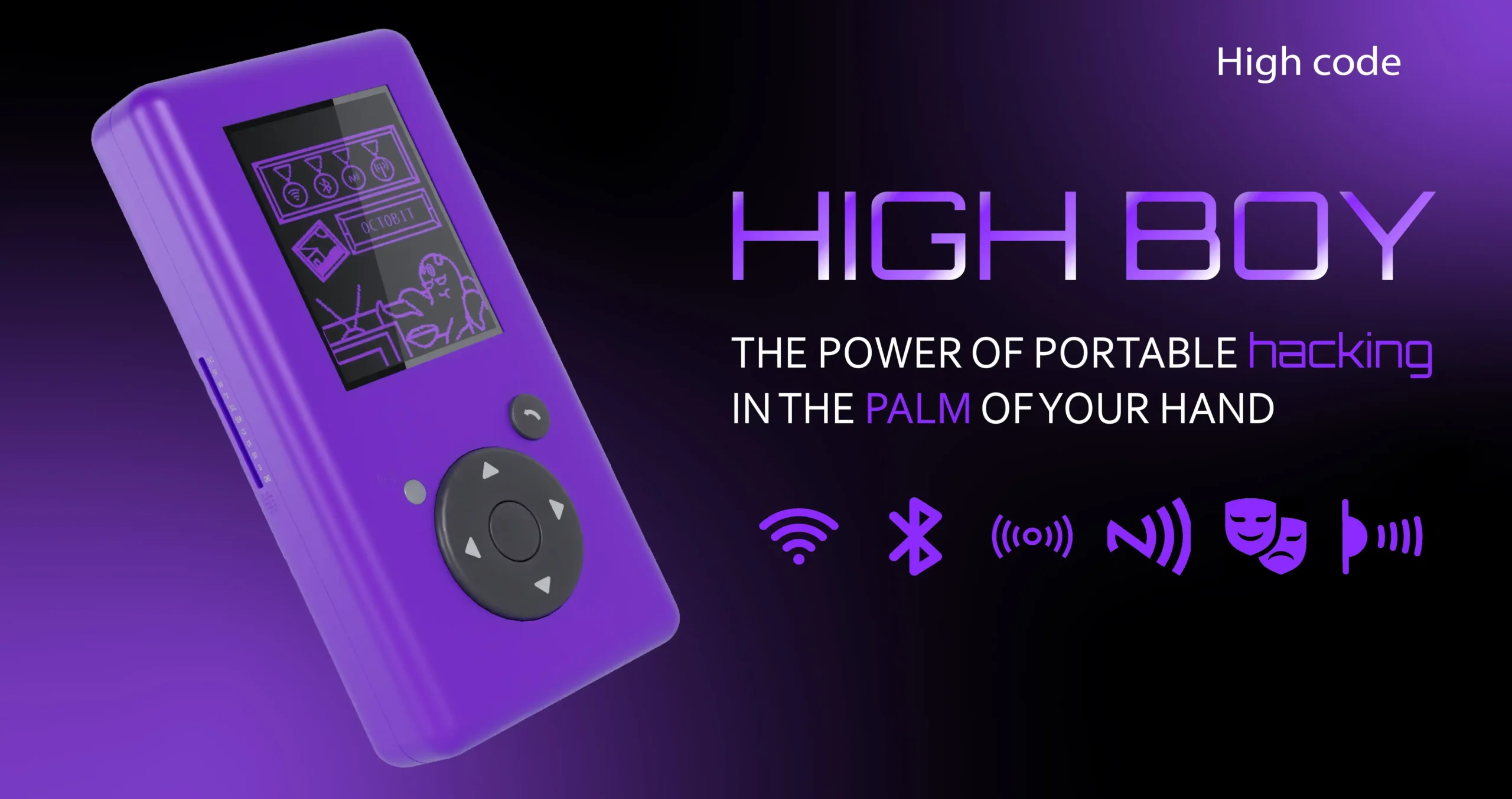
Aesthetically, HIGH BOY is a departure from the utilitarian rubber-and-plastic look of most pentesting hardware. Its vertical form factor — centred D-pad, button layout, 2-inch colour display — deliberately evokes early 2000s handheld gaming devices. That’s intentional. High Code wanted HIGH BOY to look approachable, not intimidating, and to appeal to the learner just as much as the professional.
HIGH BOY uses a vertical handheld form factor with a D-pad and button layout reminiscent of early gaming handhelds — unlike the horizontal orientation of the Flipper Zero. The 2-inch colour display shows navigation menus, signal monitoring data, and scan outputs. The device is pocket-sized and includes a microSD card slot and USB-C port.
Source: ShiftDelete hands-onThe 2,500mAh battery with USB-C fast charging is a practical choice for field work. It won’t run for a week, but for a full day of on-site testing it should be more than adequate. The GPIO expansion interface opens the door to external sensors, hardware modules, and custom electronics prototyping — making HIGH BOY a genuine platform rather than a fixed-function gadget.
A Note on Pricing
It is worth being precise here, because the pricing figures that circulate online vary considerably. The Kickstarter campaign launched at approximately $100 USD for the base unit — placing HIGH BOY at a highly competitive price point relative to the Flipper Zero ($169) and well below any professional SDR rig or multi-tool lab setup.
Some third-party promotional materials for HIGH BOY include tiered pricing (Core / Pro / Ultra at €129 / €199 / €299) described as conceptual market positioning for potential future SKUs. These are not confirmed retail prices. The verified Kickstarter campaign pricing was approximately $100 USD for the base device. Final post-campaign retail pricing has not been officially confirmed at time of publication.
Sources: Kickstarter campaign data · ShiftDelete · GizmoCrowd · High Code official page (cross-referenced May 2026)Who Is HIGH BOY Built For?
Pentesters
A compact, always-ready engagement tool with full wireless coverage and no missing modules.
Makers & Tinkerers
GPIO expansion, open hardware, and a growing developer community to build on.
Security Researchers
Open-source firmware, full RF spectrum access, and LoRa for exploring unknown wireless surfaces.
Students & Educators
Octobit in-device guide makes HIGH BOY accessible to beginners entering cybersecurity.
RF Experimenters
Sub-GHz via CC1101, LoRa, NFC, and RFID for exploring the full wireless spectrum.
Pros and Cons
What We Like
- Dual-MCU architecture with native dual-band Wi-Fi 6 — no extra modules
- Full-spectrum wireless: Sub-GHz, LoRa, NFC, RFID, BLE, IR all built in
- 100% open-source hardware and firmware
- GPIO expansion for external hardware and prototyping
- Community-driven development — backers shaped the final spec
- Approachable retro design with in-device learning guide (Octobit)
- Highly competitive pricing vs Flipper Zero and professional tools
- Legitimate hardware security research team with published work
What to Watch Out For
- Kickstarter product — delivery timelines can shift
- Firmware still maturing — some features delivered via post-launch updates
- 2-inch display is functional but not spacious
- Steeper learning curve than consumer gadgets for complete beginners
- Final retail pricing and availability outside Kickstarter TBC
- App ecosystem still growing — native tools fewer than Flipper Zero’s
The Bottom Line
HIGH BOY is not vaporware and it is not a clone. It is a legitimately designed, Kickstarter-proven hardware security research platform built by a credible team with a track record in security research. Its dual-MCU architecture with native Wi-Fi 6 solves the single biggest limitation of every pocket pentesting tool that came before it, and its fully open-source approach means the platform will only get better as the community builds on it.
At its Kickstarter price point of around $100, it is one of the most compelling purchases in the hardware hacking space in 2026. For pentesters, makers, security researchers, and curious learners alike, HIGH BOY makes a compelling case that you no longer have to choose between capability and affordability.
Buy it if you want a capable, open-source, full-spectrum wireless security research platform at an accessible price — and you are comfortable with the expected learning curve of any serious hardware tool. Wait if you need something with a mature, fully stable firmware and a large existing app ecosystem today — the Flipper Zero’s community is more established, though HIGH BOY’s hardware is technically superior.