Meet PONGBOT Aura — The All‑in‑One AI Coach for Tennis, Pickleball & Padel

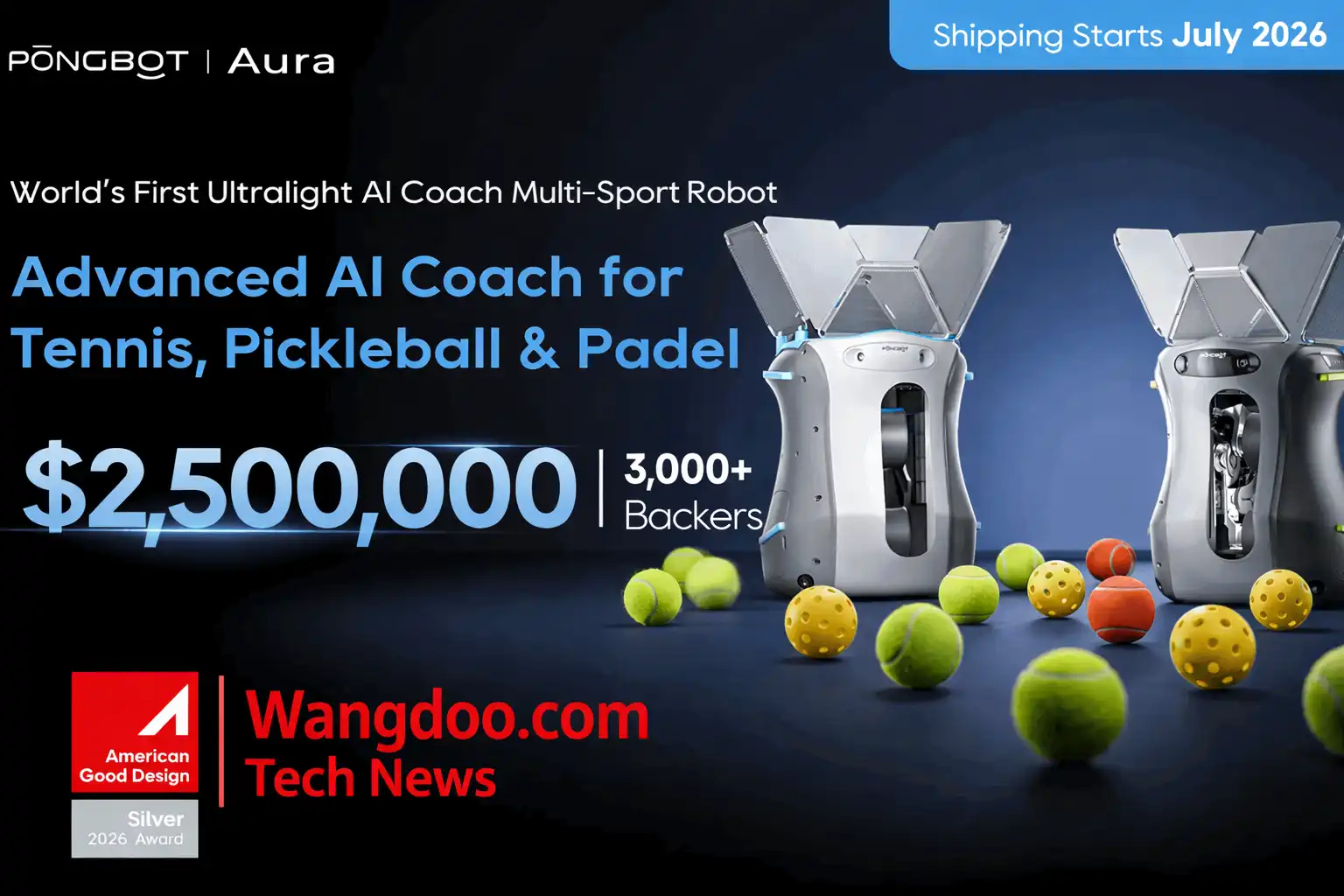
Pongbot Aura Explained: What Is an AI Multi-Sport Robot and Why Has It Raised $2.5 Million on Kickstarter?
A 7kg machine that physically reconfigures for tennis, pickleball, and padel — with an LLM-powered voice coach that adjusts shots mid-rally on command. Here’s what the Pongbot Aura actually is, how the AI works, and who it’s genuinely designed for.
Ball machines have existed for decades. The basic concept hasn’t changed much: a motorised wheel spins at speed, a ball drops in, and the ball fires out the other side at whatever angle and pace you’ve set on the dial. Useful, repetitive, and about as intelligent as a garden sprinkler.
The Pongbot Aura is trying to be something different. It’s a training robot — not just a ball machine — that adapts to three different racket sports from a single physical chassis, listens to voice commands in natural language, analyses your swing mechanics in real time, and uses a proper LLM to understand what you’re asking for. You can tell it “more topspin, wider angle” mid-rally and it adjusts. That’s a different product category than the dial-and-bucket machines that have dominated this space since the 1970s.
On May 19, 2026, PongBot launched the Aura on Kickstarter. Within weeks, the campaign had raised over $2.5 million from more than 3,000 backers — against a $19,992 funding goal. That kind of response doesn’t happen by accident. Here’s what the Aura actually is, how the technology works, and why this particular moment feels like a genuine shift in how solo sports training works.
The Pongbot Aura is a 7kg AI-powered training robot that covers tennis, pickleball, and padel from a single machine — using a patented adaptive wheel track that physically reconfigures for different ball sizes. It includes LLM-powered natural language voice control, 10,000+ built-in drills, and an optional camera module (the Spotter) that upgrades it to the Aura S with full AI swing analysis and real-time coaching feedback. The base Aura starts at $499 (one sport included; all-sports unlock costs $99 extra). The Aura S 3-in-1 with all three sports and the Spotter module is $749. MSRP after campaign is $999+. No subscription required. Shipping begins July 2026. PongBot has previously raised $2.7 million for its Pace S Series, named Best of Kickstarter 2024.
Official PongBot Aura Kickstarter launch video — May 2026. All rights respective owner.
Who Built This and Why It Matters
Before getting into what the Aura does, it’s worth understanding who PongBot is — because the company’s background is relevant to whether you should take its AI claims seriously.
PongBot was founded in 2019 by Fred Zhang (also known as Zhang Haibo), an engineer whose earlier career involved applying reinforcement learning to training robots for China’s national table tennis team. That’s not a marketing backstory — it’s the actual technical foundation for what PongBot builds. Zhang taught himself tennis using one of PongBot’s own training robots after the company built its own court in 2025, and reportedly reached an NTRP 3.0 level — typically a two-year milestone — in six months of uncoached training.
The company has received strategic investment from Qualcomm, partnered with BASF on materials development, exhibited at CES 2026 and RacquetX 2026, and has built a base of over 300,000 players across 80+ countries through more than 60 core patents. Across three funding rounds, PongBot has raised close to RMB 200 million (approximately $29.3 million USD), with investors including Pegasus Capital, Future Capital, and China Growth Capital.
Their previous Kickstarter — the Pace S Series tennis machine — raised $2.7 million in 2024, was named Best of Kickstarter, and shipped to backers. That delivery track record matters when you’re being asked to back a $499 crowdfunded product that hasn’t shipped yet.
“He did not hire a coach or practice partner. The robot served as his sole training companion.”
The Core Innovation: One Machine, Three Sports
The central engineering challenge PongBot had to solve with the Aura was a physical one. Tennis balls are 67mm in diameter. Pickleballs are 74mm. Padel balls are 67mm but behave differently — they’re pressurised and designed to interact with the enclosed court’s glass walls. A standard ball machine uses fixed wheels calibrated for one ball type. Making one machine serve all three properly isn’t a software problem. It’s a hardware problem.
PongBot’s solution is a patented adaptive wheel track. The launch mechanism physically reconfigures — not through a manual adjustment, but through a motorised system — to accommodate balls ranging from 40mm to 80mm in diameter. That range covers tennis, pickleball, padel, and according to PongBot’s roadmap, future sports including baseball and softball via over-the-air software updates.
Imagine a standard ball launcher as a fixed vice that grips and fires one specific size of ball. Open the vice too wide and the ball falls through without enough spin. Too narrow and it jams. The Aura’s adaptive wheel track is more like a self-adjusting vice that measures the ball as it arrives and sets the correct grip distance automatically — so it fires a pickleball and a tennis ball with the same precision, from the same machine, without you touching a setting.
Beyond the ball diameter difference, each sport requires distinct shot physics. Tennis needs baseline-to-baseline power — the Aura delivers up to 100 km/h ball speed with 60 RPS (rotations per second) spin and can lob up to 8 metres. Pickleball’s “kitchen” game demands precision dink drops with feeds as fast as 1.0-second intervals and ±36° wide-angle dink coverage. Padel requires calibrated rebounds that simulate the sport’s glass-wall mechanics. PongBot claims the Aura handles all three with automatic court calibration rather than requiring manual configuration between sports.
What “LLM Voice Control” Actually Means
This is the part that separates the Aura from every other ball machine on the market — and also the part that requires the most careful explanation, because “AI” gets attached to products that don’t deserve it constantly.
Traditional ball machines have remote controls. You press a button to change speed. You twist a dial to adjust spin. Some newer machines have apps with preset drill modes. What they don’t have is natural language understanding — the ability to interpret a spoken sentence and translate it into a mechanical adjustment without requiring a specific command format.
The Aura uses a large language model (LLM) for its voice control interface. This means you’re not memorising command syntax. You speak to it the way you’d speak to a coach. PongBot cites real-world examples: “more topspin,” “wider angle,” “give me a fast cross-court with heavy topspin,” “mix it up.” The LLM interprets the intent of what you’ve said and adjusts the machine’s parameters accordingly. You do this through Bluetooth earphones, the GLKVM-style companion app, or an Apple Watch — without picking up your phone or stopping play.
TOPS stands for Tera Operations Per Second — a measure of how much AI computation a chip can perform. 10 TOPS is a meaningful figure for an edge device. It’s in the same ballpark as the neural engines in recent-generation smartphones, and it’s what allows the Aura to run real-time coaching inference locally, without needing to send video to a cloud server and wait for a response. Lower-power AI chips would introduce the kind of lag that makes real-time swing correction impractical.
The base Aura includes LLM voice control and 10,000+ built-in drills. The AI coaching depth at this tier is meaningful but focused on drill delivery and voice-commanded adjustment rather than visual form analysis. The more advanced capabilities require the Spotter module.
The Spotter Module: What Upgrades the Aura to Aura S
The Spotter is a detachable camera module that, when connected to the base Aura unit, upgrades it to the Aura S. This is where the AI coaching system becomes genuinely comparable to what a human coach can observe — though it’s worth being clear about what that does and doesn’t mean.
The Spotter adds a 120fps dual-camera system that tracks both ball flight and player movement across the full court in real time. The AI running on the 10 TOPS processor uses this footage to perform swing analysis across five phases: preparation, backswing, drop, contact, and follow-through. It reportedly monitors grip pressure, swing path, body rotation, and follow-through deviation — and delivers corrections as instant voice feedback before the next ball arrives.
Additional Aura S features include Recovery Trigger (the machine detects when you’ve returned to your ready position and fires the next ball only then, keeping rally rhythm natural rather than mechanical), Video Drill Replication (you upload match footage, the AI parses the ball paths, and the machine recreates those specific shots for you to practice), Match Challenge mode (randomised feeds designed to simulate live opponent patterns), and a Movement Heatmap report that shows your court coverage across a session.
The base Aura ($499 early bird) includes the ball machine, LLM voice control, and 10,000+ drills. The Spotter camera module is a separate add-on — the Aura S tier ($699+ early bird) includes it and unlocks the full AI vision coaching suite. If real-time swing analysis and session performance reports are your primary interest, factor in the Aura S price, not the base Aura figure.
Full Technical Specifications
| Specification | Detail |
|---|---|
| Weight | 7 kg (15 lbs) — both Aura and Aura S |
| Dimensions | 457 × 376 × 430 mm (18.0 × 14.8 × 16.9 in) |
| AI Processor | 10 TOPS onboard AI chip |
| Ball Capacity | 100 pickleballs · 120 tennis/padel balls |
| Battery | 4,500 mAh swappable · up to 5 hours runtime · USB-C fast charging |
| Tennis Performance | Max speed 100 km/h · Max spin 60 RPS · Lob up to 8m · Feed interval 1.5s |
| Pickleball Performance | Max speed 120 km/h · Max spin 60 RPS · Feed interval 1.0s · ±36° dink coverage |
| Padel Performance | Max speed 100 km/h · 8m lob · Auto corner calibration |
| Ball Compatibility | 40mm–80mm diameter via adaptive wheel track |
| Voice Control | LLM natural language — via app, Bluetooth earphones, Apple Watch |
| Built-in Drills | 10,000+ |
| Aura S Camera | 120fps dual-cam · full-court tracking · swing analysis |
| Sports Supported | Tennis, Pickleball, Padel (Baseball/Softball via future OTA) |
| Kickstarter Price | $499 Aura (1 sport) · $699 Aura S (1 sport + Spotter) · $749 Aura S 3-in-1 (all 3 sports + Spotter) · $99 all-sports add-on · MSRP from $999 |
| Shipping | $49 US · $59 Europe/Canada/Australia/Japan · up to $299 India & rest of world (separate from pledge) |
| Subscription | None — all AI features included, no ongoing fees |
| Shipping | July 2026 |
| Company | PongBot Limited — founded 2019, Hong Kong/China |
How It Compares to a Standard Ball Machine
| Feature | Pongbot Aura | Standard Ball Machine | Human Coach |
|---|---|---|---|
| Multi-sport support | ✓ 3 sports, 1 machine | ✗ Single sport only | ✓ Yes |
| Natural language voice control | ✓ LLM-powered | ✗ Buttons/dial only | ✓ Yes |
| Real-time swing analysis | ✓ Aura S with Spotter | ✗ None | ✓ Yes |
| Consistent repeat delivery | ✓ Machine-precise | ✓ Machine-precise | ✗ Variable |
| Adapts to your pace | ✓ Recovery Trigger | ✗ Fixed interval | ✓ Yes |
| Match pattern replication | ✓ Upload & recreate | ✗ None | ⚠ Memory-dependent |
| Available 24/7 | ✓ Yes | ✓ Yes | ✗ Scheduling required |
| Emotional/tactical coaching | ✗ No | ✗ No | ✓ Yes |
| Cost | ✓ $499–$699 | ⚠ $200–$3,000+ | ✗ $50–$150/hour ongoing |
Who Is the Pongbot Aura Actually For?
The Pickleball and Padel Angles — Why They Matter
It’s easy to read the Aura as a tennis machine with bonus features. That would be the wrong read. Pickleball is the fastest-growing sport in the United States and is expanding rapidly across Europe and Asia. Padel is already the second most popular sport in Spain and has been growing aggressively in the UK, Scandinavia, and Latin America for the past five years.
Both sports have an equipment problem. The ball machine market has been dominated by tennis products for fifty years. Dedicated pickleball ball machines exist, but they’re expensive single-sport investments — and most of the established brands (Lobster, Spinshot, Slinger) are not AI-enabled in any meaningful sense. Padel-specific machines are rarer still, and the sport’s unique wall-rebound mechanic makes simulation harder than standard court sports.
The Aura is the first machine to treat all three sports as equal priorities rather than treating tennis as the primary use case with the others bolted on. Whether that claim holds up in practice is something only post-shipping reviews will confirm, but the technical design — adaptive wheel track, automatic court calibration, sport-specific drill libraries — suggests the multi-sport positioning is built into the hardware from the ground up rather than patched on through software.
My Take — Mr Wangdoo
What I keep coming back to with the Aura is how well-timed it is. Pickleball has existed for decades but only broke into mainstream consciousness in the last few years — it’s now the fastest-growing sport in the United States. Padel barely registered outside Spain until recently. And ball machines — not tennis equipment broadly, but specifically ball machines — have followed the same basic motorised-wheel design since the 1970s with no meaningful AI integration. Then suddenly you have a company that’s already shipped a $2.7M Kickstarter product, backed by Qualcomm, founded by an engineer who built training robots for a national sports team — and they’ve built the one machine that covers all three courts.
The LLM voice control is the detail I find most technically interesting. “AI” gets stuck on products that have a few preset modes and a Wi-Fi connection. An LLM that interprets natural language mid-rally and adjusts ball physics accordingly is a qualitatively different thing — it’s closer to how you’d actually talk to a coach standing next to you. Whether the implementation is as smooth as the marketing suggests is something we won’t know until units ship in July. But the underlying architecture — a 10 TOPS edge AI processor, dual-camera vision, natural language inference — is real engineering, not a marketing slide.
The pricing structure is where it gets interesting — and also where readers need to pay attention. The $499 entry price gets you the machine with one sport. All three sports requires either the $749 Aura S 3-in-1 or a $99 add-on on top of the base price. That’s still well under what single-sport ball machines from established brands charge — those start around $400 with no AI features and go well past $2,000. But for a global reader factoring in shipping costs of up to $59 for Europe or $299 for parts of Asia, the total cost is worth calculating before pledging. If the Aura delivers on its three-sport promise at this price point, it changes the calculus for anyone who’s ever considered a ball machine and balked at the cost-per-sport reality.
Frequently Asked Questions
What is the Pongbot Aura and what does it do?
The Pongbot Aura is an AI-powered training robot that covers tennis, pickleball, and padel from a single 7kg machine. It functions as a ball machine — feeding balls at set speeds, spins, and angles — but goes further by incorporating an LLM-powered voice interface that lets you adjust shot parameters mid-rally through natural speech, and (with the Spotter camera module) a real-time AI swing analysis system that delivers voice coaching feedback. It has 10,000+ built-in drills and 5 hours of battery runtime.
How does the adaptive wheel track work?
The adaptive wheel track is a patented motorised mechanism that physically adjusts the gap between the launch wheels to match the diameter of the ball being used. Tennis balls, pickleballs, and padel balls have different diameters (ranging from roughly 40mm to 80mm), and a fixed-width launcher calibrated for one ball type won’t perform correctly with another. PongBot’s system measures and adjusts automatically rather than requiring manual reconfiguration between sports. This is the core hardware innovation that makes a single chassis viable for three different sports.
What does LLM voice control actually mean in practice?
LLM stands for Large Language Model — the same underlying technology that powers conversational AI tools. In the Aura’s context, it means the voice interface understands natural language rather than requiring specific command formats. You can say “more topspin,” “wider to my backhand,” or “give me a fast cross-court” without memorising syntax. The system interprets the intent of your instruction and adjusts the machine’s speed, spin, and placement settings accordingly. You control this through Bluetooth earphones, the PongBot app, or an Apple Watch — without stopping play to pick up your phone.
What’s the difference between the Aura and Aura S?
The base Aura includes the ball machine, LLM voice control, 10,000+ drills, and one sport of your choice at purchase. Adding all three sports costs $99 extra as an add-on. The Aura S adds the Spotter camera module — a 120fps dual-camera system that tracks player movement and ball flight across the full court. This unlocks AI swing analysis, real-time voice coaching on your technique, Recovery Trigger (which waits for you to return to ready position before the next feed), Pro-Match Replication (recreating shot patterns from uploaded match footage), and session heatmap reports. The Aura S 3-in-1 tier ($749 early bird) includes all three sports plus the Spotter. No subscription is required for any AI features — everything is included permanently with your machine.
Is PongBot a credible company — have they shipped products before?
Yes. PongBot was founded in 2019 by Fred Zhang, whose background includes AI training robot development for China’s national table tennis team. The company launched the Pace S Series on Kickstarter in October 2024, raised over $2.7 million from 2,500+ backers, and shipped the product — it was named Best of Kickstarter 2024. PongBot has received strategic investment from Qualcomm, partnered with BASF, exhibited at CES 2026, and has 300,000+ users across 80+ countries. Across three funding rounds, the company has raised close to $29.3 million USD.
When does it ship and how much does it cost?
Kickstarter early bird pricing: $499 for the base Aura (one sport included), $699 for the Aura S (one sport + Spotter camera module), $749 for the Aura S 3-in-1 (all three sports + Spotter). An all-sports unlock is available as a $99 standalone add-on if you buy the base Aura and want to add the other sports later. Shipping is separate and not included in the pledge price: $49 to the US, $59 to most of Europe, Canada, Australia, and Japan, and up to $299 for India and the rest of the world — confirm your region’s cost before pledging. MSRP after the campaign closes starts at $999. Shipping is scheduled for July 2026.
Does it work for beginners or is it only for advanced players?
PongBot positions the Aura for all skill levels — from beginners learning the basics of court coverage and swing mechanics, to competitive players drilling match-specific patterns from opponent footage. The 10,000+ drill library spans a wide difficulty range. The AI coaching system is arguably most useful for intermediate players who have basic technique but no regular access to a coach — the swing analysis identifies deviations that a beginner might not even know to look for.
Can the Aura replace a human coach entirely?
Honestly, no — and PongBot doesn’t claim it can. What it replaces is the mechanical part of coaching: consistent ball delivery, drill sequencing, and basic technical feedback on swing mechanics. What it cannot do is provide the tactical, psychological, and motivational dimension that a good human coach brings. The more realistic framing is that the Aura makes high-quality solo drilling substantially more structured and measurable than it would be with any other machine — which is genuinely useful whether or not you also have a human coach.
- PongBot Kickstarter — Pongbot Aura — Official Kickstarter Campaign Page (live)
- PongBot Official FAQ — Aura AI Features, Spotter Module, Ball Performance specs (updated May 19, 2026)
- PongBot Official Site — Pongbot Aura product page — specifications and feature detail
- The Gadgeteer — PongBot Aura is a $499 AI ball machine for tennis, pickleball, and padel (May 15, 2026)
- Notebookcheck — Pongbot Aura AI training robot — specifications and coverage (May 28, 2026)
- KR Asia — Pongbot uses AI-powered robots to address sports coaching gap — founder profile and funding details (April 2026)
- GizmoCrowd — Pongbot Aura Robot — technical breakdown and campaign figures