Meet the xLean TR1 — The Robot That Replaces Your Mop AND Vacuum

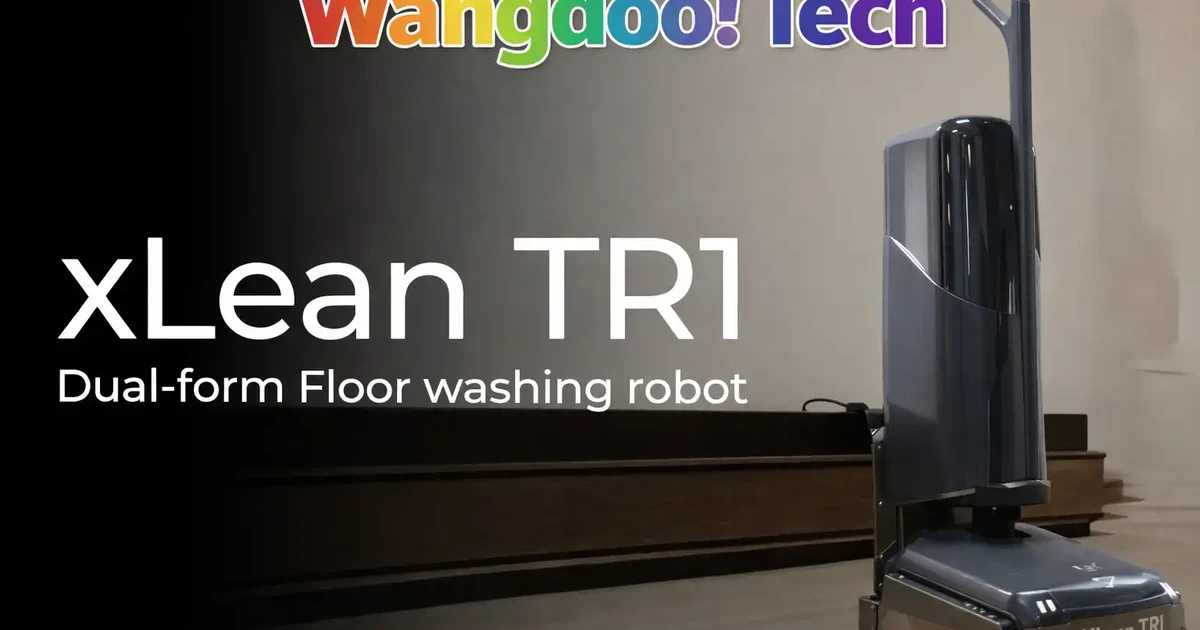
xLean TR1: The World’s First Dual-Form Floor Washing Robot — Full Specs, Price & Everything You Need to Know
It raised $1.14 million on Kickstarter in days, won Best of CES 2026 and a Red Dot Award, and does something no other robot vacuum has attempted — transform into a handheld floor washer in one second. Every confirmed spec, price tier, and feature breakdown is here.
Editorial transparency: Wangdoo has not physically tested the xLean TR1. This article is based on official press releases, Kickstarter campaign data, CES 2026 demonstration reports from TechRadar, TechWalls, Vacuum Wars, and GizmoCrowd, and xLean Robotics’ verified public statements. All specs are sourced from official xLean communications. Wangdoo has no commercial relationship with xLean Robotics.
There’s a problem with every robot vacuum that nobody talks about honestly enough: they’re useless the moment something actually goes wrong. Your coffee tips over at 7am. The cat knocks a bowl of water across the kitchen. The robot is docked, finished its morning run, and you’re standing there reaching for paper towels anyway. The machine solved scheduled cleaning. It never solved cleaning.
xLean Robotics thinks that’s the fundamental design flaw the entire industry got wrong. Their answer is the TR1 — and I’ll admit, when I first saw the concept, I was sceptical. A robot vacuum that physically transforms into a handheld floor washer in one second sounded like Kickstarter hype. Then it won Best of CES 2026, a Red Dot Award, and raised over $1.1 million from backers who clearly don’t share my scepticism. Worth taking seriously.
xLean TR1 first look and real-world tests by Vac Tech — March 2026, pre-launch access
Quick summary: The xLean TR1 is the world’s first dual-form floor washing robot — switching between autonomous robot mode and handheld mode in one second. It delivers 17,000Pa suction, dual 400 RPM rollers, AI that learns your cleaning habits via RLHF, and an OMNI self-cleaning station. Kickstarter pricing starts from $849 with shipping from September 2026. Hard floors only.
Who Built This — and Why It Matters
The TR1 first appeared publicly in a press release on 29 December 2025, ahead of its CES 2026 debut in Las Vegas in January. At CES it drew immediate attention — winning Best of CES 2026 and generating the kind of floor buzz that most robot vacuum products never achieve at trade shows. The Kickstarter campaign launched on 21 April 2026, by which point the product had already been demonstrated publicly for four months. That’s an important distinction: this isn’t a concept that went straight from renders to crowdfunding. It was shown, tested by journalists, and evaluated by industry judges before a single backer was asked to pledge.
Before getting into specs, the team behind the TR1 is worth understanding — because it changes how seriously you should take the engineering claims. xLean Robotics was founded by Kehan Xue, who left his robotics PhD at the Chinese University of Hong Kong to build it. That’s a meaningful signal. PhD candidates don’t usually walk away mid-programme unless they’re genuinely convinced the opportunity is real. The core team brings experience from DJI (navigation hardware), XREAL (sensor systems), and Roborock (consumer robot manufacturing at volume).
That combination is not accidental. DJI experience means the team understands precision navigation in real-world environments — the same challenge a floor robot faces navigating around chair legs and pet toys. XREAL experience means advanced optical and sensor systems. Roborock experience means they’ve seen exactly how a consumer cleaning robot is manufactured, QA’d, and delivered at scale. If you were designing a team from scratch to build a serious robot vacuum, that’s the résumé you’d draw up.
The academic credibility matters too. The xLean team has published research in IJRR, RSS, ICRA, and IROS — the leading robotics journals and conferences globally. ICRA and IROS in particular are where the most serious robotics engineering gets peer-reviewed. When a company claims its product uses reinforcement learning from human feedback, having published in these venues is the difference between a credible claim and marketing copy. It doesn’t guarantee the product will ship on time, but it does mean the underlying technology has been scrutinised beyond the campaign page.
xLean’s stated philosophy is also worth quoting directly: “If a robot cannot even handle floor cleaning well, how can it change the world?” They chose cleaning as their entry point not because it’s glamorous but because it’s hard — and because it’s a proving ground for the robotics technologies they want to apply more broadly over time.
The Core Concept: Why Dual-Form?
Every autonomous robot vacuum solves the same problem: scheduled, whole-floor cleaning when you’re not looking. What none of them solve is the other cleaning problem — the sudden mess, the spill, the sticky patch the robot missed, the grime under the cabinet it can’t reach. For that, you’ve always needed a second device. That’s the gap the entire robot vacuum industry has accepted as a permanent trade-off. xLean decided it wasn’t one.
The TR1’s dual-form design addresses this directly. In robot mode, it operates autonomously for everyday scheduled cleaning — AI navigation, obstacle avoidance, whole-home mapping. In handheld mode, you detach it in one second and use it as a direct-drive cordless floor washer for targeted intervention. Same machine, same rollers, same suction — different form factor depending on what you need.
TechRadar’s Homes Editor, who tested it at CES 2026 and described herself as someone who has seen her “fair share of unusual contraptions among the ranks of the best robot vacuums,” said she had “never seen anything quite like the xLean TR1.” That’s from someone professionally sceptical of robot vacuum marketing claims. It’s the kind of reaction that’s hard to manufacture at a trade show.
The transformation mechanism itself is worth understanding. The robot form and handheld form share the same core cleaning unit — the dual-motor system, the rollers, the water management. What changes is the chassis configuration and how power is routed. xLean describes the switch as a one-second mechanical action. How durable that mechanism remains after 500 or 1,000 switches will be something only long-term owners will be able to answer definitively. It’s a reasonable question to ask of any transforming mechanical product, and one that Wangdoo will revisit when post-shipping reviews become available.
Important limitation: The xLean TR1 is designed exclusively for hard floors. Automatic Carpet Detection prevents the robot from running wet rollers onto carpet. If your home has significant carpet coverage, you will still need a separate device for those areas. This is the TR1’s most significant practical limitation and the clearest reason not to back it for mixed-floor homes.
Full Specs
| Specification | xLean TR1 |
|---|---|
| Suction power | 17,000Pa via Dual-Motor DirectSuction™ |
| Rollers | Two 10.42-inch rollers at 400 RPM each |
| Liquid pickup rate | 99.99% for liquid and mixed solid-liquid waste |
| Transformation time | 1 second (robot → handheld) |
| Navigation | dTOF LiDAR (5,000+ points/sec) + RGB-D camera (44,640 3D sensing points) |
| AI chip | Autonomous-driving grade processor |
| AI system | Self-Evolving Intelligence via RLHF (Reinforcement Learning from Human Feedback) |
| Floor type | Hard floors only — Automatic Carpet Detection |
| OMNI Station wash temp | 167°F (75°C) hot water |
| OMNI Station dry temp | 149°F (65°C) hot air |
| OMNI Station functions | Auto-refill, auto-drain, solid/liquid separation, roller wash, hot air dry |
| Cat litter + cola clean time | ~15 seconds (per xLean demo data) |
| Voice & app control | Yes — custom schedules, no-go zones, voice assistants |
| Gamepad control | Yes |
| Awards | Best of CES 2026, Red Dot Award 2026, IDEA Design Award, IFA Next Best Winner |
| First announced | 29 December 2025 (pre-CES press release) |
| CES 2026 debut | January 2026, Las Vegas |
| Kickstarter launch | April 21, 2026 |
| Estimated shipping | September–October 2026 |
The AI That Learns How You Clean
The most technically ambitious claim xLean makes is the Self-Evolving Intelligence system. Unlike conventional robot vacuums that follow fixed navigation programmes, the TR1 applies Reinforcement Learning from Human Feedback (RLHF) — the same core AI technique used in ChatGPT and modern large language models — to cleaning behaviour.
In practice, this means the robot observes how you clean in handheld mode: which paths you take, how you approach corners, which areas you prioritise, which obstacles you avoid. It then carries those patterns into its autonomous navigation over time. The longer you use it, the more it adapts to your specific home and cleaning style rather than running a generic programme. A home with a dog that sheds heavily in the kitchen gets treated differently to one with a toddler who concentrates mess around the dining table. That personalisation, if it works as described, is genuinely useful rather than gimmicky.
The underlying hardware supports this ambition more credibly than most. The TR1 uses an autonomous-driving grade AI chip — the same class of processor used in semi-autonomous vehicles — paired with an RGB-D camera delivering 44,640 3D sensing points and dTOF LiDAR processing over 5,000 points per second. That’s a sensor package that would have been considered exceptional in a research robot three years ago. Applied to floor cleaning, it gives the TR1 the raw perception capability to actually learn from its environment rather than just map it.
xLean internally calls its longer-term vision “mini-Jarvis” — a robot that goes beyond cleaning to become a physical home assistant capable of checking on pets, monitoring home conditions, and helping locate misplaced objects. That’s a roadmap statement, not a product feature. Wangdoo notes this clearly: mini-Jarvis is where xLean wants to go, not what the TR1 delivers at launch. The AI learning from handheld cleaning patterns is the delivered feature. Mini-Jarvis is the five-year ambition. They’re not the same thing, and buyers should understand the distinction.
Given the team’s academic publications in ICRA and IROS, the underlying AI architecture is credible engineering. Whether it translates to a meaningfully better autonomous clean than competitors after three months of real-world use is something only hands-on long-term testing can establish. That testing doesn’t exist yet — the TR1 hasn’t shipped.
Navigation: Sensing Everything Under Your Couch
One of the practical frustrations with robot vacuums is navigation failure — getting stuck under low furniture, being confused by dark floors, or missing the same corner every run. The TR1’s sensor stack is designed to address this systematically.
The dTOF LiDAR gives it precise distance measurement across the floor plane. The RGB-D camera adds depth perception — understanding the three-dimensional structure of obstacles rather than just detecting their presence. The combination allows the robot to distinguish between a cable it should avoid and a sock it should clean around, between a pet bowl it must navigate carefully and a chair leg it can approach closely. The 44,640 3D sensing points from the RGB-D camera means it’s building a genuinely detailed environmental model rather than a coarse approximation.
The practical implication: the TR1 should handle the real-world messiness of an actual home better than robots that rely on simpler sensor setups. Whether it actually does will require real-world testing from independent reviewers after September 2026. The hardware credentials suggest it should — but hardware credentials and field performance are different things.
The OMNI Station
A robot mop is only as good as what happens when it docks. Most self-cleaning stations wash rollers with lukewarm water and call it done — which is why most robot mop owners will recognise the sour smell that develops after a few weeks of daily use. Dirty water sitting in warm rollers overnight is essentially a petri dish. The TR1’s OMNI Station takes a more thorough approach.
When the robot docks, the station automatically drains dirty water and separates it from solid waste — so neither contaminates the other in the tank. It then refills the robot’s clean water supply, washes the rollers and internal water pipes with 167°F (75°C) hot water — hot enough to break down grease and kill bacteria — and finishes with a 149°F (65°C) hot air dry cycle to prevent mould and odour. The entire process is automatic, requiring no user intervention beyond occasionally emptying the waste tank.
The Roborock S8 MaxV Ultra’s station washes at up to 140°F. The Ecovacs T90 Pro Omni dries at 145°F. xLean’s temperatures are higher across both wash and dry — a meaningful difference in terms of hygiene performance, assuming the real-world implementation matches the spec sheet. That assumption will need independent verification post-launch.
The station also handles solid waste separately from liquid — relevant for the TR1’s primary use case of cleaning mixed wet-and-dry debris. Cat litter mixed with water, cola with crumbs, muddy paw prints — these create waste that clogs conventional stations. The separation system is designed to handle this without requiring the user to manually clean the waste path.
Cleaning Performance: What the Demo Data Shows
xLean’s headline demonstration is cleaning cat litter mixed with cola in approximately 15 seconds. It’s a vivid number — but it’s important to understand what that figure represents. xLean notes clearly that this data is based on controlled video demonstrations evaluating three cleaning systems on spills and mixed wet-dry messes of defined sizes. It’s not an independent third-party test. It’s not a random real-world mess. It’s a controlled demo designed to show the system at its best.
That said, the demonstration does reveal something genuinely meaningful: the Dual-Motor DirectSuction™ system simultaneously vacuums solids and liquids rather than pushing them around. Most robot mops fail on mixed wet-dry debris specifically because the wet roller drags dry debris into liquid, spreading it rather than collecting it. The directional suction approach — lifting debris into the robot rather than across the floor — is a legitimate engineering solution to a real problem.
The 99.99% liquid pickup rate is an xLean claim. Until independent reviewers run their own standardised tests post-September 2026, it should be treated as a manufacturer target rather than a verified result. What’s more meaningful from a credibility standpoint is the dual-roller architecture: two 10.42-inch rollers running at 400 RPM each, covering a wider cleaning path than single-roller competitors and applying more consistent pressure across the full width of each pass.
Pricing & Kickstarter Tiers
VIP Exclusive
$849 For deposit backers. $50 deposit + $100 Lucky Money refunded after fulfillment. Lowest available price.Early Bird
$899 / €852 Launch pricing, up to 47% off estimated retail. Limited quantities at this tier.Standard Kickstarter
$949–$999 Standard backer pricing. Still significantly below estimated retail price.Estimated Retail
~$1,600–1,800 xLean states retail will be approximately double Kickstarter pricing. Not yet confirmed.Shipping covers a wide range of countries including the US, Canada, UK, EU, Australia, New Zealand, Japan, Singapore, South Korea, India, Southeast Asia, UAE, Saudi Arabia, Hong Kong, Macau, and Taiwan. xLean states it will cover most customs duties and trade taxes in many regions — an unusual commitment for a Kickstarter campaign.
Kickstarter risk disclosure: As with all crowdfunding campaigns, backing the xLean TR1 carries inherent risks. Estimated delivery dates may shift. Production challenges are common in hardware. xLean’s team track record at DJI, Roborock, and XREAL is reassuring, but no Kickstarter backer should treat a pledge as a guaranteed purchase. Back based on the product vision with realistic expectations about timing.
Awards & Independent Validation
All four awards were earned before mass production — which means expert judges evaluated the design and technology concept, not finished retail units. That’s meaningful validation of the engineering approach, but it’s not a substitute for long-term real-world performance data which won’t exist until post-shipping reviews arrive in Q4 2026.
How It Compares
| Feature | xLean TR1 | Roborock S8 MaxV Ultra | Ecovacs T90 Pro Omni |
|---|---|---|---|
| Dual-form (robot + handheld) | Yes — 1 second | No | No |
| Suction | 17,000Pa | 10,000Pa | 30,000Pa |
| Roller count | 2 × 10.42″ | 1 roller | 1 × 10.6″ roller |
| RLHF self-learning | Yes | No | No |
| Hot water wash station | 167°F | ~140°F | ~140°F |
| Carpet support | Hard floors only | Yes | Yes |
| Kickstarter price | From $849 | ~$1,299 (retail) | ~$899 (retail) |
| Shipping | Sep–Oct 2026 | Available now | Available now |
Note: The Ecovacs T90 Pro Omni’s 30,000Pa suction exceeds the xLean TR1’s 17,000Pa. Roborock S8 MaxV Ultra suction confirmed at 10,000Pa per Roborock official specs. Ecovacs price confirmed at $699–$899 retail. xLean TR1 Kickstarter pricing only — retail TBC.
Who Is This For — and Who Should Skip It
Back it if:
Your home is predominantly hard floors — tiles, hardwood, laminate, vinyl, or polished concrete. You currently own both a robot vacuum and a separate mop or handheld vacuum and you’re tired of switching between two devices. You’re comfortable with the inherent risk of backing a pre-shipping crowdfunding product from a team with credible credentials. You don’t need the product before September 2026.
Skip it if:
Your home has significant carpet. Full stop. The TR1 doesn’t do carpet, and no software update will change that — it’s a hardware limitation of the wet-roller design. Also skip it if you need delivery certainty before Q4 2026, or if you’re comparing on raw suction power alone — the Ecovacs T90 Pro Omni’s 30,000Pa exceeds the TR1’s 17,000Pa, and both Roborock and Ecovacs products are available today with years of real-world review data behind them.
The honest trade-off:
What you’re buying with the TR1 is the dual-form concept and the self-learning AI — two things no competitor offers at any price. What you’re giving up is the certainty of buying a product with real-world reviews, proven reliability data, and guaranteed delivery timing. That trade-off is worth making for hard-floor homes. It’s not worth making if either of those caveats applies to you.
Should You Back It?
The honest answer depends on what your floors actually look like and how much uncertainty you can accept. If you have a predominantly hard-floor home and you’re tired of owning two devices for one job, the TR1’s value proposition is genuinely compelling. The dual-form concept solves a real problem that no competitor has addressed at production scale. The team credentials are legitimate and verifiable. The awards came from expert judges at CES, Red Dot, and IFA — not from Kickstarter backers. The $1.14 million raised in a matter of days reflects genuine market demand, not hype.
If your home has significant carpet coverage, stop here. The automatic carpet detection keeps the TR1 away from rugs entirely, and there’s no suction-only mode for dry carpet debris. You’ll still need a separate machine for carpeted areas, which entirely defeats the consolidation argument the TR1 is built around.
The interest in AI-powered home robots is growing fast in 2026 — from compact AI desktop companions like the Cubie to full floor-cleaning agents like the TR1. The trend is clear: the home robot category is moving from novelty to genuine utility, and the xLean TR1 sits at the serious end of that shift. The question isn’t whether the category is real. It’s whether this specific product delivers what it promises when units actually ship in September.
For hard-floor households willing to accept that uncertainty, the TR1 at $849–$999 offers technology that would cost significantly more — if it existed at retail at all. That’s the case for backing it. The case against is simply that it hasn’t shipped yet, and hardware Kickstarters have a historical track record of delays. Back with your eyes open.
Frequently Asked Questions
What is the xLean TR1?
How much does the xLean TR1 cost?
When does the xLean TR1 ship?
Does the xLean TR1 work on carpet?
What is the OMNI Station?
Is the xLean TR1 AI self-learning real?
How does xLean TR1 compare to Roborock or Ecovacs?
Sources & References
- xLean TR1 Official Kickstarter Campaign — April 2026
- xLean Official Press Release — CES 2026 Launch (PRNewswire)
- xLean Kickstarter Global Debut Announcement — April 21, 2026
- TechRadar — CES 2026 Hands-On (Homes Editor)
- Vacuum Wars — xLean TR1 CES 2026 Coverage
- Notebookcheck — xLean TR1 Kickstarter Launch & Pricing
- GizmoCrowd — xLean TR1 Full Kickstarter Analysis
- TechWalls — xLean TR1 CES 2026 Deep Dive