WavKong V2700: This $259 Router Uses Cell Tower Tech to Blow Every Mesh System Out of the Water

The Router That Rewires
the Rules with an RPU
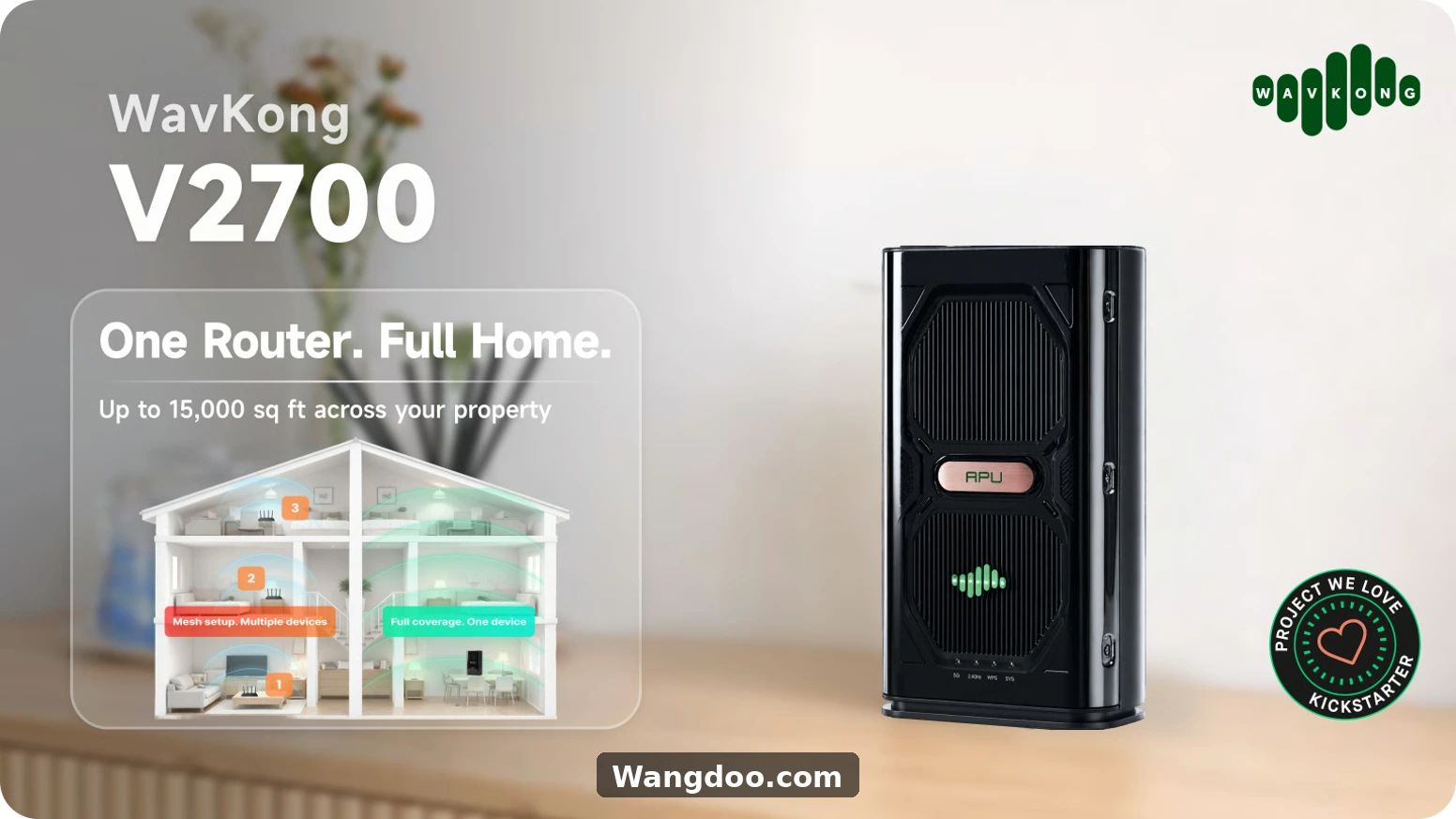
WavKong’s V2700 is the world’s first Wi-Fi router to embed a dedicated Radio Processing Unit — a chip borrowed from cellular infrastructure designed to clean up signals in real time. But does the technology live up to the marketing?
BackgroundWhy Wi-Fi Still Fails — And Why Nobody Fixed It
We’ve been adding more boxes to fix Wi-Fi for years. Mesh nodes, range extenders, powerline adapters — the standard answer to a weak signal in the back bedroom is always “buy another device.” It’s an inelegant solution to what is, at its core, a signal quality problem rather than a coverage density problem.
WavKong, a startup whose core team claims over 30 years of communications industry experience with backgrounds at Nokia and Huawei, thinks they’ve identified exactly this design flaw — and built a chip-level fix for it.
The InnovationWhat Is an RPU — And Why Does It Matter?
At the heart of the V2700 is WavKong’s custom RPU (Radio Processing Unit) — a dedicated digital RF processing chip. The concept is straightforward but the engineering is far from it: while conventional routers just boost transmission power or add more antennas, the RPU continuously monitors and corrects signal distortion in real time.
The underlying technology is called Digital Pre-Distortion (DPD) — a form of active RF correction that’s been standard in cellular base stations and satellite systems for years. Think of it like active noise cancellation for headphones, but applied to your Wi-Fi signal. Instead of blasting the signal louder and hoping for the best, the RPU actively pre-shapes the waveform before transmission to compensate for the distortion it will accumulate passing through walls, floors, and other obstacles.
Instead of adding more devices, V2700 improves the signal itself — fixing Wi-Fi at the source rather than papering over it with extra nodes.— WavKong’s core proposition, as stated in campaign materials
This is a meaningful conceptual departure from every other router currently on the market. Most routers compete on peak throughput benchmarks measured sitting directly beside the device — numbers that are essentially useless in a real three-bedroom house. WavKong is competing on a different metric entirely: mid-to-long-range real-world performance.
Full Technical Specifications
Real-World TestingThe Beta Results: Genuinely Impressive — With Caveats
WavKong has shipped units to a number of beta testers ahead of the Kickstarter campaign. The most notable test comes from YouTuber KhanFlicks, who conducted an outdoor range comparison between the V2700 and a TP-Link Archer A20 — a well-regarded mainstream router — using a smartphone and a Unitree humanoid robot roaming at increasing distances from the house.
The results at one particular outdoor test location were striking: the TP-Link managed 3.39 Mbps upload from that position, while the V2700 achieved 356.2 Mbps from exactly the same spot. That’s a difference of roughly 105× at a single test point — well beyond WavKong’s own conservative 3–10× range claim.
WavKong acknowledges that internal testing forms the basis for their 3–10× speed claim, and detailed independent data on the RPU chip itself remains scarce. Tech outlet CNX Software also noted a spec discrepancy on the Kickstarter page — the listed SoC was the MT7915 rather than the correct MT7981. These are yellow flags worth watching as the product approaches shipping in mid-2026.
The robot test is particularly interesting from a practical standpoint — the V2700’s extended range allowed the robot to travel considerably further from the house while maintaining a usable connection. For anyone running outdoor cameras, smart garden devices, or a home lab extending to a garage or workshop, that has real practical value.
Campaign PerformanceThe Kickstarter Numbers Tell a Story
WavKong launched the campaign on April 22, 2026, with a modest HK$30,000 goal. Within weeks, the project raised over HK$2.6 million — an 8,688% overfunding — from nearly 800 backers with an average pledge of roughly HK$3,278. Total funds raised in US dollar terms exceeded $200,000 at time of writing.
Kickstarter Pricing & Availability
The campaign runs until May 22, 2026. Backing starts at $259 USD (HK$2,028) for a single V2700 unit. Bundle packages of up to 10 units are also available. Shipping is free to the US, Canada, Australia, Japan, China, and Hong Kong — other countries add approximately $80 USD. Estimated delivery: June–August 2026. No subscription fees — firmware updates are free for life.
Who Is It For?The V2700’s Sweet Spot
The V2700 is most compelling for people living in large, multi-floor homes where a single conventional router falls short but a full mesh setup feels overcomplicated and expensive. If you’ve got a 2,000+ sq ft house, a detached garage, or a garden that keeps dropping signal, the RPU approach could genuinely address the root cause rather than plastering over it with extra nodes.
It’s less interesting for apartment dwellers or small-home users who are already adequately served by a mid-range router — the V2700’s technology advantage only really shines at the ranges where conventional routers start to struggle.
- Genuinely novel RPU chip technology from cellular infrastructure
- Spectacular beta range tests — real-world, not lab conditions
- Up to 15,000 sq ft coverage from a single device
- No subscription fees, free lifetime firmware updates
- Massively overfunded — strong market validation
- Team pedigree: Nokia, Huawei, Intel, China Telecom clients
- Easy setup claimed at ~60 seconds
- No detailed independent RPU chip documentation
- Spec discrepancy found on Kickstarter page (MT7915 vs MT7981)
- All performance claims based on internal or sponsored testing
- Mid-range SoC — modest RAM/storage for the price
- $259 starting price — not budget-friendly
- Crowdfunding risk — shipping not until June–August 2026
- Relatively modest Gigabit Ethernet — no 2.5G ports
Final WordA Bet Worth Considering
WavKong’s V2700 is one of the more technically credible Kickstarter networking products we’ve encountered. The RPU concept is real — Digital Pre-Distortion is a mature technology in cellular infrastructure, and applying it to consumer Wi-Fi is a logical evolution. The beta testing footage is compelling, even if it comes from WavKong-selected testers.
The missing piece is full independent verification and complete transparency around the proprietary ASIC. The spec error on the Kickstarter page, while possibly just a mistake, doesn’t help the cause. If WavKong can deliver on the promise when units ship in mid-2026 and the tech community gets hands-on time, this could genuinely be a landmark product. Back it with eyes open — the upside is real, and so is the crowdfunding caveat.