SoftBank Unveils “Natural AI Phone” Japan’s Leap Into Human‑Centric Tech

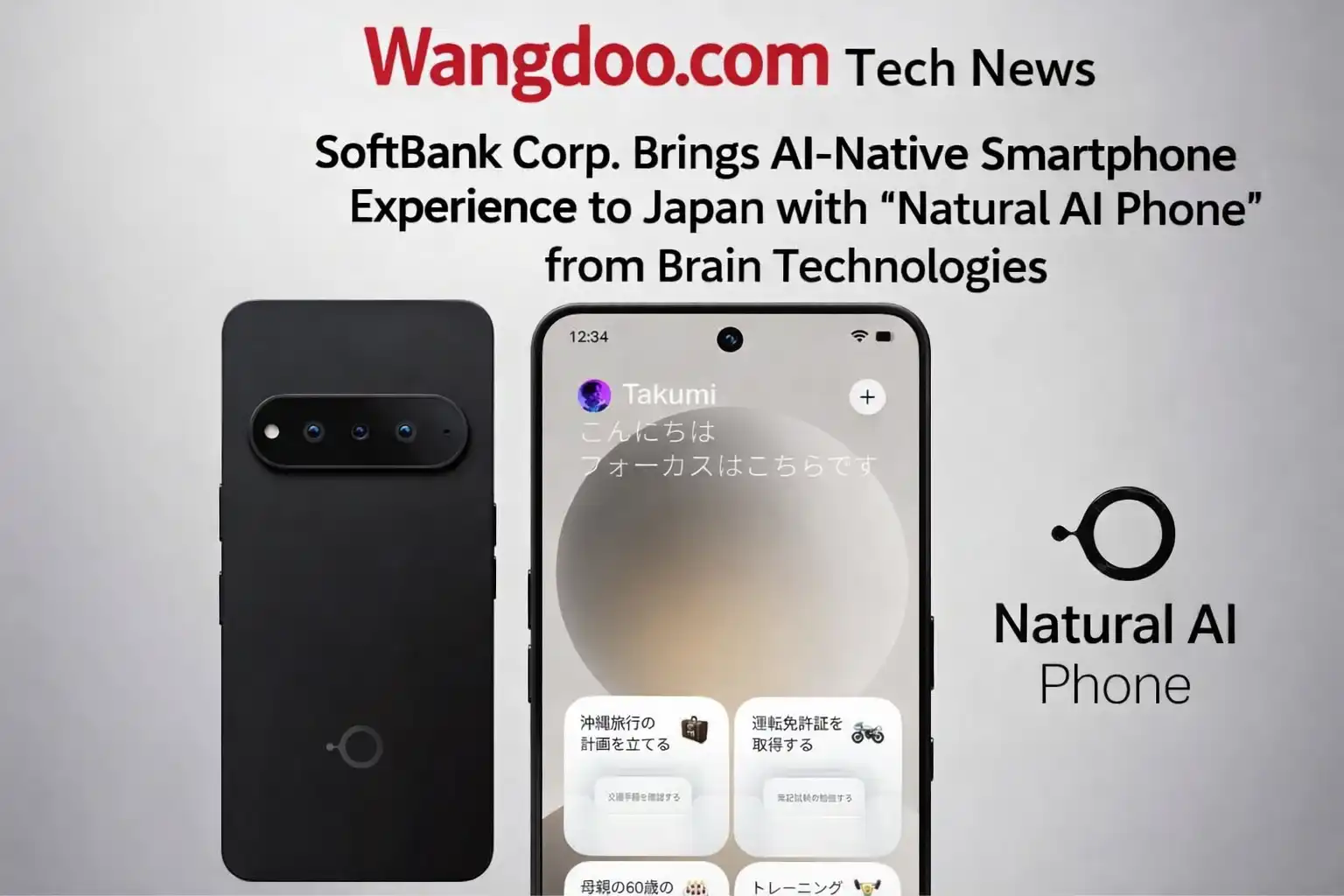
What Is the Natural AI Phone? Japan Just Launched a Smartphone With No App Grid — And the Rest of the World Is Next
SoftBank and Brain Technologies launched the world’s first commercially available AI-native smartphone in Japan on April 24, 2026. There are no app icons. There is no home screen grid. There is an AI designed to understand what you want to do and act on it directly — without opening a single app. Here is what that actually means — and why it matters to everyone, not just Japan.
Pick up your phone. Count how many steps it takes to book a restaurant for tonight. You open the browser or Google Maps to find somewhere. You switch to a review app to check ratings. You open the restaurant’s website or a booking app to reserve. You go to your calendar to add it. You open a messaging app to tell whoever you’re going with. Five apps, ten taps, two minutes — for something your brain resolved in one thought: I want to go to dinner.
Brain Technologies, a San Mateo, California company founded in 2015, has spent a decade arguing that this friction is not inevitable. It’s a design choice — a choice made in 2007 when Apple introduced the app grid as the organising metaphor for smartphone interaction, and one that has never seriously been challenged since. On April 24, 2026, in partnership with Japanese carrier SoftBank, Brain Technologies launched the Natural AI Phone — the first smartphone sold commercially to consumers that, by design, replaces the app grid entirely with an AI intended to understand intent and act on it directly.
This is not an AI assistant bolted onto Android. It is not Siri with a new name. It is a fundamentally different answer to the question of what a smartphone is for — and it went on sale in Japan six weeks ago, quietly, while most of the English-speaking tech press was looking elsewhere.
The Natural AI Phone is a 5G Android 15 smartphone developed by Brain Technologies and sold exclusively through SoftBank in Japan from April 24, 2026. It runs Natural OS — an AI layer built into the operating system that replaces app-grid navigation with intention-based interaction. A physical AI button on the side lets users activate the AI mid-task, analyse the current screen, and execute multi-app workflows automatically. The device has a 6.7-inch OLED display, supports FeliCa mobile payments for Japan, and is priced at ¥93,600 (approximately $590). No additional subscription fee is required for AI features. Global expansion — including the United States — is planned for later in 2026. SoftBank holds exclusive Japan sales rights for one year.
Brain Technologies / Natural AI Phone — official video. All rights respective owner.
Who Built This — and Why Brain Technologies Is Not a New Name
Brain Technologies was founded in 2015 by Jerry Yue, a Chinese-American entrepreneur and AI researcher based in San Mateo, California. The company is not a startup that appeared last year with a bold claim and a render. It has been building toward this specific product for a decade, and its technical history is more substantial than most coverage has acknowledged.
The company’s investors — Laurene Powell Jobs and Scott Cook among them — are not names associated with speculative consumer hardware. The Deutsche Telekom partnership at MWC 2024 gave the concept device significant public exposure. And the decision to launch in Japan first is a deliberate strategic choice, not a limitation — Japan has 41 million SoftBank subscribers, extremely high smartphone adoption, and a culture that historically embraces technology category shifts earlier than Western markets.
What Natural OS Actually Is — and What It Replaces
Every smartphone you have ever used organises itself the same way. There is a home screen. On that home screen there are icons representing applications. You tap an icon, an application opens, you do something in that application, you leave, you tap another icon. This is the app grid model. Apple introduced it in 2007. Google adopted it. Every smartphone OS since has used it as the fundamental interaction paradigm.
Natural OS does not have a home screen in this sense. There is no grid of icons to navigate. Instead, the phone presents an interface organised around what you want to accomplish — your current goals, recent tasks, and anticipated next actions — rather than around which software bucket those tasks happen to live in.
The app grid model is like being handed a filing cabinet and told to complete your work. To book dinner, you open the Maps drawer, then the Reviews drawer, then the Reservations drawer, then the Calendar drawer, then the Messages drawer. Each drawer is separate. You carry the information between them manually in your head. Natural OS is like having an assistant sitting next to you. You say “I want to go to dinner tonight with Sarah” and the assistant — who knows your preferences, your calendar, and Sarah’s availability — handles the rest. You never open a drawer. You just told someone what you wanted.
Technically, Natural OS is built as a layer on top of Android 15. This is important: the phone still runs Android underneath, which means it retains compatibility with the underlying Android ecosystem. What changes is the interface layer — the part the user actually sees and interacts with. Jerry Yue, Brain’s CEO, has been careful to note that this is not a chatbot. You are not typing questions into a search box. The AI is always active, always contextually aware, and acts on your behalf without requiring you to initiate a conversation.
The AI Button — How You Actually Use It
The most concrete explanation of how Natural OS works in practice comes from the device’s dedicated hardware AI button, located on the right side of the phone. SoftBank’s official description, confirmed at the Tokyo press event on April 17, 2026, explains the two modes:
Single press: Launches the AI interface from any state — locked screen, mid-app, or idle. The AI presents options based on your current context and recent activity.
Double press while using an app: The AI reads what is currently on the screen — text, images, prices, names, locations — and uses that information to generate suggestions for what to do next. If you are looking at a restaurant on Google Maps, a double press might offer to check its availability on Tabelog (Japan’s primary restaurant booking platform), add a reservation to your calendar, and message the person you are meeting — as a single suggested action, not three separate steps.
“When the thought ‘dinner’ comes to my mind, I only think about who I’m eating with. I’m not thinking about booking the restaurant, arranging transportation, or how to pay. The AI executes everything based on that thought of ‘I want to go to dinner.’ That is the Natural AI Phone.”
SoftBank confirmed at launch that nine apps are supported at launch in Japan, including Gmail, Google Maps, LINE (Japan’s dominant messaging platform), Tabelog (restaurant booking), Amazon, and Google Calendar. These cover the core daily workflows for most Japanese smartphone users. The Japan version of the device is described by Brain Technologies as specifically designed for local services — the global version, planned for later in 2026, will support a broader set of services.
What Makes This Different From Siri, Gemini, and Galaxy AI
This is the question that deserves the most careful answer, because every major phone maker has added AI features in the past two years. Apple has Apple Intelligence. Google has Gemini integrated into Android. Samsung has Galaxy AI. So what is actually different about Natural OS?
| Capability | Natural AI Phone | Apple Intelligence (iOS) | Gemini (Android) | Galaxy AI (Samsung) |
|---|---|---|---|---|
| Integration level | OS-level — replaces the interface | Feature layer on top of iOS | Feature layer on top of Android | Feature layer on top of One UI |
| App grid removed | ✓ Yes — entirely | ✗ No | ✗ No | ✗ No |
| Seamless multi-app execution | ✓ By design — no switching required | ⚠ Limited cross-app actions | ⚠ Limited cross-app actions | ⚠ Limited cross-app actions |
| Learns user history for personalisation | ✓ Yes — core feature | ⚠ Partial | ⚠ Partial | ⚠ Partial |
| Data stored locally (not for AI training) | ✓ Confirmed — local + Japan cloud | ✓ On-device processing | ⚠ Mixed | ⚠ Mixed |
| Dedicated physical AI button | ✓ Yes | ✗ No | ✗ No | ⚠ Bixby button (Samsung) |
| Requires user to launch apps | ✗ No — AI acts directly | ✓ Yes — standard iOS model | ✓ Yes — standard Android model | ✓ Yes — standard Android model |
The distinction SoftBank’s Yasuaki Adachi drew at the Tokyo press event is the most useful one: Natural AI’s key differentiator is not that it can answer questions or summarise text — every AI assistant can do that. It is that it accumulates and learns from user history to provide personalised suggestions, and that achieving seamless multi-app execution required embedding the AI at the OS level rather than as an app or surface feature. An API-based integration — the approach Siri and Gemini use — has architectural limitations that prevent them from doing what Natural OS does.
SoftBank confirmed at the April 17 press event that data accumulated by Natural AI — usage history, instructions, and context — is managed locally on the device and on cloud servers located within Japan. Critically, this data is not used for AI model training. For a phone that learns your patterns deeply, this distinction matters significantly. Adachi stated explicitly: the personalisation data belongs to the user and does not feed back into Brain Technologies’ training pipeline.
Full Device Specifications
| Specification | Detail |
|---|---|
| Display | 6.7-inch OLED |
| Chipset | Snapdragon 7s Gen 3 (mid-range tier) |
| Operating System | Android 15 with Natural OS (Brain Technologies) |
| Connectivity | 5G |
| Japan-specific | FeliCa (mobile wallet / contactless payments) |
| Colours | True Black · True White |
| AI Hardware | Dedicated physical AI button (right side) |
| AI Features | Natural OS · intention-based interaction · multi-app execution · screen analysis · personalised suggestions |
| Initial Supported Apps (Japan) | 9 apps at launch including Gmail · Google Maps · LINE · Tabelog · Amazon · Google Calendar |
| Data Storage | Local device + Japan-based cloud servers · not used for AI training |
| Price | ¥93,600 (~$590 USD) · ¥1/month for 24 months with SoftBank New Tokusuru Support+ (48-payment plan) |
| AI Subscription | None — all AI features included, no ongoing fee |
| Availability | Japan only (SoftBank exclusive, 1 year) · Global expansion including US planned for 2026 |
| Manufacturer | Third-party hardware partner (unnamed — described by Jerry Yue as “outstanding in smartphone development globally”) |
| Launch Date | April 24, 2026 |
Why Japan First — The Strategic Logic
It would be easy to read Japan-first as a soft launch in a contained market before attempting a harder global rollout. The reality is more considered than that.
Japan is one of the most demanding smartphone markets in the world. Japanese consumers have high standards for device quality, strong carrier loyalty, and deep integration with platform-specific services — particularly LINE, which functions as a social operating system for much of the country’s digital life. If Natural OS can integrate meaningfully with LINE and Tabelog and perform at the quality level Japanese users expect, it has passed a more rigorous test than a US launch would have provided.
SoftBank’s network of 41 million subscribers and 5,000+ retail locations is not a small proving ground — it is one of the largest carrier distribution networks in Asia. And Japan’s position as a market where consumers actually adopt new interaction paradigms — the country that made QR code payments mainstream years before the West — makes it a meaningful indicator rather than a safe irrelevance.
There is also a technical reason. Brain Technologies confirmed that the Japan version of the device is specifically designed for local services and is not intended to represent the full Natural OS experience planned for other markets. The global version — including the US launch — will have a broader service integration set. Japan is the first chapter, deliberately chosen for its infrastructure, market sophistication, and the partner willing to back a category-defining bet.
Brain Technologies did not arrive at Japan with SoftBank out of nowhere. In 2024, Brain and Deutsche Telekom announced a concept AI phone partnership at Mobile World Congress in Barcelona. That demonstration — covered by TechCrunch — showed the same core Natural OS concept: no app grid, intention-based interaction, generative UI. SoftBank’s Japan launch is built on that same technical foundation. The fact that the commercial launch ended up with SoftBank rather than Deutsche Telekom is interesting — and suggests either that SoftBank moved faster or that European regulatory and market conditions were less favourable for a first deployment.
The Bigger Context — A Category About to Get Very Crowded
The Natural AI Phone did not launch into a vacuum. It launched into a moment when every major technology company is asking the same question Brain Technologies has been asking for a decade: is the app grid the right model for AI-era computing?
In April 2026, TechCrunch reported that OpenAI is reportedly working on a smartphone in collaboration with MediaTek, Qualcomm, and Luxshare — and that instead of apps, it could rely on AI agents to complete tasks. This is not a coincidence. It is the same thesis as Natural OS, coming from the company that made large language models a household term.
Samsung’s Galaxy AI and Google’s Gemini are both pushing toward deeper OS-level integration with each annual update. Apple’s Apple Intelligence is evolving in the same direction. The industry consensus is moving toward Brain Technologies’ position — the question is whether Brain gets credit for being first, or whether the category gets defined by whoever arrives with the largest distribution network.
The Natural AI Phone is currently in Japan, on one carrier, in a Japan-specific version. But the global version is coming later in 2026. And when it arrives in the United States and Europe, the conversation about what a smartphone is for will be significantly further along than it was when the device launched in April.
My Take — Mr Wangdoo
I find the timing of this story genuinely interesting. Brain Technologies has been building toward this for ten years. They demonstrated it publicly at MWC 2024 with Deutsche Telekom. They launched commercially in Japan six weeks ago. And the English-language tech press largely missed it — because it launched in Japan, in Japanese, through a carrier most Western readers have no relationship with.
That gap is exactly what Wangdoo exists to cover. This isn’t a product you can buy outside Japan yet. But the idea it represents — that the app grid is the wrong design for how people actually think — is going to be one of the defining technology arguments of the next five years. OpenAI is heading in the same direction. Google is. Apple is inching toward it. The difference is Brain Technologies built the thing and put it in people’s hands first.
Whether Natural OS in its current Japan form is as seamless as the marketing suggests is genuinely unknown — there are no substantial English-language hands-on accounts, and the Japanese-language reviews I found are mixed on responsiveness. The honest caveat is that first-generation intent-based AI interfaces have a history of overpromising. The gap between “the AI understood what I meant” in a controlled demo and “the AI understood what I meant” at 8am on a Tuesday when you’re trying to do three things at once is real. We will know more when the global version ships.
What is not in question is that the category exists now, that it is commercially deployed at scale, and that the rest of the industry is following. Japan got it first. The world gets it later this year.
Frequently Asked Questions
What is the Natural AI Phone and what makes it different from a normal smartphone?
The Natural AI Phone is a 5G Android smartphone developed by Brain Technologies and sold in Japan through SoftBank from April 24, 2026. What makes it different is Natural OS — an AI layer built into the operating system that replaces the traditional app grid entirely. Instead of tapping icons to open apps and switching between them manually, you express what you want to accomplish and the AI executes it across whatever apps are required, without you ever navigating between them. A dedicated physical AI button on the side of the phone activates the system. No other commercially available smartphone removes the app grid as the primary interaction model.
Is this just another AI assistant like Siri or Google Assistant?
No — and the distinction is architectural, not cosmetic. Siri, Google Assistant, and Gemini are feature layers built on top of existing operating systems. They can answer questions and perform limited actions, but they still require users to navigate apps for most tasks, and their cross-app capabilities are constrained by the fact that they sit above the OS rather than inside it. Natural OS is built into the operating system itself, which allows it to execute multi-app workflows without the user opening anything. SoftBank’s Yasuaki Adachi explained at the Tokyo press event that achieving seamless multi-app execution required OS-level integration — an API-based approach has architectural limits that prevent it.
Who is Brain Technologies and are they credible?
Brain Technologies was founded in 2015 by Jerry Yue and is headquartered in San Mateo, California. The company’s technical history includes pioneering one-shot learning in NLP in 2016 — the pretrained model paradigm that predates GPT — and launching generative interfaces serving millions of users in 2020, three years before ChatGPT. Their investors include Laurene Powell Jobs’ Emerson Collective and Scott Cook. They demonstrated Natural OS publicly at Mobile World Congress 2024 with Deutsche Telekom, where TechCrunch covered the demo. The company filed foundational patents covering autonomous AI agents and multi-step execution in 2016–2017. This is not a company that appeared with a render last year.
Can I buy the Natural AI Phone outside Japan?
Not yet. SoftBank holds exclusive sales rights in Japan for one year from the April 24, 2026 launch. Brain Technologies has confirmed that global expansion — including the United States — is planned for later in 2026, but has not announced specific markets, carriers, or timelines. The Japan version is specifically designed for local services (LINE, Tabelog, FeliCa payments) and is not the full Natural OS experience planned for global markets. The global version will have broader service integration.
What does the phone cost and is there a subscription fee for the AI?
The Natural AI Phone is priced at ¥93,600 (approximately $590 USD at time of writing). SoftBank offers an installment plan — New Tokusuru Support+ — that brings the monthly cost to ¥1 for the first 24 months of a 48-payment arrangement. There is no additional subscription fee for Natural AI features. Everything is included in the device price. This is significant — most AI-enhanced services charge ongoing monthly fees for full feature access.
What happens to my personal data — is it used to train the AI?
SoftBank confirmed at the April 17, 2026 Tokyo press event that user data — including usage history, instructions, and contextual information — is stored locally on the device and on cloud servers located within Japan. Critically, this data is not used for AI model training. The personalisation the AI develops from learning your habits stays with you and does not feed back into Brain Technologies’ training data. For a device whose core value proposition is learning your patterns deeply, this is a meaningful privacy commitment — though, as with all such claims, it should be verified against Brain Technologies’ published privacy policy before purchase.
Why did it launch in Japan and not the United States or Europe?
Several factors make Japan the logical first market. SoftBank’s 41 million subscribers and 5,000+ retail locations provide genuine scale. Japan has one of the highest smartphone adoption rates globally and a strong track record of early technology adoption — including QR payments, which Japan normalised years before Western markets. The Japan market’s dominant apps (LINE, Tabelog) are also deeply integrated into daily life in ways that make cross-app AI execution immediately demonstrable. Additionally, Brain Technologies noted that the Japan version is specifically tailored for local services — it represents the first chapter of a broader platform, not the finished global product.
How does the phone handle situations where the AI gets it wrong?
SoftBank’s Yasuaki Adachi acknowledged at the April 17 press event that the release “did indeed become later than initially planned,” explaining that additional time was spent improving AI response quality and reducing hallucinations. He confirmed that advanced reasoning capabilities will continue to be improved via updates after launch. The practical implication is that the AI will not always interpret intent correctly, particularly in ambiguous situations — this is a known limitation of current AI systems, not a flaw unique to Natural OS. Brain Technologies has designed the system so the AI presents suggested actions for user approval rather than executing everything automatically, which provides a checkpoint before anything consequential happens.
- SoftBank Corp. Official News — SoftBank Brings AI-Native Smartphone Experience to Japan with Natural AI Phone from Brain Technologies (April 20, 2026)
- GlobeNewswire — Brain Technologies and SoftBank Launch Natural AI Phone in Japan — official press release (April 17, 2026)
- BigGo Finance — SoftBank to Launch Natural AI Phone — full Tokyo press event transcript including Jerry Yue and Yasuaki Adachi quotes (April 18, 2026)
- Brain Technologies Official — brain.ai — company history, patent background, and Natural OS description
- TechCrunch — With Brain.ai, generative AI is the OS — MWC 2024 hands-on with Jerry Yue (February 29, 2024)
- Tom’s Guide — Brain AI aims to make a smartphone that does what you tell it to, without apps — MWC 2024 demo coverage (February 2024)
- Dealroom.co — Brain Technologies company background — patent history, investor details, founding timeline (April 2026)
- TechCrunch — OpenAI could be making a phone with AI agents replacing apps — context on the broader category shift (April 27, 2026)