
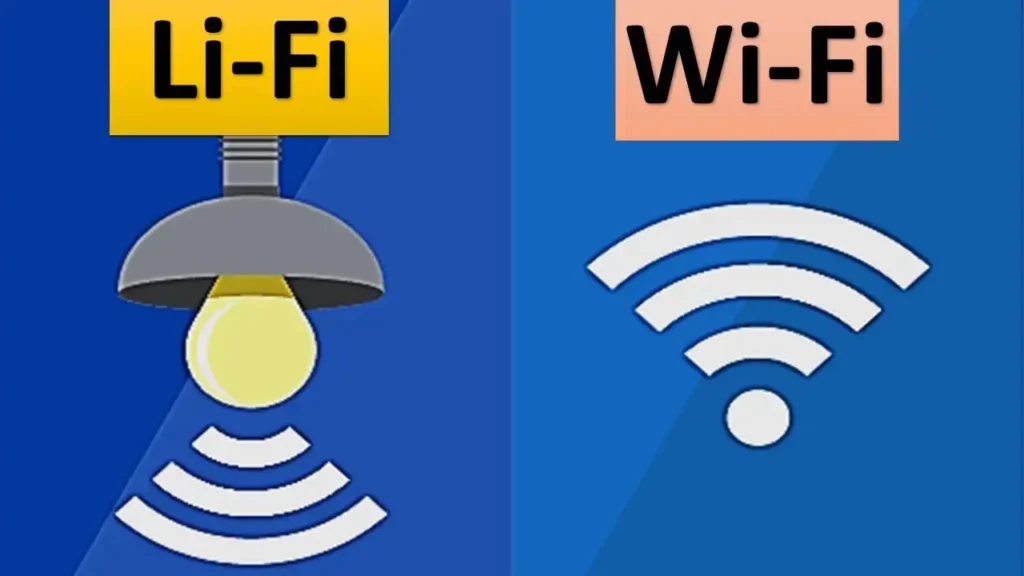
What is Li-Fi and How Does it Work?
Li-Fi, short for Light Fidelity, is a wireless communication technology that uses visible light (or, in some cases, infrared and ultraviolet light) to transmit data. It was first introduced in 2011 by Professor Harald Haas at the University of Edinburgh, who famously demonstrated that light from an ordinary LED bulb could carry high-speed internet signals.
Whereas Wi-Fi relies on radio waves, Li-Fi uses light waves from LEDs. This allows it to deliver potentially faster and more secure wireless connections, opening new possibilities for the way we access the internet.
How Li-Fi Works
- Light Source
Li-Fi requires an LED light source, which is fitted with a special driver to control its light output at extremely high speeds. - Data Encoding
The LED’s brightness is subtly modulated – switching on and off millions of times per second. These changes happen far faster than the human eye can detect, so the light appears constant to us but is actually carrying binary data (0s and 1s). - Receiver
A photodiode or light sensor in the receiving device detects the tiny fluctuations in the light intensity and converts them back into electronic data. - Two-Way Communication
For uplink (sending data back), Li-Fi systems can use infrared transmitters or another light-based return channel.
This process allows for wireless communication at very high speeds without interfering with radio frequency networks.
Benefits of Li-Fi Compared with Wi-Fi
| Feature | Li-Fi | Wi-Fi |
| Speed Potential | Speeds exceeding 1 Gbps have been demonstrated, with potential for 10 Gbps or more. | Standard consumer speeds are generally lower, often under 1 Gbps. |
| Security | Light cannot pass through walls, making it harder for outsiders to intercept the signal. | Radio waves can pass through walls, so extra encryption is essential. |
| Interference | Unaffected by electromagnetic interference, making it ideal in environments such as hospitals or aircraft. | Can suffer from interference with other RF devices and networks. |
| Spectrum Availability | Uses visible and near-visible light spectrum, which is vast and currently underutilised. | Relies on congested radio frequency spectrum. |
| Energy Efficiency | Can integrate with LED lighting systems, reducing the need for separate infrastructure. | Requires dedicated transmitters and routers, using more energy. |
| Density | Allows high-speed connections in high-density environments without signal crowding. | Performance may drop in crowded areas due to limited bandwidth. |
Limitations to Consider
- Line of Sight – Li-Fi typically requires a direct or reflected path of light between transmitter and receiver.
- Coverage – Each Li-Fi access point covers a smaller area than a Wi-Fi router.
- Lighting Dependency – The LED light needs to be switched on (though it can be dimmed to very low levels).
The Future of Li-Fi
Li-Fi is still emerging as a mainstream technology, but trials are already taking place in offices, transportation hubs, hospitals, and even underwater communications, where radio waves are ineffective. As LED lighting becomes universal, Li-Fi could integrate naturally into our everyday environments, offering ultra-fast, secure, and efficient wireless connections alongside – or eventually replacing – traditional Wi-Fi.