Dreame Health Ring The AI‑Powered ECG & Vital Monitoring.

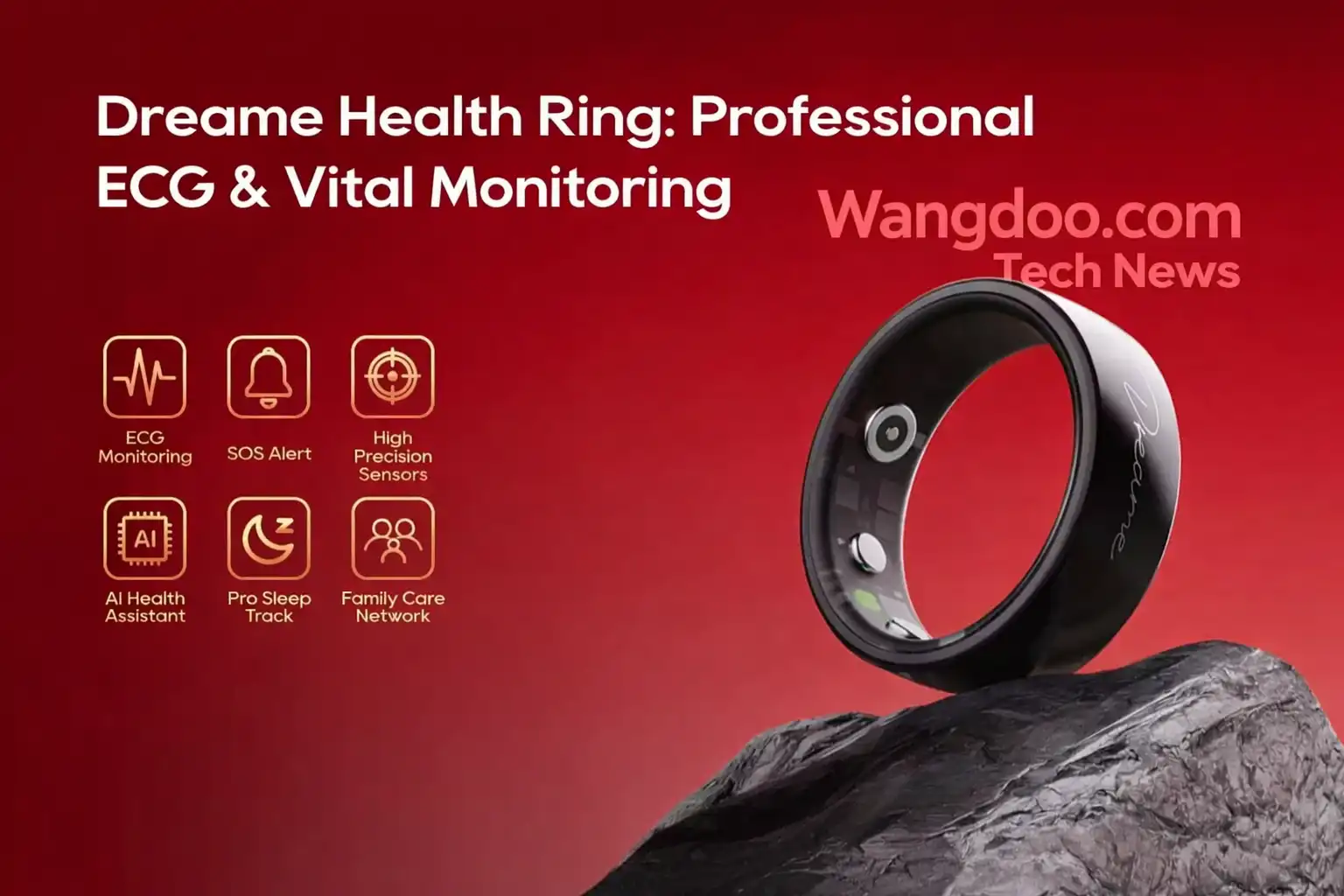
What Is the Dreame Smart Ring? The Robot Vacuum Company Just Entered the Health Wearable Market — Here Is What Makes It Different
Dreame Technology — the brand best known for its robot vacuum cleaners and hair care products — unveiled three AI smart rings at CES 2026 and held a global launch event in San Francisco in April 2026. One of them is the first smart ring in the category to include haptic feedback. Another has ECG monitoring. Here is what the three models are, how they compare to Oura and Samsung, and what the subscription question actually means for your wallet.
The question most people have when they hear “Dreame Smart Ring” is the same one they had when Dyson launched headphones: why is the company that makes your floor cleaning appliances now making a health wearable? It’s a fair question. Dreame built its global reputation on robot vacuums that map your home with lidar and mop without supervision. That has nothing obvious to do with your heart rate.
The less cynical answer is that Dreame is a Chinese consumer electronics company with deep manufacturing expertise, significant AI R&D investment, and a business reason to diversify beyond appliances. The smart ring market is growing rapidly — Oura has sold millions of units, Samsung entered with the Galaxy Ring in 2024, and the category is expanding from athletes into mainstream health-conscious consumers. Dreame’s entry is timed with that expansion.
What is actually interesting about the Dreame rings — and the reason they earned the CES 2026 Best Wearable Device Award — is not the brand name on them. It is that one of them does something no Oura Ring, Samsung Galaxy Ring, or RingConn has done: it vibrates on your finger. That sounds simple. In a 2.5mm chassis, it is not.
Dreame Technology launched three smart rings at CES 2026 and formally announced the global lineup at its DREAME NEXT event in San Francisco on April 29, 2026. The three models are the Dreame AI Smart Ring (haptic feedback, health tracking), the Dreame Glow Ring (ECG monitoring, advanced health), and the Dreame AI NFC Smart Ring (NFC access, smart home control). All three feature a 2.5mm titanium alloy chassis weighing as low as 2.6 grams with approximately seven days battery life. The AI ring pre-order opens June 2026. Pricing for the global market has not been officially confirmed at time of publication — Chinese pricing for the Glow Ring (AI ECG) is 1,799 yuan (~$248 USD) at launch. No subscription fee has been announced for any model. Wangdoo will update this article when global pricing is confirmed.
Dreame AI Smart Ring — CES 2026 introduction. All rights respective owner.
Why Haptic Feedback in a Smart Ring Is Harder Than It Sounds
Every smart ring currently on the market — Oura Ring 4, Samsung Galaxy Ring, RingConn, Ultrahuman Ring Air — communicates with you in exactly one way: through your phone. You get a notification on your screen, or you open the app and check your data. The ring itself is passive. It collects information but it never talks back to your finger.
The reason no existing ring has changed this is not lack of interest — it is physics. A vibration motor requires a rotating or oscillating mass. That moving component needs space, and smart rings have almost none. The Dreame AI Smart Ring measures 2.5mm in thickness — roughly the width of two stacked credit cards. Fitting a micro-vibration motor capable of producing perceptible haptic feedback inside that chassis, alongside a PPG sensor, accelerometer, temperature sensor, and battery, requires component miniaturisation that The Shortcut’s reviewer specifically described as engineering they had not seen from other ring manufacturers.
Think about the difference between a smartwatch and a smart ring in terms of notifications. Your smartwatch taps you when a message arrives — you feel it immediately, even in a meeting, without looking at your phone. Your smart ring does nothing. All the health data it collects sits in an app you have to actively open. The Dreame AI Smart Ring changes that dynamic — it can tap your finger for a phone call, a message, a health alert, or a reminder to stand up and move. Whether that is actually useful in daily life, or whether it becomes annoying within a week, is a question that can only be answered by extended wear — which is why hands-on reviews from people who have worn it for weeks will be the most valuable reading once they are published.
The Three Models — What Each One Actually Does
Dreame’s official website states “AI Ring Pre-order Starts June 2026” for the global market. Pricing for the US, UK, and European markets has not been officially published at time of writing. The only confirmed pricing is for the Chinese market: the Glow Ring launched at ¥1,799 (~$248 USD) with a ¥1,499 (~$207 USD) early bird price. The original haptic AI ring launched in China in October 2025 at ¥2,699 (~$373 USD). Global pricing will likely differ. Wangdoo will update this article when official international pricing is confirmed. Do not make a purchase decision based on Chinese yuan pricing alone.
Full Specifications — Dreame AI Smart Ring (Haptic Model)
| Specification | Detail |
|---|---|
| Thickness | 2.5mm — industry-leading for a ring with haptic motor |
| Weight | From 2.6g (size dependent) — Yahoo Tech measured 5.38g on a size 11 review unit |
| Outer Material | Aviation-grade titanium alloy |
| Inner Band | Hypoallergenic epoxy resin (antibacterial alloy in Haptic model) |
| Surface Hardness | Mohs 8 — microcrystalline zirconia nano-ceramic (Haptic model) |
| Haptic Feedback | Ultra-compact micro-vibration motor — calls, messages, alarms, health alerts, reminders |
| Touch Controls | Yes — photo capture, music playback via surface tap |
| Sensors | PPG (heart rate + SpO₂) · skin temperature · accelerometer · gyroscope |
| Health Tracking | Heart rate · blood oxygen · HRV · skin temperature · sleep stages · activity · menstrual cycle |
| Sleep Algorithm | AI sleep analysis — claimed <5% error rate for REM/deep/light stage detection |
| Battery Life | ~7 days (claimed) · wireless charging case |
| Water Resistance | Confirmed water resistant — specific ATM rating not published at time of writing |
| App | Dreame app (iOS + Android) |
| Subscription | None announced — no subscription fee confirmed for any model |
| Global Pre-order | June 2026 — pricing TBC |
| Manufacturer | Dreame Technology · Suzhou, China |
| CES Award | CES 2026 Best Wearable Device Award |
The Subscription Question — What It Costs to Own a Smart Ring in 2026
This is the question that matters most for most buyers and it is the area where Dreame’s positioning is most clearly targeted at the market’s biggest pain point.
The Oura Ring 4 starts at $349 and requires a $5.99 per month membership to access the full feature set. Without it, the app shows three basic readiness, sleep, and activity scores with no context, no data trends, and no heart rate graphs — which is to say, almost nothing worth having. Over three years of ownership, you are paying $349 for the hardware plus $215.64 in membership fees — a total cost of ownership of approximately $565.
Samsung’s Galaxy Ring costs $399 with no subscription fee. However, accessing the full AI analysis features requires a Samsung Galaxy phone. iPhone users cannot access the advanced features at all, and Android users without a Samsung device get a reduced experience.
Dreame has not announced a subscription fee for any of its three ring models. If that holds when the global product launches, it directly competes with Samsung’s subscription-free positioning — but without the Samsung ecosystem lock-in, and with the addition of haptic feedback that Samsung does not offer.
Based on confirmed pricing at time of publication. Oura Ring 4: $349 hardware + ($5.99 × 36 months = $215.64 subscription) = $564.64 total over three years. Samsung Galaxy Ring: $399 hardware + $0 subscription = $399 total over three years — but only full features on Samsung Galaxy phones. Dreame Glow Ring (China pricing): approximately $248 hardware + $0 subscription (if confirmed) = ~$248 total — though global pricing may differ significantly. These are not apples-to-apples comparisons — the three products have different feature sets, software maturity, and track records. The calculation is presented to illustrate the subscription cost impact, not as a recommendation.
How the Dreame Rings Compare to Oura and Samsung
| Feature | Dreame AI Smart Ring | Dreame Glow Ring | Oura Ring 4 | Samsung Galaxy Ring |
|---|---|---|---|---|
| Thickness | 2.5mm | 2.5mm | 2.88mm | ~2.6mm |
| Weight (min) | 2.6g (claimed — size dependent; real-world size 11 measured 5.38g per Yahoo Tech) | 2.6g (claimed) | 3.3g (min) — up to 5.2g | 2.3g |
| Haptic feedback | ✓ Yes — vibration motor | ✗ No | ✗ No | ✗ No |
| ECG monitoring | ✗ No | ✓ Yes — on demand | ✗ No | ✗ No |
| Heart rate | ✓ Continuous | ✓ Continuous | ✓ Continuous | ✓ Continuous |
| Blood oxygen (SpO₂) | ✓ Yes | ✓ Yes | ✓ Yes | ✓ Yes |
| Skin temperature | ✓ Yes | ✓ Yes | ✓ Yes | ✓ Yes |
| HRV tracking | ✓ Yes | ✓ Yes | ✓ Yes | ✓ Yes |
| NFC access control | ✗ No | ✗ No | ✗ No | ✗ No |
| Monthly subscription | None announced | None announced | $5.99/month required | None |
| iPhone compatible | ✓ Yes | ✓ Yes | ✓ Yes | ✗ Limited |
| Battery life | ~7 days (claimed) | ~7 days (claimed) | Up to 8 days | Up to 7 days |
| Hardware price | TBC globally | ~$248 (China) | $349 | $399 |
| Software maturity | New — unproven at scale | New — unproven at scale | Years of updates | 2 years in market |
Since this article was written, Oura launched the Ring 5 on June 4, 2026. The Ring 5 starts at $399, weighs 2–2.69g, and measures 2.28mm in thickness — making it thinner and lighter than the Dreame AI Smart Ring. The Ring 5 still requires the $5.99/month subscription. The comparison table above reflects the Oura Ring 4, which remains available at $349. Buyers should compare the Dreame ring against both current Oura models when making a decision.
What the CES Best Wearable Award Actually Means
The CES 2026 Best Wearable Device Award for the Dreame AI Smart Ring is a meaningful signal — but understanding what CES awards mean in context is useful. CES Innovation Awards are judged before products ship, based on submitted specifications, design documentation, and prototype demonstrations. They recognise innovation in design and engineering concept — not real-world performance over time.
The haptic feedback in a 2.5mm ring earned the award because it is a genuine engineering achievement in the category — not because it has been independently validated as a better wearable experience than the Oura Ring 4 in long-term use. The award says the concept is innovative. It says nothing about whether the vibration motor will still function reliably after 18 months of daily wear, whether the sleep algorithms perform as claimed across diverse body types, or whether the companion app will improve meaningfully over time. Those questions are answered by sustained independent reviews, not trade show judges.
My Take — Mr Wangdoo
The Dreame Smart Ring lineup raises the most interesting question in the wearables category in 2026: is haptic feedback on a ring finger something people actually want, or is it a feature that sounds compelling in a press release and becomes annoying within a fortnight of daily use?
The answer almost certainly depends on the implementation. A micro-vibration that distinguishes between an urgent call and a low-priority app notification is genuinely useful. A ring that vibrates constantly because every app on your phone sends alerts is a ring you take off and put in a drawer. Dreame’s materials describe programmable haptic alerts for specific notification types, which suggests they are aware of this risk. Whether the implementation is actually granular enough to be useful is what reviewers who wear it for a month will tell you — not what a CES demonstration shows.
The subscription-free positioning is the clearest strategic decision in the lineup and it is the right one for a new entrant competing against Oura. Oura’s subscription model has generated significant user complaint and given every competitor an easy marketing angle. Dreame arriving with no subscription announced — and with a China launch price suggesting meaningful hardware cost savings versus Oura — gives them a clear price-to-value argument to make once global pricing is confirmed.
The honest unknown is the software. Hardware you can specify in a press release. Software depth — the quality of sleep insights, the accuracy of health alerts, the usefulness of the AI health algorithms over months of accumulated personal data — is what separates a wearable people wear every day from one they try for two weeks and abandon. Dreame’s robot vacuum software is excellent. Whether that AI and software investment translates to meaningful health wearable intelligence is a different question entirely, and one that cannot be answered until the product has been in the hands of real users for a meaningful period.
Frequently Asked Questions
What is the Dreame Smart Ring and who makes it?
The Dreame Smart Ring is a line of AI-powered health tracking rings made by Dreame Technology, a Chinese consumer electronics company based in Suzhou, China. Dreame is best known globally for its robot vacuum cleaners and hair care products. The company debuted three smart ring models at CES 2026 in January and held a global launch event in San Francisco on April 29, 2026. The three models are the Dreame AI Smart Ring (with haptic feedback), the Dreame Glow Ring (with ECG monitoring), and the Dreame AI NFC Ring (with smart home and access card integration).
What makes the Dreame Smart Ring different from the Oura Ring or Samsung Galaxy Ring?
The primary differentiator is haptic feedback — the Dreame AI Smart Ring is the first smart ring in the mainstream market to include a micro-vibration motor, allowing the ring to tap your finger for notifications, health alerts, and reminders. No current Oura Ring, Samsung Galaxy Ring, or RingConn model has this feature. The Dreame Glow Ring adds ECG monitoring — also not available on the Samsung Galaxy Ring. Additionally, no subscription fee has been announced for any Dreame ring model, which contrasts with Oura’s mandatory $5.99/month membership requirement for full feature access. The trade-off is that Dreame’s software is new and unproven at scale compared to Oura’s years of algorithm refinement.
Does the Dreame Smart Ring require a monthly subscription?
No subscription fee has been announced for any of the three Dreame ring models. This is in direct contrast to the Oura Ring 4, which requires a $5.99 per month membership to access the full feature set — without it, the Oura app is stripped to three basic scores. Samsung’s Galaxy Ring also has no subscription fee but requires a Samsung Galaxy phone for the full AI analysis features. Dreame has not announced ecosystem lock-in of this kind. The absence of a subscription fee is one of the most commercially significant aspects of the Dreame ring lineup. Note that this could change — Dreame has not made any long-term commitment about subscription pricing, and the global launch pricing has not yet been officially confirmed.
How thick and heavy is the Dreame Smart Ring?
The Dreame AI Smart Ring and Glow Ring both measure 2.5mm in thickness — thinner than the Oura Ring 4 (2.88mm) and the Oura Ring 4 Ceramic (3.51mm). The minimum weight is 2.6 grams depending on size, which is comparable to the Samsung Galaxy Ring (2.3g minimum) and lighter than the Oura Ring 4 (4.1g minimum). The outer material is aviation-grade titanium alloy with a hypoallergenic inner band. The Haptic model uses a microcrystalline zirconia nano-ceramic surface with a Mohs hardness of 8 — harder than most metal scratches at hardness 5–7.
What health metrics does the Dreame ring track?
The Dreame AI Smart Ring tracks heart rate continuously (PPG sensor), blood oxygen saturation (SpO₂), skin temperature, heart rate variability (HRV), sleep stages (REM, deep, and light — with a claimed less than 5% error rate), activity and movement, and menstrual cycle tracking. The Dreame Glow Ring adds continuous respiratory rate monitoring, fall detection alerts, and ECG on demand — which can generate reports for sinus arrhythmia, atrial fibrillation, and premature beats. These are Dreame’s claimed specifications and have not been independently validated at time of publication.
When can I buy the Dreame Smart Ring and how much does it cost?
Dreame’s official website shows “AI Ring Pre-order Starts June 2026” for the global market. Official pricing for the US, UK, and European markets has not been confirmed at time of writing. In China, the Glow Ring (ECG model) launched in March 2026 at ¥1,799 yuan (~$248 USD) with an early bird price of ¥1,499 yuan (~$207 USD). The original haptic AI ring launched in China in October 2025 at ¥2,699 yuan (~$373 USD). Global pricing will be different and should be verified on Dreame’s official website before purchasing.
Has anyone independently tested the Dreame Smart Ring?
The Shortcut’s writer handled all three models at CES 2026 and described the haptic feedback as a feature that “makes you wonder why no one else is doing this” — but noted it was a brief hands-on at a trade show, not extended wear testing. Yahoo Tech published a brief impressions piece in February 2026 describing it as beating the Oura Ring 4 in three key ways based on specifications and short hands-on time. No independent reviewer has published the results of extended wear testing — measuring sleep accuracy over weeks, evaluating long-term haptic reliability, or assessing the AI health insights over months of personal data accumulation. That level of independent validation is what should inform a purchase decision, and it does not yet exist for the global version of the product.
- Dreame Technology / PR Newswire — Beyond Wearables: Dreame Unveils AI-Driven Health Ecosystem at CES 2026 — official specifications and product lineup (January 8, 2026)
- Dreame Technology / PR Newswire — DREAME NEXT launch event — San Francisco April 29, 2026 — updated specifications and global launch timeline
- The Shortcut — Dreame unveils three AI smart rings at CES 2026 — hands-on impressions including haptic feedback assessment (January 8, 2026)
- Yanko Design — Dreame Smart Ring detailed breakdown — ECG, sleep algorithms, and model differentiation (February 12, 2026)
- GSMArena — Dreame enters wearables market with AI and ECG-enabled smart rings — CES 2026 coverage (January 7, 2026)
- 36Kr / The Frontline — Dreame targets trillion-dollar wearable market — Chinese market pricing, AWE 2026 Glow Ring launch, cumulative order data (March 2026)
- Wareable — Best smart rings 2026 — Oura Ring 4 pricing and subscription requirements confirmed (updated May 2026)
- Fast Company — Smart rings compared: Oura, Samsung, and the no-fee newcomers — subscription model analysis (2026)