Do You Really Need a $350 Smartwatch for Fitness Tracking? Explained

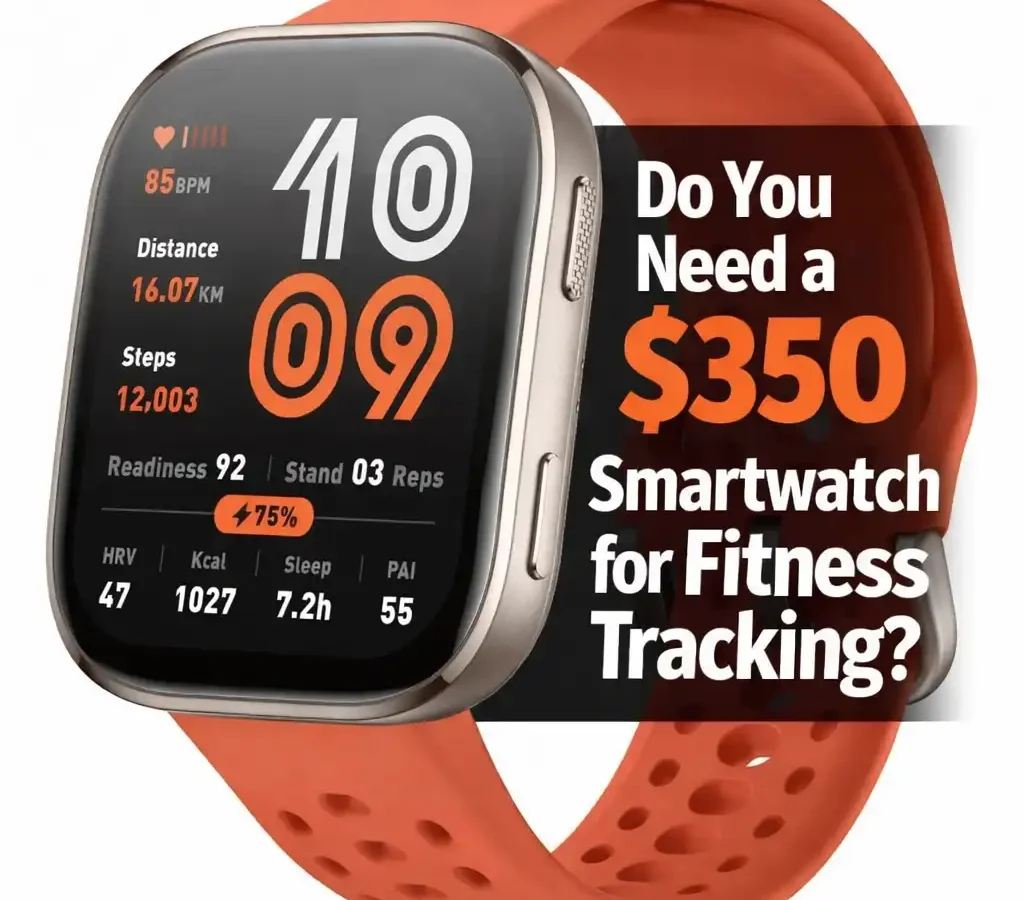
Do You Need a $350 Smartwatch for Fitness Tracking? Here’s What the Data Actually Shows
Premium smartwatches cost three to four times more than budget alternatives and, by widespread account, need charging every single day. Here’s what you’re actually paying for — and whether it matters if fitness tracking is the main use case.
How this was researched: built from independent device reviews (Wareable, Trusted Reviews, Live Science, CGMagazine), documented user reports on battery performance, and official pricing, all linked throughout. This is not a buyer’s guide or a recommendation to purchase any specific device — it’s a look at what the evidence actually shows about the price-to-capability gap.
There are two types of smartwatch buyer. One spends $350 and charges every night. The other spends $50 and charges roughly once a fortnight. Both track their workouts. The question this piece tries to answer honestly is: what does the person who spent $350 actually get for the extra money — and for fitness tracking specifically, does it matter?
The Battery Gap Is Not Close
Samsung’s Galaxy Watch 8 is rated at 30 hours with the always-on display on, or 40 hours with it off. That’s the official figure, confirmed by independent testing — roughly one to two days between charges under normal conditions. It’s a capable watch in many respects, but “charge every couple of days” is simply the reality of owning one, and no amount of optimisation changes that fundamentally.
Budget watches in the Redmi Watch range charge every 10 to 24 days depending on usage. That’s not a marginal difference — it’s a different relationship with the device entirely. A watch you charge twice a month sits on your wrist continuously, including overnight, which matters for sleep tracking. A watch you charge every two days doesn’t.
There’s also a documented recurring problem worth knowing about before buying: routine software updates have repeatedly caused significant battery drain across multiple Galaxy Watch generations, with some owners reporting a full charge gone in 4-5 hours after an update. This has happened more than once. It’s not a defect — it’s a pattern of software updates degrading battery performance on an already-limited baseline.
Samsung is reportedly working on this. The Galaxy Watch 9, expected in late July 2026, is rumoured to carry a 23% larger battery. Whether that translates to a meaningfully different ownership experience remains to be seen.
If you own a Galaxy Watch 8 and want to maximise battery life, this independent video covers the settings worth adjusting — not a Wangdoo production.
What Budget Watches Get Right — and Where They Don’t
Xiaomi‘s wearables — sold under the Redmi sub-brand — have earned a consistent reputation for reliable basic fitness tracking at prices that are genuinely hard to argue with. Step counting is accurate. Sleep tracking works. Resting heart rate monitoring holds up well across models. These aren’t approximations — they’re the metrics most people actually use day to day, and budget watches deliver them capably.
Where the gap shows up is during intense exercise. Real-time heart rate tracking during high-intensity workouts is less consistent on budget optical sensors — the readings can drift in a way that resting measurement doesn’t. SpO2 (blood oxygen) readings run around 3-4% off medical-grade devices, which matters if you’re using it to manage a health condition, and which Xiaomi itself acknowledges by stating the data isn’t for medical diagnosis.
The other genuine gaps aren’t about accuracy — they’re about features. Budget watches rarely include LTE, so leaving your phone at home entirely isn’t an option. Not all include standalone GPS, so check before buying if you run without your phone. The software ecosystem is simpler and more closed than Wear OS, with fewer third-party apps and less smartphone integration. Build materials are typically aluminium and plastic rather than titanium or sapphire glass.
Side-by-Side, In Numbers
| Factor | Premium (Galaxy Watch 8, launched July 2025) | Budget (Redmi Watch 5/6 range) |
|---|---|---|
| Launch price | $350-$380 (Classic: $499) | $40-$90 |
| Real-world battery | ~30 hrs with AOD on; ~40 hrs with AOD off (matches official Samsung claim) | 10-24 days typical |
| Charging frequency | Every 1-2 days typical; potentially faster after some software updates | Roughly weekly to fortnightly |
| Heart rate accuracy | Generally strong, including during exercise | Resting: generally reliable. During intense exercise: inconsistency reported by some reviewers |
| SpO2 accuracy | Closer to medical-grade | ~3-4% deviation reported |
| Built-in GPS | Yes, all models | Varies by model — confirm before buying |
Where Budget Watches Genuinely Fall Short
This isn’t a case where the cheaper option is secretly just as good in every way — there are real, honest trade-offs. Budget watches generally run simpler, more closed software ecosystems compared to Wear OS, with fewer third-party app options. Build materials are more often plastic and aluminum rather than titanium or sapphire glass. Cellular/LTE connectivity, useful for leaving your phone at home entirely, is far less common on budget models. And not every budget watch includes standalone GPS — some rely on a connected phone for route tracking, which matters if running without your phone is part of your routine.
The Honest Caveat
Reviewers consistently frame budget Xiaomi/Redmi watches as excellent for fitness basics but not a replacement for premium devices if you need deep smartphone integration, an app ecosystem, cellular independence, or want the most accurate available health sensors for managing an actual medical condition. The gap is real — it’s just narrower than the price difference implies for fitness tracking specifically.
Who Should Actually Pay the Premium
- If you rely on cellular connectivity to leave your phone behind entirely during workouts, budget options are far more limited.
- If you’re managing a diagnosed health condition where sensor precision genuinely matters, the closer-to-medical-grade accuracy on premium devices is a real, justified reason to pay more.
- If app ecosystem and deep phone integration matter to you — third-party fitness apps, smart replies, a wider range of smart-home control — premium platforms are still meaningfully ahead.
- If your main goal is tracking workouts, steps, heart rate, and sleep without daily charging anxiety, the evidence suggests a budget watch covers that use case capably, at a fraction of the cost.
Frequently Asked Questions
Is it normal for a premium smartwatch to need daily charging?
Close to it. Independent testing by Tom’s Guide found the Galaxy Watch 8 lasted about 30 hours with always-on display on — meaning every one to two days rather than every single day for most users. That said, documented software updates in 2026 caused widespread battery drain on multiple Galaxy Watch generations, with some users reporting as little as 4-5 hours — so real-world experience varies significantly depending on software state.
Are budget smartwatches accurate enough for fitness tracking?
Independent reviews consistently report strong accuracy for steps, heart rate, and sleep tracking on budget models, with one long-term review measuring 97% accuracy. The main gap is SpO2 (blood oxygen) readings, which run a few percentage points off medical-grade devices on some models.
What do budget smartwatches actually lack compared to premium ones?
Mainly: cellular/LTE independence from a phone, broader third-party app ecosystems, premium build materials, and in some models, standalone GPS. These are real gaps for some use cases, but don’t necessarily affect basic fitness tracking accuracy.
Does every budget smartwatch have built-in GPS?
No — this varies significantly by model. Some budget watches rely on a paired phone’s GPS for route tracking rather than including their own GPS chip, which matters if you want to track outdoor workouts without carrying your phone.
Sources
- Galaxy Watch 8 official battery specs and pricing — Samsung
- “Galaxy Watches are running out of battery way too fast” — Android Central
- “Redmi Watch 5 review” — Wareable
- “Redmi Watch 5 review” — Live Science
- “Xiaomi Redmi Watch 5 Review” — Trusted Reviews
- “Samsung Galaxy Watch 9: Release Date, Price & Specs” — Tech Advisor
- Galaxy Watch 8 launch pricing — SamMobile