BYD Motors Will Pay If Its Cars Crash Themselves — But Only in China

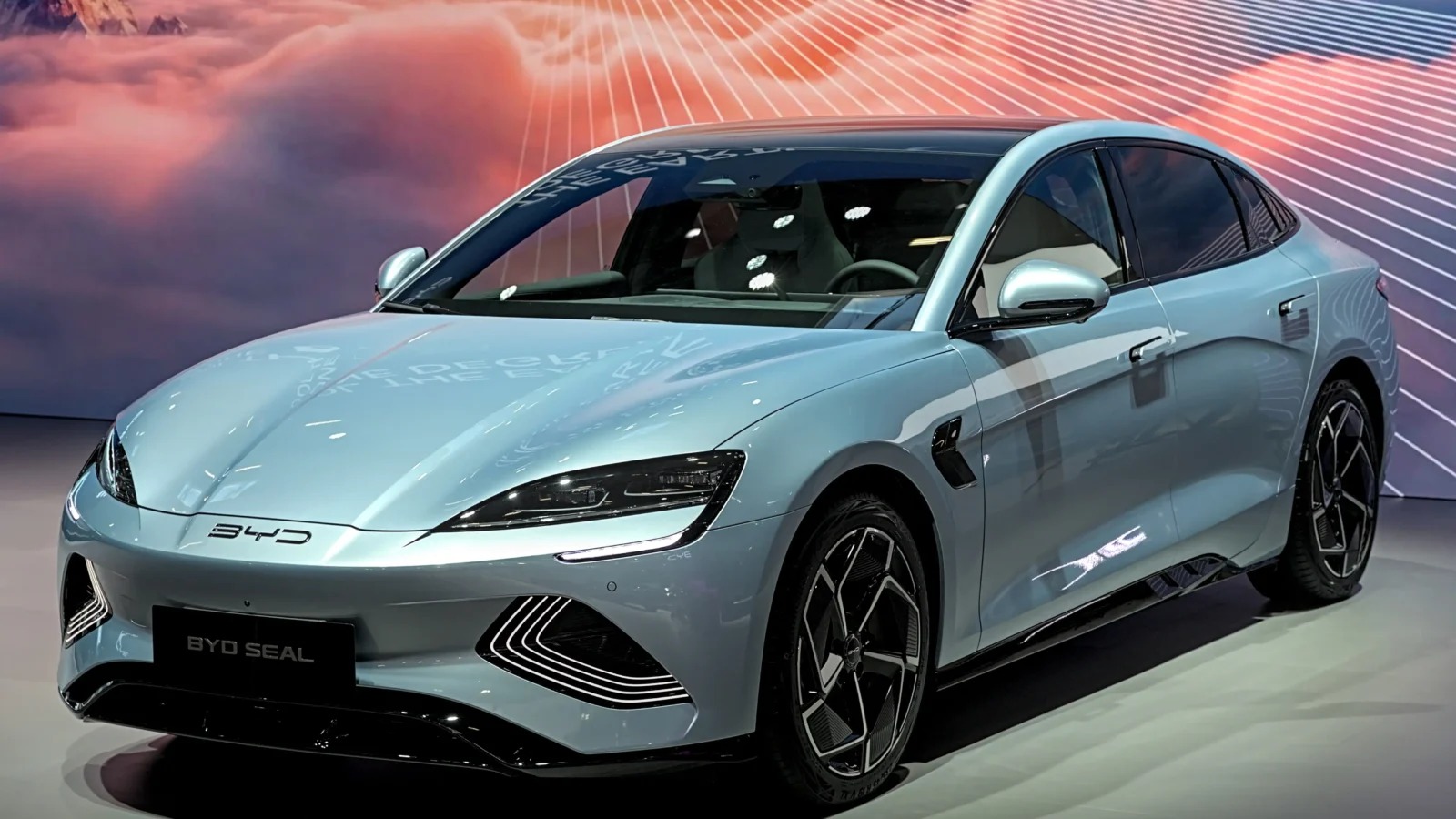
BYD launched the 2027 Seal 06 in Shenzhen on 11 August. Twelve versions, prices from 99,900 yuan — about €12,800 — and a roof-mounted LiDAR unit on a car the size of a Volkswagen Passat.
The specification changes are incremental. The guarantee attached to the car is not.
BYD is taking the liability
The Seal 06 carries BYD’s Full Damage Coverage guarantee: if the car crashes while driving itself through a city, BYD covers the economic losses. No manufacturer offers this at Level 2 in any other market.
This is not new to the Seal 06, and most coverage of the launch gets that wrong. BYD announced the policy company-wide on 28 May 2026 at its Intelligence Strategy Launch Event in Shenzhen, and publishes it in English on its own media site. The Seal 06 inherits it. What is new is the price point it now reaches.
BYD’s own wording: if a legally-liable accident occurs while a user is operating the Urban NOA function in compliance with regulations, BYD will directly cover all resulting economic losses.
This does not apply outside mainland China. BYD’s press release specifies the Chinese market and the God’s Eye 5.0 system. Anyone driving a BYD in Ireland, the UK, elsewhere in Europe or Australia — an Atto 3, a Dolphin, a Seal, a Sealion — gets the same arrangement every other carmaker offers: the driver supervises, the driver is liable. BYD has announced no plan to extend it.
What BYD states, and what it does not
| From BYD’s press release | |
| Announced | 28 May 2026, Shenzhen, at BYD’s Intelligence Strategy Launch Event |
| Duration | One year |
| Who qualifies | New buyers and existing owners who upgrade to God’s Eye 5.0, Chinese market |
| Covers | Intelligent parking and Urban NOA — BYD calls this the world’s first dual coverage |
| Condition | Use in compliance with regulations; accident must be legally liable |
| Availability | BYD’s entire lineup can now be optionally fitted with the God’s Eye LiDAR version |
| Reported elsewhere, not in BYD’s release | |
| Motorway exclusion | Inferred by electrive from BYD’s use of the word “urban”. BYD does not state it |
| Training requirement | Chinese reporting of the first settled claim says the owner had completed driver-assistance training and passed an in-app exam. Not in BYD’s release |
| Claims route | CleanTechnica reports claims run through BYD aftersales rather than an insurer |
The distinction matters. A guarantee whose exclusions are inferred from a single adjective is not the same as one with published terms, and the training prerequisite — which decides whether an owner qualifies at all — appears nowhere in what BYD has published in English.
The three pillars BYD cites
BYD names three pillars behind the guarantee, and separately commits the spending to sustain them.
| Fleet | Over 3.15 million assisted-driving vehicles on the road, which BYD says is the largest of any Chinese automaker |
| Data | Over 200 million kilometres logged daily |
| Engineering | 5,000 dedicated R&D engineers, which BYD calls the largest team in China’s automotive industry |
| Investment | BYD says it will continue investing over RMB 100 billion in assisted-driving R&D |
Alongside the guarantee BYD announced the XUANJI A3, which it describes as China’s first self-developed 4nm automotive driving chip, already in mass production. BYD says it natively supports Level 3 and Level 4 autonomous driving, that a three-chip configuration delivers over 2,100 TOPS per vehicle, and that power consumption per TOPS is 20% below comparable products.
Chairman Wang Chuanfu made the same point about the guarantee, per electrive: liability obligations are mandatory only at Level 3 or 4, and BYD is accepting them at Level 2. The XUANJI A3 is built for those higher levels, though BYD has not said when it expects to deploy them.
The guarantee has already paid out. Chinese reporting records the first Urban NOA claim settled on 30 May 2026, two days after the announcement. BYD investigated, confirmed the incident occurred during compliant use, and reimbursed all direct economic losses including paint protection film damage.
The guarantee changes how the system is used. CleanTechnica reports intelligent parking usage rose from 21% to 93% after the parking guarantee, and city driving usage rose around 50% in the days after this one. Guaranteeing the system generates the data that improves the system.
The specifications
| Launched | 11 August 2026, Shenzhen — China market only |
| Versions | 12, split across plug-in hybrid and battery electric |
| PHEV pricing | 99,900–141,900 yuan (approx. €12,800–€18,200) |
| EV pricing | 109,900–155,900 yuan (approx. €14,100–€20,000) |
| Driver assistance | God’s Eye B with LiDAR — urban and highway navigation-guided driving |
| Battery | Second-generation Blade Battery with flash charging, standard on EV versions |
| Claimed range | Up to 630 km CLTC, from 545 km on the outgoing model |
| Motors | Single motor at 120 kW or 240 kW, up from 110 kW and 160 kW |
| 0–100 km/h | From 5.9 seconds |
| PHEV drivetrain | 1.5-litre engine, electric-only range of 170, 205 or 230 km CLTC |
| Dimensions | 4,870 × 1,890 × 1,495 mm, wheelbase 2,820 mm — 47 mm shorter than a Volkswagen Passat |
| Launch offer | Free flash charging for the first year, per BYD |
On the range figure: 630 km is CLTC, China’s domestic cycle, which produces markedly more optimistic numbers than WLTP and considerably more than EPA. As a rough guide, CLTC figures typically fall by a fifth to a quarter under WLTP. Treat it as a comparison against other Chinese-market cars, not against a European one.
Pricing against the outgoing model
The Seal 06 EV launched in June 2025 at 109,800 to 129,800 yuan. The replacement starts at 99,900 for the hybrid and 109,900 for the EV, with LiDAR added, a larger body, higher motor outputs, the second-generation battery and 85 km more claimed range.
More equipment at a lower entry price is the pattern that has defined Chinese EV competition for three years. Vertical integration is part of it: BYD makes its own batteries, semiconductors and motors. Scale is another. Domestic LiDAR suppliers have driven unit costs down by an order of magnitude since the technology was a rooftop spinning drum on prototype robotaxis.
The third reason is less comfortable. Chinese authorities have publicly criticised price competition in the sector as unsustainable, and margins across the industry are thin. Cars priced this way are not necessarily profitable at the model level.
A defensive launch
The Seal series is BYD’s volume play in affordable sedans. It sold 518,412 units in 2025, about 11.26% of BYD group sales.
This year it is shrinking. July sales were 40,399, down 13.77% year on year. The January–July total of 210,541 is down 15.60%.
A carmaker adding expensive sensor hardware while cutting prices on a model losing 15% of its volume is defending territory, not extending it.
Why this matters outside China
The Seal 06 is not sold in Europe or North America and there is no indication it will be. Its relevance is as a benchmark.
When European carmakers describe LiDAR as a premium feature, or treat city-level assisted driving as a flagship capability, this is the competitive reality that claim is measured against. BYD already sells in Europe — the Dolphin Surf is the European version of its Chinese Seagull — and the technology arriving on a Chinese sedan at this price tends to reach export models within a generation or two, adjusted for European regulation and pricing.
The regulatory gap is the real barrier. Urban navigation-guided driving of the kind BYD is shipping here would not be approved for use on European roads under current UNECE rules. The hardware travels far faster than the permission to use it does, which is why a feature list from China is not a preview of a European car so much as an indication of what is technically possible and legally blocked.
My Take — Mr Wangdoo
The LiDAR headline is the least interesting thing here. Sensor hardware gets cheap; that is what sensor hardware does.
Every carmaker selling Level 2 assisted driving structures it identically — capable feature, confident marketing, legal responsibility on the driver. That arrangement exists because manufacturers are not confident enough to stand behind the systems financially. BYD is, and it has settled a claim to prove the mechanism works rather than leaving it as a press release.
What tempers that is how much of the guarantee is undocumented. BYD publishes the duration, the market and the condition of compliant use. It does not publish the exclusions. The motorway carve-out is an inference drawn from one adjective. The training requirement, which decides whether an owner qualifies at all, surfaced only through reporting of the first claim. A guarantee is its exclusions, and those are the part BYD has not written down in English.
It is also a commercial instrument, and BYD is open about the mechanism: guarantee the system, usage climbs, usage generates data, data improves the system. Underwriting the risk is how it buys the training data, and the fleet size is what makes the bet affordable.
What I cannot assess from documentation is whether the system is better than a supervised European equivalent, or whether BYD has calculated that payouts cost less than the data is worth. Both would produce this announcement.
Common questions
How much does the 2027 BYD Seal 06 cost?
Plug-in hybrid versions run from 99,900 to 141,900 yuan, roughly €12,800 to €18,200. All-electric versions run from 109,900 to 155,900 yuan, roughly €14,100 to €20,000. Converted at about ¥7.79 to the euro, mid-market, 11 August 2026. Prices are Chinese domestic, before local taxes and incentives, and a currency conversion is not a European price.
Do I get the liability guarantee if I buy a BYD in Europe?
No. BYD has stated the Full Damage Coverage guarantee applies to the Chinese market and the God’s Eye 5.0 system. BYD models sold in Ireland, the UK, elsewhere in Europe and Australia are not covered by it, and the driver remains responsible for supervising any assisted driving features, as with every other manufacturer. BYD has not announced any plan to extend the guarantee to export markets.
Is it sold outside China?
No. The Seal 06 is a China-market model and BYD has not announced international availability. BYD does sell other models in Europe, including the Dolphin Surf.
What is God’s Eye B?
BYD’s mid-tier driver assistance system, which includes LiDAR and supports both urban and highway navigation-guided driving. The outgoing Seal 06 used God’s Eye C, a camera-only system without LiDAR. This is the first time BYD has fitted the LiDAR system to a family sedan in this price bracket.
What is the real-world range?
Unknown. BYD claims up to 630 km on China’s CLTC cycle. CLTC produces substantially higher figures than WLTP or EPA testing, and no independent range test has been published.
Sources
- BYD — “BYD Becomes World’s First Automaker to Provide Full Damage Coverage for Both Intelligent Parking and Urban NOA,” 28 May 2026. media.byd.com
- CnEVPost — “BYD launches 2027 Seal 06 with 630 km range, second-gen Blade Battery,” 11 August 2026. cnevpost.com
- CnEVPost — “BYD’s 2027 Seal 06 set for August 11 launch with LiDAR-based driver assistance,” 8 August 2026, including Seal series sales data. cnevpost.com
- CarNewsChina — “The 2027 BYD Seal 06 launches in China featuring Flash Charging and DiSus-C,” 12 August 2026. carnewschina.com
- electrive — “BYD introduces damage cover for driver assistance system in China,” 2 June 2026, on the inferred motorway limitation and Wang Chuanfu’s remarks. electrive.com
- CleanTechnica — “BYD Taking Responsibility Increases God’s Eye Use & Makes Vehicles Safer,” 16 June 2026, on usage rates and claims handling. cleantechnica.com