What Is the AWOL Vision Aetherion? The $14M Projector Replacing TVs in 2026

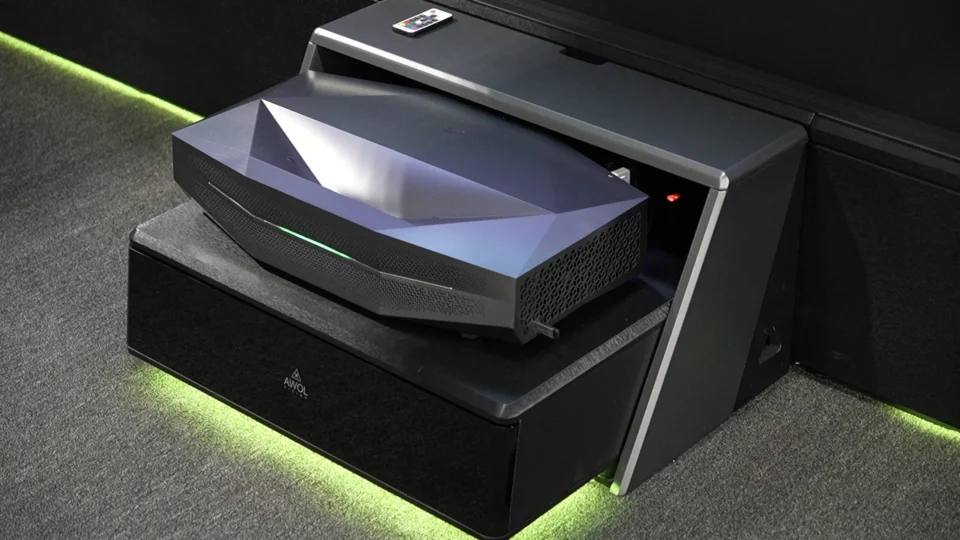
AWOL Vision Aetherion Review Roundup — What Independent Tests Actually Found About the $18.6M Kickstarter Projector
The Aetherion raised $18.6 million from 7,050 backers and earned a Highly Recommended designation from ProjectorCentral. Here is what specialist reviewers with measurement equipment actually found — the strengths, the caveats, and the one spec that matters more than any other for real-world use.
Most people buying a large TV spend somewhere between $800 and $2,000 and get a screen between 65 and 85 inches. That is the practical ceiling for flat-panel displays — beyond that, the price curve goes vertical and the logistics of getting the thing through a front door become absurd. A 100-inch TV exists. It costs around $10,000 and weighs as much as a wardrobe.
Ultra-short-throw projectors exist to break that ceiling. Instead of mounting a projector across the room, a UST unit sits a few centimetres from the wall and uses extreme optics to throw a massive image at close range. The technology has existed for years — but until recently, UST projectors made compromises that bothered serious home cinema buyers. Black levels were mediocre. Gaming performance was poor. Colour gamut fell short of premium TVs. And the price for a good one was high enough to make a large OLED look reasonable by comparison.
The AWOL Vision Aetherion is the latest attempt to close all of those gaps at once. Unveiled at CES 2026 and launched on Kickstarter in February 2026, it raised $18.6 million from over 7,000 backers — hitting $10 million in its first 12 hours. Independent specialist outlets have since published full hands-on reviews. Here is what those reviewers found when they tested it with measurement equipment.
The AWOL Vision Aetherion is a 4K ultra-short-throw triple RGB laser projector in two variants — the Pro (2,600 ISO lumens, $3,499) and the Max (3,300 ISO lumens, $4,499). Both support Dolby Vision, HDR10+, VRR gaming, Google TV, Wi-Fi 7, and HDMI 2.1. The Kickstarter campaign raised $18,649,456 from 7,050 backers. Retail units began shipping April 2026. ProjectorCentral awarded the Max its Highly Recommended designation and AVS Forum gave it a Top Choice Award. The main real-world caveat confirmed by reviewers: 120–150 inches is the practical optimal size, not the marketed 200 inches.
AWOL Vision Aetherion Max — independent review. Wangdoo has not tested this product. All rights respective owner. Source: YouTube.
What Is Ultra-Short-Throw and Why Does It Matter?
A standard projector needs to be placed metres away from the screen to produce a large image — the further back, the bigger the picture. This creates obvious practical problems: you need a ceiling mount or a dedicated stand in the middle of the room, the projector beam passes through the viewing area and can be interrupted, and the setup requires careful room planning.
An ultra-short-throw projector solves this by using an extreme wide-angle lens — in the Aetherion’s case, a 0.2:1 throw ratio. That means for every 1 metre of image width, the projector only needs to be 0.2 metres from the wall. In practice, the Aetherion sits a few centimetres from the wall to produce a 100-inch image, or roughly 30 centimetres from the wall to produce a 150-inch image. The unit goes on a piece of furniture below the wall — no ceiling mount, no room planning, no beam crossing the seating area.
A standard projector is like standing at the back of a theatre to project onto a distant screen. An ultra-short-throw projector is like holding a torch six inches from a wall and still illuminating the entire wall. The optics involved in making that work without distortion or colour fringing are genuinely complex — which is why good UST projectors have historically been expensive and technically challenging to build.
The Technology — What Is Inside the Aetherion
The Aetherion uses a 4K DLP chip — specifically a 0.47-inch Texas Instruments DMD paired with the DLPC8445 controller — combined with a triple RGB laser light source. Most projectors use a single blue laser or a blue laser plus phosphor wheel to create white light, then filter it into colours. Triple RGB laser means three separate lasers — red, green, and blue — each producing their respective colours directly. This approach produces a wider colour gamut and avoids the colour wheel artefacts (rainbow effect) that single-laser DLP projectors are known for.
AWOL Vision claims 110% coverage of the Rec. 2020 colour standard — a wide-gamut reference used in professional cinema and a manufacturer claim, not an independently verified figure. ProjectorCentral’s Sammie Prescott Jr. measured the Aetherion Max at approximately 98% Rec. 2020 in the uv colour space — his note: “anything listed over 100 percent is not something that will ever be used and not realistic.” For context, most premium OLED TVs cover around 75–80% of Rec. 2020. Colour accuracy required calibration to reach reference level.
The manufacturer rates native contrast at 6,000:1. In real-world measurement, ProjectorCentral recorded FOFO contrast ranging from 9,575:1 to 22,000:1 depending on how the iris and EBL system are configured — a strong result for a 0.47-inch DLP chip. AWOL Vision also quotes a dynamic contrast figure of 60,000:1, but ProjectorCentral was direct about this: “the stated contrast ratio of up to 60,000:1 was not achievable in any of the tests I performed.” Treat that figure as a ceiling specification rather than a real-world expectation.
PixelLock — How AWOL Vision Addresses the Sharpness Problem
Ultra-short-throw projectors have historically struggled with a specific optical problem: because the image is thrown at such an extreme angle from close range, maintaining sharp focus across a large screen is technically difficult. Edges can appear softer than the centre, and colour fringing can be visible at the edges of bright objects.
AWOL Vision’s answer is a proprietary system called PixelLock, which combines optical and mechanical alignment with digital processing to maintain pixel-level sharpness across the full image area. The lens uses a sapphire glass element with specialised coatings. Reviewers noted image clarity as a standout characteristic.
Full Specifications
| Specification | Aetherion Pro | Aetherion Max |
|---|---|---|
| Technology | 4K DLP · 0.47″ Texas Instruments DMD · Triple RGB Laser | |
| Brightness (rated) | 2,600 ISO lumens | 3,300 ISO lumens |
| Brightness (measured) | ~2,100–2,600 ANSI lm | ~2,200–3,031 ANSI lm (ProjectorCentral) |
| Native Contrast (rated) | 6,000:1 (manufacturer figure) | |
| Contrast (measured) | FOFO 9,575:1–22,000:1 (ProjectorCentral — varies by iris/EBL setting) | |
| Dynamic Contrast | 60,000:1 claimed — not achieved in ProjectorCentral testing | |
| Resolution | 4K UHD (3840×2160) | |
| Screen Size | 80–200″ (120–150″ recommended by reviewers) | |
| Throw Ratio | 0.2:1 | |
| Colour Gamut | 110% Rec. 2020 (manufacturer claim) / ~98% Rec. 2020 measured (ProjectorCentral) | |
| HDR Support | Dolby Vision · HDR10+ · HDR10 · HLG · IMAX Enhanced · Filmmaker Mode | |
| Gaming | VRR · ALLM · Dolby Vision Gaming · 1ms response · 240Hz · HDMI 2.1 | |
| Smart OS | Google TV (Android TV 14) | |
| Chipset | MediaTek MT9655 | |
| RAM / Storage | 8GB RAM · 128GB storage | |
| Connectivity | 3× HDMI 2.1 · DisplayPort · 2× USB 3.0 · Wi-Fi 7 · Bluetooth 5.4 · 2.5GbE LAN · AirPlay 2 · Chromecast | |
| Audio | 2× 25W woofers + 2× 20W tweeters · Dolby Atmos | |
| Smart Home | Google Home · Apple HomeKit · Amazon Alexa | |
| Dimensions | 562 × 323 × 139.5 mm · 8.75 kg | |
| Retail Price | $3,499 | $4,499 |
| Availability | From May 2026 | From June 2026 |
What Independent Reviewers Actually Found
Wangdoo has not tested the Aetherion. What follows is a synthesis of findings from five specialist outlets that did — all of whom used measurement equipment rather than subjective impression alone.
Image Quality and Colour
ProjectorCentral’s Sammie Prescott Jr. awarded the Aetherion Max its Highly Recommended designation after testing, citing excellent colour accuracy after calibration and solid contrast performance. HomeTheaterHifi described the contrast as “seriously high” — unusually so for a DLP platform — and noted that calibration to reference level was straightforward. ProjectorJunkies confirmed the 6,000:1 native contrast figure as a genuine achievement for the 0.47-inch DLP chip.
Gaming Performance
Gaming performance was consistently highlighted as a strength across all reviews. ProjectorCentral described it as “very strong”, citing low latency and VRR support. The HDMI 2.1 implementation supports Dolby Vision Gaming — absent from most competitors at this price — along with high refresh rates and ALLM. For gaming on a large-format display these are meaningful differentiators that Wangdoo cannot independently verify but which multiple specialist reviewers confirmed.
The Brightness Reality — The Most Important Caveat
ProjectorCentral measured the Aetherion Max at 3,031 ANSI lumens in its brightest mode — approximately 8% below the rated 3,300 ISO figure. In practical picture modes (Standard, Cinema, Theater), brightness dropped further, measuring between 2,100 and 2,900 ANSI lumens. This is normal — ISO lumen ratings are measured at maximum output, not at calibrated settings.
The practical implication confirmed by reviewers: 120–150 inches is the realistic optimal screen size for most viewing environments. At 200 inches, a fully darkened room and ideally an ALR (Ambient Light Rejecting) screen are required to maintain adequate brightness. This is not a flaw unique to the Aetherion — it applies to every UST projector at every price.
The HDR Firmware Issue — Resolved Before General Sale
Pre-production and early units showed highlight clipping in HDR content. AWOL Vision addressed this with firmware update V1.4.3, released March 2026. Units shipping from April 2026 onward should have this update applied. If you receive a unit, verify the firmware version before evaluating HDR performance.
How It Compares to Key Competitors
| Feature | Aetherion Max | Hisense PX3-Pro | Samsung Premiere 9 | LG CineBeam Qube |
|---|---|---|---|---|
| Technology | Triple RGB Laser DLP | Triple Laser DLP | Triple Laser DLP | RGB Laser LCoS |
| Brightness (rated) | 3,300 ISO lm | 3,000 ISO lm | 2,800 ISO lm | 2,700 ISO lm |
| Dolby Vision | ✓ Yes | ✗ No | ✗ No | ✗ No |
| VRR Gaming | ✓ Yes | ✓ Yes | ⚠ Limited | ✗ No |
| Wi-Fi 7 | ✓ Yes | ✗ No | ✗ No | ✗ No |
| HDMI 2.1 (×3) | ✓ Yes | ⚠ 1× only | ⚠ 1× only | ✗ No |
| Google TV | ✓ Yes | ✗ No | ✗ Samsung OS | ✗ webOS |
| Retail Price | $4,499 | ~$3,799 | ~$6,499 | ~$3,999 |
Comparison figures for competitor products are drawn from manufacturer specifications and public pricing as of June 2026. Wangdoo has not tested any of the comparison products above.
Who Is the Aetherion Actually For?
The Kickstarter Story
The Aetherion campaign launched on Kickstarter in February 2026. PRNewswire confirmed it hit $10 million in the first 12 hours — described as a record for a hardware projector campaign. By the time the campaign closed on May 18, 2026, it had raised $18,649,456 from 7,050 backers against a $500,000 funding goal — 37 times overfunded.
AWOL Vision is not a first-time crowdfunder. The company’s sister brand Valerion previously ran a Kickstarter for the VisionMaster projector that raised over $10.92 million and shipped to backers. That delivery track record is relevant context for a $4,499 purchase from a company that is not yet widely known in Europe. Retail units began shipping April 2026. The Aetherion Pro is available from May 2026 and the Max from June 2026 through awolvision.com and Amazon. The Kickstarter campaign is now closed.
My Take — Mr Wangdoo
I want to be clear upfront: I have not tested the Aetherion. What I can offer is an assessment of the evidence — specifically, whether the specialist reviewers who did test it with calibration equipment found results consistent with what the marketing claims.
The answer from the reviewers is largely yes — which is less common in the projector market than it should be. ProjectorCentral, AVS Forum, HomeTheaterHifi, and ProjectorJunkies are not publications that hand out top designations lightly. The fact that all four landed in the same place — strong image quality after calibration, genuine gaming credentials, unusual contrast performance for the DLP chip size — is meaningful independent corroboration.
The one honest caveat worth repeating: 200 inches is a theoretical maximum, not a practical recommendation. Reviewers found 120–150 inches to be the realistic optimal range for most environments. If you are expecting to fill a 200-inch screen in a living room with daylight present, the brightness mathematics simply do not work. That is not unique to the Aetherion but it is worth being clear about before spending $4,499.
The Dolby Vision Gaming support is the detail that stands out as genuinely differentiating from what the comparison table shows. Most UST competitors at this price do not have it. For PS5 or Xbox Series X owners who want large-format display with full console output support, the Aetherion is currently one of very few options in the UST category that delivers it — according to the specialist reviews Wangdoo has analysed.
Frequently Asked Questions
Has Wangdoo tested the AWOL Vision Aetherion?
No. Wangdoo has not physically tested the Aetherion. This article is an independent analysis of verified hands-on reviews from specialist outlets including ProjectorCentral, HomeTheaterHifi, AVS Forum, Notebookcheck, and ProjectorJunkies — all of whom used measurement equipment. All reviewer findings are attributed to their source throughout this article.
What is the AWOL Vision Aetherion?
The AWOL Vision Aetherion is a 4K ultra-short-throw laser projector that sits close to your wall and projects an image up to 200 inches diagonally. It uses a triple RGB laser light source, supports Dolby Vision and HDR10+, runs Google TV, and includes VRR, ALLM, and Dolby Vision Gaming support. It comes in two variants — the Pro (2,600 ISO lumens, $3,499) and the Max (3,300 ISO lumens, $4,499).
Can it really project at 200 inches?
Technically yes, but independent reviewers found that 120–150 inches is the practical optimal range for most viewing environments. ProjectorCentral measured the Max at around 2,200–3,031 ANSI lumens in practical picture modes. At 200 inches, a fully darkened room and an ALR (Ambient Light Rejecting) screen are strongly recommended. At 120–130 inches, reviewers found the image works well with moderate ambient light control.
What is the difference between the Pro and Max?
Primarily brightness — 2,600 ISO lumens (Pro) versus 3,300 ISO lumens (Max). Both use the same 4K DLP chip, triple RGB laser, Google TV, Wi-Fi 7, HDMI 2.1, Dolby Vision, and gaming feature set. The Max costs $1,000 more at retail ($3,499 vs $4,499). For rooms under 130 inches with reasonable light control, the Pro’s brightness may be sufficient. For larger screens or brighter rooms, the Max’s additional output is meaningful according to reviewer guidance.
Is the 60,000:1 contrast ratio real?
It is a dynamic contrast figure — measured at the extreme ends of the iris range, not within a single fixed scene. This is a standard industry marketing metric and should not be compared to native contrast figures. The native contrast of 6,000:1 is the meaningful number for real viewing, and independent reviewers confirmed it as unusually strong for a 0.47-inch DLP platform.
Is the Aetherion good for gaming?
According to specialist reviewers — yes. ProjectorCentral confirmed “very strong” gaming performance including low latency and VRR support. The Aetherion supports VRR, ALLM, Dolby Vision Gaming, and HDMI 2.1. Dolby Vision Gaming in particular is rare in the UST projector category and works with PS5 and Xbox Series X content. Wangdoo has not independently verified gaming performance.
Is AWOL Vision a credible company?
AWOL Vision is the sister brand of Valerion, which ran a Kickstarter for its VisionMaster projector that raised over $10.92 million and shipped to backers. The Aetherion launched at CES 2026, has been reviewed by established specialist outlets, and retail units began shipping April 2026. The combination of a prior successful crowdfunding delivery, professional independent reviews, and retail availability via Amazon provides meaningful assurance for a hardware purchase at this price.
- ProjectorCentral — AWOL Vision Aetherion Max hands-on review — Highly Recommended (April 27, 2026)
- HomeTheaterHifi — AWOL Aetherion Max — full calibration and measurement review (April 29, 2026)
- AVS Forum — AWOL Vision Aetherion Max — Top Choice Award 2026
- Notebookcheck — AWOL Vision Aetherion Max — full measurement test (March 16, 2026)
- ProjectorJunkies — AWOL Vision Aetherion Max — extended hands-on (April 30, 2026)
- PRNewswire — Aetherion surpasses $10M in 12 hours — record Kickstarter debut (February 11, 2026)
- Kickstarter — AWOL Vision Aetherion campaign — $18,649,456 raised, 7,050 backers (verified May 18, 2026)