
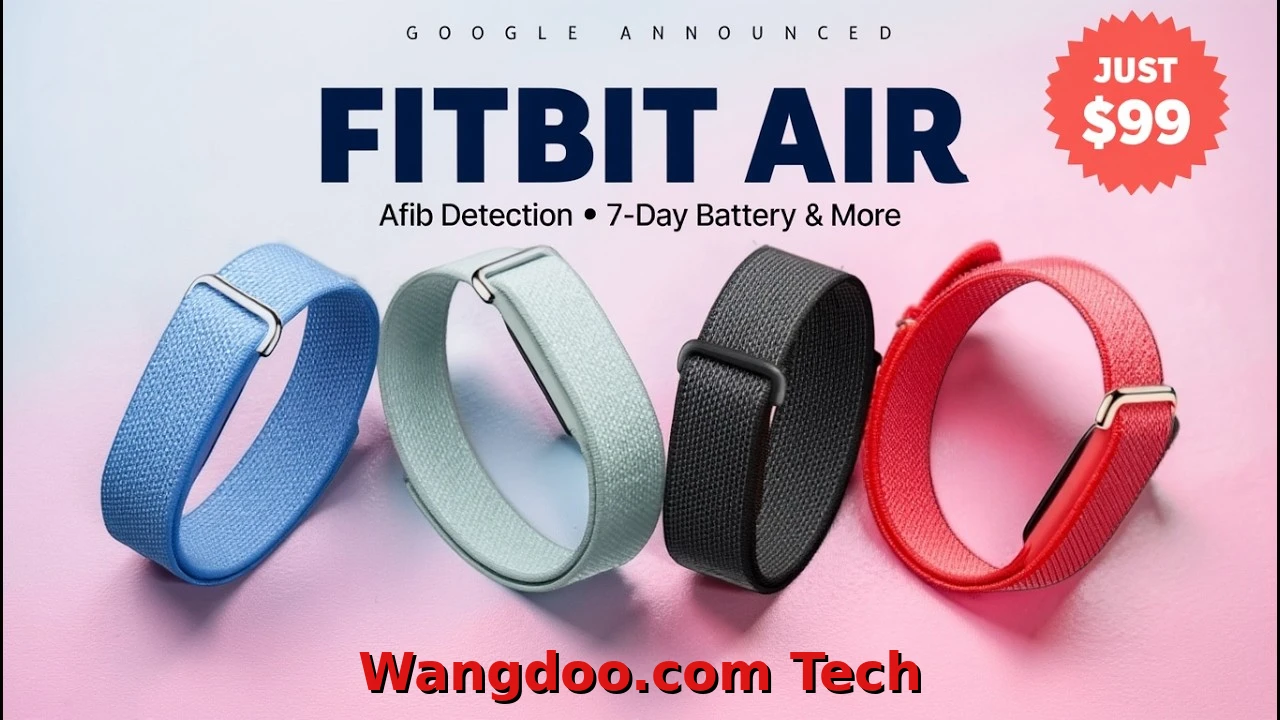
Google has made its boldest move in wearable technology since it acquired Fitbit back in 2021. The Fitbit Air is a tiny, screenless fitness tracker announced on May 7, 2026 and set to ship in the United States on May 26, 2026. Priced at just $99.99, it positions itself squarely against premium screenless trackers like Whoop and the Oura Ring — but at a fraction of the ongoing cost. It is lightweight, subscription-free for core features, and powered by Google’s growing health AI platform. Here’s everything you need to know.
What exactly is the Fitbit Air?
The Fitbit Air is Google’s smallest and most affordable wearable yet. At its core it’s a tiny polycarbonate and PBT plastic “pebble” — just 5.2 grams on its own — that slots into a swappable fabric or silicone band. It has no screen. No notifications. No apps. Just sensors quietly doing their job around the clock.
Google describes it as a “proactive wellness partner.” You live your life; the tracker collects the data; you check the insights later through the new Google Health app on your phone. This is the same philosophy that made Whoop popular, but Google is bringing it to a mainstream price point.
Google is clearly betting the same way. Screenless wearable sales surged 88% between 2024 and 2025, and the Fitbit Air is designed to capture the mainstream end of that wave.
Full Specs at a Glance
| Spec | Details |
|---|---|
| Launch Date | May 7, 2026 (announced) · May 26, 2026 (ships) |
| Price | $99.99 standard · $129.99 Stephen Curry Special Edition |
| Weight | 5.2g (pebble only) · 12g (with band) |
| Display | None — screenless design |
| Battery Life | Up to 7 days |
| Fast Charge | 5 minutes = 1 full day of use |
| Heart Rate | 24/7 optical sensor, 2-second intervals |
| SpO2 | Red + infrared sensors |
| Sleep Tracking | Sleep stages, duration, HRV |
| Afib Detection | Yes — FDA-certified background monitoring |
| Manual ECG | No |
| Skin Temperature | Yes |
| Motion Sensors | 3-axis accelerometer + gyroscope |
| Exercise Detection | Automatic |
| Cardio Load / Readiness | Yes |
| Subscription Required | No (optional Google Health Premium at $9.99/month) |
| Compatibility | Android 11+ · iOS 16.4+ |
| App | Google Health (replaces Fitbit app) |
| Materials | Polycarbonate + PBT plastic · 35%+ recycled content |
Design & Comfort
The Fitbit Air uses a two-part system: the pebble pod plus a swappable band. Bands come in fabric and silicone options, with accessory bands starting at $34.99. The entire assembly weighs just 12 grams — lighter than most rings, let alone smartwatches.
Google’s design goal was simple: make it comfortable enough that you wear it 24/7 without thinking about it. Sleep tracking and recovery data only work if you actually keep the device on, so minimising bulk was the priority from day one.
A Stephen Curry Special Edition is also available at $129.99, designed in collaboration with the NBA star who was spotted wearing prototypes on Instagram months before the official announcement.
The Google Health App — The Real Story
Arguably the bigger headline here isn’t the hardware — it’s the software. The Fitbit app is being retired and replaced by the new Google Health app, which also absorbs Google Fit (which is shutting down).
The new app features four tabs — Today, Fitness, Sleep, and Health — and introduces an AI-powered Coach for all Google Health Premium subscribers. The Coach suggests workouts based on your weather, recovery score, and personal goals.
On iOS, the app pulls in Apple Health data, so iPhone users can keep a single health hub. Google is also opening up APIs to third-party devices — Garmin, Whoop, and Oura are expected to integrate during 2026.
Some legacy Fitbit features are being dropped in the transition, including badges and “sleep animals.” Existing hardware like the Versa 4 and Sense 2 will continue to be sold and supported.
Fitbit Air vs Whoop vs Oura Ring
Pros & Cons
Pros
- Incredibly affordable at $99.99
- No subscription required for core features
- Ultra-light at just 12g with band
- FDA-certified Afib detection
- 5-minute fast charge for a full day
- Works on both Android and iPhone
- Swappable bands for style flexibility
- Comprehensive sleep and recovery tracking
- Google Health AI Coach (via Premium)
Cons
- No manual ECG feature
- No on-device display — phone-dependent
- Fitbit app being retired — transition required
- Badges and sleep animals removed
- Best features need Google Health Premium
- No GPS (relies on phone)
- Very new — long-term reliability unknown
Who Is It For?
The Fitbit Air is built for people who want health data without the distraction of a smartwatch. If you’re tired of notification pings on your wrist and you just want to understand your sleep, recovery, and heart health — this is aimed squarely at you.
It’s also a great entry point for people curious about the screenless tracker category but put off by Whoop’s mandatory subscription or Oura’s premium ring price tag. At $99.99 with no required subscription, the barrier to entry is as low as it’s ever been.
For serious athletes who want deep recovery metrics and a hardcore coaching experience, Whoop remains the gold standard. But for the majority of health-conscious people? The Fitbit Air is a compelling alternative.
Wangdoo Verdict
Editors’ Rating
The Fitbit Air is one of the most exciting wearable launches in years — not because of flashy tech, but because it democratises screenless health tracking. $99.99 with no forced subscription, FDA-certified Afib detection, a 7-day battery, and 5-minute fast charging is a remarkable package. The Google Health ecosystem is still maturing, and losing the Fitbit app will frustrate some longtime users. But for anyone looking to join the screenless tracker revolution without spending a fortune, the Fitbit Air is the one to beat in 2026.
Where to Buy
The Fitbit Air is available for pre-order now from the Google Store and Amazon in the US, with shipping beginning May 26, 2026. It will also be available in retail stores including JB HiFi, Harvey Norman, OfficeWorks, and Telstra in Australia. Accessory bands start from $34.99.
Google AI Pro and Ultra subscribers receive Google Health Premium at no extra cost as part of their existing plans.