UBTECH Launches UWORLD U1 — The First Full-Size Consumer Humanoid Robot

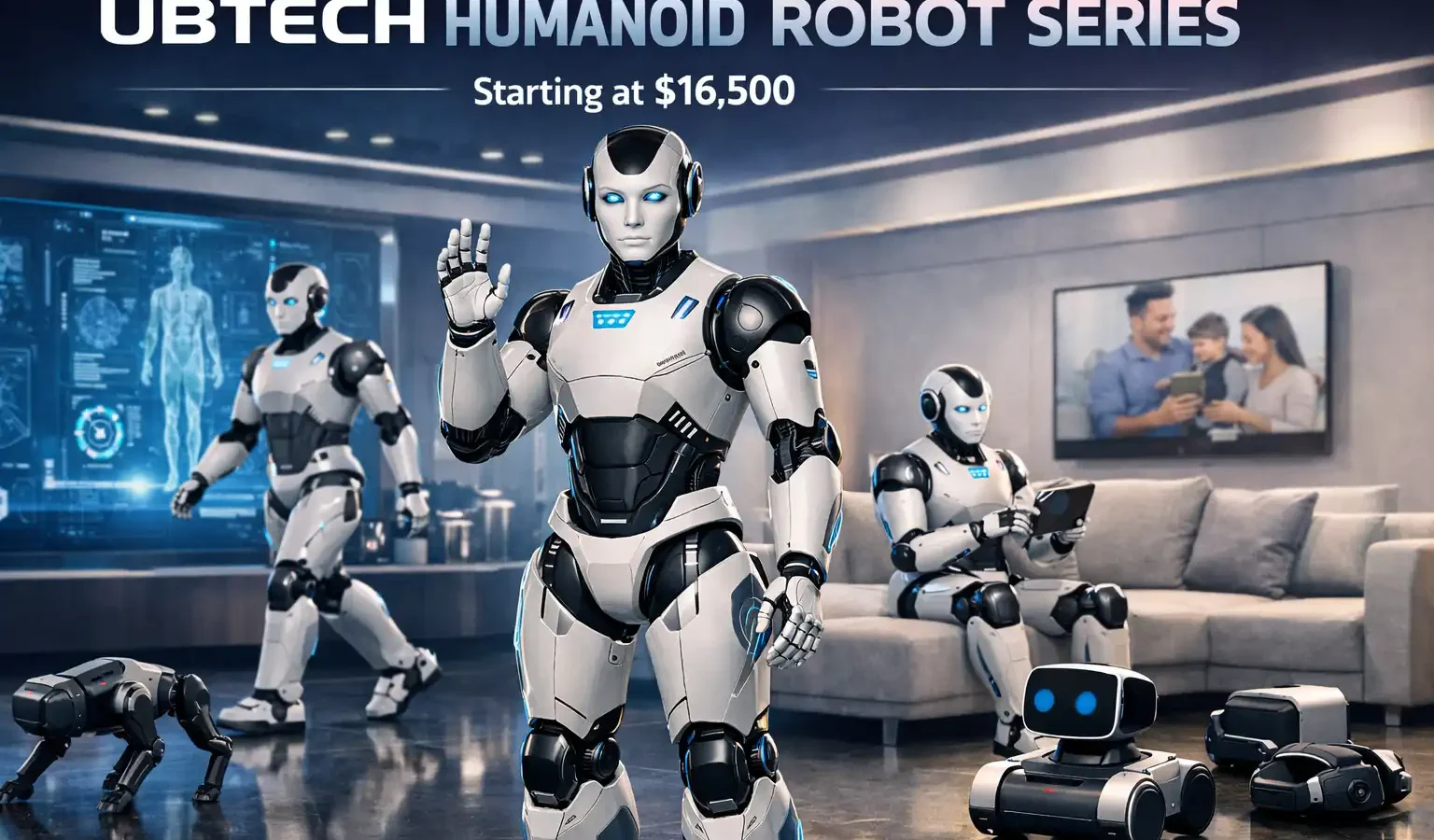
UBTECH Launched a Consumer Humanoid Robot Series Starting at $16,500 — Here Is What the Primary Source Actually Says
On June 30 in Shenzhen, UBTECH unveiled the UWORLD U1 Series: silicon skin, 88 degrees of freedom, an emotion-sensing AI, and 13,361 orders before the event ended. The entry model starts at $16,500 — but that is a semi-torso edition. The full-body models cost more and UBTECH has not published those prices. The company has been building humanoid robots since 2012 and is already shipping industrial ones. What the press release contains that nobody has looked at carefully is the part about recreating deceased loved ones in robot form.
How this was reported: all factual claims are sourced from UBTECH’s official PRNewswire press release (July 1 2026, read in full), UBTECH’s own company profile page (ubtrobot.com), Wikipedia’s UBTECH article, and cross-checked against Tracxn, RobotHub, and Robozaps for funding and market position figures. No hands-on testing was conducted and none is implied. Where claims are UBTECH’s own assertions rather than independently verified facts, they are clearly attributed as such. This is not a review.
Most of the coverage of the UWORLD U1 launch focused on one thing: the plan to build robots that look and sound like your dead relatives. That is genuinely in the official press release, and it warrants examination. So do the pricing structure, the order numbers, the technical specs, and what UBTECH’s industrial track record actually tells you about the consumer claims.
Official highlights from UBTECH Robotics’ 2026 Global Launch Event, published by UBTECH on their own channel. Not a Wangdoo production.
Who UBTECH Actually Is
UBTECH is not a startup making bold claims ahead of a prototype. It was founded in March 2012 by Zhou Jian (also known as James Zhou) in Shenzhen, making it fourteen years old at the time of this launch. Its Series C round — backed by Tencent and ICBC — valued the company at $5 billion. It listed on the Hong Kong Stock Exchange on December 29, 2023 — the first humanoid robot company ever to list on HKEX, trading under stock code 9880.HK. A $1 billion post-IPO round followed in August 2025. Its investors include Tencent, ICBC, Sequoia Capital China, and Qiming Venture Partners.
More relevant to the UWORLD U1 launch: UBTECH’s industrial humanoid robot Walker S2 entered mass production in November 2025. By December 2026, the 1,000th Walker S2 had rolled off the production line in Liuzhou. Walker robots have been deployed in automotive manufacturing at BYD, Geely, Zeekr, FAW-Volkswagen, Audi FAW, and BAIC, and in logistics operations at Foxconn and SF Express — confirmed in UBTECH’s own November 2025 press release. When UBTECH says “mass production,” they have done it before with a different model. That context matters when evaluating the UWORLD U1 claim.
What Happened on June 30
UBTECH held its 2026 Global Launch Event in Shenzhen on June 30. The company unveiled the UWORLD U1 Series — three models positioned at the consumer and commercial market rather than the industrial one:
- U1 Lite — a semi-torso edition, the entry-level option
- U1 Pro — full-body, described as “high-performance”
- U1 Ultra — full-body, described as “high-dynamic,” the top of the range
Pricing starts at 119,800 RMB — approximately $16,500 at current exchange rates. At the close of the launch event, cumulative orders for the UWORLD U1 Series had surpassed 13,361 units, according to the company’s own figures. These are pre-orders, not deliveries. At the starting price, 13,361 units represents approximately $220 million in order value — a figure UBTECH has not stated and which Wangdoo has calculated independently from the disclosed price and order count. For context, UBTECH’s H1 2024 operating revenue was 487 million RMB (~$67 million). The order figure is UBTECH’s own number and has not been independently audited.
The Technical Specifications
These figures come directly from the official press release. They are UBTECH’s own claims about the U1 Series and have not been independently benchmarked or verified by Wangdoo.
| Specification | UBTECH’s Stated Figure |
|---|---|
| Degrees of freedom | 88 — described as enabling replication of up to 90% of fundamental human movements |
| Cervical spine | Proprietary dual-pivot biomimetic design |
| Emotional states recognised | 20+ fine-grained states, claimed accuracy exceeding 90% |
| Intuitive response latency | 500 milliseconds — “fast brain” for immediate interaction |
| Deep reasoning | “Models with hundreds of billions of parameters” — no specific model named |
| Speech-to-lip sync latency | Within 20 milliseconds |
| Privacy architecture | Local-first processing, minimal cloud dependency, user-controlled hardware safeguards |
The 88 degrees of freedom figure is notable in context. Boston Dynamics confirmed at CES 2026 that the current electric Atlas has 56 degrees of freedom — itself a significant figure for an industrial robot, but 36 fewer than the U1’s claimed 88. Agility Robotics’ Digit has approximately 28 to 30 total degrees of freedom. The U1’s higher DoF count is consistent with a robot designed to replicate human facial expressions and fine hand movements rather than one optimised purely for walking and payload. The “90% of fundamental human movements” claim is UBTECH’s own benchmark and the methodology behind it is not disclosed in the press release.
The Feature Nobody Has Examined Carefully
The press release describes UBTECH’s Human-Robot Companionship Initiative, under which the company plans to donate 100 customised U1 Series robots in 2026. The stated beneficiaries are older adults living alone, children separated from parents, and families facing difficult circumstances. The framing is a mental health and companionship programme. That much most coverage noted. What it noted less specifically is the exact description of what those donated robots will do:
“Recreate designated individuals” is the language UBTECH chose. The press release does not specify whether “designated individuals” refers to living people or deceased ones. In the context of a mental health companion programme for isolated elderly people and grieving families, the most plausible interpretation is that it includes deceased loved ones — a robot rebuilt to look, sound, and remember like someone who has died. UBTECH has not clarified this publicly beyond the press release language. The technology — 3D facial reconstruction combined with voiceprint replication and long-term memory — is technically consistent with that use case.
This is not a judgment on whether that is right or wrong. It is a description of what is actually in the document, more specifically than most coverage conveyed.
The Privacy Paradox
Worth noting
UBTECH’s privacy architecture for UWORLD centres on “local-first processing” and “minimal cloud dependency” — positioning the robot as private by design. At the same time, UBTECH is a Chinese company subject to Chinese law, which includes provisions that can require companies to share data with government authorities on demand. The privacy architecture UBTECH describes would reduce routine data exposure. Whether it would prevent government-mandated access under Chinese law is a different question and one the press release does not address. Buyers outside China considering this product should factor in the legal environment of the manufacturer, not only the technical privacy design.
The China Context Behind the Numbers
The scale of the demographic problem UBTECH is addressing is real, and it is specific to China in a way that makes the companion robot market genuinely different there than anywhere else. The press release cites figures that Wangdoo has not independently verified at a primary statistical source, but which are consistent with published demographic research: 90 million adults living alone in China, and 118 million empty-nest senior citizens. UBTECH also cites that an estimated 10 to 20 percent of individuals living alone meet clinical criteria for mental health disorders — a figure attributed to unnamed research and presented without citation in the press release.
These numbers explain why a Chinese robotics company is building a companion robot with emotion recognition and long-term memory rather than a warehouse picker. The market UBTECH is targeting with UWORLD U1 is not the same market Boston Dynamics or Agility Robotics are targeting with their industrial deployments. It is closer to a category that does not yet exist at commercial scale: the AI-enabled companion device for people who live alone, but in a full-body humanoid form at a price point that sits between a premium appliance and a small car.
What Is UBTECH’s Claim vs What Is Verified
To be clear about what is established fact and what is UBTECH’s assertion:
Confirmed independently
UBTECH founded March 2012. HKEX IPO December 29 2023. Total funding $1.34B. Walker S2 mass production began November 2025. 1,000th Walker S2 produced December 2026. Launch event June 30 2026 in Shenzhen. Three models, pricing from 119,800 RMB. 13,361 orders reported by UBTECH at launch.
UBTECH’s own claims — not independently verified
“World’s first full-size mass-produced ultra-bionic humanoid robot” — UBTECH’s description. Unitree’s G1 at a similar price point is also commercially available, though it targets a different use case. The “ultra-bionic” qualifier (silicon skin, emotion LLM, facial expressiveness) is what UBTECH uses to differentiate. The “first designed for mass production” is a forward-looking claim; mass production of the U1 had not commenced at the time of the launch event. Also: the emotion recognition accuracy figures, the 90% human movement replication claim, the “hundreds of billions of parameters” LLM reference, and the demographic statistics cited in the companion initiative.
My Take — Mr Wangdoo
Reading through the launch documents rather than the secondary coverage: what stands out is not the robot replica of your grandmother, though that is striking. It is the order number. 13,361 units before the event ended is not a crowd of early adopters. At $16,500 average, that is serious consumer demand for a product category that did not exist at this price point a year ago. The closest comparable is Unitree’s G1, also at around $16,000, but the G1 is explicitly a research and development tool. UWORLD is pitching to people who live alone.
The “recreate designated individuals” line is the thing I keep returning to. UBTECH did not hide it — it is in the official press release, in plain English, describing a donation programme for vulnerable people. The company either did not anticipate the reaction, or anticipated it and decided the positioning was sound. Either way, it tells you something about how UBTECH sees its product: not as a gadget but as a welfare intervention. Whether a robot that looks and speaks like someone who has died is a welfare intervention or a grief complication is a question worth having, separate from the technology itself.
On the privacy architecture: I take the “local-first, minimal cloud” claim at face value as a technical design decision, and I also note that technical design decisions do not override legal obligations. Those are two separate things, and buyers should treat them as such.
Frequently Asked Questions
How much does the UWORLD U1 cost?
Pricing starts at 119,800 RMB for the U1 Lite semi-torso edition — approximately $16,500 USD at current exchange rates. The U1 Pro (full-body, high-performance) and U1 Ultra (full-body, high-dynamic) are priced higher, though UBTECH has not published separate pricing for the upper two models at the time of writing.
Is it actually in mass production?
As of the June 30 launch event, UBTECH described the U1 Series as “designed for mass production” — a forward-looking description rather than a statement that production had already begun at scale. For comparison, UBTECH’s industrial Walker S2 robot reached 1,000 units produced in December 2026 after mass production commenced in November 2025. The 13,361 orders reported are pre-orders. UBTECH has not published a delivery timeline for the U1 Series.
What does “recreate designated individuals” mean?
The exact phrase is from UBTECH’s own press release, describing the donated robots in their companion initiative. The robots will “incorporate 3D facial reconstruction and voiceprint-based identity replication technologies to recreate designated individuals.” UBTECH has not publicly clarified whether this refers only to living people or also to deceased ones. The charitable context — lonely elderly people, grieving families — suggests the latter is included, but the company has not confirmed this.
How does the price compare to other humanoid robots?
Unitree’s G1 is priced at approximately $16,000 and is available now, though it is targeted at research and development use rather than consumer companionship. Boston Dynamics’ Atlas is not sold to consumers. Engineered Arts’ Ameca starts at around $100,000. Tesla’s Optimus is not yet available for purchase and Elon Musk has stated a target price between $20,000 and $30,000. The UWORLD U1 sits at the lower end of the full-size humanoid price range — the same band as Unitree, with a very different use case.
Is UBTECH a reliable company?
It is a publicly listed company on the Hong Kong Stock Exchange (9880.HK), founded in 2012 and backed by Tencent, ICBC, and Sequoia Capital China among others. Its Walker S2 industrial robots are already in mass production with confirmed deliveries. These are not the characteristics of a vaporware startup. The relevant uncertainty is not company reliability but delivery timeline for the U1 Series specifically, which is a new product category for UBTECH even if humanoid robotics is not.
Sources
- UBTECH Launches UWORLD U1 — official press release — PRNewswire, July 1 2026 (primary source, read in full)
- UBTECH company profile — ubtrobot.com (primary source — Walker S2 production timeline, patent count, deployment history)
- UBtech Robotics — Wikipedia — founding date, IPO details, funding history cross-reference
- UBTech launched its first full-size Ultra-Bionic humanoid robot — TechRadar, July 2 2026 (secondary coverage, context)