Tata Nexon.ev Explained: Batteries, Charging, Safety and Pricing

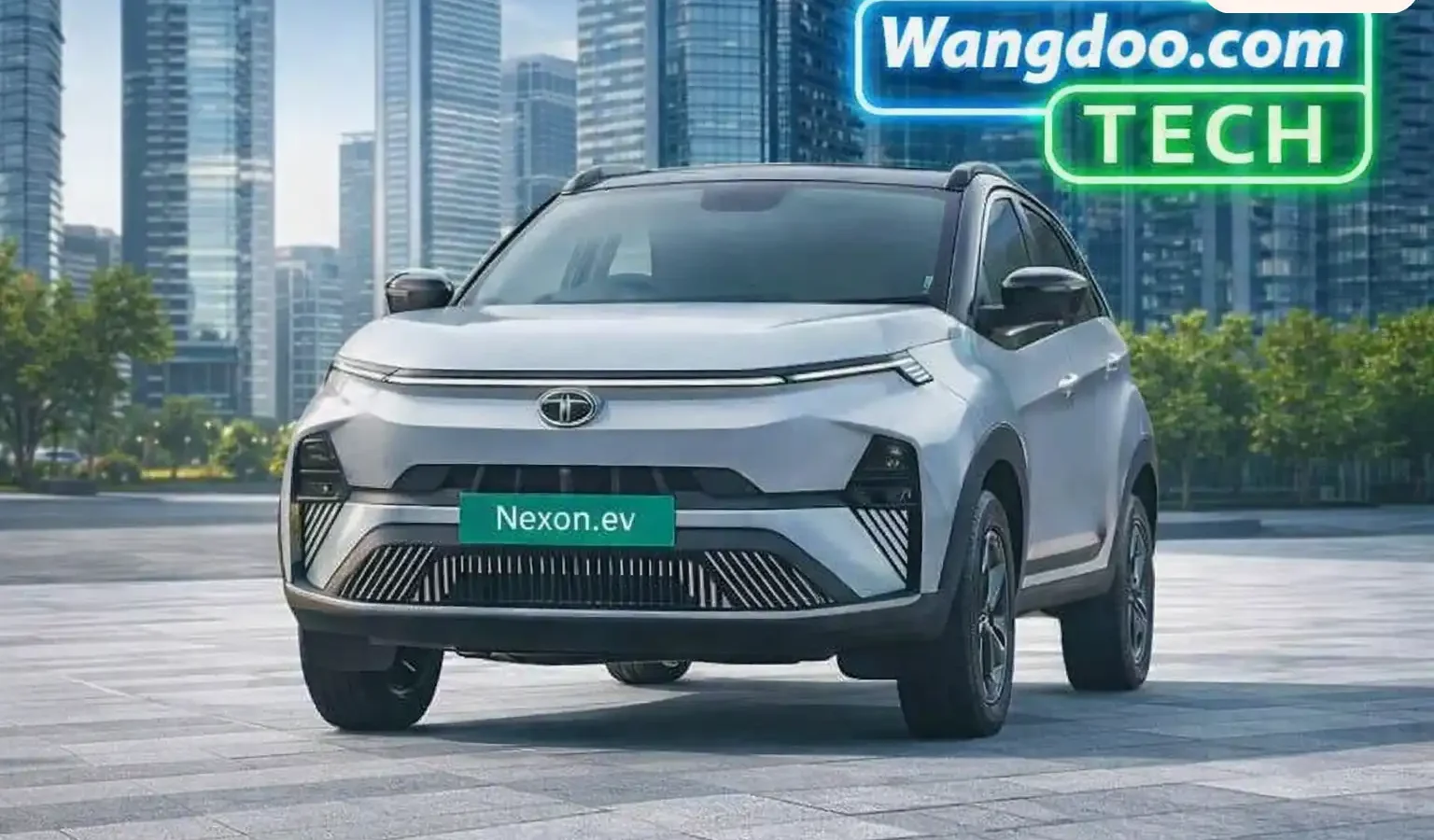
The Nexon.ev is Tata’s highest-volume electric model, sold as a compact SUV in India from ₹12.49 lakh ex-showroom — about €11,350 at roughly ₹110 to the euro, mid-August 2026. That conversion is a reference point, not a European price.
It comes in two battery sizes, which Tata labels MR and 45. They differ in more than capacity: power output, charging speed and equipment all change with the pack. The ₹12.49 lakh entry price applies to the smaller battery.
The two battery options
| MR (30 kWh) · 45 (46.08 kWh) | |
| Claimed range | 275 km · 489 km, ARAI certified on MIDC |
| Power | 129 PS · Tata states 106 kW; listings cite 145–149 PS |
| Torque | 215 Nm on both |
| DC fast charging | Up to 50 kW · up to 60 kW |
| 10–80% on DC | About 56 minutes · about 40 minutes |
| AC charging | 3.3 kW · 7.2 kW |
| Starting price | ₹12.49 lakh (about €11,350) · about ₹14 lakh (about €12,700) |
Where the sources disagree. Tata’s main page details the 45 kWh version; MR figures come from Indian automotive listings, which do not fully agree. Most give the MR 275 km, though at least one cites 325 km. Power for the 45 is quoted as 145 PS or 149 PS depending on the outlet, against Tata’s own 106 kW. Top-of-range pricing is listed anywhere between ₹16.99 lakh and ₹17.69 lakh, and variant counts between 8 and 15. Figures below the MR row are Tata’s own.
The rest of what follows is what Tata publishes for that 46.08 kWh car, alongside how affordable EVs are specified in other markets.
Pricing in rupees and euros
| Range starts (MR) | ₹12.49 lakh ex-showroom · about €11,350 |
| 46.08 kWh starts | About ₹14 lakh · about €12,700 |
| Range tops out | ₹16.99–17.69 lakh depending on listing · about €15,400–€16,100 |
| Starting EMI | ₹10,199 per month · about €93 (first six months, per Tata) |
| Claimed 10-year saving | ₹8–9 lakh · about €7,300–€8,200 |
| Rate used | Approximately ₹110 = €1, mid-market, August 2026 |
Two things the conversion does not carry. Indian prices are quoted ex-showroom, which excludes registration, insurance and road tax. And a currency conversion is not a European price: import duties, homologation, VAT and different equipment levels mean a car specified this way would not reach a European showroom at this figure, which is part of why it is not sold there.
Powertrain and range: the 46.08 kWh version
| Battery | 46.08 kWh, liquid cooled, IP67 rated |
| Power | 106 kW |
| Torque | 215 Nm |
| 0–100 km/h | 8.9 seconds |
| Claimed range | 489 km, ARAI certified on MIDC Part 1 + Part 2 |
| Drive modes | Eco, City, Sport |
| Regeneration | Multiple levels, adjustable via steering-wheel paddles |
Tata’s own caveats on these figures. The 489 km is ARAI certified on the Urban plus Extra Urban cycle, and Tata notes actual performance varies with driving pattern and other conditions. The 8.9-second figure is described as internal testing data recorded under test ambient temperature conditions rather than an independently verified result. MIDC produces markedly higher numbers than WLTP or EPA, so it is a fair comparison against other Indian-market EVs and a misleading one against European or American cars.
Charging: the 46.08 kWh version
| DC fast charging | 60 kW — 10% to 80% in 40 minutes |
| 7.2 kW AC wall box | 10% to 100% in 6 hours 36 minutes |
| 3.3 kW AC wall box | 10% to 100% in 17 hours 36 minutes |
| 15A portable cable | 10% to 100% in 17 hours 36 minutes |
| Power output | Vehicle-to-vehicle and vehicle-to-load. Tata’s footnotes reference maximum outputs of 3 kVA and 5 kVA |
Charging network: Tata cites both 23,000+ and 33,000+ charging stations across India on its Nexon.ev page, and offers 24-hour emergency charging support in five cities. It also provides a route planner, noting the link leaves the Tata Motors domain.
What the two packs mean in practice
| Claimed range gap | About 214 km on the common figures, on a test cycle that runs optimistic |
| Reported real-world | Listings put the MR near 200–220 km and the 45 near 310–330 km. One outlet’s own test of the larger pack returned 296 km |
| Price gap | About ₹1.5 lakh (around €1,400) between entry points |
| DC charging stop | 16 minutes longer on the MR for the same 10–80% window, despite the smaller pack |
| Home charging | The MR accepts 3.3 kW AC, the 45 accepts 7.2 kW — so overnight charging differs as well |
Why the MR takes longer despite a smaller battery: it accepts a lower maximum DC rate, 50 kW against 60 kW, so the reduced capacity does not translate into a shorter stop. Charging time depends on the rate a car can accept, not only on how much there is to fill.
On the equipment split: listings indicate vehicle-to-load, vehicle-to-vehicle charging, the front boot and the 12.3-inch touchscreen appear on upper 45 variants rather than across all 45 models. Variant equipment changes between model years and outlets describe it inconsistently, so it is worth checking against a current dealer price list rather than a specification summary.
The lifetime battery warranty, as Tata defines it
Tata announced this on 12 June 2025, having first offered it on the Harrier.ev. Its release specifies the Nexon.ev 45 kWh, so it is worth confirming with a dealer whether the MR version carries the same cover. The full terms define it as follows.
| “Lifetime” means | Fifteen years from the date of first registration, per the Motor Vehicles Act 1988 |
| Distance | Unlimited kilometres |
| Who qualifies | Vehicles registered to private individuals only |
| Company cars | Covered under employee perk schemes, including later transfer to that same employee |
| On resale | A third-party buyer is treated as a second owner, and the lifetime cover does not carry across |
| Also excluded | Commercial or trade use, and usage outside what Tata calls the ordinary course of personal use |
The warranty follows the owner, not the car. Cover applies to the first private registrant. On transfer to a third party, that buyer is treated as a second owner and the lifetime cover does not apply to them.
Separately from the battery cover, listings give the Nexon.ev a standard vehicle warranty of three years or 125,000 km, whichever comes first.
Tata also states a running-cost saving it estimates at ₹8–9 lakh over ten years (about €7,300–€8,200) against a comparable petrol model. Its savings calculator assumes a Mumbai petrol price of ₹106 per litre averaged over six months, and includes registration, taxes, fuel and maintenance.
Safety
| Bharat NCAP | 5 stars. Adult occupant protection 29.86 / 32; child occupant protection 44.95 / 49, per the 2024 score |
| Airbags | Six, standard |
| Braking | Disc brakes on all four wheels; hill ascent and descent control; auto hold |
| Stability | Electronic stability programme with vehicle brake assist |
| Cameras | 360-degree surround view; blind spot view monitor |
| Driver assistance | ADAS suite. Tata states it is not a substitute for driver vigilance and the driver remains responsible |
| Other | Tyre pressure monitoring; emergency SOS call, available in select cities only |
Cabin and equipment
| Touchscreen | 31.24 cm (12.3 inch), Harman system |
| Instrument cluster | 26.03 cm (10.25 inch), reconfigurable |
| Audio | Nine JBL speakers including an external subwoofer |
| Connectivity | Wireless Apple CarPlay and Android Auto; over-the-air updates; multiple voice assistants including Alexa |
| Storage | 11.6-litre front boot, plus the main boot |
| Seats | Ventilated front seats; 60:40 split rear bench with centre armrest |
| Climate | Rear air vents; cooled glovebox; cabin air purifier |
| Convenience | Panoramic sunroof with voice control; wireless phone charging; 45W USB-C; rain-sensing wipers; auto headlamps; auto-dimming interior mirror; electronic parking brake |
| Wheels | R16 alloys with aerodynamic inserts |
| Colours | Five, listed by Tata with contrasting roof finishes |
On the feature names: Tata gives most of these branded names on its site. They are described here by function, so they can be compared against equivalent features from other manufacturers.
Finance
Tata lists a starting EMI of ₹10,199 a month, about €93, based on a flexi scheme at ₹809 per lakh for the first six months, with instalments rising thereafter. A separate estimate on the page is calculated over a 96-month term at 9% interest. Tata states final terms rest with the financier.
Modelling the running cost yourself. A manufacturer’s savings calculator uses that manufacturer’s assumptions — in Tata’s case a specific city, a specific petrol price and a fixed comparison vehicle. To run the numbers on your own electricity rate and mileage, the inputs needed are here: 46.08 kWh and 489 km claimed.
My Take — Mr Wangdoo
Four figures set the character of this car.
106 kW and 215 Nm from the 46.08 kWh pack is a sensible pairing for a compact SUV — enough for the 8.9-second acceleration Tata quotes without a battery large enough to make the car heavy or expensive. The 30 kWh version is quoted at 129 PS with the same 215 Nm, so the choice between packs affects pace as well as range.
60 kW DC charging is the figure that shapes how the car is used. Forty minutes from 10% to 80% suits occasional long journeys rather than frequent ones, and pairs with a 6h36m home charge on a 7.2 kW box. For a car built around city driving, that is a coherent set of trade-offs rather than a limitation.
The Bharat NCAP result is the strongest number on the sheet, and the only one produced independently. 29.86 out of 32 for adult occupant protection and 44.95 out of 49 for children is a high score, with six airbags standard rather than reserved for upper grades.
The warranty terms are the detail I would read twice before assuming anything — fifteen years and unlimited kilometres is substantial, and it applies to the first private owner rather than to the vehicle.
How the car drives is not something I can comment on, having not driven it.
Common questions
What is the Tata Nexon.ev price and range?
The range starts at ₹12.49 lakh ex-showroom, about €11,350, for the 30 kWh MR version. The 46.08 kWh version starts around ₹14 lakh and claims 489 km on India’s MIDC Part 1 + Part 2 cycle, ARAI certified; the MR is most commonly quoted at 275 km, though at least one listing cites 325 km. Tata notes actual figures vary with driving pattern and conditions. Ex-showroom excludes registration, insurance and road tax.
What does the lifetime battery warranty actually cover?
Tata defines “lifetime” as fifteen years from first registration, with unlimited kilometres, for vehicles registered to private individuals. It does not transfer on resale — a third-party buyer is treated as a second owner and is not covered. Commercial and trade use are excluded. Tata’s announcement specifies the 45 kWh version, so coverage on the 30 kWh MR is worth confirming with a dealer.
How fast does the Nexon.ev charge?
For the 46.08 kWh version, Tata quotes 10% to 80% in 40 minutes on a 60 kW DC fast charger. On a 7.2 kW home wall box it takes 6 hours 36 minutes from 10% to 100%, and 17 hours 36 minutes on either a 3.3 kW wall box or a 15A portable cable. The 30 kWh MR version accepts up to 50 kW DC, taking about 56 minutes for the same 10–80% window.
What safety rating does it have?
Five stars under Bharat NCAP, scoring 29.86 out of 32 for adult occupant protection and 44.95 out of 49 for child occupant protection, per the 2024 assessment. Six airbags are standard.
Is the Nexon.ev sold outside India?
Tata sells the Nexon.ev in India. Prices quoted in euros or dollars are currency conversions of the Indian ex-showroom figure rather than pricing announced for any other market.
Sources
- Tata Motors — Nexon.ev product page, including specifications, charging times and full footnotes. ev.tatamotors.com
- Tata Motors — Nexon.ev specifications page. ev.tatamotors.com
- Tata Motors — Nexon.ev brochure (PDF). ev.tatamotors.com
- AutoIndiaDaily — “Tata Nexon EV Variants Explained,” on MR and 45 battery outputs and charging times. autoindiadaily.in
- CarDekho — Nexon EV variant and price listing. cardekho.com
- Tata Motors — Lifetime HV Battery Warranty terms and conditions. ev.tatamotors.com