Sleepal AI Lamp: The Bedside Device That Tracks Your Sleep

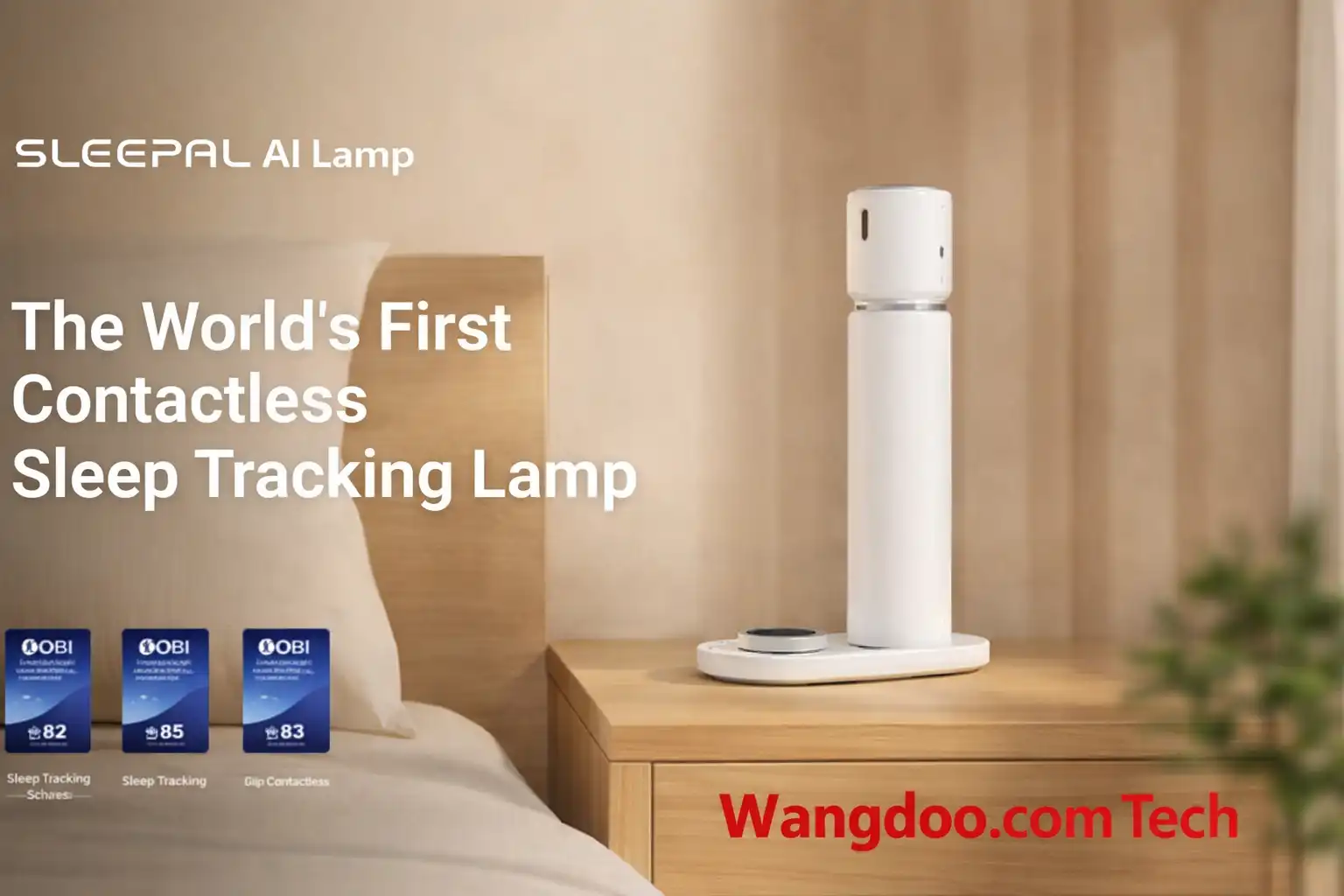
Sleepal AI Lamp: What It Is, How It Works, and Why It Changes Sleep Tracking
A bedside lamp that monitors your breathing, sleep stages, snoring, and heart rate — using 60GHz millimetre-wave radar — without anything touching your body. Here is everything confirmed about how it works, what it tracks, and who it is built for.
Editorial transparency: Wangdoo has not physically tested the Sleepal AI Lamp. This article is a factual overview based on official Sleepal press releases, Kickstarter campaign data, CES 2026 Innovation Award records, the peer-reviewed validation preprint published on arXiv (2604.16442), and third-party reporting from AndroidHeadlines, Sleep Review magazine, Tom’s Guide, and HomeKit News. Wangdoo currently has no commercial relationship with XSmart or Sleepal. Where any commercial relationship exists in the future, it will be clearly disclosed at the top of the relevant article.
Most sleep trackers share the same fundamental problem: you have to wear them. A ring on your finger that needs nightly charging. A watch that leaves marks on your wrist. A sensor patch that requires replacing. The idea that you must strap something to your body to understand how you sleep has been the accepted trade-off for a decade. The Sleepal AI Lamp is built on the premise that the trade-off was never necessary.
Developed by Hong Kong-based XSmart Century Technology and launched publicly in May 2026, the Sleepal is a bedside lamp that tracks sleep using 60GHz millimetre-wave radar — the same class of technology used in automotive driver monitoring and hospital-grade patient sensing. Nothing touches you. Nothing needs charging beside your bed. The lamp sits on your nightstand and works while you sleep.
The Sleepal AI Lamp is a contactless sleep tracking system built into a bedside lamp. It uses 60GHz mmWave radar, thermal sensing, and acoustic monitoring to track sleep stages, breathing rate, snoring, sleep posture, and room environment — without any wearable device. It won three CES 2026 Innovation Awards and is currently available for reservation on Kickstarter at an early bird price of $270. It connects to Apple HomeKit, Home Assistant, Amazon Alexa, and Google Home via Matter over Wi-Fi.
Sleepal AI Lamp at CES 2026 — contactless sleep tracking without wearables
Who Makes the Sleepal AI Lamp?
The Sleepal AI Lamp is made by XSmart Century Technology Co., a Hong Kong-based hardware company led by founder and CEO Dian Fan, who previously headed IoT platform operations at a Fortune 500 smart home company. The team behind the product is not a first-time crowdfunding startup. Before Sleepal, XSmart shipped over one million millimetre-wave radar units — giving the company production-scale manufacturing experience in the exact sensor type that powers the lamp.
The engineering team spans radar engineering, RF design, algorithm development, and AI systems — close to 100 people. The product was developed over three years of research before its public debut at CES 2026 in January. The Sleepal AI Lamp also holds more than thirteen patents covering radar sensing methods, sleep analysis algorithms, and sleep-inducing content systems — a level of IP coverage unusual for a crowdfunded consumer product.
How Does the Sleepal AI Lamp Track Sleep Without Touching You?
The core technology is 60GHz millimetre-wave (mmWave) radar. The lamp emits low-power radio waves that bounce off your body and return to the sensor. Because these waves are operating at 60GHz — a very high frequency — they can detect movement at a resolution of approximately 0.1 millimetres. That is fine enough to detect the subtle rise and fall of your chest as you breathe, and micro-vibrations associated with your heartbeat, from across a nightstand.
This is the same radar technology class used in automotive applications for driver drowsiness detection, and in hospital environments for patient monitoring where attaching sensors would be impractical. Applied to consumer sleep tracking, it allows the Sleepal to continuously monitor physiological signals throughout the night without any physical contact.
60GHz mmWave Radar — Vital Sign Detection
The radar detects chest movement from breathing, micro-vibrations from heartbeat activity, and full body movement. It operates continuously through the night at 0.1mm resolution without emitting any light or sound.
Thermal Sensing — Sleep Position Tracking
A secondary thermal sensor detects body heat distribution to identify your sleep posture — on your back, side, or front — and tracks position changes throughout the night. This feeds into snoring analysis, as sleep position significantly affects breathing and snoring patterns.
Acoustic Monitoring — Snoring Detection
A microphone monitors audio in the room to detect snoring events, their frequency, and their severity. Combined with position data, the system can identify whether snoring is posture-dependent — which is clinically significant for those dealing with positional sleep apnea.
Environmental Sensing — Room Context
Built-in sensors monitor temperature, humidity, light levels, and acoustics throughout the night. Room environment data is correlated with sleep quality, allowing the app to identify whether poor sleep on a given night was linked to environmental factors — a capability wearables cannot provide.
AI Sleep Stage Analysis — 1B+ Parameter Model
All sensor data is processed by a deep learning model with over one billion parameters, trained on data collected across more than 2,000 simultaneous polysomnography nights in hospital sleep laboratories. The model classifies sleep into four stages — wake, light sleep, deep sleep, and REM — and generates a personalised sleep profile over time.
Because the Sleepal uses radar, placement is critical. The lamp must be positioned on the nightstand within range of the sleeping area. The mmWave sensing covers a defined detection zone — accurate positioning on the correct side of the bed is essential for reliable tracking. XSmart provides setup guidance in the app during initial configuration.
What Does the Sleepal AI Lamp Actually Track?
The Sleepal captures a significantly broader data set than most wearable sleep trackers, including several metrics that wrist-worn devices cannot measure at all.
| What It Tracks | How |
|---|---|
| Sleep stages (Wake, Light, Deep, REM) | AI model on mmWave radar + movement data |
| Breathing rate | 60GHz radar chest movement — RMSE <2 vs medical devices |
| Heartbeat micro-vibrations | High-sensitivity radar at 0.1mm resolution |
| Sleep posture (back, side, front) | Thermal sensor body heat mapping |
| Snoring — detection and frequency | Acoustic microphone + correlation with posture |
| Time to fall asleep (sleep onset) | Radar presence + movement cessation |
| Night wakings and restlessness | Movement detection during sleep periods |
| Room temperature | Integrated environmental sensor |
| Humidity | Integrated environmental sensor |
| Light levels | Integrated ambient light sensor |
| Noise events | Acoustic monitoring |
| Sleep-wake discrimination | 92.77% accuracy vs PSG in clinical validation |
How Accurate Is It? The Clinical Validation Behind the Claims
Most consumer sleep trackers launch with accuracy claims that are either unverified or supported by studies involving a small number of participants. Sleepal’s approach is different. Before its Kickstarter campaign launched, the company published a validation preprint on arXiv (paper ID: 2604.16442) — making their methodology and results publicly available for scrutiny by the sleep science community.
The validation dataset covers 1,022 nights of sleep and over 2,000 total nights of simultaneous polysomnography (PSG) — the gold-standard clinical sleep study — and millimetre-wave radar monitoring, conducted in multiple hospital sleep laboratories. The results reported in the preprint:
- 92.77% correct assignment of sleep-wake states
- 77.2% correct identification of four sleep stages
- Among participants with severe obstructive sleep apnea (AHI >30): 74.3% accuracy maintained
- Respiratory rate accuracy: RMSE <2 versus medical-grade devices
Sleep Review magazine, a publication serving sleep medicine professionals, noted that the dataset size “provides a benchmark for the industry, where the vast majority of products are based upon far smaller groups of participants.” The publication of an arXiv preprint before commercial launch is uncommon for consumer devices and represents a meaningful step toward clinical credibility.
77.2% four-stage sleep accuracy is consistent with or better than several established wearable sleep trackers tested independently. Polysomnography scoring between trained human technicians typically achieves around 80–87% inter-scorer agreement depending on the study and scoring manual used — figures vary across published sleep medicine literature. This range provides a useful ceiling for interpreting consumer device accuracy claims, not a fixed absolute benchmark.
Sleepal AI Lamp vs Oura Ring 5 vs Apple Watch — How They Differ
| Feature | Sleepal AI Lamp | Oura Ring 5 | Apple Watch Series 10 |
|---|---|---|---|
| Wearable required | No — contactless | Yes — worn all night | Yes — worn all night |
| Nightly charging needed | No | Yes (ring) | Yes (watch) |
| Sleep stages tracked | 4 stages | 4 stages | 4 stages |
| Room environment tracked | Yes — temp, humidity, light, noise | No | No |
| Sleep posture tracked | Yes — via thermal sensing | No | No |
| Snoring detected | Yes — acoustic mic | No | Limited |
| Clinical validation study | Yes — 2,000+ PSG nights, arXiv preprint | Internal validation | Internal validation |
| Apple HomeKit compatible | Yes — Matter over Wi-Fi | No | Yes |
| Monthly subscription | None confirmed | $5.99/month | Apple One bundle |
| Price | $270 early bird | $399 | $399+ |
| Ships | Late 2026 | Available now | Available now |
The most meaningful difference is not accuracy — it is what each device can and cannot physically measure. A wrist-worn device or finger ring cannot track your room temperature, your sleep posture, your snoring correlation with body position, or your bedroom humidity. The Sleepal, because it sits outside the body and monitors the room as well as the sleeper, captures a different and in some ways broader data set. The trade-off is that it is a pre-shipping product with a confirmed delivery date in late 2026, while the Oura Ring 5 and Apple Watch are available to buy today.
Smart Home Integration — Matter, HomeKit, Alexa, Google Home
The Sleepal AI Lamp supports Matter over Wi-Fi — the new universal smart home standard — which means it integrates directly with Apple HomeKit, Home Assistant, Amazon Alexa, and Google Home without requiring proprietary bridges or hubs. This is unusually comprehensive smart home support for a Kickstarter product and positions it well in the growing Matter ecosystem.
In practice, this means the lamp can be controlled via voice commands through whichever assistant you use, incorporated into automations (for example, automatically dimming when your lights-out routine runs), and monitored alongside other smart home devices in a single dashboard. Home Assistant users can access deeper integration including custom automations based on sleep state data.
The lamp also includes a hardware privacy button on the top of the device that physically disconnects all sensors. This is not a software switch — it is a physical interrupt that stops all data collection regardless of app settings, designed for users who want certainty that the device is inactive rather than trusting a software toggle.
The Lamp Itself — Lighting and Sleep Aid Features
Beyond the tracking technology, the Sleepal functions as a full smart bedside lamp. It uses full-spectrum, low-blue light designed to support natural melatonin production during wind-down. The lighting and audio systems work together as a sleep aid:
- Wind-down mode: Guided breathing exercises, meditation content, and calming soundscapes begin when you activate bedtime mode
- Auto-fade: Both light and sound fade gradually as the radar detects you falling asleep — no abrupt cutoff
- Smart wake alarm: Detects your lightest sleep phase within a set wake window and triggers the alarm at the optimal moment, rather than at a fixed time
- Adaptive soundscapes: Environmental audio that adjusts based on room noise and your monitored sleep state
CES 2026 Awards
Winning across three separate CES Innovation Award categories is significant. The CES Innovation Awards evaluate products against different criteria per category — a product winning in Digital Health, Smart Home, and Accessibility simultaneously demonstrates that judges assessed it as genuinely strong across multiple dimensions, not just as a single-use case device. Importantly, these awards were given before mass production — based on the technology concept and engineering, not on shipped consumer units.
Who Is the Sleepal AI Lamp For?
People who dislike wearables
Anyone who finds smartwatches or rings uncomfortable to sleep in, or who simply doesn’t want to charge another device every night.
Older adults and caregivers
For elderly users who struggle with wearables or where skin contact is impractical. Passive monitoring without interaction is a key accessibility advantage.
Snorers and their partners
The posture-correlated snoring detection specifically identifies whether snoring is position-dependent — clinically useful information for positional sleep therapy.
Smart home enthusiasts
Matter support, Apple HomeKit, Home Assistant, Alexa, and Google Home compatibility makes it an unusually well-integrated addition to existing smart home setups.
Athletes focused on recovery
Deep sleep and REM stage tracking combined with room environment data provides a more complete picture of recovery conditions than wrist-based trackers.
Parents of young children
A non-wearable, no-camera monitoring approach that can track a sleeping child’s breathing patterns without attaching anything to their body.
Pricing and How to Reserve
The Sleepal AI Lamp is available to reserve directly on Kickstarter and through the official Sleepal website. Early bird pricing is confirmed at $270 — a significant reduction from the expected retail price. XSmart has opened reservations with a deposit system, and the Kickstarter campaign is currently live.
Estimated shipping is late 2026. As with all crowdfunded hardware, delivery timelines should be treated as estimates. The team’s prior track record of shipping over one million radar units at commercial scale provides more confidence than a typical first-hardware Kickstarter campaign, but buyers should still account for possible delays.
Reserving or backing a Kickstarter product carries inherent risk. Estimated delivery dates can shift. The Sleepal team’s manufacturing background in mmWave radar is a meaningful trust signal, but no Kickstarter pledge should be treated as a guaranteed purchase with confirmed delivery timing.
Frequently Asked Questions
Does the Sleepal AI Lamp use a camera?
How does the Sleepal AI Lamp track sleep without touching you?
Is the Sleepal AI Lamp safe — does the radar emit harmful radiation?
Can the Sleepal track two people sleeping in the same bed?
Does the Sleepal AI Lamp require a monthly subscription?
What smart home platforms does the Sleepal AI Lamp work with?
How accurate is the Sleepal AI Lamp compared to a sleep study?
When does the Sleepal AI Lamp ship?
How is the Sleepal AI Lamp different from a sleep tracking mat under the mattress?
Sources & References
- Sleepal Official Website — sleepal.ai
- CES 2026 Innovation Awards — Sleepal AI Lamp (Digital Health, Smart Home, Accessibility & Longevity)
- Yahoo Finance / Newsfile — XSmart Opens Early Reservations, May 6, 2026
- Sleep Review Magazine — Contactless Sleep Monitoring Validation Standards, May 2026
- AndroidHeadlines — Sleepal AI Lamp Introduces Contactless Sleep Monitoring, March 25, 2026
- HomeKit News — Sleepal Unveils Matter Lamp Ahead of Kickstarter, April 1, 2026
- Tom’s Guide — Best Sleep Tech from CES 2026
- arXiv preprint 2604.16442 — Sleepal PSG validation study (publicly available)