Rorolee: The AI Pendant That Talks Back

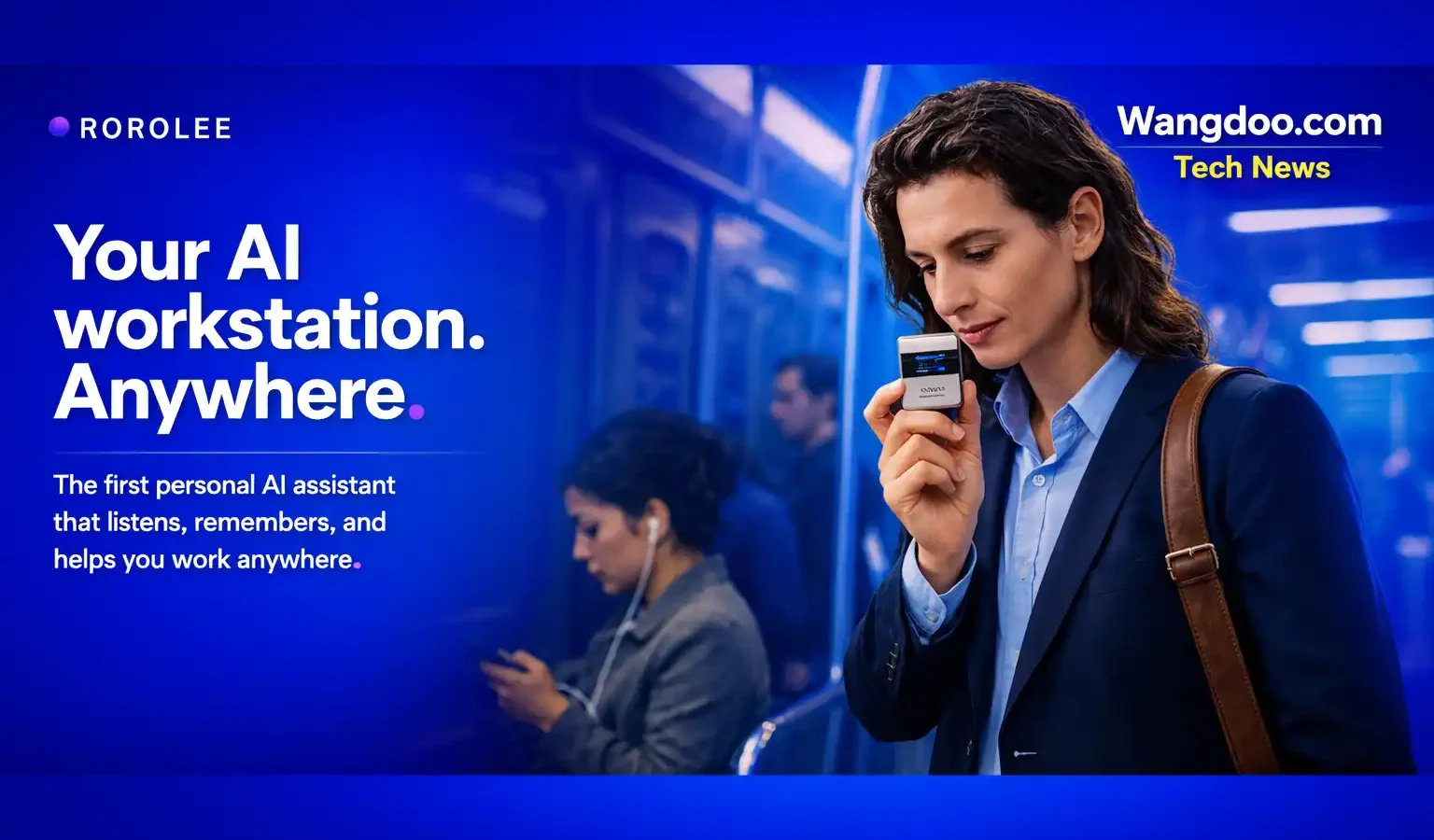
What Is Rorolee? A Look at the Wearable AI Pendant on Kickstarter — and the Security Question Its Marketing Doesn’t Mention
Rorolee is a neck-worn AI device currently raising money on Kickstarter. Before looking at what it claims to do, it’s worth knowing that wearable AI assistants have a short, mostly rough track record — several have shut down, been acquired, or quietly scaled back since 2024. There’s also a more specific issue: one of the two technologies Rorolee markets as a headline feature has had a genuinely bad few months on the security front. Here’s what Rorolee is, what it’s built on, and how it compares to what’s already shipping.
Transparency note: Rorolee is a live crowdfunding campaign. We have not tested this device, and no independent hands-on review exists anywhere yet. Everything below about Rorolee is sourced from its Kickstarter page and campaign-tracking sites, clearly marked as such. Specs and pricing for competing products are sourced separately from their official listings.
Official Deotaland campaign video, embedded from YouTube. This is promotional material from the company, not independent footage or testing by Wangdoo.com.
What Rorolee Is
Rorolee is a small pendant, worn around the neck, made by a company called Deotaland. The pitch is a private AI agent you can tap to talk to, which keeps a persistent memory of your tasks and conversations rather than starting fresh each session. It’s pitched as multi-model — the campaign page lists access to GPT, Claude, and Gemini rather than one in-house assistant.
Where Rorolee’s data actually lives is, confusingly, not consistent across Deotaland’s own marketing. The Kickstarter campaign page describes the system as “a cloud computer operated by your own AI Agent,” with each device pre-bound to a cloud virtual machine before shipping and user context stored in an encrypted format that syncs across sessions. Separately, Deotaland’s Instagram marketing for the product describes it as “Private On-Device AI: No cloud. No sharing.” Those two descriptions don’t square with each other — one is explicitly cloud-based, the other explicitly isn’t. We couldn’t resolve which is accurate from public material, and it’s a question worth asking Deotaland directly before backing the campaign rather than assuming either claim.
Deotaland calls its system “SuperClaw,” which the campaign describes as a personal AI workstation rather than a simple assistant — the idea being that it remembers preferences, keeps files and login states, and keeps working across sessions instead of resetting each time you open it. That branding sits on top of two underlying technologies named directly in Rorolee’s marketing: OpenClaw and Hermes.
What OpenClaw and Hermes Actually Are
This is the part that doesn’t show up in Rorolee’s campaign material, and it matters. OpenClaw and Hermes Agent aren’t Deotaland inventions — they’re two of the most widely discussed open-source AI agent frameworks of 2026, built by entirely separate teams. OpenClaw began as a personal project before growing into one of the fastest-growing open-source projects on GitHub, with a large marketplace of community-built add-on skills. Hermes Agent comes from Nous Research, a separate AI lab, and takes a different approach focused on the agent learning from its own past task performance.
Rorolee’s pitch is “One-Tap OpenClaw” — the campaign describes each device as pre-bound to a cloud virtual machine before shipping, so OpenClaw’s normally involved setup process happens automatically. That’s a genuine convenience claim, if it works as described.
Worth knowing before you back this: OpenClaw has had a rough security run in the months leading up to this campaign. Independent reporting in early 2026 documented nine separate CVEs (security vulnerabilities) disclosed in a four-day span in March, including one rated near the maximum severity score. A supply-chain audit of OpenClaw’s community skills marketplace found roughly 12% of a sample of nearly 2,900 community-built skills were malicious. Separately, security researchers identified more than 135,000 publicly exposed OpenClaw instances across 82 countries — and Cisco’s security team has described personal AI agents in this category as a serious security concern.
None of this means Rorolee’s specific implementation is unsafe — Deotaland may have hardened its deployment in ways the campaign doesn’t detail. But a product built around “one-tap” automatic setup of a framework with this recent a security record is something worth knowing about before pledging, not something we’d expect a crowdfunding page to volunteer.
The Category’s Track Record So Far
This matters more than usual here, because “wearable AI agent” has a short and fairly brutal history. The Humane AI Pin launched in 2024 at nearly $700 and was discontinued within a year. The Limitless Pendant built a following around always-on memory and conversation recall, then was acquired by Meta in late 2025 and pulled from sale to new customers. Bee, a similar always-listening pendant, was acquired by Amazon in mid-2025 and folded into its Alexa roadmap. Friend, another pendant in this space, drew more attention for subway ad backlash over its always-recording design than for the product itself.
Two products from the same wave are still independently available and reviewed: Rabbit R1, a handheld (not worn) AI device, and Plaud’s NotePin and Note Pro line, which lean more toward meeting transcription than general-purpose assistance. Those are the most useful real-world comparisons for Rorolee, since they’re the closest things to it that you can actually buy today.
How Rorolee Compares to What’s Already Shipping
The table below lines up Rorolee’s claimed specs against three products currently on the market. Rorolee’s column is built entirely from campaign material and is unverified; the other three are sourced from their official listings and existing reviews.
| Feature | Rorolee (campaign claims) | Rabbit R1 | Plaud NotePin S | Bee Pioneer |
|---|---|---|---|---|
| Form factor | Neck pendant, no screen | Handheld, 2.88″ screen | Clip / pin / wristband, no screen | Clip-on pendant, no screen |
| Core function | General AI agent, task capture, memory | Voice-driven app actions | Meeting/conversation transcription | Always-on day summaries, reminders |
| AI model access | GPT, Claude, Gemini (claimed); One-Tap OpenClaw + Hermes | Proprietary “Large Action Model”; OpenClaw access added in 2026; Perplexity for live answers | Plaud’s own transcription/summary engine | Amazon-built summarization (post-acquisition) |
| Persistent memory | Marketed as central feature (“SuperClaw”) | Largely session-based | Per-recording, not continuous | Always-on, day-level summaries |
| Hardware price | Reported avg. pledge varies sharply by tracker — see note below | $199 | $179 | $49.99 |
| Required subscription? | Not disclosed in campaign material | No — full features included | Free tier (300 min/mo); Pro plan $99.99/yr for heavier use | Subscription terms still settling post-acquisition |
| Status | Kickstarter campaign, not shipped | Shipping since 2024 | Shipping, Forbes Vetted 2026 pick | Shipping, recently changed ownership |
| Independent reviews | None yet | Several, mixed — transcription praised, “action” features criticized | Several, generally positive on transcription accuracy | Mixed — flagged for privacy concerns and multi-speaker confusion |
A correction worth being explicit about: the multi-model, OpenClaw-based approach is not unique to Rorolee. Rabbit R1 added its own OpenClaw integration in 2026, so a backer comparing the two on “model flexibility” alone won’t find much daylight between them. Where Rorolee’s pitch is genuinely different is the emphasis on persistent memory as the core feature, rather than an add-on — that’s closer to what Limitless tried before its acquisition than to what Rabbit R1 or Plaud are doing.
What it actually costs in year one
Hardware price alone is misleading for this category, because several of these devices carry an ongoing subscription that the sticker price doesn’t show. Rabbit R1’s $199 is the full cost — no subscription is required for its core features. Plaud’s NotePin S is $179 up front, and the free tier (300 transcription minutes a month) covers light use; heavier users on the Pro plan are looking at roughly $279 in year one. Bee’s $49.99 hardware is the cheapest entry point, but its subscription terms are still being worked out following the Amazon acquisition, so a final year-one number isn’t really knowable yet. Rorolee’s campaign material doesn’t mention a subscription at all — which could mean there isn’t one, or could mean it simply hasn’t been disclosed yet. Either way, treat the pledge price as a floor, not a final number, until Deotaland confirms ongoing costs.
On the pledge pricing figures
We could not get a clean number here. One campaign-tracking site lists an average pledge per backer that converts to roughly $120–130, while another lists a figure nearly seven times higher under what appears to be a different currency assumption. Kickstarter campaigns often display pledge amounts in different currencies depending on the tracker and the viewer’s settings, and this campaign’s data is inconsistent across the trackers we checked. If pricing is the deciding factor for you, check the reward tiers on the live campaign page directly rather than relying on any third-party summary, including this one.
What’s Still Unproven
- Deotaland’s own marketing is inconsistent on a fairly basic question: whether your data is processed on-device or in the cloud. The Kickstarter page describes cloud-based infrastructure; Instagram marketing for the same product claims it’s on-device with no cloud involved. This should be clarified before backing, not assumed either way.
- No independent hands-on review exists anywhere right now — every claim about how well it actually works is unverified.
- The campaign doesn’t clearly address what happens to stored memory/data if the company’s servers go down, or whether a subscription is required after any included period ends.
- The “One-Tap OpenClaw” convenience feature is built on a framework with a documented, recent history of security vulnerabilities and a meaningful rate of malicious third-party add-ons — and the campaign doesn’t mention how, or whether, Deotaland has hardened against that.
- Deotaland has no public hardware shipping track record to evaluate against.
- Given that three of the most prominent products in this category (Humane, Limitless, Bee) were discontinued or absorbed by larger companies within roughly two years of launch, a new entrant from a first-time hardware maker carries real continuity risk — regardless of how the product performs on day one.
My Take — Mr Wangdoo
Going by what’s publicly documented, Rorolee’s core idea — a device built around persistent memory rather than one-off voice commands — is a more specific and arguably smarter bet than what Rabbit R1 tried first. The “I don’t want to re-explain myself to an AI every session” frustration is real.
But the OpenClaw security history — and the unresolved cloud-vs-on-device contradiction in Deotaland’s own marketing — are the two things I’d want answered before backing anything in this category right now, and neither is addressed in Rorolee’s own campaign material. “One-tap setup” for a framework that had nine vulnerabilities disclosed in four days a couple of months before this campaign launched isn’t automatically a problem, and a company describing its own product two different ways across channels isn’t automatically dishonest — these things happen when marketing teams and engineering teams aren’t perfectly in sync. But both are exactly the kind of detail a backer should be asking the creator directly via the campaign’s Q&A, not assuming is fine because it wasn’t addressed clearly.
If you’re curious, the most useful thing you can do is read the live campaign page and its FAQ section closely, and specifically ask how device-level OpenClaw access is sandboxed or secured — rather than taking any single summary, including this one, as the full picture.
Frequently Asked Questions
Is Rorolee’s data stored locally or in the cloud?
Unclear, and Deotaland’s own marketing conflicts on this point. The Kickstarter campaign page describes a cloud-based architecture in detail. Instagram marketing for the same product describes it as private, on-device, with no cloud involved. We could not confirm which is accurate from public sources — it’s worth asking Deotaland directly before backing.
Is Rorolee available to buy right now?
No. It’s a live Kickstarter campaign, not a retail product, with no confirmed shipping date in the material we reviewed.
Is Rorolee’s multi-model AI access unusual?
Less than the campaign framing suggests. Rabbit R1 added similar OpenClaw-based flexibility in 2026, so this isn’t a feature unique to Rorolee at this point.
Are OpenClaw and Hermes made by Deotaland?
No. Both are independent, separately developed open-source AI agent frameworks that Rorolee integrates with. “SuperClaw” is Deotaland’s own branding for how Rorolee packages and automates that integration.
What happened to the other AI pendants like this?
It’s a mixed history. Humane’s AI Pin was discontinued under a year after launch. The Limitless Pendant was acquired by Meta in late 2025 and is no longer sold to new customers. Bee was acquired by Amazon in mid-2025. Rabbit R1 and Plaud’s devices are still independently sold and reviewed.
Has any major outlet reviewed Rorolee?
Not at the time of writing. Coverage so far is limited to crowdfunding-focused sites and campaign trackers.
Sources
- Rorolee campaign page and Creator FAQ — Kickstarter
- Rorolee product marketing — Deotaland Instagram
- Rorolee campaign tracking data — Kicktraq, BackerTracker, PledgeBox
- “Rorolee: Wearable 1-Click Hermes OpenClaw AI Agent” — Gadgetify
- Rorolee official campaign video — Deotaland / YouTube
- Rabbit r1 product listing and OpenClaw access details — Amazon
- Rabbit R1 review coverage — Android Authority, Medium, TechRadar
- Plaud NotePin S / Note Pro pricing and specs — Plaud, Amazon
- “5 Best AI Wearables in 2026” — The Gadgeteer
- “9 Life-Changing AI Wearable Devices in 2026” — Plaud
- “AI pendants and wearables return to CES” — Malay Mail
- OpenClaw vs Hermes Agent framework comparison and security history — Flowtivity, innFactory AI Consulting, Medium (Sathish Raju)