Nvidia’s New Jetson Thor Chips Aren’t About Speed — They’re About Making Robots Affordable

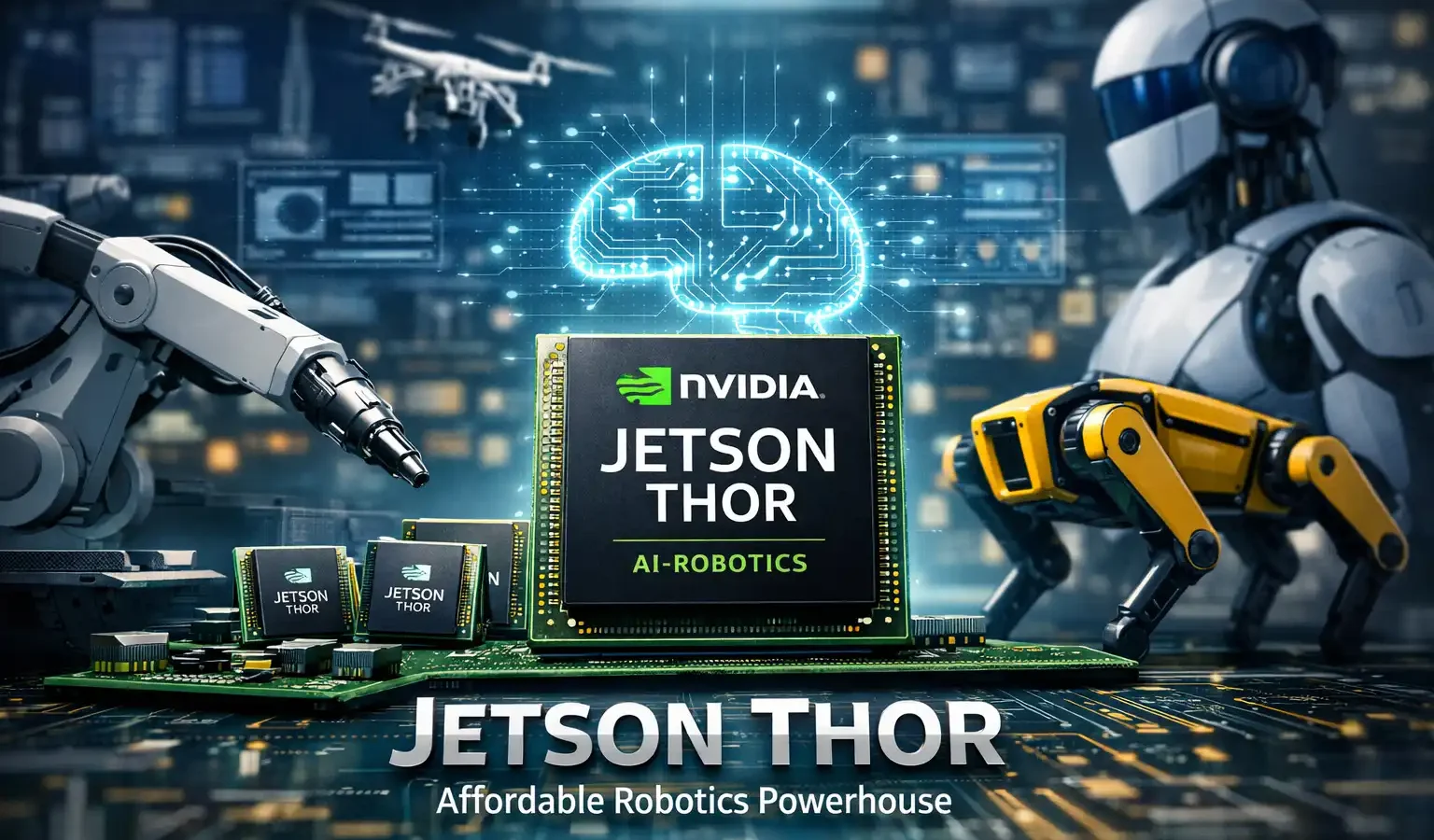
Nvidia’s New Jetson Thor Chips Are Built to Make Robots Cheaper, Not Just Faster
Nvidia just unveiled two smaller, cheaper versions of its robot computer — announced in Tokyo, alongside a Japanese government initiative to build the country’s AI robotics industry. Here is what the Jetson T2000 and T3000 actually are, and why the real story is about cost, not raw power.
How this was reported: This article is based on Nvidia’s official announcement published July 15, 2026, CNX Software’s technical specification comparison, AI Insider’s reporting on customer adoption figures, and coverage from GamesBeat, VideoCardz, and WCCFTech confirming the Tokyo announcement context. All specifications are drawn from Nvidia’s own published materials; CNX Software noted that full official specs for the new modules had not yet been released as of publication and relied partly on specifications for third-party carrier boards already announced around the new modules.
What Nvidia Actually Announced
On July 15, Nvidia introduced two new members of its Jetson Thor family of robot computers: the T3000 and the T2000. Both are smaller, lower-power, lower-cost versions of the T4000 and T5000 modules the company launched in 2025. Nvidia’s own framing for the announcement was blunt: general-purpose robots are moving out of research labs and into mass-market deployment, and that shift needs compute that is cheap enough to put inside a robot you can actually sell.
The timing and location were not incidental. Nvidia CEO Jensen Huang made the announcement while in Tokyo, where he had spent the preceding days meeting robotics builders and appeared alongside Japan’s Minister of Economy, Trade and Industry, Ryosei Akazawa, at the kickoff of a government-backed physical AI initiative. That initiative — separate from, but related to, this hardware announcement — is aimed at developing open multimodal foundation models for robotics and AI agents using Japan’s manufacturing expertise and industrial data.
Full event coverage: Jensen Huang joins Japan’s Physical AI Summit, where the Jetson Thor T2000/T3000 announcement was made. Independent production, not affiliated with Wangdoo or Nvidia.
Why a Smaller Chip Is the Actual News
“Smaller and less powerful” sounds like a downgrade. It isn’t — and the original Jetson Thor line explains why.
Nvidia launched the first Jetson Thor system — the T5000, delivering roughly 2,070 FP4 TFLOPS — in August 2025, positioning it as the compute platform for humanoid robots and advanced industrial machines. It has since become the standard brain for companies including Boston Dynamics, Amazon Robotics, FANUC, Hitachi, and Agile Robots. It is genuinely powerful hardware. It is also expensive, power-hungry, and physically large relative to what a mass-market robot — a warehouse picking arm, a delivery robot, a simple visual inspection system — actually needs.
The T3000 and T2000 exist to close that gap. They use the same Blackwell GPU architecture and the same software stack as the flagship T5000, but at roughly half the size, half the power draw, and a fraction of the cost. The pitch to developers is specific: you get most of the real-world inference performance without paying for compute headroom you will never use in a warehouse robot or a retail kiosk.
Full Jetson Thor family — spec comparison
| T2000 | T3000 | T4000 | T5000 | |
|---|---|---|---|---|
| AI compute | 400 TFLOPS | 865 TFLOPS | 1,200 TFLOPS | 2,070 TFLOPS |
| GPU | 1,024-core Blackwell | 1,536-core Blackwell | 1,536-core Blackwell | 2,560-core Blackwell |
| CPU cores | 6-core Arm Neoverse | 8-core Arm Neoverse | 12-core Arm Neoverse | 14-core Arm Neoverse |
| Memory | 16 GB LPDDR5X | 32 GB LPDDR5X | 64 GB LPDDR5X | 128 GB LPDDR5X |
| Networking | 2× 10 GbE | 25 GbE | 3× 25 GbE | 4× 25 GbE |
Swipe left/right to see all columns on mobile.
Figures for T2000/T3000 are preliminary — based on Nvidia’s announcement and specifications for early third-party carrier boards, pending Nvidia’s full official datasheet.
The Software Story Matters as Much as the Silicon
Alongside the new hardware, Nvidia introduced what it calls Jetson agent skills — software tools that automate memory optimisation, system configuration, and deployment across the whole Jetson Thor and Jetson Orin lineup. This is a less flashy announcement than a new chip, but it is arguably the more interesting one for anyone actually shipping a robot product.
Nvidia said that companies including UBTech, Agile Robots, and Connect Tech used these tools to cut memory usage by as much as 15 gigabytes on existing deployments — enough to move from the 64GB Jetson AGX Orin module down to the 32GB variant without any loss of functionality. SandStar, GROOVE X, and NoTraffic achieved comparable reductions across retail, companion robotics, and traffic management systems respectively. In practical terms: some companies that already had Jetson-based robots in the field can now cut their per-unit hardware bill simply by installing updated software, without touching a single physical component.
That points to where Nvidia thinks the real bottleneck in robotics deployment sits right now: not access to powerful enough chips, but memory — and the cost that comes with it — as the binding constraint on scaling from a working prototype to thousands of shipped units.
The AI memory shortage is the subtext here
Nvidia’s own framing calls out “high memory prices” directly as a reason migrating to the T3000 helps reduce costs — a pointed detail. 2026 has seen a sustained global memory chip shortage driven by AI data centre demand, pushing DRAM and NAND prices up sharply across the industry. A robotics company building thousands of units a year feels that shortage in a very concrete way: every gigabyte of onboard memory in every unit adds real cost at scale. Nvidia designing the T3000 and its software tools specifically to reduce memory footprint is a direct response to that market condition, not an incidental feature.
Cosmos 3 Edge — Putting a World Model on the Robot Itself
Nvidia also expanded its Cosmos family of world foundation models with Cosmos 3 Edge, a 4-billion-parameter model specifically sized to run directly on Thor-based hardware rather than in the cloud. Nvidia describes its purpose as letting embodied systems “see the world, reason over it in real time, and predict and generate actions through on-device inference.”
The distinction between cloud inference and on-device inference matters enormously for physical robots. A robot that has to send camera data to a remote server, wait for a response, and then act introduces latency that can range from mildly annoying to genuinely dangerous, depending on the task. A robot arm reacting to an object moving unexpectedly, or a mobile robot navigating around a person who steps into its path, cannot afford a network round-trip. Running a capable world model directly on the T3000 or T2000 means the robot can reason about its physical environment without leaving the device — which is also why Nvidia is pairing this release with hardware specifically optimised to run it efficiently at a lower price point.
Who Is Actually Using This
Nvidia’s Jetson AGX Thor platform is already deployed across a genuinely broad customer base: 1X, Agile Robots, Amazon Robotics, Boston Dynamics, FANUC, Hitachi, and Techman Robot were all named as current users in Nvidia’s announcement. Reporting from the Tokyo event added Kawasaki Heavy Industries, which is applying the platform to hospital robotics — its FORRO, Nyokkey, and NURABOT systems support hospital logistics, nursing assistance, and transport — and Medtronic, working on medical applications.
That scale figure is worth sitting with. Ten thousand companies is not a niche developer community — it is a broad industrial base that Nvidia has spent over a decade building, largely without the same public attention that its data centre GPU business receives. The T2000 and T3000 are aimed squarely at expanding that base further downmarket, toward companies and use cases that could not previously justify the cost of a T4000 or T5000-class system.
What This Isn’t — and a Realistic Timeline
Here is what has and hasn’t actually happened. Nvidia has announced the T2000 and T3000. It has not shipped them. Developers can begin emulating T3000 performance on the existing Jetson AGX Thor developer kit this month using JetPack 7.2.1; T2000 emulation support is coming in a future software release. Physical T2000 and T3000 modules are scheduled to become commercially available in Q1 2027 — more than six months from now.
That gap between announcement and availability is standard practice for Nvidia’s Jetson line, giving robotics companies time to design hardware and software around the new modules before the physical chips arrive. But it does mean none of the performance or cost claims in this article can currently be independently verified against shipping hardware. Nvidia’s claim that the T3000 matches the T5000’s inference performance on multimodal workloads despite roughly half the raw compute is a specific, testable claim — and one worth revisiting once the hardware is actually in developers’ hands.
My Take — Mr Wangdoo
Most coverage of this announcement led with the TFLOPS figure. That’s the wrong thing to focus on. Companies build smaller, cheaper versions of flagship products all the time — that part isn’t news. What matters is what Nvidia chose to solve for in building this one: memory efficiency, specifically, as a direct response to a supply-driven memory price spike squeezing every company trying to ship physical hardware with AI compute onboard in 2026.
The 15-gigabyte memory reduction figure from UBTech, Agile Robots, and Connect Tech is more revealing than the new chip’s spec sheet. It tells you that the actual constraint on robotics scaling right now is not “can we build a robot smart enough” — the models and the compute for that largely exist already. It is “can we build a robot cheap enough to sell in volume when a core component category is going through a global price shock.” Nvidia positioning both new hardware and new software specifically around cost and memory efficiency, rather than raw performance, is a fairly direct acknowledgment of that reality.
I would also flag the Tokyo timing as more than backdrop. Nvidia choosing to make this specific announcement alongside Japan’s government-backed physical AI initiative, with Huang appearing directly next to the country’s trade minister, signals which markets Nvidia sees as the near-term volume opportunity for mainstream — not just flagship — robotics compute. Japan has a demographic labour shortage driving genuine commercial urgency around robotics adoption, not just research interest. A cheaper, more efficient Jetson Thor variant timed to that market is not a coincidence.
Frequently Asked Questions
What is Nvidia Jetson Thor?
Jetson Thor is Nvidia’s family of compact AI computers designed to be built directly into robots, industrial machines, and other edge devices that need to process AI models — like vision systems and language models — without relying on a cloud connection. It is built on Nvidia’s Blackwell GPU architecture. The line launched with the flagship T5000 module in August 2025 and has since expanded to include the T4000, and now the smaller, lower-cost T3000 and T2000 announced in July 2026.
What is the difference between the Jetson T2000, T3000, T4000, and T5000?
They are four tiers of the same Thor architecture, differing mainly in compute performance, memory, and physical size. The T5000 is the flagship, delivering roughly 2,070 FP4 TFLOPS with 128GB of memory. The T4000 offers 1,200 TFLOPS with 64GB. The new T3000 delivers 865 TFLOPS with 32GB at roughly half the size and power of the T5000. The T2000 is the entry-level tier at 400 TFLOPS with 16GB, aimed at simpler applications like visual AI agents and basic mobile robots.
When can I actually buy a robot with the new Jetson T2000 or T3000?
Not yet. Nvidia has only announced the modules — they are not shipping. Developers can begin emulating T3000 performance this month on the existing Jetson AGX Thor developer kit using JetPack 7.2.1, with T2000 emulation support following in a future release. Physical commercial modules are scheduled to become available in Q1 2027.
Why does Nvidia keep mentioning memory prices in this announcement?
2026 has seen a significant global memory chip shortage, driven largely by AI data centre demand pulling DRAM and NAND supply away from other markets, pushing prices up sharply. For a robotics company shipping thousands of units, memory cost per unit is a major line item. Nvidia’s new software tools, which some partners used to cut memory usage by up to 15 gigabytes on existing deployments, and the lower-memory T2000/T3000 modules themselves, are both direct responses to that price pressure.
What is Cosmos 3 Edge?
Cosmos 3 Edge is a 4-billion-parameter world foundation model from Nvidia’s Cosmos family, sized specifically to run directly on Jetson Thor hardware rather than requiring a cloud connection. It is designed to let robots interpret their physical surroundings and generate real-time action decisions through on-device inference, which avoids the latency of sending sensor data to a remote server and waiting for a response — important for robots operating around people or in time-sensitive tasks.
Is the T2000/T3000 launch connected to Japan’s government AI plans?
The two are related but separate. Nvidia’s Jetson Thor hardware announcement and Japan’s government-backed physical AI initiative — where CEO Jensen Huang appeared alongside Trade Minister Ryosei Akazawa — happened in the same week, in the same city, but are formally distinct programmes. The government initiative funds development of open multimodal foundation models using Japanese manufacturing data; the T2000/T3000 launch is a commercial hardware release. The overlap in timing reflects Japan’s strategic push into physical AI as a response to its labour shortage, which makes it a natural market for Nvidia’s mainstream robotics compute push.
Sources
- NVIDIA Introduces New Jetson Thor Computers to Advance Mainstream Robotics and Edge AI — Nvidia official blog, July 15, 2026 (primary source: specifications, customer list, Cosmos 3 Edge)
- NVIDIA launches smaller, mainstream Jetson T2000 and T3000 modules — CNX Software, July 16, 2026 (full spec comparison table, preliminary data caveat)
- Nvidia Introduces New Jetson Thor Computers for Robotics and Edge AI — AI Insider, July 16, 2026 (memory optimisation partner figures)
- Nvidia unveils Jetson Thor computers for mainstream robotics and edge AI — GamesBeat, July 15, 2026 (Deepu Talla quote, developer/company scale figures)
- NVIDIA and Japan Bring Full-Stack AI and Robotics to Every Industry — Nvidia official blog, July 16, 2026 (Tokyo event context, METI Minister Akazawa, Physical AI Initiative)
- NVIDIA Jetson Thor T3000 & T2000 Unveiled For Physical AI — WCCFTech, July 16, 2026 (Kawasaki Heavy Industries, Medtronic, Japan event details)