
The Birth of a Revolution
On the morning of 3 April 1973, a Motorola engineer named Martin Cooper stepped onto a New York City pavement, pulled out a device roughly the size of a house brick, and placed a telephone call. The person he rang? Joel Engel, his chief rival at Bell Labs. The message was simple: Motorola had beaten Bell to the world’s first handheld mobile phone call — and Cooper wanted him to know it.
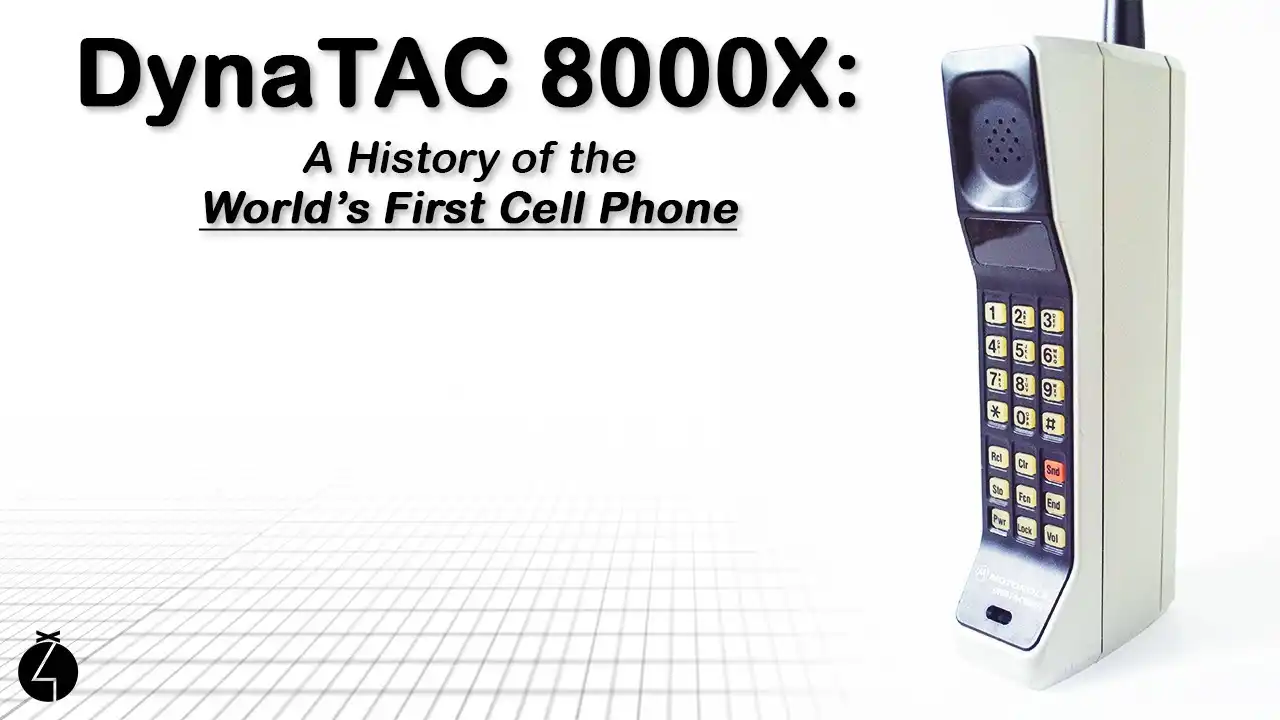
It would take another ten years of engineering, regulatory battles, and infrastructure development before that prototype became a product consumers could actually buy. When it finally arrived in September 1983, it had a name: the Motorola DynaTAC 8000X — DynaTAC standing for Dynamic Adaptive Total Area Coverage.
“I made a call, and I knew at that point this was going to be something important.”
— Martin Cooper, Motorola engineer, on the 1973 prototype callGetting the Facts Right
The Motorola DynaTAC 8000X — original footage and history
Many articles — including some that rank highly on Google — repeat the same errors about the DynaTAC 8000X. Here are the corrections that matter:
The phone weighed 794 grams (about 1.75 lbs) ✓ CORRECTED — not the 1.1kg commonly quoted. It stood 33cm tall with the antenna extended, and 25cm with it retracted. The charge time was approximately 10 hours for a battery that provided just 30 minutes of talk time and around 8 hours of standby. Yes, you read that right: ten hours charging for half an hour of calls.
The launch price of $3,995 in 1983 is roughly equivalent to €11,500–€12,500 today when adjusted for inflation — not the vague “over £10,000” cited elsewhere. It was not a phone for ordinary people. It was a status object for the boardroom.
What’s In a Name?
The phone is often called simply the “Motorola 8000X” but its proper designation is the DynaTAC 8000X. DynaTAC was Motorola’s brand for the device family. The “8000X” refers to the specific model — later variants included the 8000S and 8000M with incremental improvements to battery and weight.
Design & Features
Strip away the nostalgia and the DynaTAC 8000X was, by any modern measure, a punishment to use. Its plastic body housed a numeric keypad with physical rubber buttons, a tiny LED display capable of showing dialled digits and little else, and a retractable antenna that added significant height. There was no voicemail, no text messaging, no hold button, no address book beyond 30 stored numbers.
And yet — every single one of those features was revolutionary. Storing 30 numbers meant you no longer needed to memorise them. An LED readout meant you could confirm a number before dialling. Portability meant you could be unreachable only if you chose to be. The DynaTAC changed what being available meant to society.
The phone operated on the AMPS network (Advanced Mobile Phone System), the United States’ first-generation (1G) analogue cellular standard. Calls were transmitted as unencrypted radio waves, meaning they were technically interceptable with the right scanner — a security gap that would only be addressed with the shift to digital (2G) networks in the 1990s.
How the World Reacted
The DynaTAC 8000X was not a mass-market product — it was never meant to be. Motorola shipped it initially through a handful of US carriers and it took years before meaningful volumes moved. Early customers were executives, celebrities, Wall Street traders, and the occasional drug dealer (the subject of several 1980s tabloid exposés).
Its cultural impact, however, was immediate and outsized. The phone appeared in films, television shows, and music videos throughout the 1980s. Gordon Gekko’s famous DynaTAC scene in Wall Street (1987) became one of cinema’s most enduring images of excess. The phone had become a prop for power — something you carried not just to make calls, but to demonstrate that you could afford to.
Gordon Gekko’s DynaTAC scene in Wall Street turned a telephone into a symbol of an entire decade’s ambition.
— Mr Wangdoo, Wangdoo.comA Timeline of Firsts
Martin Cooper makes the world’s first handheld mobile phone call on a prototype DynaTAC, calling Bell Labs rival Joel Engel from a Manhattan street.
Motorola and AT&T begin trial cellular networks in Chicago and the Baltimore–Washington corridor. The infrastructure needed to support mobile phones starts taking shape.
The FCC authorises commercial cellular service in the United States. The regulatory green light triggers the race to market between Motorola and AT&T’s equipment division.
The DynaTAC 8000X receives FCC certification and goes on sale. Price: $3,995. The mobile phone era officially begins for consumers.
Motorola discontinues the original 8000X, replacing it with lighter, cheaper DynaTAC variants. By this point, one million mobile subscribers exist in the US alone.
Full Technical Specifications
| Specification | DynaTAC 8000X (1983) |
|---|---|
| Official Name | Motorola DynaTAC 8000X |
| Released | 21 September 1983 (US) |
| Weight | 794 g (1.75 lb) corrected |
| Height | 33 cm (antenna extended) / 25 cm (retracted) |
| Network | AMPS (1G Analogue) |
| Display | LED, digits only (no backlight) |
| Talk Time | ~30 minutes |
| Standby Time | ~8 hours |
| Charge Time | ~10 hours |
| Memory | 30 phone numbers |
| Launch Price (US) | $3,995 USD |
| Equivalent Today (€) | ~€11,500–€12,500 2026 estimate |
| Discontinued | ~1987 |
| Developed by | Martin Cooper & team, Motorola |
Legacy: What It Really Changed
The DynaTAC 8000X didn’t just invent the mobile phone — it invented the concept that a person could be their own communications hub, untethered from a wall, a desk, or a vehicle. Every smartphone in every pocket in the world today is a direct descendant of that 794-gram brick.
Motorola went on to refine the DynaTAC line through the mid-1980s, reducing weight and price with each iteration. By the late 1990s, the mobile phone had become a mainstream consumer product — and by the late 2000s, with Apple’s iPhone, it had become a pocket-sized computer that also happened to make calls.
Martin Cooper, now in his 90s, has continued to speak publicly about mobile technology and its impact. He has expressed concern about smartphone addiction and argued that the phone was meant to liberate people’s time — not consume it. A thought worth sitting with the next time you reach for yours.