iPhone Duo — Apple’s innovative foldable phone

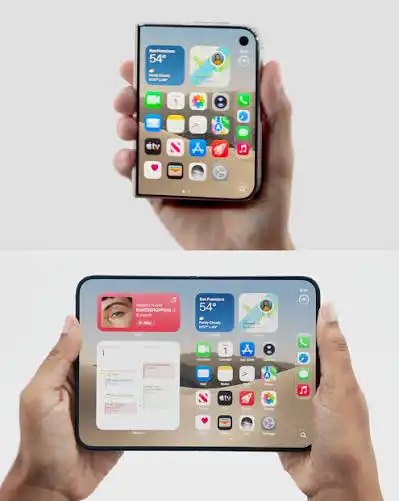
Apple’s first foldable arrives in October at $1,999. Face ID is gone, the SIM tray is gone worldwide, and European buyers get a version with one major feature missing. Here is what the specification actually says.
Not tested. Wangdoo has not handled an iPhone Duo. This article is drawn from Apple’s press release of 9 September 2026 and the footnotes attached to it. Every performance and battery figure below is Apple’s own, measured by Apple on preproduction units.
Status: Accurate as of 11 September 2026. The device has not shipped and no independent testing exists.
Apple announced the iPhone Duo on 9 September, after a rumour cycle stretching back the better part of a decade that never settled on the right name. It is a book-style foldable: a 5.4-inch phone that opens into a 7.6-inch one. Pre-orders start 16 October, it ships 23 October, and it starts at $1,999.
A folding chassis forces design choices that a fixed one does not, and the specification records several. Three of them affect what the device can do more directly than the hinge does.
Face ID is not on this phone. Touch ID returns, built into the side button.
There is no SIM tray anywhere in the world — the Duo is eSIM-only in every market.
And in the European Union, Siri AI is not available at launch, along with every feature that depends on it.
Video: Apple’s “Surprise and Shine” keynote of 9 September 2026, from Apple’s official channel. This is the company’s own presentation, so the claims in it are marketing claims — the specifications below come from the accompanying press release and its footnotes.
Two displays, one aspect ratio
Closed, the outer display is 5.4 inches and covers 90 percent of the screen area of an iPhone 18 Pro. Opened, the inner display is 7.6 inches and 50 percent larger than an iPhone 18 Pro Max. Apple’s footnote gives the true rectangular measurements as 7.58 and 5.36 inches, with the usable area smaller again once the rounded corners are accounted for.
Both panels share the same aspect ratio. Content therefore scales between them proportionally rather than reflowing, which is a different approach from earlier book-style foldables, where the two screens have generally had different proportions.
Apple’s release calls the opened device the thinnest iPhone ever without giving a figure. Reporting from the event puts it at 5.2 mm open and 11.3 mm folded — figures worth checking against independent measurements once units ship.
Both panels are Super Retina XDR with ProMotion, Always On and 3000 nits peak outdoor brightness. The inner one carries a nano-texture finish — the matte treatment Apple has used on Pro Display XDR and recent iPads — and Apple says it serves a second purpose here beyond reducing glare: it makes the crease harder to see.
A FaceTime camera sits under the inner display and stays hidden when not in use.
Touch ID is back, and Face ID is gone
This is the largest reversal in the announcement. Apple has shipped Face ID on flagship iPhones since 2017 and has steadily removed Touch ID from the line. On the Duo, Apple states that Touch ID is integrated into the side button. Face ID is not mentioned anywhere in the press release, and launch coverage has confirmed it is absent from the device.
Apple does not say why, so what follows is inference rather than the company’s explanation. Face ID depends on the TrueDepth array — a dot projector, an infrared camera and a flood illuminator — and that stack needs depth behind the glass. A chassis thin enough to fold in half, and to be the thinnest iPhone ever when open, has little of that depth to give.
Apple’s stated case for the side button is consistency: it authenticates the same way whether the device is open or closed, where a face scanner would work only on whichever display happened to be facing you. Apple Watch unlock is supported as a secondary route.
What this means in practice: capacitive fingerprint sensing and infrared face mapping fail in different conditions. Touch ID struggles with wet or cold fingers and gloves. Face ID struggles with masks and certain angles.
They are not equivalent on false-match rate either. Apple has historically published a roughly 1 in 50,000 chance of another fingerprint unlocking Touch ID, against roughly 1 in 1,000,000 for another face unlocking Face ID. Both are low enough that a passcode is the more realistic weak point, but the figures are not the same, and this is a step back on that measure.
The hinge, and what holds the screen together
Apple’s durability claims come with enough detail to be tested once units ship.
The hinge is built from more than 100 components and supports the centre of the panel so it sits flat when open, with a magnet array handling closure. The enclosure is grade 5 titanium with a mirror-polished finish and a 3D-printed hinge cover. Internally, support ribs add stiffness and the antenna splits carry ceramic fibre inserts to stiffen the frame.
The screen stack works as follows. High-strength glass sits above and below the folding panel, and the layers are bonded with custom adhesives designed to let them slide past one another as the phone closes — Apple’s comparison is the pages of a book — which relieves bending stress rather than resisting it. A titanium plate sits underneath. The nano-textured cover layer is a custom polymer that Apple says is up to 40 percent stiffer than materials others in the industry use.
Ceramic Shield 2 on the front is rated at three times the scratch resistance of the previous generation, Ceramic Shield protects the back, and the whole device is IP68 — tested to six metres for up to 30 minutes.
Two rear cameras, not three
The Duo has a 48MP Fusion Main and a 48MP Fusion Ultra Wide. There is no dedicated telephoto lens, which is the clearest place the thin chassis shows its cost against the Pro line.
Zoom instead comes from a 2x crop of the main sensor, which Apple describes as optical-quality — the same approach used on non-Pro iPhones. The Ultra Wide is the same unit as the iPhone 18 Pro models and handles macro. Video goes to 4K120 in Dolby Vision on the main camera.
Having a screen on both sides adds several camera functions. The outer display can act as a viewfinder for the rear cameras, so a self-portrait uses the higher-resolution sensors. It can also show a live preview to the subject rather than the photographer. On a video call, a second person can appear on the outer display instead of sharing the inner one. An on-device model analyses the scene and triggers the shutter when it detects subjects posing, which Apple offers as an alternative to a timer. And the outer display can play licensed animations intended to attract a young child’s attention toward the lens.
Silicon and power
The A20 Pro is the same chip as the iPhone 18 Pro models, on a 2-nanometre process. Apple quotes a 6-core CPU up to 20 percent faster than A19 Pro, a 7-core GPU up to 40 percent faster, a dual 16-core Neural Engine with twice the AI compute, and 50 percent more unified memory bandwidth.
The thermal design is where the foldable constraint shows. A chip package Apple describes as borrowed from its M-series design connects the processor directly to a custom vapour chamber, and the claim is up to 35 percent better sustained performance than iPhone 17 Pro. Sustained is the operative word — peak numbers are easy, holding them is not, and a folding phone has less surface area to shed heat through.
Power comes from two separate cells, one in each half, managed by rebalancing algorithms so they behave as a single battery. Apple quotes up to 31 hours of video playback on the inner display, 44 hours on the outer, and 24 hours of mixed use. Fast charging reaches 50 percent in around 20 minutes wired, or 30 minutes on MagSafe or Qi2.
What European buyers do not get
The detail most relevant to anyone reading this in Ireland or the rest of the EU sits in the footnotes rather than the body of the announcement.
Siri AI — the rebuilt assistant rolling out in beta with iOS 27 — will not be available initially in the European Union on iOS, iPadOS or watchOS. Nor will any feature that depends on it. Apple’s stated position is that it is working to find a path forward that preserves user privacy and security.
That affects one of the announcement’s headline demonstrations, in which a Siri conversation runs on one half of the screen while an app runs on the other. Split View itself still works in the EU; the assistant half of that demonstration does not, at launch.
The eSIM-only decision is worldwide rather than regional, so European buyers are not singled out there. Apple says it saves internal volume for battery, and notes eSIM is supported by more than 500 carriers. It does mean no physical SIM swapping while travelling, in any market.
Specifications
| Item | Detail |
|---|---|
| Displays | 7.6″ inner and 5.4″ outer Super Retina XDR (7.58″ and 5.36″ measured as rectangles); ProMotion, Always On, 3000 nits peak; nano-texture inner finish |
| Biometrics | Touch ID in the side button. No Face ID. Apple Watch unlock supported |
| Chip | A20 Pro, 2 nm; 6-core CPU, 7-core GPU, dual 16-core Neural Engine; custom vapour chamber |
| Cameras | 48MP Fusion Main with 2x crop, 48MP Fusion Ultra Wide, Center Stage front camera, under-display FaceTime camera. No dedicated telephoto |
| Battery | Two cells with rebalancing; up to 31 h video inner, 44 h outer, 24 h mixed. 50% in ~20 min wired |
| Thickness | Reported at 5.2 mm open, 11.3 mm folded. Apple states “thinnest iPhone ever” when open without publishing a figure |
| Build | Grade 5 titanium, Ceramic Shield 2 front, Ceramic Shield back, IP68, 100+ component hinge |
| Connectivity | eSIM only worldwide; N1 chip for Wi-Fi 7, Bluetooth 6 and Thread; C2 modem with mmWave in the US |
| Software | iOS 27.1 with Split View, side-mounted Dynamic Island, StandBy without charging. Apple Pencil USB-C support later in 2026 |
| Colours | Star white, night sky |
| Storage and price | 256GB, 512GB, 1TB, 2TB. From $1,999 |
Availability
Pre-orders open 16 October in more than 70 countries and regions, with sales from 23 October and a further 28 markets on 30 October. It ships with iOS 27.1.
UK pricing is reported at £1,999. Apple sells a two-part case at $79 and a folio with an integrated kickstand at $129, both MagSafe and Qi2 compatible.
The Duo is the first flagship launched under John Ternus, who has succeeded Tim Cook as chief executive, with Cook moving to chair. It also arrives in an unusual lineup: Apple announced only the iPhone 18 Pro and Pro Max alongside it, with no standard iPhone 18 at this event.
Frequently asked questions
Does the iPhone Duo have Face ID?
No. Apple states that Touch ID is integrated into the side button, and Face ID is not mentioned anywhere in the announcement — its absence has been confirmed by launch coverage. Apple has not explained the decision; the likely constraint is that the TrueDepth array behind Face ID needs more depth than a folding chassis allows. Apple Watch unlock is offered as an alternative.
How much does it cost?
From $1,999 in the US for 256GB, with 512GB, 1TB and 2TB options. Pre-orders begin 16 October 2026 and sales start 23 October.
Is Siri AI available in Europe?
Not at launch. Apple states Siri AI will not initially be available in the EU on iOS, iPadOS or watchOS, along with features that rely on it, and says it is working to find a path forward that preserves privacy and security.
Does it have a SIM tray?
No. The iPhone Duo is eSIM-only in every market worldwide. Apple says this frees internal space for battery capacity.
How many cameras does it have?
Two on the rear — a 48MP Fusion Main and a 48MP Fusion Ultra Wide — plus a Center Stage front camera and a FaceTime camera beneath the inner display. There is no dedicated telephoto lens; 2x zoom comes from a crop of the main sensor.
How durable is the folding screen?
Apple describes a hinge of more than 100 components, high-strength glass above and below the panel, adhesives that let layers slide during folding to relieve stress, a titanium support plate and a nano-textured cover layer it says is up to 40 percent stiffer than industry alternatives. The device is IP68 rated. No independent durability testing exists yet.
How thin is the iPhone Duo?
Apple describes it as the thinnest iPhone ever when opened but does not publish a measurement in its press release. Reporting from the launch event puts it at 5.2 mm open and 11.3 mm when folded.
Can it use an Apple Pencil?
Apple says Apple Pencil with USB-C support arrives later in 2026, working on either display.
Sources
- Apple — “Apple unveils iPhone Duo”, press release, 9 September 2026, including the footnotes on display measurement, battery testing methodology, IP68 conditions and EU availability of Siri AI. All specifications, performance percentages and battery figures in this article are Apple’s own. apple.com
- Apple — pricing and availability section of the same release, covering storage tiers, case and folio pricing, and the October pre-order and launch dates across more than 70 markets.
- Apple — “Apple Event September 9 2026: Introducing iPhone Duo and more”, official keynote video. youtube.com
- Macworld — live coverage of the launch event, 9 September 2026. Source for the 5.2 mm open and 11.3 mm folded thickness figures, which do not appear in Apple’s press release.
- T3 and Stuff — launch coverage. Source for the Tim Cook to John Ternus succession, the absence of a standard iPhone 18 from this event, and the £1,999 UK price.

Clayton Samuel (Mr Wangdoo), QFA — Founder & editor, Wangdoo.com. Qualified Financial Adviser with a background in electronics, web development, and cloud infrastructure.