Huawei Debuts a 122TB SSD, Setting a New Benchmark in Enterprise Storage

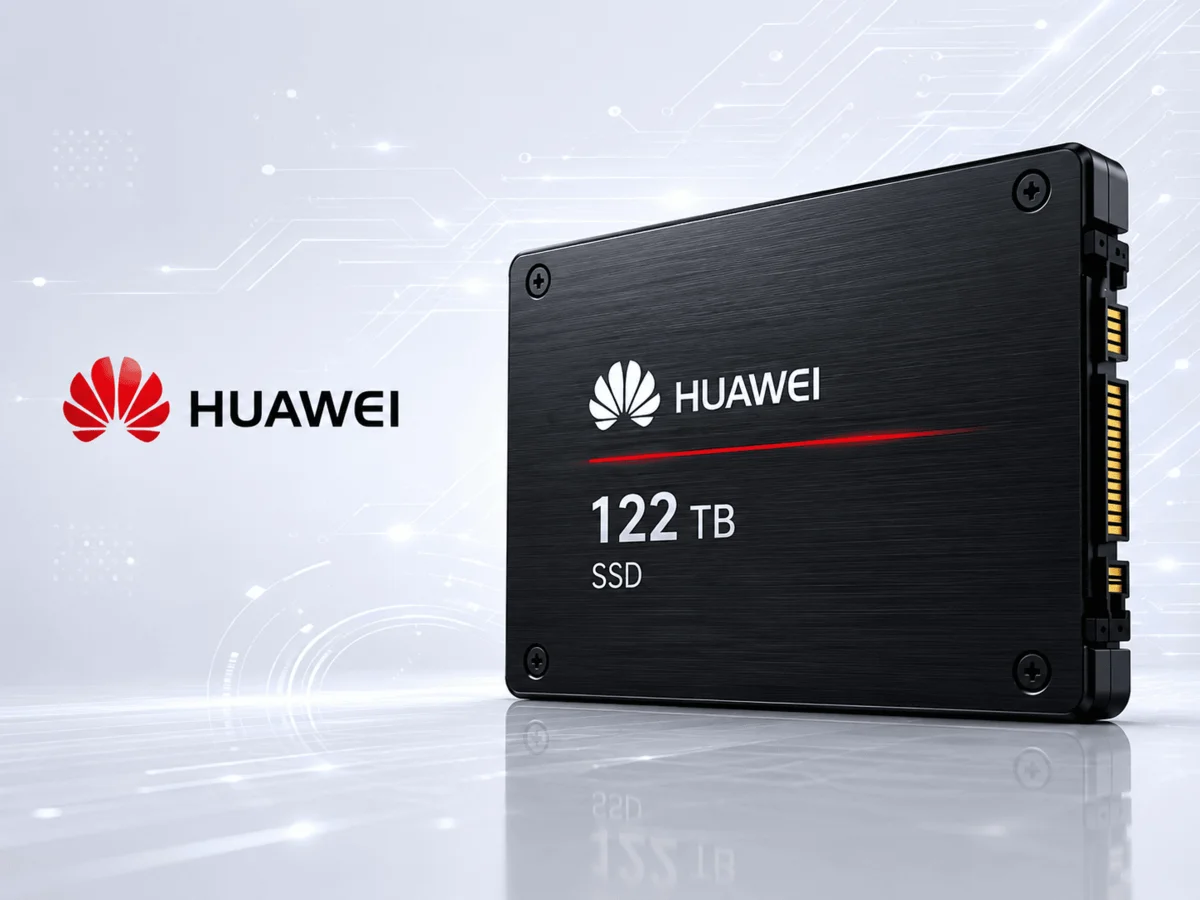
Huawei Built a 122TB SSD Using Chips It Isn’t Supposed to Have — Here’s What That Actually Means
A storage record broken using improvised engineering and domestic Chinese chips. Revealed at Paris, May 2026. Here is the full story — the technology, the geopolitics, the competitor context, and why it matters beyond the headline number.
Here is the short version: Huawei has built a 122TB solid-state drive. It did this without access to the advanced Western memory chips that would normally make such a drive possible. It used a packaging technique of its own invention instead. The result was announced quietly at an analyst briefing during the Huawei ID Forum 2026 in Paris on May 21–23, and within 48 hours every major tech publication was covering it.
The longer version is more interesting — because this story is not really about a big number on a storage spec sheet. It is about what happens when one of the world’s largest technology companies is deliberately cut off from the global semiconductor supply chain and decides to engineer its way around the problem anyway.
What Actually Happened — The Full Story
Since 2019, Huawei has been on the US Entity List — a trade restriction that blocks American companies from supplying it with technology without special government approval. In practice, this means Huawei cannot buy the most advanced 3D NAND flash memory chips from the companies that make the best ones: Samsung, SK Hynix, Micron, or Kioxia. These chips use 100-plus layers of stacked memory cells and are the foundation of high-density modern SSDs.
Without access to those chips, Huawei has had to rely on YMTC — China’s domestic NAND supplier — which currently produces 232-layer flash. That is competitive, but it falls short of what companies like SK Hynix (321 layers, in production since late 2024) and Kioxia (332-layer BiCS10, entering production in 2026) are now achieving — while Samsung’s current mass-production V9T sits at 286 layers with a 400-plus-layer design in development. In the world of SSD density, that gap matters. Fewer layers means fewer bits per chip, which means less total capacity in the same physical space.
So Huawei did something unexpected. Rather than waiting for YMTC to catch up in layers, its engineers tackled the problem from a completely different angle — they changed how the chips are arranged on the drive itself.
Die-on-Board: The Engineering Solution, Explained Simply
Huawei’s Die-on-Board (DoB) approach cuts out the middle step entirely. The raw silicon dies are mounted directly onto the SSD’s circuit board — no intermediate packaging, no wasted space from sealing layers. The result is a tighter layout that fits more total memory into the same footprint. Huawei says this approach delivers a 33% improvement in capacity density compared to conventional packaging.
The technique itself is not entirely new — wafer-level packaging has existed in various forms — but applying it at this scale to enterprise SSD production, using domestically sourced NAND, is a meaningful engineering achievement. Blocks & Files, the specialist storage industry publication that first broke the story, described the approach as a genuine capacity density milestone for drives built without access to leading-edge Western memory.
The result: three SSDs in production or planned. The 61.44TB and 122.88TB variants are already in production and deployed in Huawei hardware. A future 245TB version — the LC 560 — uses a 36-layer stacking process and is capable of 14.7 GB/s read bandwidth.
Full Specifications — What Has Been Confirmed
| Detail | Specification |
|---|---|
| Capacities (in production) | 61.44TB · 122.88TB |
| Capacity (planned) | 245TB — LC 560 AI SSD |
| Packaging Technology | Die-on-Board (DoB) — wafer-level, proprietary Huawei |
| Density Improvement | 33% over conventional BGA/TSOP packaging |
| NAND Source | YMTC — 232-layer QLC (domestic Chinese supplier) |
| Interface | PCIe Gen4 (OceanDisk SSDs confirmed) · PCIe Gen5 (OceanStor Pacific 9926 system — per Blocks & Files) |
| Deployed In | OceanStor Pacific 9926 AFA scale-out storage system |
| Raw Capacity (System) | 4.42PB per 2U unit (36 × 122.88TB) — source: Blocks & Files |
| Storage System | 36 disk slots in a 2U chassis · up to 4PB per unit |
| LC 560 Bandwidth | 14.7 GB/s sequential read |
| EX 560 Performance | 1.5M random write IOPS · sub-7 microsecond latency · 60 DWPD |
| SP 560 Performance | 600K random write IOPS · sub-7 microsecond latency · 1 DWPD |
| Target Market | Enterprise data centres · AI inference · hyperscale storage |
| Consumer Availability | None — proprietary to Huawei OceanStor systems |
| Pricing | Not disclosed |
| Announced | Huawei ID Forum 2026, Paris — May 21, 2026 |
How It Compares: Huawei OceanDisk 122TB vs Phison Pascari D205V
The Phison Pascari D205V is the most direct Western comparison — it also targets the 122.88TB enterprise capacity tier but takes a fundamentally different approach. Where Huawei compensates for less-advanced NAND through packaging innovation, Phison uses more conventional stacking with a next-generation PCIe Gen5 interface and a flagship enterprise controller. The two drives tell you almost everything you need to know about the diverging strategies of Eastern and Western storage engineering in 2026.
| Feature | Huawei OceanDisk 122TB | Phison Pascari D205V |
|---|---|---|
| Capacity | 122.88TB | 122.88TB |
| Interface | PCIe Gen4 | PCIe Gen5 |
| NAND Type | YMTC 232-layer QLC | Western QLC NAND (advanced multi-layer) |
| Key Innovation | Die-on-Board packaging (+33% density) | X2 controller + 2Tb QLC die |
| Read Speed | Not fully disclosed | 14,600 MB/s sequential |
| Consumer Purchase | ❌ Proprietary to Huawei systems | ✅ Available to OEM buyers |
| Pricing | Undisclosed | Enterprise pricing (high) |
| Geopolitical Risk | High — US-sanctioned supply chain | Low — Western supply chain |
| Next Step | 245TB (LC 560) planned | 128TB variant upcoming |
| Best For | Chinese AI data centres | Global enterprise buyers |
Why This Matters Beyond the Headline Number
The people asking “what is 122TB?” deserve a real answer. To put it in terms that make sense: a single 122TB SSD could store roughly 30 million high-resolution photos, or approximately 40,000 hours of HD video. A single OceanStor Pacific 9926 unit — which holds 36 of these drives — stores 4.42 petabytes of raw capacity. That is 4,420TB in a box roughly the size of two stacked pizza boxes (a 2U server chassis).
At the scale of AI training and inference, that density matters enormously. Large language models — the kind that power AI assistants, image generators, and the new wave of reasoning systems — require vast amounts of data to be stored and retrieved at speed. The closer that data sits to the processing units, the faster the system runs. A 4PB-per-unit storage system changes the economics of how AI infrastructure is built and where it can be physically deployed.
This is also relevant to anyone watching the AI hardware arms race more broadly. AI-driven hardware innovation is reshaping everything from data centres to the devices in your home — if you want to understand how AI is changing the consumer tech you use day to day, our look at the JMGO N3 AI Gimbal Projector shows how that infrastructure-level intelligence is reaching living rooms in 2026.
The Geopolitical Angle — What the Export Controls Story Actually Tells Us
US semiconductor export controls have operated on the assumption that controlling access to the most advanced chip fabrication technology would constrain China’s ability to build competitive AI hardware. Huawei’s Die-on-Board announcement complicates that assumption in an important way.
The controls targeted the chips themselves — the manufacturing processes, the lithography equipment, the layer counts. What Huawei demonstrated is that there is a second axis of competition that the controls did not fully address: packaging and system-level engineering. By rethinking how existing, domestically available chips are physically arranged, Huawei achieved capacity parity with drives built using superior NAND.
This does not mean the controls have failed entirely. Huawei’s drives are slower in some performance metrics and cannot be openly sold to third parties — they are locked inside proprietary systems. But the capacity number is now matched, and if YMTC pushes past 232 layers — which it is actively working toward — that packaging advantage compounds. The gap between Chinese and Western storage capability is narrower today than it was 12 months ago, and the trajectory is moving in one direction.
The packaging workaround demonstrates that system-level engineering can partially offset process-node restrictions — shortening the timeline before China fields competitive AI storage infrastructure.
— AI Weekly analysis, May 2026What Happens Next
Three things are worth watching. First, YMTC’s layer count. If China’s domestic NAND supplier breaks past 232 layers — which multiple industry analysts consider achievable within 12–18 months — the DoB packaging advantage stacks on top of improved NAND, and Huawei’s storage numbers scale significantly without changing the architecture.
Second, the 245TB LC 560. Huawei has already outlined a 245TB variant using 36-layer stacking. For context, TechRadar noted that the current world record for SSD capacity — the Kioxia LC9 at 245.76TB — was only just announced. Huawei is targeting the same tier with its own technology roadmap.
Third, the Western response. Companies including Pure Storage, NetApp, and the major NAND suppliers will be watching closely. If Huawei’s drives reach verified volume production at competitive pricing within China’s AI infrastructure market, it changes the competitive calculus for every enterprise storage vendor with Asian hyperscaler customers.
Pros & Cons
✅ What Huawei Got Right
- Reached 122TB capacity without sanctioned chips — a genuine engineering first
- 33% density improvement through DoB packaging — confirmed by independent analysts
- Already in production and deployed in real systems — not a paper announcement
- 245TB roadmap positions Huawei alongside Kioxia at the global capacity frontier
- Demonstrates that packaging innovation can partially offset NAND disadvantage
- 4PB per 2U chassis is competitive with Western enterprise storage at the system level
❌ The Honest Limitations
- PCIe Gen4 interface — Phison Pascari D205V already operates on faster Gen5
- Proprietary only — cannot be purchased or used outside Huawei OceanStor systems
- No pricing disclosed — impossible to assess value against Western alternatives
- YMTC’s 232-layer NAND still lags behind Samsung and Kioxia’s most advanced designs
- Geopolitical risk remains — further export controls could target packaging materials
- No independent benchmark data published — all performance figures are Huawei’s own
Frequently Asked Questions
Can I buy the Huawei 122TB SSD?
What is Die-on-Board packaging and why does it matter?
How does 122TB compare to what you can buy today?
Why can’t Huawei use Samsung or Micron NAND chips?
Does this mean US export controls on China are failing?
What is the next version after 122TB?
Will this affect SSD prices for consumers?
📚 Sources & References
- Blocks & Files — Huawei’s new stacking tech for high-capacity SSDs (May 21, 2026) — first report, by Chris Mellor
- Tom’s Hardware — Huawei develops 122TB SSD with new packaging tech (May 23, 2026)
- TrendForce — Huawei reportedly achieves 122TB SSDs (May 22, 2026)
- TweakTown — Huawei produces 122TB SSDs using proprietary packaging (May 2026)
- Crypto Briefing — Huawei develops 122TB SSD with DoB packaging (May 2026)
- TechRadar — The largest SSD and hard drive of 2026 (context on competitive landscape)
- AI Weekly — Huawei builds 122TB SSD using homegrown packaging — geopolitical analysis