Huawei Atlas 950 SuperPoD: China’s Strategic Rival to Nvidia’s AI Powerhouse

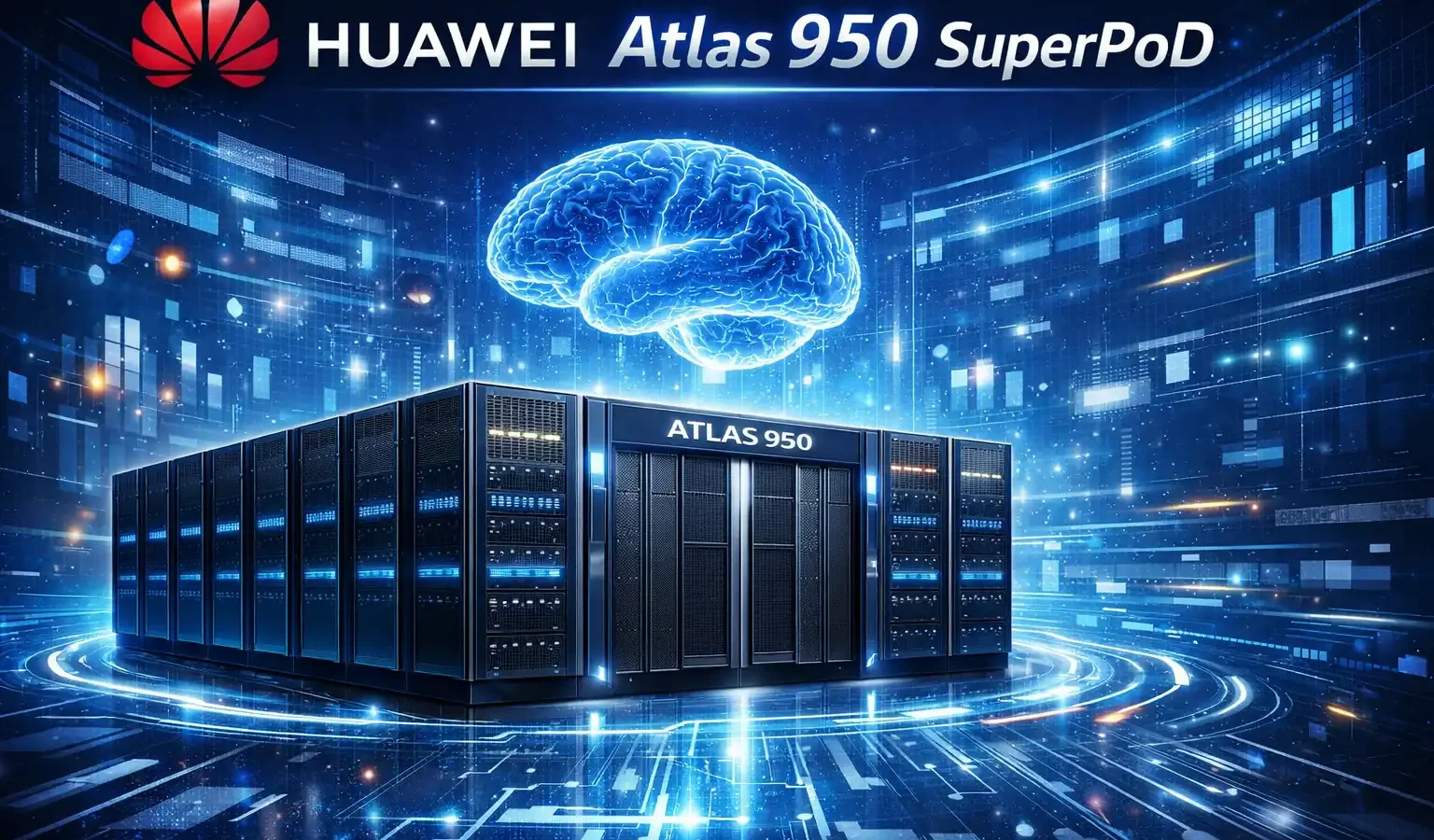
Huawei’s Atlas 950 SuperPoD: China’s Answer to Nvidia’s AI Infrastructure Explained
The 2026 World Artificial Intelligence Conference opens in Shanghai today. Xi Jinping is attending for the first time in eight years of the event. Huawei is debuting its most powerful AI computing system on home soil. Here is what the Atlas 950 SuperPoD actually is, how it works, and what it signals about where the global AI infrastructure race is heading.
How this was reported: This article is a tech explainer drawn from Huawei’s official product announcements at MWC Barcelona 2026 and Huawei Connect 2025, the Aixia MWC deep-dive published July 2026, Techzine Global’s MWC coverage, Reuters’ WAIC preview published July 16, 2026, BigGo Finance’s WAIC analysis, George Chen’s Substack WAIC preview published July 13, 2026, ChinaTechNews, and the Futunn/STAR Market Daily Atlas 950 briefing from July 7, 2026.
On Huawei’s figures: Every performance comparison in this article comes from Huawei’s own published specifications. Independent third-party benchmarks do not yet exist — the system enters commercial availability in Q4 2026. Where figures are Huawei’s claims, that is stated clearly.
What Is Happening in Shanghai Today
The World Artificial Intelligence Conference (WAIC) opened this morning in Shanghai, running through July 20. Chinese President Xi Jinping delivered the opening keynote — his first attendance since WAIC launched in 2018. For the previous two years, Premier Li Qiang handled the opening. Sending the president instead of the premier is a statement about priority, and Beijing made it deliberately.
The conference floor covers 100,000 square metres. More than 1,100 companies are exhibiting, with over 300 products making their global debut across four days. Among them is the public China showcase of Huawei’s Atlas 950 SuperPoD — which had its international debut at MWC Barcelona in March but has not been shown publicly at home until today.
TaiwanPlus News: Could Huawei’s Atlas 950 AI SuperPoD shift the market? Analysis of the MWC 2026 debut — March 4, 2026. Independent production, not affiliated with Wangdoo or Huawei.
What the Atlas 950 SuperPoD Actually Is
The Atlas 950 SuperPoD is Huawei’s largest AI computing system, built around 8,192 Ascend 950DT neural processing units — the company’s own AI chip, developed in-house after US export controls blocked access to Nvidia hardware. The system is not a server rack. It is not a cluster of independent machines networked together. Huawei engineered it to operate as a single logical computer, with unified memory addressing across all 8,192 chips simultaneously.
In a standard data centre setup, each server node manages its own memory. Moving data between nodes means sending it across a network fabric — which adds latency, consumes bandwidth, and creates coordination overhead that compounds as clusters grow larger. The Atlas 950 addresses this by using Huawei’s proprietary UnifiedBus interconnect to create a shared memory address space across the entire system. Any chip can read from or write to any part of the total memory pool without a discrete network transfer. At 1,152 terabytes of total memory across 8,192 chips, that is a significant departure from how most large-scale AI infrastructure currently operates.
Physically, the full configuration runs to 160 cabinets — 128 compute, 32 communications — across roughly 1,000 square metres of floor space. The optical interconnect supports cable runs of up to 200 metres within a data centre. Huawei claims 100 times greater reliability than conventional copper interconnect at this scale, and 95% compute efficiency across the full 8,192-NPU configuration. Those are Huawei’s own figures; independent verification does not yet exist.
Atlas 950 SuperPoD — full specifications
NPUs: Up to 8,192 Ascend 950DT | Per cabinet: 64 NPUs | Cabinets: 160 total (128 compute, 32 comms) | Floor space: ~1,000 m²
Compute: 8 EFLOPS FP8 / 16 EFLOPS lower precision | Memory: 1,152 TB | Interconnect: 16 PB/s UnifiedBus | Cooling: Fully liquid-cooled
Claimed efficiency: 95% utilisation at full scale | Commercial availability: Q4 2026
The Chip That Exists Because of US Export Controls
The Ascend 950DT is not the chip Huawei would have chosen to build if it had unrestricted access to Nvidia hardware. It is the chip Huawei had to build because it does not. US export controls, first tightened significantly in October 2022 and expanded in subsequent rounds, prohibit the sale of advanced AI chips — including Nvidia’s H100, H200, and Blackwell series — to Chinese entities. Licences to bypass that restriction are not being issued.
Huawei’s chip programme had been running since the first sanctions in 2019, but the 2022 controls accelerated it considerably. The 950DT uses HiZQ 1.0, Huawei’s own high-bandwidth memory technology, which the company describes as comparable in specification to HBM3E — the current-generation memory in Nvidia’s Blackwell GPUs. The chip is manufactured in China. Which foundry and which process node Huawei is using has not been publicly confirmed.
At Huawei Connect 2025, the company’s rotating chairman said directly: “there is a short-term gap in single-chip performance compared with Nvidia.” That is an unusually frank admission for a product launch context. The strategy to close it is not to match Nvidia chip-for-chip — it is to build systems that connect far more chips into a single coherent unit and offset the per-chip gap with scale.
Alongside the 950DT, Huawei produces the Ascend 950PR — a separate chip targeting inference and recommendation workloads where memory capacity matters more than raw bandwidth. The 950PR uses HiBL 1.0, Huawei’s lower-cost HBM variant, and entered production in Q1 2026. The two chips are designed for different workload profiles within the same ecosystem.
UnifiedBus vs NVLink — Two Very Different Architectural Bets
Nvidia’s NVLink connects a bounded number of high-performance GPUs with very high bandwidth and very low latency within a rack. The current NVL72 connects 72 Blackwell GPUs in a single NVLink domain; Nvidia’s NVLink Switch extends this to up to 576 GPUs across multiple racks in a non-blocking fabric. The NVL144, due in the second half of 2026, will connect 144 GPUs in a single domain. NVLink’s strength is maximising per-chip performance and latency within those bounds — it is not architecturally designed to unify thousands of chips under a single shared memory address space in the way UnifiedBus attempts to do.
UnifiedBus is the opposite bet. Rather than maximising what 72 or 144 chips can do together, it creates a fabric that ties 8,192 chips into a single logical machine. Huawei has also announced that UnifiedBus 2.0 technical specifications will be open-sourced — a move that mirrors Nvidia’s decision to open NVLink to third parties and signals that Huawei is trying to build an ecosystem around the standard rather than treat it as a proprietary moat.
What “56.8× more NPUs” actually means
Huawei’s published claim is that the Atlas 950 SuperPoD has 56.8 times more NPUs than Nvidia’s NVL144 and delivers 6.7 times more computing power. The first figure is arithmetic — 8,192 divided by 144. The second is a specification comparison, not a benchmark. Whether 56.8× the chip count produces 6.7× real-world training throughput depends on parallelisation efficiency, memory bandwidth utilisation, and software stack quality at scale. Huawei claims 95% compute efficiency. That figure has not been independently validated. The NVL144 has not yet shipped. Neither system has been compared in a controlled third-party benchmark. These numbers are a specification claim, not a performance result.
The Software Problem Nobody Talks About
Nvidia’s actual competitive moat in AI infrastructure is not the GPU. It is CUDA — the software platform announced in 2006 and publicly released in 2007 that allows developers to write code once and run it efficiently on Nvidia hardware. Nearly 20 years of library development, compiler optimisations, framework integrations, and developer muscle memory sit on top of CUDA. Switching to a different hardware platform is not a procurement decision. It is a software migration that touches every model, every training script, and every inference pipeline an organisation runs.
Huawei’s equivalent is CANN — Compute Architecture for Neural Networks, currently at version 8.0. It supports PyTorch, vLLM, and Triton through a backend plugin called torch_npu, which runs PyTorch models on Ascend NPUs via PyTorch’s PrivateUse1 mechanism. The practical meaning: existing PyTorch codebases can be ported to Ascend hardware without a full rewrite, though workload-specific performance tuning still requires engineering investment. The Aixia technical assessment of MWC 2026 described CANN’s developer experience as “not yet on par with CUDA.” That is an accurate characterisation. The gap is real and shrinking, but it is not gone.
For any organisation already running production AI workloads on Nvidia infrastructure, moving to Atlas 950 requires solving a software problem before the hardware question even arises. That does not mean it will not happen — it means it will not happen quickly or cheaply.
Why Xi Jinping Showing Up at WAIC Matters
WAIC has run every year since 2018. Li Qiang opened it in 2024 and 2025. Before that, it was handled by other senior officials. Xi has never attended — until today. The shift is not ceremonial. It reflects a specific geopolitical moment.
Last week, the United States and China clashed at a UN AI governance dialogue in Geneva, where Washington argued against sweeping regulation and Beijing framed its open-source AI models as a public good for the developing world. In May, Trump and Xi agreed at their Beijing summit to establish a government-level AI dialogue — the first under the Trump administration — though the formal structure of those talks was still being determined as of this week. WAIC opens against that backdrop. Beijing is using the conference as a platform to advance a concrete institutional proposal: the World AI Cooperation Organisation (WAICO), which would be headquartered in Shanghai and serve as China’s alternative to US-led AI governance frameworks.
WAICO was proposed by Premier Li at WAIC 2025. No countries have formally joined yet. Xi is expected to advance the proposal in today’s keynote. The Shanghai AI Laboratory — backed by the Shanghai municipal government — is serving as the organisation’s de facto secretariat while formal membership is established.
Also attending: UN Secretary-General Antonio Guterres, Kazakh President Kassym-Jomart Tokayev, Thai Prime Minister Anutin Charnvirakul, and nine Turing Award and Nobel laureates including deep learning pioneer Yoshua Bengio and reinforcement learning pioneer Richard Sutton. Bengio is scheduled to present a proposed UN framework for AI governance. Notably absent: Google, Microsoft, Meta, and OpenAI. Reuters confirmed “there is little representation from major U.S. tech firms.” That absence is not incidental — it defines what kind of conversation WAIC 2026 is.
DeepSeek, the Model Performance Gap, and Why the Atlas 950 Is Connected to Both
Stanford University’s 2026 AI Index report found that the performance gap between the leading US and Chinese AI models had narrowed to 2.7 percentage points as of March 2026. DeepSeek’s share of the global AI model market nearly doubled from 9% at the start of the year to 18% by early June. Neither figure is directly about hardware — but both connect to the Atlas 950 in a specific way.
DeepSeek has publicly stated that once Ascend 950 super nodes reach mass production in the second half of 2026, it intends to substantially reduce the price of DeepSeek-V4-Pro. Large model inference costs are a direct function of the compute they run on. If Huawei can produce Ascend 950 hardware at scale and at competitive cost, it changes the economics of running Chinese AI models not just domestically but in every market where Nvidia hardware is either restricted, expensive, or politically complicated to procure. That is a large share of the world.
My Take — Mr Wangdoo
Two things about this story are being reported imprecisely, and I think both matter.
The first is the performance comparison framing. “56.8× more NPUs delivering 6.7× the computing power” sounds like a benchmark. It is not. It is Huawei comparing its own specification to Nvidia’s specification for a product that has not yet shipped, without any independent validation of its claimed 95% efficiency at full scale. This does not mean the Atlas 950 will underperform — it means we genuinely do not know yet. Treating Huawei’s figures as equivalent to independent benchmarks is a mistake. The real test starts when the hardware ships in Q4 2026 and third parties get access.
The second is the market framing. Most coverage positions this as Huawei versus Nvidia for the same customers. That misreads the situation. The Atlas 950 is not trying to displace Nvidia in US hyperscaler data centres or European cloud providers. It is addressing a market that Nvidia literally cannot serve: Chinese cloud companies barred from Nvidia hardware, governments in the Global South looking for infrastructure independence, and the belt of countries across Southeast Asia, the Middle East, and Africa where China is building AI relationships through bilateral agreements. That market is large, growing, and currently uncontested by Western vendors at the infrastructure level. Whether the Atlas 950 performs well enough to capture it is a real question. Whether it faces Nvidia as its primary competitor in those markets is not — it largely does not.
The architectural bet itself — extreme scale-up as a substitute for per-chip performance — is not obviously wrong. Some of the most important computing systems in history have won on scale rather than per-unit performance. Whether it works for frontier AI training at the workload level is what the next year will start to show.
Frequently Asked Questions
What is the Atlas 950 SuperPoD in simple terms?
It is Huawei’s largest AI computing system — 8,192 of its own Ascend 950DT AI chips, connected by a proprietary high-speed interconnect called UnifiedBus so that the entire system shares a single memory pool and operates as one logical computer. At full scale it fills 160 cabinets across roughly 1,000 square metres of data centre floor. It is designed for large-scale AI model training and high-concurrency inference. Commercial availability is scheduled for Q4 2026. The performance figures Huawei publishes for it are self-reported specifications, not independently verified benchmarks.
Why does Huawei have to build its own AI chips?
US export controls introduced in October 2022 and tightened since prohibit the sale of advanced AI chips — including Nvidia’s H100, H200, and Blackwell series — to Chinese entities. Licences are not being granted. Huawei had been running its own chip programme since being added to the US Entity List in 2019, but the 2022 controls made domestic chip development a strategic necessity rather than an option. The Ascend 950DT is the current result of that programme.
How does UnifiedBus compare to Nvidia’s NVLink?
NVLink connects bounded numbers of high-performance GPUs within a rack — the current NVL72 connects 72 Blackwell GPUs in a single domain, Nvidia’s NVLink Switch extends this to 576 GPUs across multiple racks, and the upcoming NVL144 will connect 144 in a single domain. UnifiedBus takes a different approach entirely — connecting up to 8,192 chips into a single unified memory address space, prioritising extreme scale over per-chip performance. They are different architectural bets, not direct equivalents. Huawei has announced that UnifiedBus 2.0 specifications will be open-sourced.
Can you just swap Nvidia GPUs for Ascend NPUs in existing AI infrastructure?
Not without significant software work. The barrier is CUDA — Nvidia’s programming platform, in public release since 2007, which has nearly 20 years of library development behind it. Every AI training script, model, and inference pipeline optimised for CUDA needs to be ported to CANN, Huawei’s equivalent. CANN 8.0 supports PyTorch via a backend plugin, which reduces the rewrite required, but workload-specific tuning and performance validation still take engineering time. For organisations running production Nvidia workloads, migrating to Ascend is a software project before it is a hardware decision.
What is WAIC and why does Xi Jinping attending matter?
WAIC is China’s annual AI conference, held in Shanghai since 2018. It has grown into a combination of product showcase, policy forum, and increasingly a geopolitical platform. Xi’s attendance — his first since the event launched — coincides with US-China AI governance talks and a UN AI dialogue where the two countries put forward opposing frameworks last week. Beijing is using WAIC to advance a concrete governance proposal: the World AI Cooperation Organisation (WAICO), which would give China a formal institutional role in setting AI governance norms internationally, headquartered in Shanghai.
Are Huawei’s performance claims verified?
No. All the figures in this article — 8 EFLOPS compute, 16 PB/s interconnect bandwidth, 56.8× more NPUs than NVL144, 6.7× more computing power, 95% efficiency — come from Huawei’s own published materials. The Atlas 950 SuperPoD enters commercial availability in Q4 2026. The Nvidia NVL144 it is being compared against has not shipped either. Independent third-party benchmarks of the two systems side by side do not currently exist.
Sources
- Huawei Unveiled the Latest SuperPoD — MWC Barcelona 2026 — Huawei official newsroom, March 2, 2026 (primary: NPU count, UnifiedBus, cabinet configuration, open-source announcement)
- Groundbreaking SuperPoD Interconnect: Leading a New Paradigm for AI Infrastructure — Huawei Connect 2025 keynote (memory capacity, bandwidth comparisons, rotating chairman quote on single-chip gap)
- Huawei AI Stack vs. Nvidia DGX: MWC 2026 Deep Dive — Aixia, July 2026 (floor space, optical interconnect specs, CANN 8.0 assessment, torch_npu)
- Huawei unveils Atlas 950 SuperPoD for AI infrastructure — Techzine Global, March 4, 2026 (CANN framework support, 8 exaFLOPS figure)
- Huawei Atlas 950 hardware to debut at WAIC — Futunn / STAR Market Daily, July 7, 2026 (WAIC debut confirmation, DeepSeek pricing commitment, liquid cooling)
- China’s Xi to outline AI diplomacy vision at key Shanghai forum — Reuters via Yahoo News, July 16, 2026 (Xi attendance, US firm absence, WAICO, Bengio/Sutton, Geneva dialogue)
- Xi Jinping to Attend WAIC for First Time as China Declares AI Ecosystem Dominance — BigGo Finance, July 14, 2026 (Stanford AI Index 2.7% gap, DeepSeek market share, analyst quote)
- PREVIEW: WAIC 2026 showcases Xi’s keynote, Huawei’s Atlas 950 — George Chen (chair of digital practice, Asia Group), July 13, 2026 (WAICO secretariat, conference scale, Li Qiang 2024/2025 attendance)