How EV Charging Robots Work: Inside the Race to Automate Plugging In

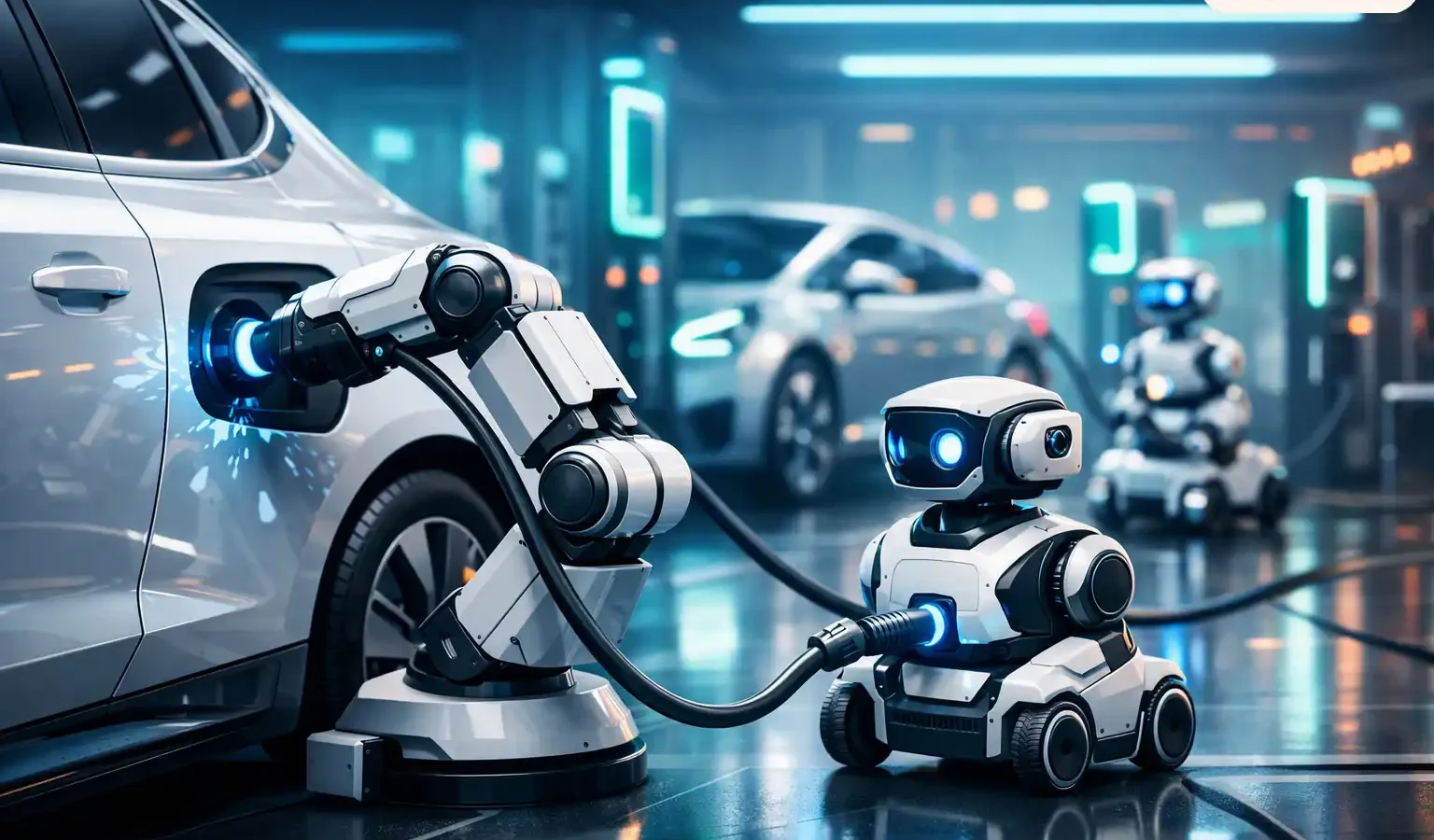
A Korean government-backed consortium just started building a robot that finds your parked EV, locates its charging port, and plugs itself in — no human involved. It’s part of a much bigger race most drivers have never heard of. Here’s what EV charging robots actually are, how the different approaches compare, and why this is a harder problem than it looks.
How this was reported: This article is based on reporting from the Seoul Economic Daily on Tirarobotics’ government-backed consortium, Electrek’s coverage of China’s overhead rail charging systems and Xiaomi’s home charging robot, and Hyundai’s own official press materials for its Automatic Charging Robot. Wangdoo has not tested any of the products described.
The Problem Nobody Talks About
Plugging in an EV sounds trivial until you look at it from an engineering perspective. Every manufacturer puts the charging port somewhere different — front, rear, driver’s side, passenger’s side, at different heights, behind different styles of cover. A robot built to plug in a Tesla can’t necessarily find the port on a Hyundai. Add in that today’s fastest DC chargers use increasingly thick, heavy cables — physically difficult for some elderly or mobility-impaired drivers to lift and connect — and you have a real, underappreciated accessibility problem hiding inside the EV transition.
That’s the gap a growing number of companies, from small Korean startups to Xiaomi and Hyundai, are now racing to close. This week, a Korean consortium made up of Tirarobotics, autonomous charging specialist Bion Ever, and charging infrastructure operator Chaevi announced a project — backed by South Korea’s Ministry of Trade, Industry and Energy — to build a fully autonomous robot-based EV charging system, combining vision AI with precision robot control to handle the entire process without a person present. It’s a narrow, specific application of the same physical AI wave behind the cheaper, more efficient robotics hardware we covered in our recent piece on Nvidia’s Jetson Thor chips — the compute that increasingly powers exactly this kind of real-world robotic vision and control task.
Three Completely Different Ways to Solve This
What makes this category interesting is that no single design has won yet. Three distinct architectural approaches are being commercialised at the same time, each with real trade-offs.
Approach 1 — Floor-roaming robots
A mobile robot navigates a parking area on wheels, finds the target vehicle, and either connects a cable or carries a battery pack to it. This is what Tirarobotics is building in Korea, and it’s the approach behind Rocsys’s M1 system in the US and Europe — which the company says achieves a 99.9% plug-in success rate and is specifically being aimed at robotaxi fleets that need to charge themselves without any human present, since operations like Waymo already run largely unattended overnight.
Approach 2 — Overhead rail systems
Instead of a robot roaming the floor, a charging unit rides a track mounted to the parking garage ceiling, traveling directly above the target car and lowering a connector down to plug in. Multiple Chinese companies are commercialising this concept: Li Auto and CGXi call theirs the world’s first rail-based unmanned charging arm, while Wawa Charging’s HAVA Robot uses an 18-degree-of-freedom arm on an H-shaped rail that the company says can serve eight or more parking spaces from a single unit. The advantage is significant — one electrical connection can serve an entire row of spaces, avoiding the cost of wiring every individual bay. The trade-off is charging speed: these are Level 2 AC systems, not ultra-fast DC chargers, which suits a car parked for hours at an office or apartment complex far better than a quick top-up.
Approach 3 — Fixed robotic arms at home
Rather than a mobile system, a stationary robotic arm mounts beside a single parking space — at home or in a private garage — and reaches out to plug in whichever car parks there. Xiaomi’s version, unveiled in June 2026 and slated for a Q4 2026 commercial release, mounts to a wall or floor, uses AI vision for what the company describes as sub-millimetre plugging precision, and measures just 152mm wide — narrow enough for tight residential garage bays. Hyundai has been developing a similar single-arm system, its Automatic Charging Robot, and has been testing it at Incheon International Airport.
Xiaomi’s own demonstration of its home EV charging robotic arm, published June 11, 2026. Independent production, not affiliated with Wangdoo.
Why This Is a Harder Robotics Problem Than It Looks
Precisely plugging a connector into a moving target’s port sounds simple until you consider what has to happen in sequence: the system needs to identify the specific vehicle, locate the charging port using cameras and sensors despite variation in port position between manufacturers, calculate the exact angle and depth needed for insertion, communicate with the vehicle to open any motorised port cover, and complete a physical connection precise enough that a plug rated for hundreds of volts seats correctly — all without human correction if something is slightly misaligned.
Different companies are solving the standardisation problem differently. Star Charge’s “Armstrong” system, for instance, uses a patented adapter ring specifically so one robotic arm can support GB, EU, and US connector standards rather than being locked to a single region’s plug format. That detail matters more than it might seem — a charging robot that only works with one country’s connector standard isn’t a globally scalable product, just a regional one.
Why Korea and China Are Moving Fastest
The Tirarobotics project isn’t happening in isolation — it fits a pattern. China’s charging infrastructure already dwarfs every other country’s: roughly 14.4 million charging points serving 31.4 million EVs as of mid-2025, according to government data cited by Electrek. But even at that scale, the ratio works out to only about one charger per 2.2 EVs, and installing individual fixed chargers in older underground parking garages is expensive and disruptive — exactly the gap mobile and overhead robotic systems are built to fill.
Beijing alone reportedly plans to deploy 1,000 mobile charging robots across 150 parking lots. CharGo, a mobile charging robot operator that is a subsidiary of battery giant CATL, has a CEO who has publicly projected that 20% of all new energy vehicles in China could be charged by robots by 2030. China’s broader plan to install 100,000 ultra-fast public charging stations by 2027 explicitly builds in smart charging and automation requirements, which mobile robotic systems fit into naturally.
Korea’s approach with Tirarobotics reflects a similar logic but with a specific accessibility angle built directly into the government support programme: as fast-charger cables get heavier to handle higher power delivery, robotic assistance addresses a real, near-term mobility issue for elderly and disabled drivers rather than purely optimising for convenience.
Where Western Companies Stand
The concept isn’t exclusively Asian, though the pace of deployment differs sharply. US-based Westfalia Technologies launched a system called WEPLUG in 2025 — a 50kW DC overhead gantry charger for automated parking structures and fleet depots, using a vision-guided robotic arm to lower a connector into a driver-inserted adapter. Google-backed charging startup Gravity has installed ceiling-mounted 500kW chargers in some US parking garages, though those are fixed units rather than mobile robots that travel to find a car.
Rocsys, meanwhile, is targeting a different customer entirely: not individual consumers, but the operators of autonomous robotaxi fleets. Its M1 system uses an automated robotic arm gliding above a row of chargers to plug in vehicles without any human on-site — addressing a specific operational need as more robotaxi services move toward fully unattended overnight charging. The company says the technology is currently in pilot mode with an official 2027 launch planned, targeting thousands of chargers across North America and Europe.
What’s actually available to buy right now
Almost none of this is commercially available to individual consumers today. Xiaomi’s home arm is the furthest along toward real availability, targeting a Q4 2026 launch — but even then, compatibility is currently limited to a handful of Xiaomi’s own vehicle models. Most of the systems described here — Tirarobotics, Hyundai’s ACR, Rocsys’s M1, the various Chinese rail systems — remain in pilot, testing, or limited-deployment phases rather than being something an ordinary driver can order and install today.
My Take — Mr Wangdoo
What strikes me most about this category isn’t any single robot — it’s that three fundamentally different architectures are being commercialised simultaneously, and none of them has established itself as the obvious winner yet. That’s an unusual moment in a technology’s development. Floor-roaming robots make sense where infrastructure is fixed and vehicles move around unpredictably, like a robotaxi depot. Overhead rail systems make sense where you have a large, fixed parking structure and want to serve many spaces from minimal wiring. Fixed arms make sense at a single home garage space where the same one or two cars will park in the same spot every day. These aren’t really competing solutions to the same problem — they’re three different problems that happen to share the word “charging robot.”
The detail I’d flag for anyone tracking this space is the standardisation question Star Charge’s adapter-ring approach highlights. A charging robot tied to one country’s connector format is a regional curiosity. One that can handle GB, EU, and US standards through a single mechanical interface is a real export-ready product. That’s the difference between a clever pilot project and something that could scale globally — and it’s worth watching which companies solve that problem elegantly versus which ones simply avoid it by staying in a single home market.
I’d also gently push back on the framing some coverage gives this as primarily a “convenience” story. The accessibility angle — heavy fast-charger cables becoming physically difficult for some drivers to handle as charging speeds increase — is the more concrete, near-term justification, and it’s the one Korea’s government-backed programme is explicitly built around. Convenience sells the concept. Accessibility is the actual unmet need underneath it.
Frequently Asked Questions
What is an EV charging robot?
An EV charging robot is a system that automates some or all of the process of connecting an electric vehicle to a charger, without a human physically handling the cable. Designs vary widely — from mobile robots that roam a parking area on wheels, to ceiling-mounted units that travel along overhead rails, to fixed robotic arms installed beside a single parking space at home. Most use cameras and AI vision systems to locate a vehicle’s charging port and calculate the precise angle needed to insert the connector.
Can I buy an EV charging robot for my home right now?
Not yet, in most cases. Xiaomi’s home charging robotic arm is currently the closest to real availability, with a targeted Q4 2026 commercial launch, though initial compatibility is limited to a small number of Xiaomi’s own vehicle models. Most other systems described in current coverage — from Hyundai, Tirarobotics, Rocsys, and various Chinese manufacturers — remain in testing, piloting, or limited commercial deployment rather than being available for individual consumer purchase.
Why is finding an EV’s charging port automatically so difficult?
Charging port location, height, and orientation vary considerably between manufacturers and even between models from the same manufacturer. A robotic system has to identify the specific vehicle, locate the port using cameras and sensors despite that variation, calculate a precise insertion angle, and often communicate with the vehicle to trigger a motorised port cover to open — all before the actual physical connection happens. Some companies address this with adapter systems designed to handle multiple regional connector standards, such as Star Charge’s patented adapter ring supporting GB, EU, and US formats.
Why is China deploying these robots faster than other countries?
China already has the largest EV charging infrastructure in the world by volume, but the ratio of chargers to vehicles still leaves gaps, particularly in older underground parking structures where installing individual fixed chargers is expensive and disruptive. Government-backed infrastructure plans, including a target of 100,000 ultra-fast public charging stations by 2027, explicitly incorporate smart and automated charging requirements. Chinese battery and charging companies, including CATL subsidiary CharGo, have also set aggressive public targets for robot-assisted charging adoption.
Are these robots meant for regular drivers or for autonomous vehicle fleets?
Both, depending on the specific product. Systems like Xiaomi’s home arm and Hyundai’s ACR are designed with everyday individual drivers in mind, including accessibility benefits for elderly or mobility-impaired users — the same accessibility-first design thinking we’ve seen show up in smart home standards, like the shared-access improvements in Matter 1.6. Others, like Rocsys’s M1 system, are specifically built for autonomous robotaxi fleet operators who need vehicles to charge themselves overnight without any human present on-site, which is an increasingly common operational requirement as robotaxi services scale up.
Sources
- Tirarobotics Pushes to Commercialize Autonomous EV Charging Robot System — Seoul Economic Daily, July 22, 2026 (Korean consortium, MOTIE programme details)
- These Chinese robots ride ceiling rails to charge your EV — Electrek, February 23, 2026 (rail-based systems, market size data, China infrastructure statistics)
- Xiaomi delivers on Tesla’s decade-old robot charger vision with new home robotic arm — Electrek, June 12, 2026 (Xiaomi specs, home charging context)
- Hyundai Motor Group Shows Newly Developed Automatic Charging Robot for Electric Vehicles — Hyundai official press release (ACR technical details)
- This EV Charging Robot Actually Makes A Ton Of Sense For Charging Robotaxis — Yahoo Autos (Rocsys M1 system, robotaxi fleet context)