Galaxy Watch 9: Full Official Specs, Price and August 7 Release Date

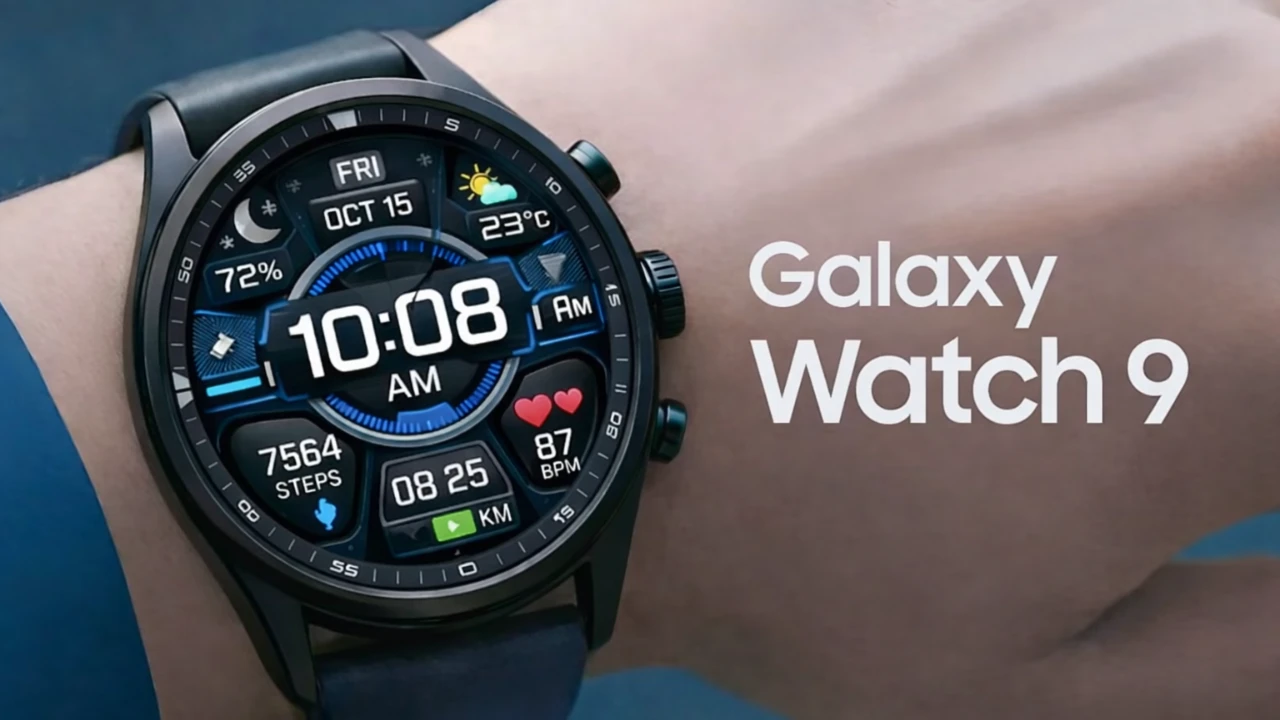
The Galaxy Watch9 reaches general availability on August 7, 2026, and the headline change is the silicon. It runs Qualcomm’s Snapdragon Wear Elite Platform, the same chip Samsung put in the Galaxy Watch Ultra2 announced alongside it.
The second change is the battery. Samsung has put a 390mAh cell in the 40mm model, which its FAQ describes as 20% larger than the Watch8 40mm, and describes the Watch9 as having a slimmer body. Samsung does not publish a Watch8 thickness alongside the Watch9, so how much slimmer is not something its own materials answer. Against the Watch7, which Samsung does show, the case is 8.6 mm versus 9.7 mm.
A wording conflict in Samsung’s own materials: Samsung’s newsroom describes the Galaxy Watch Ultra2 as the first Galaxy Watch powered by the Snapdragon Wear Elite Platform. The Galaxy Watch9 product page FAQ describes the Watch9 as the first Galaxy Watch with that platform. Both were announced on the same day and both use the chip, so the difference appears to be marketing wording rather than a hardware distinction. This article avoids the “first” framing for that reason.
The comparison Samsung does not put on its own page
Here is something odd. On the Galaxy Watch9 product page, Samsung offers a built-in comparison showing how the design and battery have changed over time. The two models it compares against are the Galaxy Watch7 and the Galaxy Watch6. The Galaxy Watch8 — last year’s model, the one an upgrader is most likely to own — is not in that comparison at all.
Samsung does address the Watch8 in its FAQ, but only on a single point: the Watch9 40mm has a 20% larger battery than the Watch8 40mm. Beyond that one figure, Samsung’s published comparison skips a generation.
So the honest version of a year-on-year comparison table is shorter than most sites will give you. Here is what Samsung actually publishes, marked for what it does and does not confirm.
| Spec | Galaxy Watch9 | Galaxy Watch7 | Galaxy Watch6 |
|---|---|---|---|
| Case thickness | 8.6 mm | 9.7 mm | 9.0 mm |
| Band weight | 14 g | 22 g | 23 g |
| Battery capacity | 390 mAh | 300 mAh | 300 mAh |
On the Watch8: The only year-on-year figure Samsung publishes is the battery. Its FAQ states the Watch9 40mm carries a 20% larger battery than the Watch8 40mm. Samsung does not publish a Watch8 thickness or band weight in its Watch9 comparison, so those rows are left blank here rather than filled in from elsewhere.
Full specifications
| Sizes | 40 mm and 44 mm |
| Dimensions & weight | 40mm: 42.7 × 40.4 × 8.6 mm (31.5 g) · 44mm: 46.0 × 43.7 × 8.6 mm (34.0 g) |
| Display | 40mm: 1.34-inch, 438×438 · 44mm: 1.47-inch, 480×480 · Super AMOLED, Full Colour Always On Display, up to 3,000 nits |
| Processor | Qualcomm Snapdragon Wear Elite — 3nm, 5-core (shared with Watch Ultra2) |
| Memory & storage | 2GB memory + 32GB storage |
| Battery | 40mm: 390 mAh · 44mm: 445 mAh · up to 30 hrs with Always On Display enabled |
| Charging | 40mm: 100% in 80 min (50% in 30 min) · 44mm: 100% in 90 min (45% in 30 min) |
| Casing | Aluminium, signature cushion silhouette |
| Durability | 5ATM / IP68 / MIL-STD-810H |
| Sensors | Samsung BioActive Sensor (optical bio-signal, electrical heart signal, bioelectrical impedance), temperature, accelerometer, barometer, gyro, geomagnetic, light |
| Connectivity | Bluetooth or Bluetooth + LTE, Wi-Fi, NFC, GPS (L1+L5 dual frequency) |
| Software | Wear OS 7 powered by Samsung, One UI 9 Watch; Google Gemini with Raise to Talk |
| Compatibility | Android 13.0 or higher with more than 1.5GB of memory; activation requires a phone supporting Google Mobile Services |
| Colours | 40mm: Graphite, Cream · 44mm: Graphite, Silver |
| Price | $379.99 Bluetooth / $429.99 LTE |
A note on sourcing: The table above is taken from the specification chart Samsung publishes at the foot of its Galaxy Watch Ultra2 and Watch9 press release, supplemented by its Watch9 product page and FAQ. Where Samsung gives a figure per size, both are shown rather than one being presented as the headline number.
The health stack is where Samsung is putting its weight
Samsung frames the updated Samsung Health app around five pillars: Activity, Mindfulness, Nutrition, Sleep and Vitals. Vitals is the newest piece, and the one Samsung leads with.
It works by establishing a personal baseline from five signals measured while you sleep — heart rate, heart rate variability, respiratory rate, skin temperature and blood oxygen saturation — then flagging when something falls outside your usual range. Samsung’s footnote sets a real setup cost on this: it requires wearing the watch for at least seven nights before a baseline exists, and Samsung specifies seven out of 28 nights for initial setup.
Sleep Apnea detection builds on the feature that, per Samsung’s Unpacked briefing, earned the company a De Novo authorisation from the US Food and Drug Administration in 2024. Samsung’s press release describes the 2026 version as backed by new FDA clearance, with an AI algorithm that counts breathing disruptions per hour and sorts them into three levels. Heart Health Score combines four daily factors into one number — sleep duration, blood pressure trend, BMI and vigorous activity, per the Watch9 FAQ. Fitness Index draws on body composition and workout history; Daily Cardio Load estimates strain and recovery need. Samsung also lists a Hearing feature that alerts to unsafe noise levels and produces reports, though it notes this must be switched on from the watch before it does anything.
Read Samsung’s own disclaimers: Samsung states plainly that Vitals, Heart Health Score and Blood Pressure Trend are not intended for diagnosing, treating or preventing disease, and are for personal reference only. Blood Pressure Trend also requires calibration against a separate blood pressure cuff, sold separately, every 28 days. These are Samsung’s own conditions, not an outside caveat.
Setup requirements worth knowing before you commit
A recurring theme in Samsung’s footnotes is that the marquee health features do not work on day one. Each carries its own qualifying period:
| Vitals | At least 7 nights of sleep data to build a baseline |
| Heart Health Score | 24 hours of wear, awake and asleep |
| Sleep Apnea | 2 nights of sleep data within a 10-day window; ages 22+ only |
| Bedtime Guidance | 3 nights of sleep analysis |
| Daily Cardio Load | 7 days of activity records; 28 days recommended for accuracy |
| Fitness Index | One BIA and one VO2 Max reading, plus 2 days of activity data |
Samsung also notes that Sleep Apnea is available in selected countries only, and that the feature should not be used by anyone pregnant or already diagnosed with sleep apnea.
Pricing and availability
Samsung’s newsroom release sets US pre-orders from July 22, with general availability from August 7, 2026. The Galaxy Watch9 starts at $379.99 for Bluetooth and $429.99 for LTE. The Galaxy Watch Ultra2, announced alongside it, is $699.99 in a single 47mm size.
| Announced | July 22, 2026 — Galaxy Unpacked, London |
| General availability | August 7, 2026 |
| Watch9 Bluetooth | $379.99 |
| Watch9 LTE | $429.99 |
| Watch Ultra2 | $699.99, 47mm only, Titanium Silver or Titanium Gray |
Included trials: Samsung lists a 60-day Strava trial and a 2-month iFIT trial with both watches. The Strava offer is worldwide with a list of excluded territories; the iFIT offer is limited to 23 named markets, which include Ireland, the UK, the US, Australia, Canada and much of western Europe.
Where the Ultra2 money goes: Samsung lists an 800mAh battery on the Ultra2 — 35% more than the previous Ultra — rated at up to 60 hours with Always On Display, against the Watch9’s 30. It has a 5,000-nit display Samsung calls a world first for a smartwatch, 10ATM and IP69K ratings with EN13319 dive certification, 64GB storage against the Watch9’s 32GB, a titanium casing, and a body 12% thinner than the previous generation. Two caveats from Samsung’s own footnotes: the Diving app is expected later in 2026, developed with Mares, and beyond depth, timer and ascent alarm its features require a subscription.
My Take — Mr Wangdoo
The chip is the story here, and it is a bigger deal than a spec-sheet line makes it look. Samsung’s own specification chart lists the same Qualcomm Snapdragon Wear Elite platform for the Watch9 and the Ultra2, and the Watch9 product page carries “Powered by Snapdragon” branding of the kind usually reserved for phones. Putting a partner’s platform across an entire flagship line is a decision about who builds the foundation of the product, not a routine spec bump.
What I keep coming back to, though, is that missing Watch8 comparison. Samsung built a nice interactive on its own product page showing how the Watch9 stacks up against older models, and quietly picked the Watch7 and Watch6 to sit next to it. If the year-on-year gains were large, that is the comparison you would lead with. Choosing the two-year-old and three-year-old models instead is a choice, and it tells you something about how much changed in twelve months outside the battery and the chip.
The other thing I would want anyone reading a health-feature list to notice is how much of it is conditional. Vitals needs a week of nights before it says anything. Daily Cardio Load wants 28 days for accuracy. Blood Pressure Trend needs a cuff you buy separately and recalibration every 28 days. None of that is hidden — it is all in Samsung’s own footnotes — but a feature that needs a month of consistent wear to become useful is a different proposition from one that works out of the box.
On battery, Samsung does put a number on it: up to 30 hours with Always On Display enabled. Set that against the Ultra2’s 60 hours from an 800mAh cell and the shape of the range becomes clear — the Ultra2 carries roughly twice the capacity and claims roughly twice the runtime. What a quoted figure cannot tell you is how the watch behaves with GPS running, sleep tracking every night and a week of Vitals data collection on top. That needs testing, and I have not handled the device.
Frequently asked questions
When does the Galaxy Watch9 go on sale?
Samsung opened US pre-orders on July 22, 2026, the day of Galaxy Unpacked in London, with general availability starting August 7, 2026.
How much does the Galaxy Watch9 cost?
Samsung lists the Galaxy Watch9 from $379.99 for the Bluetooth model and $429.99 for the LTE model. The Galaxy Watch Ultra2, announced at the same event, is $699.99.
How is the Galaxy Watch9 different from the Galaxy Watch8?
Samsung publishes one direct year-on-year figure: the Watch9 40mm has a 20% larger battery than the Watch8 40mm, at 390mAh. The Watch9 also moves to the Snapdragon Wear Elite Platform. Samsung’s own on-page comparison tool compares the Watch9 against the Watch7 and Watch6 rather than the Watch8, so other direct year-on-year figures are not published there.
How long does the Galaxy Watch9 battery last?
Samsung rates the Galaxy Watch9 at up to 30 hours with Always On Display enabled. The 40mm model carries a 390mAh battery and the 44mm a 445mAh battery. Samsung quotes charging at 100% in 80 minutes for the 40mm and 90 minutes for the 44mm.
What sizes and colours does the Galaxy Watch9 come in?
Two sizes. The 40mm model comes in Cream and Graphite; the 44mm model comes in Silver and Graphite.
What is the Vitals feature?
Vitals tracks five signals while you sleep — heart rate, heart rate variability, respiratory rate, skin temperature and blood oxygen saturation — and builds a personal baseline to flag unusual changes. Samsung requires at least seven nights of sleep data before a baseline exists, and states the feature is for wellness only, not for diagnosing or treating any medical condition.
Does the Galaxy Watch9 work with an iPhone?
Samsung’s specification chart lists compatibility as Android 13.0 or higher with more than 1.5GB of memory, and states that device activation is only available after connecting to a smartphone supporting Google Mobile Services. Samsung does not list iOS compatibility.
Sources
- Samsung Newsroom — “Samsung Galaxy Watch Ultra2 and Watch9: Your Health Companion on the Wrist.” news.samsung.com
- Samsung Newsroom — “[Galaxy Unpacked July 2026] A First Look at Galaxy Watch Ultra2 and Galaxy Watch9.” news.samsung.com
- Samsung — “Galaxy Watch9 Official Product Page” (including published FAQ and footnotes). samsung.com