DC‑ROMA RISC‑V Mainboard III: DeepComputing’s Open‑Source Motherboard That Challenges Intel

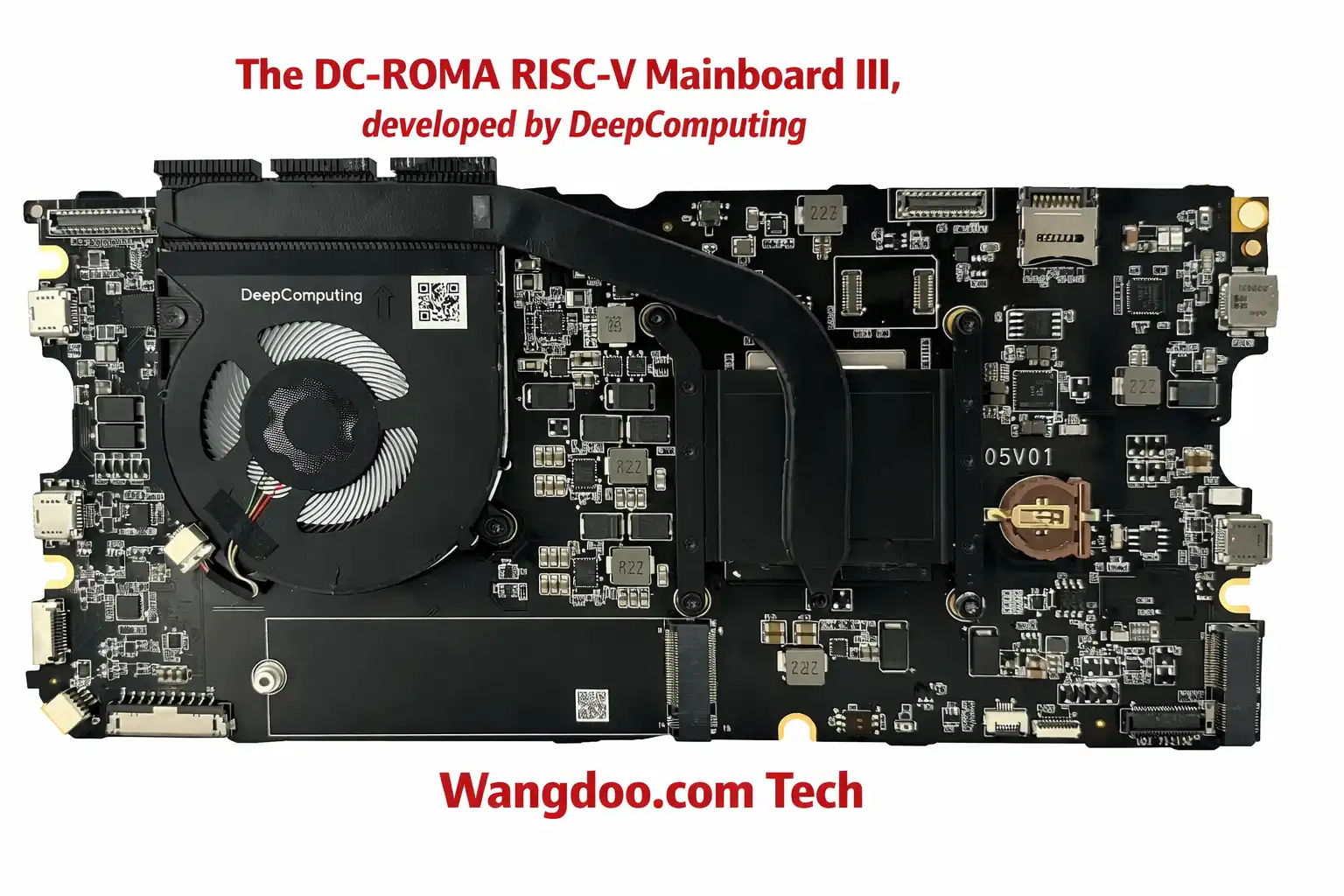
DC-ROMA RISC-V Mainboard III Explained: The Open-Source Chip That Replaces Intel in Your Laptop
DeepComputing’s third-generation RISC-V mainboard drops directly into the Framework Laptop 13 chassis — replacing Intel or AMD with a completely open-source processor architecture, 60 TOPS of AI performance, and no proprietary licensing. Here is everything confirmed about what it is, how it works, who built it, and who it is designed for.
Editorial transparency: Wangdoo.com has not physically tested the DC-ROMA RISC-V Mainboard III. This article was written independently — Wangdoo.com was not paid, sponsored, or contacted by DeepComputing or Framework to write this article and received no product samples, fees, or any other compensation. No commercial relationship exists with either company. This article is a factual overview based on the official DeepComputing product page, the FOSDEM 2026 announcement, Framework’s NextGen event coverage, CNX Software’s technical analysis, LinuxGizmos, Electronics-Lab, EmbedSBC, DigitalCitizen.life, the DeepComputing official blog, IEEE Spectrum’s interview with CEO Yuning Liang, and Phoronix benchmark testing. All specifications are sourced from primary documentation. Where any commercial relationship develops in the future, it will be disclosed clearly at the top of the relevant article.
Every laptop you have ever owned has one thing in common: the chip inside it is proprietary. Intel’s x86 architecture is licensed and controlled by Intel. AMD’s x86-64 is licensed and controlled by AMD. Arm’s architecture is licensed by Arm Holdings, which charges royalties to every company that uses it. The processor that runs your computer — the fundamental layer of everything your machine does — belongs to a corporation, not to you.
RISC-V is the first credible attempt to change that at the laptop level. It is an open-source instruction set architecture developed at the University of California, Berkeley, in 2010 — free for anyone to use, modify, implement, or build on without licensing fees or restrictions. And for the first time, a company has built a mainboard powered by RISC-V that drops directly into an existing, widely-owned laptop chassis — the Framework Laptop 13 — allowing owners to swap their Intel processor for an open-source alternative without replacing the screen, keyboard, battery, or chassis.
That mainboard is the DC-ROMA RISC-V Mainboard III, made by Hong Kong-based DeepComputing. It ships in June 2026. Here is everything confirmed about what it is and why it matters.
The DC-ROMA RISC-V Mainboard III is a drop-in replacement mainboard for the Framework Laptop 13, powered by the SpacemiT K3 — the world’s first RISC-V SoC to support the RVA23 profile. It features a 16-core RISC-V CPU (8 RVA23 + 8 RVA22 AI cores), up to 32GB LPDDR5, up to 60 TOPS of AI compute, and full compatibility with Framework’s Expansion Card system. Starting price: $699 (16GB, no SSD). First batch ships end of June 2026. A $99.99 refundable deposit reserves a unit. OS: Ubuntu 24.10 — developer usage, not production-ready.
// DeepComputing CEO Yuning Liang & Canonical — RISC-V Forward to the Future: The Move to RVA23 (Ubuntu Summit 2025)
Who Is DeepComputing and Who Made This?
DeepComputing is a hardware company founded in 2022 and headquartered in Sheung Wan, Hong Kong. Its founder and CEO is Yuning Liang, who previously founded Xcalibyte — a compiler software company — in 2018. The idea for DeepComputing came when Liang configured an old MIPS processor to compile for RISC-V and realised there was almost no RISC-V hardware available for personal use. He identified a self-reinforcing problem: developers were not building RISC-V software because there was no accessible hardware, and hardware manufacturers were not building RISC-V devices because there was insufficient software. His solution was to become the hardware company that breaks that cycle.
DeepComputing shipped the world’s first RISC-V laptop — the DC-Roma — in 2023, followed by the DC-Roma II in 2024 with Ubuntu Linux pre-installed. The Framework Laptop 13 mainboard programme began with the Mainboard I (StarFive JH7110 chip) and Mainboard II (ESWIN EIC7702X chip, 50 TOPS). The Mainboard III is the third generation of that programme and the most capable yet.
“We built this to empower developers who believe in local-first AI, open innovation, and sustainable computing. It’s a foundational step toward a more open and privacy-respecting computing future.”
— Yuning Liang, Founder & CEO, DeepComputingThe mainboard was first unveiled publicly at FOSDEM 2026 on January 31, 2026 — the world’s largest open-source software conference — and appeared again at Framework’s NextGen event in April 2026. Orders opened in May 2026 with first batch delivery confirmed for the end of June 2026.
What Is RISC-V and Why Does It Matter?
RISC-V (pronounced “risk five”) is an open-source Instruction Set Architecture — the fundamental language that defines how software communicates with hardware. It was developed at the University of California, Berkeley beginning in 2010 and released publicly with no licensing restrictions. Any company, individual, researcher, or government can implement RISC-V in hardware without paying royalties to anyone.
This is fundamentally different from every other mainstream chip architecture. Intel and AMD’s x86 is proprietary — you cannot legally build an x86 chip without licensing from those companies. Arm’s architecture, used in Apple Silicon and most smartphones, requires licensing from Arm Holdings. RISC-V has no such gatekeeper. It has been described as “the Linux of processor architectures” — open, community-developed, and free to use.
RVA23 is the 2023 edition of the RISC-V Application processor profile — a standardised specification that defines what extensions a processor must support to ensure software compatibility across different RISC-V implementations. Before profiles like RVA23, RISC-V software often had to be compiled specifically for each chip’s unique feature set. RVA23 means software written for one RVA23-compliant chip should run on any other. The SpacemiT K3 in the DC-ROMA Mainboard III is the first RISC-V SoC to implement RVA23 — making it the first step toward a portable RISC-V software ecosystem for laptop computing.
Full Confirmed Specifications
| Specification | DC-ROMA RISC-V Mainboard III |
|---|---|
| SoC | SpacemiT K3 — world’s first RVA23-compliant RISC-V SoC First |
| CPU cluster 1 | 8× RISC-V X100 cores — RVA23 compliant, up to 2.4GHz (marketed as 2.5GHz by SpacemiT; independently measured at 2.4GHz by Phoronix and CNX Software), ~130 KDMIPS (similar to Rockchip RK3588) |
| CPU cluster 2 | 8× RISC-V A100 AI cores — RVA22 compliant, up to 1,024-bit RVV1.0 parallel computing, optimised for matrix operations |
| Total cores | 16-core RISC-V (8 + 8 heterogeneous) |
| GPU | Imagination Technologies BXM4-64-MC1 — Vulkan 1.3, OpenCL 3.0, OpenGL ES 1.1/2.0/3.2 |
| AI performance | Up to 60 TOPS general-purpose AI compute (sparse) Confirmed |
| LLM inference | Up to 30B parameter models at 10+ tokens per second (SpacemiT claim, independently cited by LinuxGizmos) |
| NPU | 30 TOPS NPU (dense) |
| RAM options | 16GB LPDDR5 (base) / 32GB LPDDR5 (upgraded) |
| Storage slot | M.2 2280 Key-M — supports both SATA and NVMe; optional 1TB NVMe SSD |
| Expansion storage | MicroSD card slot |
| USB-C ports | 4× USB-C via Framework Expansion Card system |
| Charging | 65W USB PD 3.0 via two of the USB-C ports |
| Display output | DisplayPort 1.4 (up to 4K @ 60Hz) via USB-C |
| Operating system | Ubuntu 24.10 pre-installed Developer use — not production-ready |
| Framework compatibility | Framework Laptop 13 — all generations (2021 Intel onwards) Confirmed |
| First shown publicly | FOSDEM 2026, January 31, 2026 |
| Also shown at | Framework NextGen Event, April 2026 |
| Price (16GB, no SSD) | $699 USD |
| Price (32GB) | $999 USD |
| Early access deposit | $99.99 USD — fully refundable |
| First batch shipping | End of June 2026 |
| Ubuntu Pro support | Optional paid subscription from Canonical for security maintenance |
The Framework Laptop 13 Connection — Why It Matters
The Framework Laptop 13 is one of the most significant laptops sold in the past five years — not because of its performance, but because of its philosophy. Framework designed it to be fully repairable and modular: the display, keyboard, battery, ports, and mainboard are all replaceable by the owner with standard screwdrivers. The mainboard is not soldered to the chassis. It slides in and out.
This design decision — which Framework calls the Expansion Card system — makes the DC-ROMA RISC-V Mainboard III possible in a way that would be impossible with any other laptop brand. An owner of a Framework Laptop 13 with an 11th, 12th, or 13th generation Intel mainboard can unscrew the bottom panel, slide out the existing Intel motherboard, slide in the DC-ROMA RISC-V Mainboard III, and boot into Ubuntu on a completely open-source processor architecture — while keeping every other component they already own.
When swapping to the DC-ROMA RISC-V Mainboard III, Framework Laptop 13 owners keep: the display (13.5-inch, 2256 × 1504px or 2.2K depending on generation), the keyboard, the trackpad, the battery, the chassis, and all four Expansion Card slots. The mainboard is the only component that changes. No new laptop purchase required.
“This launch is a powerful demonstration of what’s possible when modular design meets open architecture. We’re happy to see DeepComputing bringing a substantially more powerful RISC-V processor to developers worldwide through the Framework Laptop ecosystem.”
— Nirav Patel, Founder & CEO, FrameworkHow It Compares to Previous DC-ROMA Mainboards
| Feature | Mainboard I (2024) | Mainboard II (2025) | Mainboard III (2026) |
|---|---|---|---|
| SoC | StarFive JH7110 | ESWIN EIC7702X | SpacemiT K3 |
| CPU cores | 4× SiFive U74, 1.5GHz | 8× SiFive P550, 2GHz | 16-core (8+8), up to 2.4GHz |
| RISC-V profile | RVA20 | RVA22 | RVA23 — first laptop ever |
| AI performance | None | 50 TOPS (NPU) | 60 TOPS (general purpose) |
| Max RAM | 8GB | 64GB | 32GB LPDDR5 |
| Memory type | LPDDR4 | LPDDR4X | LPDDR5 |
| Starting price | $199 | $349 | $699 |
| OS pre-installed | Ubuntu / Fedora | Ubuntu 24.04 LTS | Ubuntu 24.10 |
| Performance class | Raspberry Pi 3 level | Basic productivity | ~Arm Cortex-A76 class |
The jump from Mainboard I (no AI acceleration) to Mainboard III (60 TOPS) is not incremental — it is an order-of-magnitude shift. Mainboard II’s 2 TOPS NPU was capable of basic edge inference. At 60 TOPS, Mainboard III can run local AI models, on-device inference pipelines, and AI-accelerated workloads at speeds that were previously only possible on cloud GPU instances or dedicated AI hardware. This is the most significant single upgrade in the DC-ROMA Mainboard line.
How to Install the DC-ROMA RISC-V Mainboard III
Confirm Framework Laptop 13 compatibility
The DC-ROMA RISC-V Mainboard III is compatible with all Framework Laptop 13 generations from 2021 onwards — including the original 11th Gen Intel model and all subsequent Intel and AMD generations. Verify your laptop model number before ordering.
Place your order and pay the deposit
Order through the DeepComputing store at store.deepcomputing.io. A fully refundable $99.99 deposit secures your place in the first batch. The remaining balance is collected by email before shipment.
Back up your existing system
Before swapping mainboards, back up all data from your existing Framework system. The new mainboard runs Ubuntu 24.10 and does not carry over any data from your previous operating system.
Swap the mainboard
Framework’s official guides walk through mainboard replacement. The process requires a Torx T5 screwdriver and takes approximately 15–20 minutes. The DC-ROMA RISC-V Mainboard III slots into the same position as any standard Framework Laptop 13 mainboard.
Boot into Ubuntu 24.10 on RISC-V
The mainboard ships with Ubuntu 24.10 pre-installed. Boot directly into a RISC-V Linux environment. All four Expansion Card slots are fully functional. DisplayPort, USB, and 65W charging work from day one.
Who Is the DC-ROMA RISC-V Mainboard III For?
DeepComputing explicitly states on the product page: “This Ubuntu instance is for RISC-V developer usage and is not production-ready.” The RISC-V software ecosystem is still maturing. Not all applications are compiled for RISC-V. Performance on RVA23 is improving but lags behind x86 and modern Arm for many tasks. This mainboard is for developers, researchers, and open-source contributors — not for users expecting a seamless daily driver replacement.
RISC-V Developers
The primary audience. A native RISC-V laptop enables compiling, testing, and debugging RISC-V software without emulation — significantly faster and more accurate than cross-compilation.
Open Hardware Advocates
Anyone philosophically opposed to proprietary processor licensing. RISC-V is the only mainstream architecture with no licensing fees — complete ownership of the hardware stack.
Edge AI Researchers
60 TOPS of general-purpose AI compute on an open-source architecture. The K3 is confirmed to run 30B parameter language models at over 10 tokens per second — the first RISC-V platform capable of meaningful local AI inference without a GPU.
Computer Architecture Students
Study processor architecture on real hardware. RISC-V’s open specification means students can read exactly how the chip they are running works — top to bottom.
Governments and Institutions
Nations seeking computing independence from US or Chinese chip companies. RISC-V’s license-free nature makes it the only architecture where full sovereignty is possible.
Framework Laptop Owners
Existing Framework Laptop 13 owners who want to extend the life of their chassis with a next-generation processor without buying a new laptop.
What About Performance?
This is the honest question and the article would be incomplete without addressing it directly. The DC-ROMA RISC-V Mainboard III is significantly more capable than its predecessors — but it is not a performance competitor to the Intel Core Ultra or AMD Ryzen chips that normally go in a Framework Laptop 13.
DeepComputing’s CEO Yuning Liang confirmed in his IEEE Spectrum interview that the Mainboard III targets performance comparable to an Arm Cortex-A76 — the architecture used in the Raspberry Pi 5. Phoronix, which tested a K3-powered system ahead of the DC-ROMA launch, independently confirmed the X100 cores running at 2.4GHz deliver performance broadly comparable to a Cortex-A76 — consistent with DeepComputing’s own positioning and giving the claim third-party corroboration beyond manufacturer statements.
CNX Software notes that the 8 RVA23 X100 cores achieve approximately 130 KDMIPS — a performance metric comparable to Rockchip’s RK3588 chip used in high-end single-board computers. For RISC-V, this represents a generational leap. For anyone coming from an Intel laptop, it represents a meaningful step down in raw compute performance.
The 60 TOPS AI performance figure changes the calculus for AI workloads specifically. For inference tasks — running pre-trained models locally — TOPS matter more than CPU GHz. At 60 TOPS, the Mainboard III is capable of running meaningful local AI inference workloads that the previous generations could not touch.
RISC-V Mainboard III vs Standard Intel or AMD Framework Mainboard — The Direct Question
Framework Laptop 13 owners will ask this directly: should I get a RISC-V mainboard or stick with Intel or AMD? The honest answer depends entirely on your use case. A Framework Laptop 13 with a 12th or 13th Gen Intel Core Ultra mainboard will outperform the DC-ROMA RISC-V Mainboard III on virtually every general computing task — web browsing, document editing, video playback, and productivity software. Intel and AMD mainboards for the Framework cost between $179 and $399 and run the full Windows or mainstream Linux software stack without compatibility concerns.
The DC-ROMA RISC-V Mainboard III is not competing on those terms. It exists for a different purpose: native RISC-V development, open hardware research, edge AI on an open architecture, and computing independence from proprietary chip licensing. If those goals matter to you — professionally or philosophically — the RISC-V mainboard is the only option. If you simply want the best-performing Framework Laptop 13 for everyday use, an Intel or AMD mainboard is the correct choice.
The DC-ROMA RISC-V Mainboard III is available directly through the DeepComputing store at store.deepcomputing.io. A $99.99 fully refundable deposit reserves your place in the first batch — the remaining balance is collected by email before shipment. Shipping fees and customs duties are not included. First batch ships end of June 2026. The Early Access Programme is designed for developers and early adopters — DeepComputing explicitly notes the Ubuntu instance is for developer usage and is not production-ready.
Frequently Asked Questions
What is the DC-ROMA RISC-V Mainboard III?
What is RISC-V and how is it different from Intel or AMD?
Which Framework Laptop 13 models are compatible?
Is the DC-ROMA RISC-V Mainboard III suitable for everyday use?
What is RVA23 and why does it matter?
How much does the DC-ROMA RISC-V Mainboard III cost?
Can I keep my existing Framework Laptop and just swap the mainboard?
Who is DeepComputing and are they credible?
Can you run AI models on a RISC-V laptop?
Are there any reviews of the DC-ROMA RISC-V Mainboard III?
Is a RISC-V laptop worth buying in 2026?
Sources & References
- DeepComputing Official — DC-ROMA RISC-V Mainboard III unveiled at FOSDEM 2026, January 31, 2026
- DeepComputing Store — DC-ROMA RISC-V Mainboard III product page (primary specs source)
- DeepComputing Official Website — deepcomputing.io
- CNX Software — SpacemiT K3-powered DC-ROMA RISC-V Mainboard III, May 13, 2026
- LinuxGizmos — DC-ROMA RISC-V Mainboard III RVA23, February 2026
- Electronics-Lab — DC-ROMA RISC-V Mainboard III full specs, March 9, 2026
- DigitalCitizen.life — DeepComputing brings RISC-V upgrade to Framework Laptop 13, May 2026
- EmbedSBC — DC-ROMA RISC-V Mainboard III technical analysis, February 2026
- IEEE Spectrum — RISC-V Laptops Really Arrive in 2025 (Yuning Liang interview), January 2025
- Phoronix — Initial SpacemiT K3 RVA23 RISC-V CPU Benchmarks (confirms 2.4GHz, Cortex-A76 class performance), May 2026
- CNX Software — SpacemiT K3 system information and early benchmarks (confirms 2.4GHz real-world clock), January 2026
- Canonical — DC-ROMA RISC-V AI PC with Ubuntu 24.04 LTS (includes Framework CEO and RISC-V International CTO quotes)