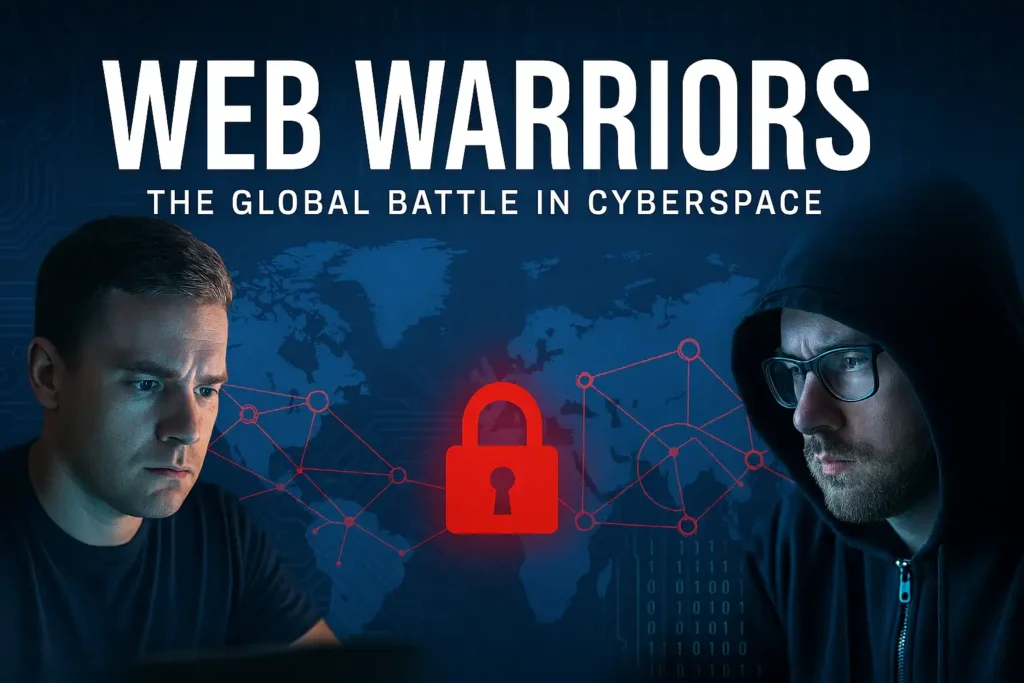
The internet was once heralded as a force for liberation, commerce, and culture. But as Web Warriors lays bare, it has also become a contested warzone. The documentary defines the conflict, establishes the stakes, and reveals the combatants engaged in an escalating global battle where keystrokes can have consequences far beyond the screen12.
A conflict without borders
Web Warriors frames modern cyber conflict as constant and borderless. Attacks can be launched from a bedroom, routed through compromised networks, and felt by households, hospitals, and stock markets alike. The film underscores a stark headline: cybercrime’s global impact has been measured in the hundreds of billions annually, and it continues to grow as criminal groups and nation-state actors refine their tools and tactics.
While the documentary cites an annual cost of more than $500 billion, broader analyses show that estimates have climbed sharply since its 2008 release. Industry and research projections now range from over $1 trillion to multi-trillion figures, reflecting direct losses, downtime, reputational damage, and systemic disruption.

Michael Calce: the teenager who tested the web’s armour
One of Web Warriors’ most striking narratives is that of Michael Calce, known online as “Mafiaboy.” At just 15, Calce carried out a wave of distributed denial-of-service (DDoS) attacks in February 2000 against some of the internet’s biggest names, including Yahoo!, Amazon, CNN, and Dell. By flooding targets with traffic from compromised machines, he demonstrated that even the largest platforms were vulnerable to coordinated digital pressure78.
The attacks—linked to Calce’s “Project Rivolta”—brought Yahoo! down for nearly an hour and were followed by disruptions to eBay, CNN, Amazon, and Dell over the subsequent days. His case became a watershed moment, catalysing public understanding of DDoS as a weapon, and underscored the difficulty of attribution and deterrence in cyberspace79.
Web Warriors features Calce recounting how those events unfolded from the vantage point of a teenager in his bedroom, speaking to the unnerving accessibility of attack tools and the ripple effects that can follow from their use.
Donnie Werner: a grey hat in the underworld
The documentary also follows Donnie Werner—online alias “Morning Wood”—a grey hat hacker who inhabits the blurred terrain between disclosure and criminal pursuit. Werner’s storyline takes him into direct contact with the Russian cyber mafia as he searches for the creators of a new computer virus, illustrating how organised cybercrime operates with the structure, scale, and reach of multinational enterprises.
In exploring Werner’s investigation, Web Warriors highlights the ecosystem of malware authors, brokers, and affiliates—an underground economy that thrives on stolen data, extortion, and service-based crimeware. The film’s perspective is reinforced in broadcast adaptations that emphasise both the personal risk and the systemic sophistication behind modern cyber gangs.
The stakes: from bank accounts to power grids
The film’s thesis is clear: the stakes in digital warfare are vast. Beyond direct theft, attacks can shutter commerce, undermine trust in democratic processes, and strain vital services like healthcare and energy. Web Warriors presents this as a wake-up call—the global economy’s losses were already estimated at hundreds of billions of dollars annually by the late 2000s, and the scale has only intensified.
Recent data points to a dramatic escalation. Analysts project that annual cybercrime impacts will reach into the trillions by the mid-2020s, encompassing direct losses, downtime, brand damage, and nation-state operations. Estimates vary, but even conservative figures signal an economic shock that governments and businesses cannot ignore.
Ireland’s exposure and responsibility
Ireland’s position as a European technology hub, home to primary multinational operations and an increasingly digital public sphere, heightens both its exposure and its responsibility. The lessons of Web Warriors are acutely relevant here: robust defences, rapid incident response, and cross-border cooperation are essential. As more critical services become connected—from payments to energy—the resilience of Irish systems becomes a matter of public safety and economic continuity.
Ethics, ambiguity, and the rules of engagement
Web Warriors doesn’t romanticise hacking; it interrogates the ethical grey zones. Grey hats may reveal vulnerabilities, but they can also breach laws and norms. Likewise, governments develop offensive cyber capabilities alongside defensive measures, complicating the moral calculus. The documentary invites viewers to consider accountability, proportionality, and transparency in a domain where deterrence is collateral and challenging damage can be hidden yet profound.
A pragmatic wake-up call
The film delivers its warning without technical jargon: this is the era of digital warfare. Cyberattacks are not a remote possibility; they are a daily reality. That message has only grown sharper with time. Where Web Warriors set the alarm at $500 billion-plus annual losses, later analyses—factoring in underreported incidents and secondary effects—place the global toll anywhere from $1 trillion to multiple trillions, depending on methodology and scope. Precision is elusive, but the direction of travel is unmistakable.
For businesses, governments, and citizens, pragmatic steps matter: strong authentication, patch discipline, network segmentation, rehearsed incident response, and honest post-incident communication. For policymakers, harmonised laws, shared threat intelligence, and investment in talent pipelines are not optional—they are the baseline for national resilience in a connected age.
Conclusion: the war is already underway
Web Warriors closes with a reminder that the combatants in this conflict are as diverse as their motives: teenage hackers, professional cybercriminals, corporate defenders, and state teams. The weapons are code, botnets, and exploits; the terrain is everywhere that networks reach. The battles rarely make noise, yet their outcomes shape economies, privacy, and trust. The war has already begun—and the cost of complacency is rising fast.
In Ireland and beyond, the path forward is not fear, but preparation. Treat cybersecurity as infrastructure—plan for failures. Share intelligence. Invest in people. And remember the lesson that Web Warriors captured early: in cyberspace, the smallest actor can create an outsized impact—making collective vigilance our most credible defence.
Mojo | Tech Correspondent at Wangdoo.com Cybersecurity and digital trends specialist. Breaking down complex tech with clear insights. Advocates innovative tools like Cloudflare to keep the internet resilient.