AI Found a Cheaper Way to Print NASA’s Rocket Alloy

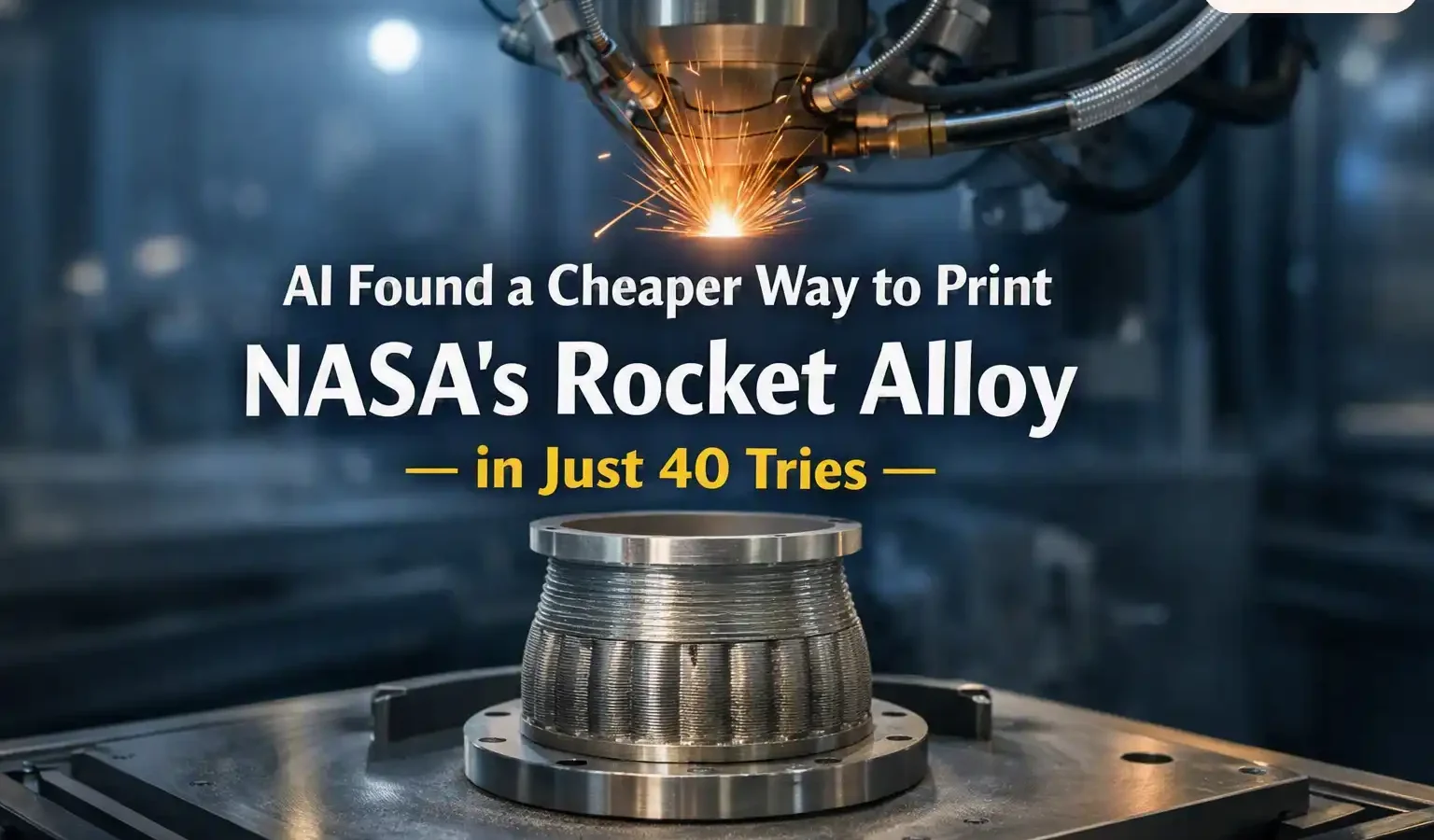
In short: GRCop-42 is a copper alloy NASA developed for rocket engine parts, and 90% of commercial 3D printers can’t print it at all. Finding settings that work means testing physical configurations one at a time, at hundreds of dollars per attempt, out of more than 100 million theoretical combinations. A WSU team built an AI model that predicted which untested settings were most likely to succeed, then used that to guide just 40 real experiments — finding six working configurations, including the first successful print at a record-low 500 watts of laser power.
The alloy almost nothing can print
GRCop-42 is a copper-chromium-niobium alloy NASA developed for parts that need to survive extreme heat without losing strength — the kind of environment inside a liquid rocket engine’s combustion chamber. That combination of properties is exactly why it’s difficult to work with: printing it currently requires high laser power that most commercial 3D printers simply can’t deliver. According to Professor Jana Doppa’s own account of the research, roughly 90% of commercial printers are unable to print the alloy at all.
Even on equipment that can attempt it, getting the settings right has been mostly trial and error. A single failed print run can cost hundreds of dollars in materials, and evaluating whether a print actually succeeded can take days of post-processing analysis. PhD student Azza Fadhel, the study’s first author, described what that failure looks like in practice: “Sometimes they printed a certain configuration, and the product just melted.”
Why testing every option was never realistic
The number of possible printer settings for this alloy exceeds 100 million combinations, and the research team’s own published paper notes they already knew going in that only a small fraction would actually work. Testing all of them individually — at hundreds of dollars and potentially days of evaluation per attempt — was never a realistic option, financially or in terms of time. The team’s starting point was 37 configurations that had already failed in earlier attempts by WSU’s own materials engineering researchers, which became training data rather than wasted effort.
Why this is a hard problem for AI, not just a big search. Each real-world test only returns one of two outcomes: the print worked, or it didn’t. There’s no partial credit, no gradient telling the model it’s “getting warmer.” Professor Jana Doppa, who led the research, put the core difficulty simply: “it’s a very challenging case for AI” — every trial gives a binary success-or-failure signal, and the goal is finding rare successes in that huge space while running as few costly physical experiments as possible.
How the AI actually chose which experiments to run
| The method | Called BEAM (Bayesian Experimental design for Additive Manufacturing) in the team’s published paper — a model that estimates how likely an untested printer setting is to succeed, based on results seen so far. |
| The selection strategy | Each round, the model picked a small batch of new settings to physically test, deliberately mixing configurations it was fairly confident would work with uncertain ones that would teach the model the most regardless of outcome. |
| Why failures still counted | Every real test — success or failure — improved the model’s next batch of predictions. Fadhel described the value of failed attempts directly: they “improved our AI model” even when the print itself didn’t work. |
| The physical loop | WSU computer scientists selected the settings; a separate materials engineering team, including Nathaniel Zuckschwerdt, Susmita Bose, and Amit Bandyopadhyay, physically printed and evaluated each sample, with Aryan Deshwal at the University of Minnesota also contributing to the modeling work. |
The results
Over three months, the team ran its full budget of 40 physical experiments and came away with six configurations that reliably printed GRCop-42 — including, for the first time, a successful print at just 500 watts of laser power, well below what the alloy has previously required. That specific result matters beyond the headline number: lower laser power means less energy consumed, less wear on the printing equipment, and lower post-processing costs, and it’s the kind of setting that ordinary commercial printers — not just specialized industrial machines — can potentially reach.
What “democratizing” this alloy would actually mean
Doppa framed the practical stakes plainly: since most commercial printers can’t currently handle GRCop-42 at all, finding settings that work on more accessible equipment could open the alloy up to universities, small labs, and companies that don’t own specialized high-power printing systems — organizations for whom the alloy has effectively been out of reach regardless of how useful it might be to their own work. WSU’s team also believes the same AI-guided approach isn’t specific to this one alloy: it could, in principle, be adapted to find working settings for other metal alloys and other additive manufacturing systems, and more broadly for any scientific problem where successful outcomes are rare, each real test is expensive, and testing everything simply isn’t an option — the same underlying shape of problem behind a materials-science efficiency story covered on this site earlier this month, where the constraint wasn’t a search space but raw power consumption.
What’s still unproven
Six working configurations validate that the alloy can be printed at lower power — they don’t by themselves establish that parts printed this way meet the mechanical performance a real rocket engine component would need under actual operating stress. None of the publicly available summaries of this research — WSU’s own release, the published abstract of the peer-reviewed companion journal article, or the independent science press coverage — mention independent mechanical testing results for the printed samples, though the full papers behind these abstracts may cover technical detail not reflected in what’s publicly summarized. Doppa’s own framing of the project keeps this in perspective: as he put it, “I was very surprised that we were able to do this so well” — a result the researchers themselves treat as a genuine success against real uncertainty, not a foregone conclusion.
A research result, not a manufacturing standard yet. The team’s own stated next step is adapting the same framework to other alloys and manufacturing systems — language describing an active research direction, not a finished, deployable process. Getting from “six working lab configurations” to something a small company or university lab can reliably replicate on its own equipment is a separate, unstated timeline.
My Take — Mr Wangdoo
What stands out here isn’t that AI helped with manufacturing — that’s increasingly common. It’s the specific shape of the problem it solved: a search space too large to brute-force, where every real test costs real money, and the only feedback is a flat yes or no. That’s a much narrower and more honest description of what AI is actually good for than most “AI breakthrough” coverage tends to offer. No language model wrote code or generated an image here — a statistical model made a sequence of useful bets about which expensive physical experiments were worth running, and it made those bets well enough to beat months of manual trial and error down to 40 tries. If the same approach really does generalize to other alloys, other manufacturing problems, or drug discovery as the researchers suggest, the actual contribution is this: turning “we can’t afford to test everything” from a hard stop into a solvable resource-allocation problem.
Common questions
What is GRCop-42 and why is it hard to print?
A copper-chromium-niobium alloy developed by NASA for high-heat aerospace applications like rocket engine combustion chambers. It requires high laser power to print successfully, which roughly 90% of commercial 3D printers can’t deliver.
How did the AI actually reduce 100 million options to 40 experiments?
The team’s method, called BEAM, built a predictive model estimating how likely an untested printer setting was to succeed, based on results from prior tests. Each round, it selected a small batch of new settings that mixed likely successes with uncertain configurations that would improve the model’s future predictions.
What did the AI actually find?
Six working printer configurations at different laser power levels, including the first successful print of GRCop-42 at just 500 watts — a record low that could make the alloy printable on more widely available commercial equipment.
Can this AI approach be used for other materials?
The researchers believe the same framework could be adapted to other metal alloys and additive manufacturing systems, and more broadly to other scientific problems where successful outcomes are rare and testing every possibility is too costly — including, they suggest, drug discovery. This hasn’t yet been demonstrated beyond the current study.
Is this alloy ready for wider commercial use now?
Not yet. The research demonstrates that lower-power printing is possible and repeatable in a lab setting, but the publicly available summaries of this research don’t mention independent mechanical performance testing of the printed parts under real operating conditions, and the researchers describe extending the method to other materials as a future step, not a completed one.
Sources
- Washington State University — “Researchers use AI to ‘democratize’ 3D printing of crucial metal alloy,” original research announcement with full researcher quotes. news.wsu.edu
- ScienceDaily — supplementary coverage confirming the 500-watt milestone and alloy background. sciencedaily.com
- Phys.org — supplementary coverage confirming Doppa’s quotes and the drug-discovery generalization claim. phys.org
- 3dprinting.com — supplementary coverage confirming the 37 prior failed configurations. 3dprinting.com
- Fadhel, A. et al. — “Discovery of Feasible 3D Printing Configurations for Metal Alloys via AI-Driven Adaptive Experimental Design,” Proceedings of the AAAI Conference on Artificial Intelligence, 2026. ojs.aaai.org
- Fadhel, A. et al. — “Artificial intelligence-driven approach to accelerate discovery of directed energy deposition of GRCop-42,” peer-reviewed companion journal article. tandfonline.com