A Space Mirror Just Got Approved to Beam Sunlight to Earth – On Demand Sunlight

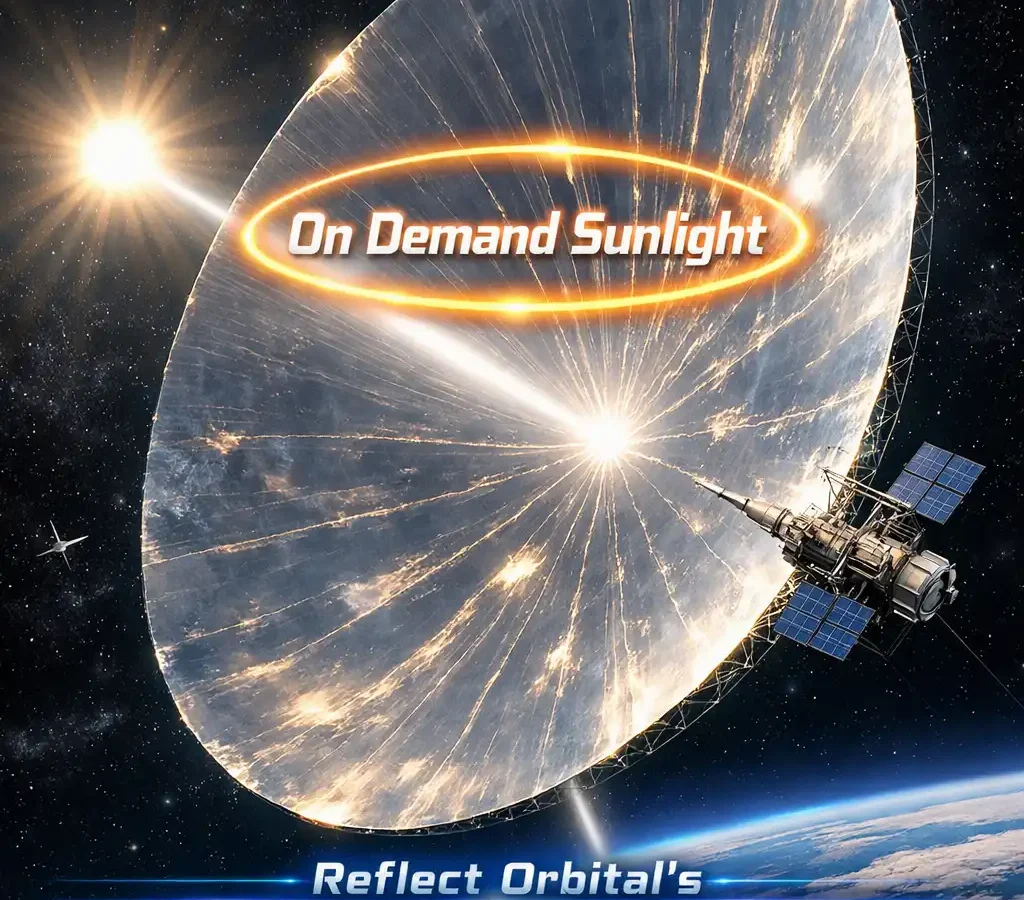
A California startup just got federal approval to launch a giant mirror into orbit and beam sunlight to Earth after dark. What actually got approved is narrower than the headlines suggest — and what didn’t get reviewed by anyone is the more interesting part.
How this was reported: This article draws on FCC approval coverage from Space.com, Sky & Telescope, Astronomy.com, Aerospace America, Scientific American, and Engadget, plus Reflect Orbital’s own public statements and Wikipedia’s documented company history. Wangdoo has not independently verified Reflect Orbital’s technical claims and has no relationship with the company.
What Actually Got Approved
On July 9, 2026, the Federal Communications Commission granted a licence to Reflect Orbital, a Hawthorne, California startup, to launch and operate a satellite called Eärendil-1. The satellite carries an 18-by-18-metre thin-film reflector — roughly 59 by 59 feet, or about the footprint of a small house — designed to unfurl in orbit and redirect sunlight toward a chosen spot on Earth’s night side.
The coverage that followed was extensive, and mostly accurate on the basics. What got less attention is exactly what the FCC’s approval covers, and — more importantly — what it doesn’t.
NBC News coverage of Reflect Orbital’s plans, published March 2026, ahead of the FCC’s July approval. Independent production, not affiliated with Wangdoo.
The Regulatory Gap Almost Nobody Explains Clearly
Here’s the detail buried in nearly every article about this story, usually in the final paragraphs: the FCC’s authority here is narrow by design. Federal law gives the agency jurisdiction over radio spectrum use — the communications systems a satellite uses to talk to ground stations. That’s it. The mirror itself, the beam of sunlight it produces, and every environmental or safety consequence that beam might have are, by the FCC’s own account, outside what it’s legally permitted to evaluate.
The FCC’s ruling said as much directly, weighing “the small risk that an individual happens to be using a large telescope at the exact moment” against “the benefits of permitting American companies to test innovative technology in space” — and concluding the risk, while real, was small enough to proceed. DarkSky International, an advocacy group focused on light pollution, put the underlying problem more bluntly in its response: if the FCC says it isn’t responsible for evaluating the environmental impact of a sunlight-reflecting satellite, “which authority is?” For now, there isn’t a clear answer.
What was actually reviewed
The FCC’s approval covers exactly two things: Eärendil-1’s use of radio spectrum for communications, and its orbital debris and collision-avoidance plan. Reflect Orbital’s calculations — that the satellite can manoeuvre around tracked objects, will respond to conjunction warnings, and should deorbit within roughly a year even without an active disposal manoeuvre — were accepted as sufficient for a single demonstration satellite. No federal agency formally reviewed the reflector itself, its brightness, or its effect on the night sky.
How Bright Is This, Actually
Reflect Orbital’s own public roadmap describes the illumination from its planned satellites as comparable to a full moon for roughly five minutes at a time. That figure describes the light landing on the ground inside the target zone. It is not the same as how bright the satellite itself appears to someone who isn’t standing in the beam.
According to an analysis by the European Southern Observatory cited in coverage of the approval, Eärendil-1 would be the brightest artificial satellite ever launched. To an observer outside the illuminated beam, it would appear roughly as bright as Venus — already one of the brightest objects in the night sky. To someone standing inside the beam itself, the light would appear about four times brighter than a full moon. Reflect Orbital maintains the intensity will never exceed natural sunlight and states it’s designed to be safe to view even through a telescope; the American Astronomical Society disputes that assessment specifically, warning of a real, if statistically small, risk of eye damage to anyone observing the satellite through amateur equipment at the wrong moment.
The Engineering, in Plain Terms
Eärendil-1 will operate in a near-polar low Earth orbit at roughly 500 to 625 kilometres altitude — high enough to maintain a stable, predictable path, low enough to keep the satellite’s apparent brightness and pointing accuracy workable. Its reflector consists of four triangular mylar panels, made from the same type of glossy, ultra-thin material used in spacecraft insulation, that unfold into a single flat 18-metre square once in orbit. The whole reflective assembly reportedly weighs around 16 kilograms — startlingly light for something the size of a small house’s footprint, a direct consequence of using thin-film material rather than rigid glass or metal.
Pointing that surface precisely at a target on a spinning, orbiting satellite is the harder engineering problem. Reflect Orbital’s solution, according to CEO Ben Nowack speaking to Aerospace America, is “massively oversized” reaction wheels — the kind of hardware typically found on satellites more than four times Eärendil-1’s mass. Reaction wheels let a spacecraft change its orientation by spinning an internal flywheel rather than burning propellant, which matters both for precision and for how many times the satellite can reposition itself over its operational life.
This Isn’t the First Space Mirror — It’s the First Commercial One
Orbital mirrors aren’t a new idea. Russia’s Znamya 2 experiment successfully swept a beam of reflected sunlight across parts of Europe back in 1993, using a 20-metre mirror deployed from a Progress cargo spacecraft — proof the basic physics works, decades before Reflect Orbital existed. What’s different this time isn’t the concept. It’s that a private company is attempting to build a commercial, repeatable service around it, rather than a one-off government experiment — the same shift from state-led to commercially-driven infrastructure we’ve tracked in other emerging tech sectors, including the AI infrastructure race between China and the West.
Reflect Orbital was founded in January 2021 by Nowack and Tristan Semmelhack and now employs around 60 people. Its public track record includes a March 2024 demonstration using a roughly 6-square-metre mirror controlled from a hot air balloon to redirect light onto ground-based solar panels, and — according to the company — more than 260,000 inquiries by the end of 2025 from parties interested in nighttime illumination for construction, public events, search-and-rescue, and disaster relief. The company has also reportedly held a contract with the US Air Force, though the scope and current status of that work isn’t detailed in public reporting Wangdoo has reviewed.
What Happens Next
The FCC’s approval covers Eärendil-1 specifically — a single demonstration satellite operating for up to two years. It explicitly does not extend to Reflect Orbital’s stated ambition of a 50,000-satellite constellation, and the agency noted this approval doesn’t predetermine how any future, larger application would be judged. Reflect Orbital has not yet filed for that larger constellation.
What isn’t confirmed yet
As of publication, Reflect Orbital has targeted a launch “later in 2026” but has not announced a specific date. The company says its first demonstrations will illuminate roughly ten locations globally, coordinated with organisations it describes as considering purchasing its services, though it has declined to name those locations or organisations publicly. Independent, real-world confirmation of the satellite’s actual on-orbit brightness, pointing accuracy, and safety performance won’t exist until after a successful launch and demonstration — everything above the FCC’s narrow regulatory review remains, for now, based on the company’s own projections.
My Take — Mr Wangdoo
What strikes me most about this story isn’t the mirror — it’s the shape of the regulatory gap underneath it. The FCC didn’t approve “sunlight on demand.” It approved a radio licence and a debris-mitigation plan for one test satellite, and said, in effect, that everything else about a giant reflective object in low Earth orbit falls outside its job description. That’s a completely coherent legal position for an agency whose statutory mandate is spectrum management. It’s also an unusually strange place for a decision this consequential to land, because nobody else’s mandate obviously covers it either.
I don’t think that makes Reflect Orbital’s technology illegitimate or their engineering dishonest — the physics does work, and a single 1993 Russian experiment already proved the basic concept three decades ago. What I’d flag is the gap between “the FCC approved this” and “someone with the relevant expertise evaluated whether beaming moonlight-to-four-times-moonlight-bright light across five-kilometre zones of the planet, potentially fifty thousand times over, is a good idea.” Those are different questions, and right now only the first one has actually been answered by anyone with regulatory authority.
The company’s own framing — that this is a limited, single-satellite demonstration — is accurate as far as it goes. But a demonstration whose stated purpose is proving out the technology for a 50,000-satellite constellation is not really a story about one satellite. It’s the opening move in a much larger question about who, if anyone, gets to decide what happens to the night sky as space becomes a place private companies build commercial infrastructure rather than just launch occasional missions. That question doesn’t have an answer yet, and this approval didn’t provide one — it just showed that the current rules don’t require one before the first launch.
Frequently Asked Questions
What exactly did the FCC approve?
The FCC granted Reflect Orbital a licence covering two specific things: the radio spectrum Eärendil-1 will use to communicate with ground stations, and the company’s orbital debris and collision-avoidance plan for that single satellite. The FCC’s own ruling states its authority does not extend to evaluating the mirror’s environmental impact, its effect on astronomy, or broader safety concerns — those fall outside the agency’s statutory jurisdiction over radiofrequency spectrum.
Is this actually a functioning “order sunlight” service right now?
No. Eärendil-1 is a single demonstration satellite that has not yet launched, targeted for “later in 2026” without a confirmed date. Reflect Orbital’s long-term vision of a commercial, on-demand sunlight service involving thousands of satellites is not what has been approved — only this one test satellite has regulatory clearance, and the company has not yet filed for its larger planned constellation.
How bright would the reflected sunlight actually be?
Reflect Orbital’s own figures describe illumination comparable to a full moon for the target area on the ground. However, independent analysis cited in coverage of the approval, from the European Southern Observatory, suggests the satellite itself would be the brightest artificial satellite ever launched — appearing roughly as bright as Venus to observers outside the beam, and up to four times brighter than a full moon to anyone standing directly inside the illuminated zone.
Why are astronomers opposed to this?
The American Astronomical Society and other groups have raised several concerns: potential eye damage risk to anyone observing the satellite through amateur telescopes at the wrong moment, degradation of scientific data from research observatories due to increased sky brightness, and the precedent a single approval sets for a much larger planned constellation of up to 50,000 satellites, which multiple astronomers warn could meaningfully brighten the night sky on a global scale if fully deployed.
Has anything like this been done before?
Yes, though not commercially. Russia’s Znamya 2 experiment in 1993 successfully demonstrated the basic concept, using a 20-metre mirror deployed from a Progress spacecraft to sweep a beam of reflected sunlight across parts of Europe. That was a one-off government technology experiment rather than an attempt to build a repeatable commercial service, which is the main way Reflect Orbital’s approach differs.
Sources
- FCC approves Reflect Orbital filing for mirror in space — Astronomy.com (AAS response, ESO brightness analysis, future constellation status)
- The FCC just gave Reflect Orbital permission to launch its 1st space mirror to orbit — Space.com (company statements, constellation roadmap)
- Observers Beware: Reflect Orbital’s Space Mirrors Approved for Launch — Sky & Telescope (AAS eye-safety warning, FCC’s stated reasoning)
- Reflect Orbital readies for first on-orbit demo of shining sunlight at night — Aerospace America (technical specifications, Ben Nowack quotes, reaction wheel detail)
- Reflect Orbital — Wikipedia (company history, founding date, 2024 hot air balloon demonstration)
- FCC grants approval for sun-reflecting space mirror that’s been widely criticized by astronomers — Engadget (FCC ruling language, safety precautions listed by Reflect Orbital)