The KiWear Ring — Control ANY Device With Hand Gestures!

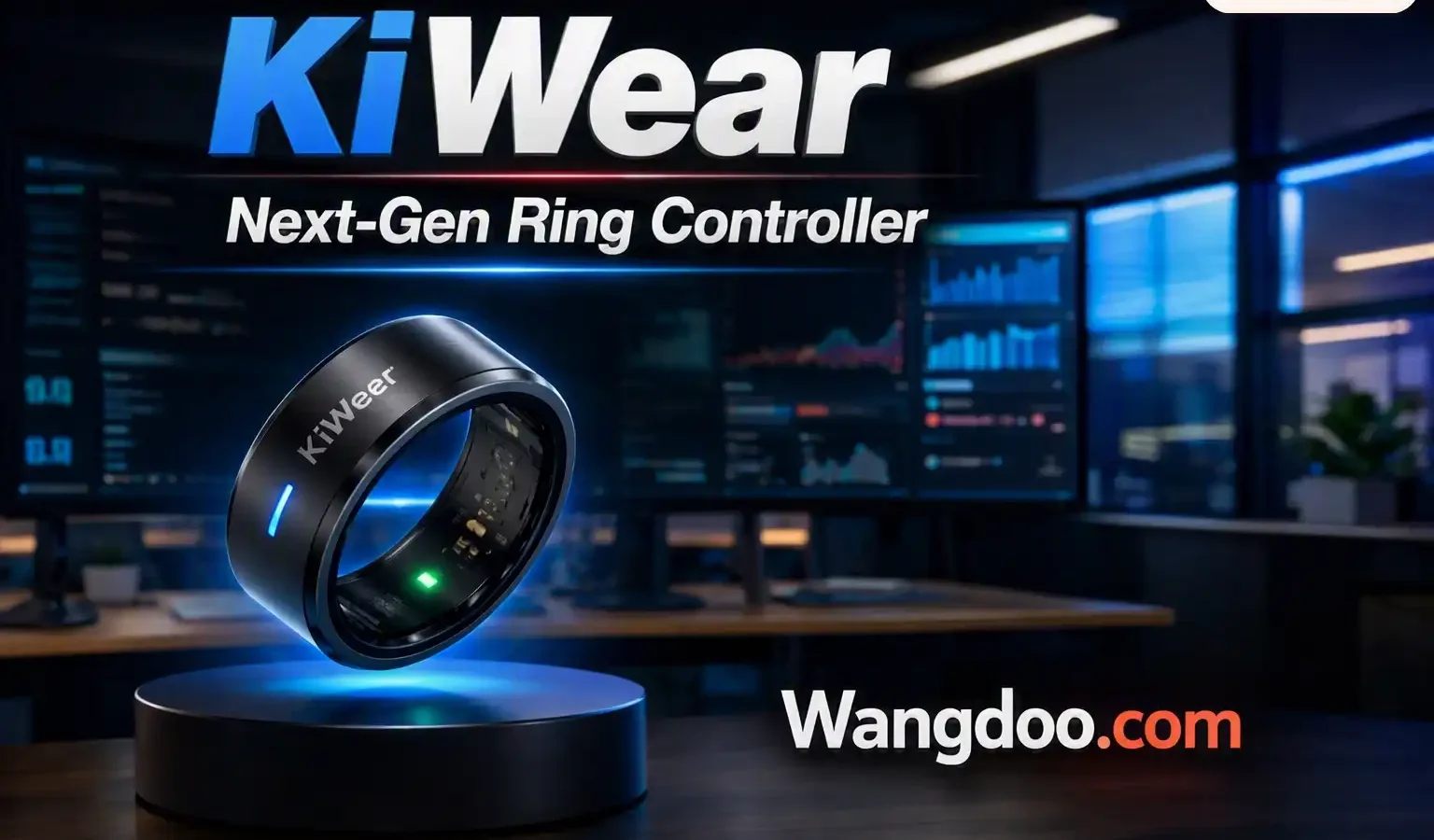
A five-gram ceramic ring that reads finger movements and sends them as commands to phones, computers, televisions, smart glasses and car screens. Here is what it does, how the sensing works, and what has been published so far.
Not tested. Wangdoo has not handled a KiWear ring and no shipping unit exists yet. This article is based on reading KiWear’s published material, its Kickstarter listing, Qualcomm’s conference announcements and third-party coverage. Nothing here is a performance assessment.
Source notes. The most detailed hands-on account currently available is sponsored content — its publisher discloses that KiWear paid for it and supplied the specifications. Figures drawn from it are labelled in the specifications table. Wangdoo has no relationship with KiWear and carries no affiliate links.
Status: Accurate as of 4 September 2026.
Smart rings have spent the last few years being health trackers. They count steps, watch your heart rate overnight, and produce a score in the morning. The KiWear ring does that too, but its main purpose is different: it is an input device. You move a finger, and something else on the network does what you told it.
KiWear, Inc. works in gesture recognition and spatial computing and issues its announcements from Wilmington, Delaware. The ring is its first consumer product. It went live on Kickstarter on 2 September 2026, with the campaign running to 7 October.
The ring pairs over Bluetooth and can hold connections to multiple devices at once, switching between them. Finger movements map to commands — scroll, select, back, volume, answer a call.
Alongside that it carries the sensors found in most health rings: heart rate, activity, sleep and blood-oxygen trends.
Video: the ring in use. Wangdoo is not affiliated with the publisher. Much of the hands-on footage of this ring is sponsored by KiWear, so check the description of any video for a disclosure.
The gestures
The published gesture set is small and specific, which is normal for this kind of device. Five movements have been demonstrated:
- Swipe the thumb along the index finger — scroll
- Tap the index finger — select or click
- Tap the middle finger — go back
- Draw a circle in the air — adjust volume
- Draw a check mark — answer a call
Two of those involve the thumb touching a finger, and three are movements in open space. The distinction matters more than it looks. A thumb-to-finger contact produces a sharp, distinctive signal that is difficult to perform accidentally. A circle drawn in the air has to be told apart from ordinary hand movement, which is the harder engineering problem in any motion-based system.
KiWear says the gestures are movements the hand already makes — a twist, a tap, a flick — rather than a vocabulary that has to be memorised.
How the sensing works
The ring is reported to use inertial sensing. KiWear’s own material describes it only as motion-tracking and gesture-recognition sensors, without naming a component; the inertial description comes from the hands-on account listed in the sources. An inertial measurement unit is a small package of accelerometers and gyroscopes that reports how the object it is attached to accelerates and rotates. Attached to a finger, it produces a continuous stream of motion data, and software classifies that stream into recognised gestures.
This approach has two practical consequences. Because nothing needs line of sight, the ring works with your hand in a pocket, at your side, or under a table — unlike camera-based hand tracking, which stops when your hands leave the frame. And because an IMU is tiny and draws very little power, a sensor of this type adds little to the size or power budget of a ring.
The trade-off is that motion data describes what your hand did, not what you meant. Distinguishing a deliberate gesture from reaching for a cup is a software problem, handled through pattern matching and gesture designs that are unlikely to occur by accident. It is the central challenge for every device of this type.
Other wearables solve the same problem differently. Meta’s Neural Band reads electrical activity in the forearm muscles rather than motion, which lets it register an intended movement that barely happens. Some rings use a small optical sensor the thumb moves across, which removes accidental triggering but requires contact. Each approach trades something away.
What it connects to
KiWear lists phones, tablets, televisions, projectors, computers, car screens, smart speakers and audio glasses, across both iOS and Android. The ring holds up to nine paired devices and switches between them.
In practice, the commands that work most widely across devices are the standard Bluetooth media controls — play, pause, track skip, volume — because those are understood by almost anything with a Bluetooth radio. Richer, app-specific control depends on integration work with individual platforms, which is true of every device in this category rather than particular to this one.
The company has also built gesture-controlled games for the ring, and says up to four rings can connect to a single device for multiplayer use.
Design and build
The body is ceramic and weighs about five grams. There is no screen and no indicator light, which KiWear presents as a reason the battery lasts as long as it does. That is consistent with how wearables of this size are built — displays and LEDs typically dominate the power budget.
It carries a 5 ATM water rating, which covers swimming, showering and hand washing. Charging descriptions differ slightly: KiWear refers to charging in its case, while third-party listings describe a magnetic dock.
On battery figures: KiWear’s own material describes an all-day battery charged in its case without giving a number. Third-party listings report over 72 hours. No independently verified runtime figure exists yet, so both should be treated as provisional.
Published specifications
| Item | Stated | Source |
|---|---|---|
| Weight | Around 5 g | Hands-on account |
| Material | Ceramic, no screen or indicator light | Hands-on account, KiWear |
| Sensing | Inertial motion sensor | Hands-on account |
| Connectivity | Bluetooth 6.0, up to nine paired devices | Third-party listing |
| Battery | All-day per KiWear; over 72 hours per third-party listings | Figures differ |
| Water rating | 5 ATM | Third-party listing |
| Health sensing | Heart rate, activity, sleep, blood-oxygen trends | KiWear |
| Charging | Magnetic dock per listings; “in its case” per KiWear | Third-party listing |
| Multiplayer | Up to four rings per device | Third-party listing |
| Price | $249 reported for one pledge tier | Hands-on account |
The Qualcomm reference design
KiWear’s work reaches beyond its own product, and this is the part of the story with the widest relevance.
At AWE 2026 in June, Qualcomm released a second-generation smart ring controller reference design built on its Snapdragon S7+ Gen 1 platform, combining Bluetooth Low Energy with low-power Wi-Fi and using on-device models to recognise small gestures such as swipes and pinches. A reference design is a working blueprint that other manufacturers build products from, so it shapes what a whole category looks like.
KiWear states that its technology powers both generations of that reference design, and that its next-generation prototype was displayed at Qualcomm’s booth. Qualcomm’s senior vice-president for XR, wearables and personal AI is quoted in KiWear’s announcement, and independent conference coverage confirms the reference design exists as described.
Qualcomm’s own framing is worth carrying away, because it says something about where the category is heading. The company described the smart ring primarily as an accessory for interacting with wearable devices, and said it has no current plans to develop it as a separate reference design product category. In Qualcomm’s view, a ring is an input method for smart glasses first.
Availability
The campaign runs on Kickstarter from 2 September to 7 October 2026, with a $5,000 funding goal that has been exceeded many times over. KiWear says it moves into production once funded and ships in the order backers joined.
Wangdoo found no shipping date in KiWear’s published material, and no retail price has been announced. Crowdfunded hardware is funded rather than purchased, and delivery timelines commonly move.
Frequently asked questions
What is the KiWear ring?
A smart ring that sends gesture commands over Bluetooth to paired devices including phones, computers, televisions, smart glasses and car screens, and also tracks heart rate, activity, sleep and blood-oxygen trends. It is the first consumer product from KiWear, Inc.
What gestures does it recognise?
Five have been demonstrated: swiping the thumb along the index finger to scroll, tapping the index finger to select, tapping the middle finger to go back, drawing a circle in the air to adjust volume, and drawing a check mark to answer a call.
How does it detect gestures?
Reported as inertial sensing — accelerometers and gyroscopes that measure how the finger accelerates and rotates, with software classifying that motion into recognised gestures. KiWear has not named the component itself. Because the method does not rely on a camera, it works with the hand out of sight.
How many devices can it control at once?
Up to nine paired devices, switching between them. Up to four rings can connect to a single device for multiplayer gaming.
How long does the battery last?
KiWear describes an all-day battery charged in its case without stating a figure, while third-party listings report over 72 hours. No independently verified runtime figure is available.
Can it be worn in water?
It carries a 5 ATM water rating, which covers swimming, showering and hand washing.
Is KiWear connected to Qualcomm?
KiWear states its technology powers both generations of Qualcomm’s smart ring controller reference design, and a Qualcomm executive is quoted in KiWear’s announcement. Qualcomm’s second-generation reference design on the Snapdragon S7+ Gen 1 platform is independently confirmed to exist.
When does it ship?
Wangdoo found no shipping date in KiWear’s published material. The company says it moves into production once funded and ships in the order backers joined.
Sources
- KiWear, Inc. — company question-and-answer page and announcement issued 17 June 2026 via GlobeNewswire. Source for supported device types, health sensing, the no-screen design, the battery description and the Qualcomm reference design claim.
- Kickstarter — KiWear campaign listing. Source for the 2 September 2026 launch, the 7 October end date and the $5,000 goal. kickstarter.com
- Cas and Chary XR — hands-on account published 22 August 2026. Source for the gesture list, the five-gram ceramic body, the inertial sensor and the $249 pledge figure. Disclosed by its publisher as sponsored by KiWear, based on a short prototype session.
- AWE 2026 conference coverage — Qualcomm’s second-generation Smart Ring Controller reference design on Snapdragon S7+ Gen 1, and Qualcomm’s description of the smart ring as an accessory for wearable device interaction.
- Gadgetify — specification listing reporting Bluetooth 6.0, nine paired devices, four rings per device, 5 ATM rating, over 72 hours of battery and a magnetic charging dock.

Clayton Samuel (Mr Wangdoo), QFA — Founder & editor, Wangdoo.com. Qualified Financial Adviser with a background in electronics, web development, and cloud infrastructure.