EU Cyber Resilience Act: What Changes on 11th September 2026

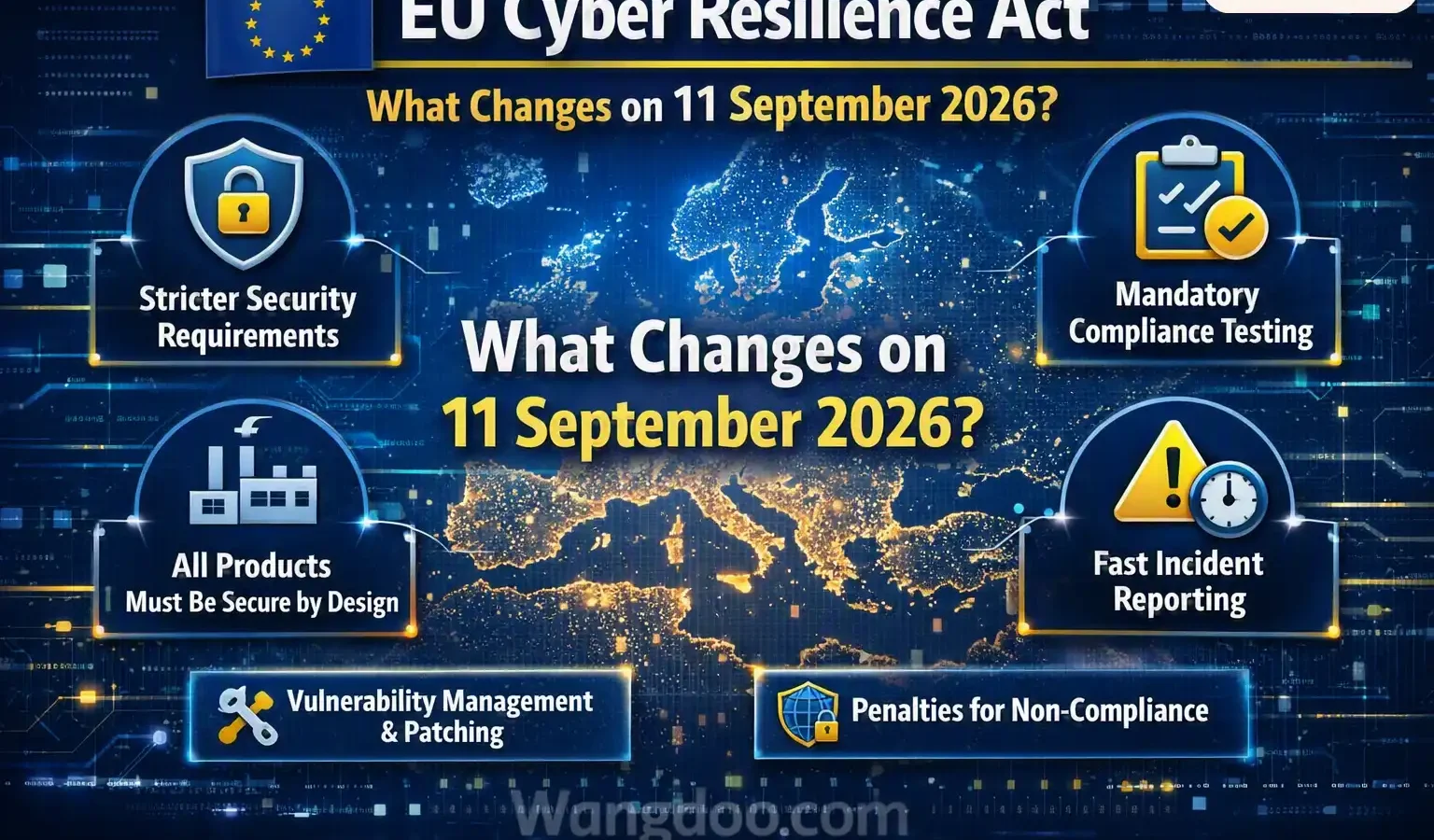
A 24-hour reporting clock, a new EU platform that has not opened yet, and obligations that reach back to hardware sold years ago. The Cyber Resilience Act’s first real deadline arrives on 11 September 2026.
Transparency: Wangdoo has not tested the Single Reporting Platform described in this article. It was not publicly accessible at the time of writing, and its web address had not been published. Everything below is drawn from the text of Regulation (EU) 2024/2847, the European Commission’s published implementation pages, and the guidance ENISA released in July and August 2026.
Status: Accurate as of 30 August 2026. This is a live implementation and the agencies involved update their pages frequently, sometimes without announcement. Check the primary sources listed at the end before acting on any of it.
Ask most people in the hardware business when the EU’s Cyber Resilience Act starts to bite and you will hear December 2027. That is the date on all the slide decks. It is also the wrong date to be worried about right now.
The first binding obligation under the CRA switches on in a matter of days, on 11 September 2026. From that morning, any company that makes a connected product available in the European Union has to tell regulators when a flaw in that product is being actively exploited, and it has to do so within 24 hours of finding out. Not 24 working hours. Not 24 hours after the patch is written. Twenty-four hours from awareness.
What makes this more interesting than the average compliance deadline is that it does not only apply to products launched after that date. It reaches back into the installed base. And the tool everyone is supposed to use to file these reports was not open for business when I last checked.
Article 14 of the Cyber Resilience Act applies from 11 September 2026. Manufacturers must notify actively exploited vulnerabilities and severe security incidents through a central EU system called the Single Reporting Platform, run by the European Union Agency for Cybersecurity. Reports go to a national incident response team and to ENISA at the same time.
The rest of the regulation — CE marking, mandatory security-by-design, published support periods, software bills of materials — waits until 11 December 2027.
Video: a walkthrough of the Cyber Resilience Act’s scope and obligations. Wangdoo is not affiliated with the publisher and the video is included as background context only — the dates and platform status in this article are taken from the Commission and ENISA sources listed at the end.
What actually changes on 11 September
Two things have to be reported, and the distinction matters because they run on slightly different clocks.
The first is an actively exploited vulnerability. The regulation defines this narrowly: there has to be reliable evidence that a malicious actor has exploited the flaw in a system without the owner’s permission. A theoretical weakness does not qualify. A CVE sitting in a database does not qualify. Someone has to be using it.
The second is a severe incident affecting the security of the product — something that damages, or could damage, the product’s ability to protect the availability, authenticity, integrity or confidentiality of data or functions.
For either one, the sequence is the same three steps. An early warning within 24 hours. A fuller notification within 72 hours, with an initial assessment and whatever mitigations exist. Then a final report — no later than 14 days after a corrective measure becomes available for a vulnerability, or within one month of the 72-hour submission for an incident.
The 24-hour form is lighter than the panic around it suggests. ENISA’s published field list makes only a handful of items mandatory at that stage: what kind of notification it is, the manufacturer’s name, the product, a title, and — for incidents — whether malicious activity is suspected. The technical detail is expected at 72 hours. That is a sensible design. Nobody has a root cause analysis in the first day.
The platform is not open yet
Here is where it gets awkward.
The CRA does not let manufacturers report however they like. Article 16 requires ENISA to build a Single Reporting Platform, and Article 14 notifications go through it. One submission, routed automatically to the incident response team in the country where the manufacturer has its main establishment, and to ENISA simultaneously.
The Commission’s position is that the platform will be operational by 11 September, with functional and security testing under way. ENISA says the same, and adds that a testing period is expected beforehand.
But go and read ENISA’s own step-by-step registration guide and the very first instruction tells you to open the platform website — followed by a parenthesis.
URL to be provided at launch
— ENISA, CRA SRP registration guidance, last updated 31 July 2026That parenthesis has been sitting there for a month. ENISA has also not yet published the list of national incident response teams designated as coordinators, which is the drop-down menu a manufacturer has to pick from during registration. And there is no API. ENISA states plainly that organisations may want to automate their reporting workflows, but no application programming interfaces are provided at this stage.
For a company shipping one product line, that is a minor annoyance. For a vendor with a large catalogue and a busy disclosure calendar, it means a human being filling in a web form against a 24-hour clock, possibly at three in the morning, possibly several times in one week.
The detail that will catch people out: ENISA’s guidance says a saved draft notification is visible only to the person who created it. If your primary representative starts a report and then goes offline, the backup account cannot see the draft and cannot finish it.
The platform has exactly two seats per manufacturer — a Primary Assigned Representative and a Secondary one who joins by email invitation. That invitation expires after seven days, after which the record is marked as expired and has to be reissued.
Why this reaches devices already in people’s homes
Most of the CRA has a clean transitional rule. Products placed on the EU market before 11 December 2027 fall under the regulation only if they are substantially modified after that date. Ship it now, and the design requirements do not chase you retroactively.
The reporting duty is carved out of that. The Commission’s own summary of the legislation states that reporting obligations apply to all products with digital elements made available on the Union market, including those already placed on the market before 11 December 2027.
Think about what that covers. Routers sold in 2022. Cameras from 2023. Smart plugs, baby monitors, robot vacuums, network-attached storage, the firmware in a car’s infotainment head unit. If a manufacturer becomes aware that a flaw in any of it is being exploited in the wild, the clock starts.
A useful comparison: think of a food recall notice rather than a product safety standard. The standard governs what you are allowed to put on the shelf tomorrow. The recall obligation governs what you have to say about the tins already in people’s cupboards.
The CRA’s December 2027 requirements are the standard. The September 2026 requirement is the recall notice — and it applies to stock that was perfectly legal when it left the factory.
There is one limit, and it is a fair one. The obligation bites when a manufacturer becomes aware of active exploitation. ENISA has confirmed it does not extend to vulnerabilities the manufacturer already knew were being exploited before the reporting obligation applied. Old known problems do not have to be retro-filed on 11 September. New knowledge triggers the duty.
Which is a reminder that the weak point in this system has always been the same one. Plenty of exploited home devices are running firmware that was abandoned years ago by a company that will never file anything. If you want a sense of what that looks like in practice, our guide to checking whether your router has been compromised by a botnet covers the symptoms worth watching for on hardware nobody is patching.
Who has to report, and who is off the hook
The duty sits with manufacturers — the party that puts the product on the market under its own name or trademark. Not importers, not distributors, not retailers. They have separate obligations under the CRA, but Article 14 reporting is not one of them.
The interesting addition is open-source software stewards. This is a category the CRA invented for legal entities that systematically support the development of open-source software intended for commercial use, and that keep those projects viable — foundations, essentially, rather than individual maintainers. Article 24 gives them a reporting duty too, though a narrower one, limited to products they are actually involved in developing and to incidents affecting the systems they provide for that development.
Manufacturers
Full Article 14 duty. All three reporting stages, all products made available in the EU, including older ones. Exposed to the top fine tier.
Open-source stewards
Narrower Article 24(3) duty. Report where involved in developing the affected product. Not subject to penalties for CRA infringements at all.
Micro and small firms
Same duties, but may not be fined specifically for missing the 24-hour deadline. The later stages still carry exposure.
Anyone else
No obligation, but voluntary reporting of vulnerabilities, threats, incidents and near misses opens up after 11 September.
On penalties: Article 64 puts breaches of Article 14 in the highest band, alongside failures of the essential cybersecurity requirements. That is up to €15 million or 2.5% of total worldwide annual turnover for the preceding financial year, whichever is higher. Two lower bands sit beneath it at €10 million or 2%, and €5 million or 1% for supplying incorrect or misleading information to authorities.
Fines are set nationally, by each member state’s market surveillance authority, and Article 64 requires them to take the size of the business into account. So the headline number is a ceiling, not a forecast. It is also worth being clear that no enforcement action has happened yet, because the obligation has not started.
The full timeline, in one place
| Date | What applies |
|---|---|
| 10 Dec 2024 | Regulation (EU) 2024/2847 enters into force. No obligations yet. |
| 11 Jun 2026 | Chapter IV applies. Member states designate notifying authorities; conformity assessment bodies can be notified. Already passed. |
| 11 Sep 2026 | Article 14 reporting obligations apply. Single Reporting Platform due to be operational. |
| 11 Dec 2027 | Full application. Essential requirements, CE marking, technical documentation, declared support periods, SBOMs. |
| 11 Jun 2028 | Existing EU type-examination certificates and approval decisions on cybersecurity requirements cease to be valid, unless they expired earlier. |
What is not changing yet
It would be easy to read the September date as the moment the CRA arrives in full. It is not, and conflating the two is how compliance projects get mistimed.
None of the following applies until 11 December 2027: the essential cybersecurity requirements in Annex I, the CE marking obligation, the EU declaration of conformity, the technical documentation package, the requirement to draw up a software bill of materials in a machine-readable format, and the duty to state a product’s support period end date — month and year — at the point of purchase.
That last one is the change consumers will actually notice on a shelf. From December 2027, a connected device sold in the EU has to tell you the date its security updates stop. Not a vague promise of ongoing support. A date.
The genuine benefit for buyers, once the whole thing is running, is not really the incident reports. Those go to CSIRTs, not to the public. It is the declared support period.
Right now a €40 smart plug and a €400 one look identical on the update question, because neither has to say anything. In December 2027 they both have to put a date on it, and one of those dates will be a lot further away than the other.
What happens to the reports
They do not become public. This is the part that tends to surprise people who assume a mandatory disclosure regime means disclosure to them.
A report goes to the coordinating CSIRT and to ENISA. That CSIRT then disseminates it to other national teams in countries where the product is available, and to market surveillance authorities as needed. ENISA’s submission guidance states that concerned CSIRTs receive the final report only after manual full dissemination by the coordinating team, which puts a human step inside a process otherwise built around hard deadlines.
In exceptional circumstances, on justified security grounds, that dissemination can be delayed. A Commission delegated regulation adopted on 11 December 2025 sets out the conditions. Where a manufacturer flags those circumstances at the 72-hour stage, ENISA itself receives only partial information until the coordinating team releases the rest.
Public visibility comes later and indirectly. ENISA is tasked with disclosing fixed vulnerabilities to the European Vulnerability Database, and with producing biennial trend reports, the first of which is due within 24 months of the reporting obligations starting. So the aggregate picture will eventually be public. Individual reports mostly will not be.
If you just own the gadgets
Nothing you have to do. No action, no registration, no setting to change. This is a regulation aimed at companies.
What it changes for you is slower and more structural. Over the next couple of years, the manufacturers selling into Europe have to build vulnerability handling processes that can actually respond inside a day, because the alternative is a fine calculated against global turnover. Firms that currently sit on a disclosure for six weeks while legal reviews the wording will find that option removed.
Whether that produces faster patches or just faster paperwork is the open question, and I would not want to guess. Reporting a flaw to a CSIRT and fixing it for customers are different activities, and the CRA mandates the first far more precisely than the second.
One practical note for anyone outside the EU reading this: the regulation follows the product, not the company. A manufacturer in Taiwan, California or Shenzhen that makes a connected device available on the EU market carries the same Article 14 duty as one in Dublin or Dortmund. Where there is no EU establishment, the reporting route runs through an authorised representative established in the Union.
Frequently asked questions
Does the Cyber Resilience Act start on 11 September 2026 or 11 December 2027?
Both dates are real. The regulation entered into force on 10 December 2024 and becomes fully applicable on 11 December 2027. The reporting obligations in Article 14 apply earlier, from 11 September 2026, and Chapter IV on notifying conformity assessment bodies applied earlier still, from 11 June 2026.
Does my company have to report vulnerabilities in products we sold years ago?
Yes, if a vulnerability in them is being actively exploited and you become aware of it. The Commission states that reporting obligations cover all products with digital elements made available on the Union market, including those placed on the market before 11 December 2027. The obligation does not extend to active exploitation you already knew about before the duty applied.
What counts as an actively exploited vulnerability?
The CRA defines it as a vulnerability for which there is reliable evidence that a malicious actor has exploited it in a system without the system owner’s permission. A published CVE with no evidence of exploitation does not trigger the duty on its own.
Where is the Single Reporting Platform?
It was not publicly accessible at the time of writing and its address had not been published. ENISA’s registration guidance still says the URL will be provided at launch, and states the platform will be operational by 11 September 2026. ENISA has said it intends to hold a webinar roughly two weeks before the platform enters service.
Can I register in advance?
You can create the EU Login account the platform authenticates against, at the Commission’s ECAS service. ENISA advises registering on the platform itself and starting validation only when you actually need to submit a notification, to avoid overloading the CSIRTs that carry out that validation. Validation is not a precondition for filing.
Do open-source maintainers have to report?
Individual maintainers, generally no. The CRA creates obligations for open-source software stewards, meaning legal entities that systematically support the development of open-source software intended for commercial activities and ensure its viability. Stewards report within the scope of Article 24(3), and are not subject to penalties for CRA infringements.
How large are the fines?
Article 64 places breaches of Article 14 in the highest tier: up to €15 million or 2.5% of total worldwide annual turnover for the preceding financial year, whichever is higher. Penalties are set and applied nationally, and must take the size of the business into account. Microenterprises and small enterprises may not be fined specifically for missing the 24-hour deadline.
Sources
- European Commission — Cyber Resilience Act: reporting obligations. Directorate-General for Communications Networks, Content and Technology. Last updated 31 July 2026. digital-strategy.ec.europa.eu
- European Commission — The Cyber Resilience Act: summary of the legislative text. Covers scope, manufacturer and steward obligations, conformity assessment, penalties and transitional provisions.
- ENISA — Single Reporting Platform (SRP) hub page and frequently asked questions, updated 31 July 2026. Source for reporting deadlines, mandatory field list, platform status and the absence of an API. enisa.europa.eu
- ENISA — CRA SRP assigned representative registration guidance, and notification submission and update guidance. Source for the unpublished platform URL, the two-seat representative model, the seven-day invitation expiry and draft visibility.
- Official Journal of the European Union — Regulation (EU) 2024/2847 (Cyber Resilience Act), in particular Articles 14, 16, 24 and 64, and Annexes I to IV. eur-lex.europa.eu
- European Commission — Commission Delegated Regulation on the conditions for delaying dissemination of notifications, adopted 11 December 2025.

Clayton Samuel (Mr Wangdoo), QFA — Founder & editor, Wangdoo.com. Qualified Financial Adviser with a background in electronics, web development, and cloud infrastructure.