Data Centres Could Soon Generate Their Own Power -Thanks to a Smarter Fuel Cell Catalyst

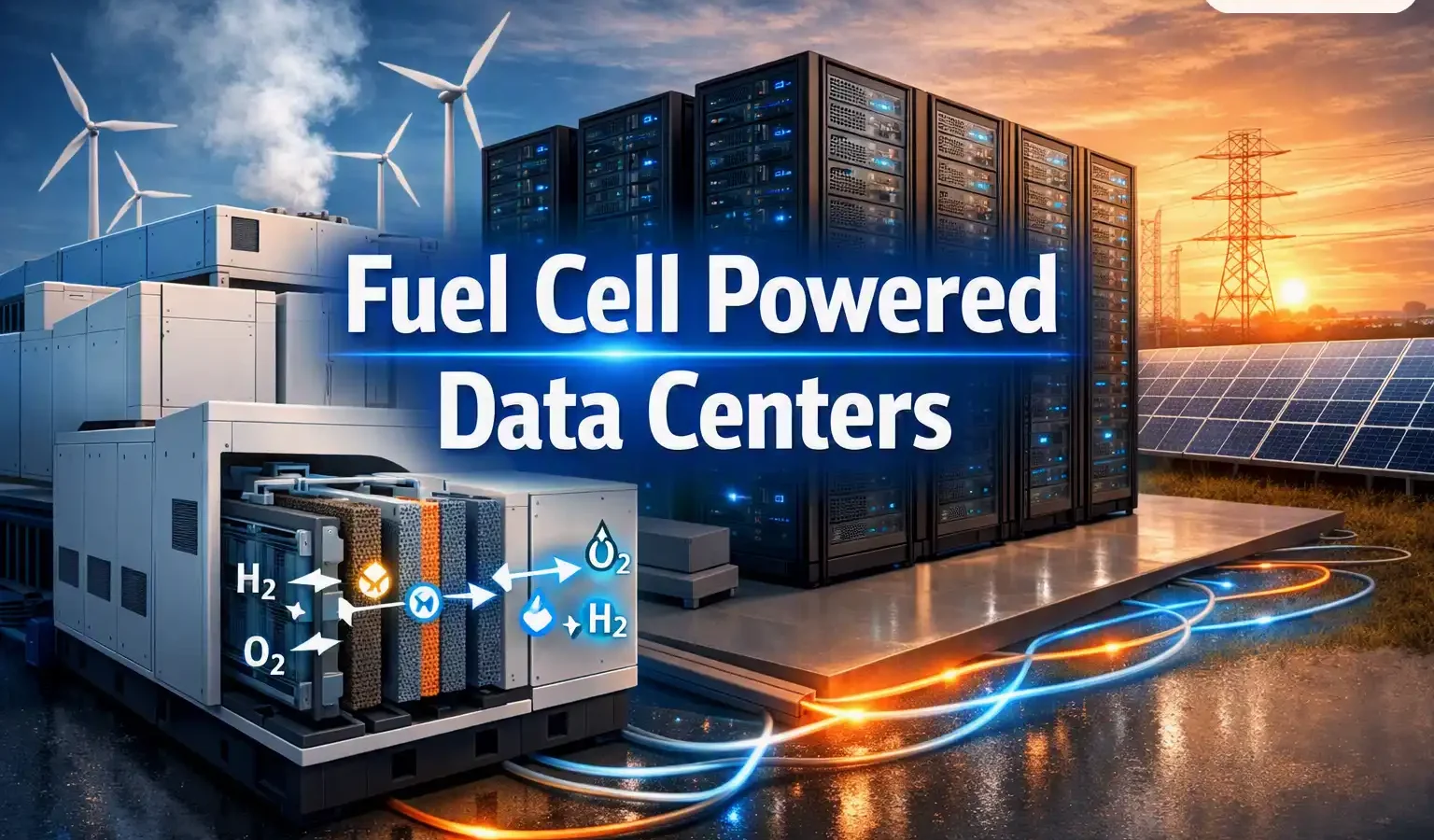
In short: Fuel cells that could let data centers make their own electricity on-site rely on a platinum catalyst — but the most active version of that catalyst has always degraded fast, and the more durable version has always been less active. A WashU-led team built a honeycomb-like carbon support that locks platinum-cobalt nanoparticles in place during a very high-temperature manufacturing step, getting both properties in the same material for the first time. The result kept 85% of its performance after 150,000 stress cycles — roughly 25,000 hours of equivalent operation. This is peer-reviewed, patent-filed lab research, not a fuel cell you can buy.
Why data centers specifically
The context for this research is a genuine, quantified problem. Washington University’s own account of the study cites the Electric Power Research Institute’s estimate that data centers could consume up to 9% of total U.S. electricity generation annually by 2030 — up from 4% of total load in 2023, more than doubling in under a decade. That’s the demand curve every AI infrastructure story this year has been circling in one way or another, whether it’s new power plants, new cooling systems, or new grid capacity.
Gang Wu, the study’s lead researcher and the Elvera and William R. Stuckenberg Professor in Washington University’s McKelvey School of Engineering, frames this specific research as a way to sidestep the grid question rather than answer it. A data center that can generate its own electricity on-site, he explained, “reduc[es] the burden on the energy grid” — rather than drawing more power from transmission lines that are already under strain. A hydrogen fuel cell installed on-site doesn’t need new transmission infrastructure or a new power plant; it converts hydrogen and other fuels directly into electricity where it’s used, with water and heat as the only byproducts.
The tradeoff that’s been stuck for years
Fuel cells combine hydrogen and oxygen to produce electricity, and platinum is the standard catalyst that makes that reaction happen fast enough to be useful. Because platinum is expensive, engineers have long shrunk it into nanoparticles to expose more surface area per gram used — modern fuel cells typically run on less than a quarter of a milligram of platinum per square centimeter of electrode. The problem is durability: those tiny particles dissolve, migrate, and clump together during real operation, and performance fades as they do.
A newer class of catalyst — platinum-cobalt intermetallics, where the two metals sit in a fixed, ordered atomic arrangement rather than randomly mixed — outperforms older platinum alloys on both activity and stability. But getting that ordered structure to form fully requires annealing the material above 700°C. Below that threshold, the nanoparticles stay well-dispersed but the atomic structure never fully orders. Push the temperature high enough to finish the ordering, and the nanoparticles clump together and grow, wrecking the fine dispersion that made them effective in the first place. Every attempt to fix one side of that tradeoff has come at the other side’s expense.
What “intermetallic” actually means here. In a standard platinum alloy, the platinum and cobalt atoms are distributed somewhat randomly throughout the material. In an intermetallic structure, they arrange into a fixed, repeating pattern — a genuine ordered lattice rather than a random mix. That ordered arrangement is what gives the material better catalytic activity and stability, but it’s also a harder structure to form, since the atoms need enough thermal energy to actually rearrange themselves into that pattern rather than just sitting wherever they happened to land.
The carbon scaffold that pulls both properties apart
Wu and his group addressed this long-standing tradeoff by developing a new nanostructured carbon support — porous, hollow carbon spheres with ordered radial nanochannels and ample porosity and surface area — designed specifically to hold the intermetallic nanoparticles in place while temperatures climb.
| What they built | A new nanostructured carbon support — porous, hollow carbon spheres containing an ordered array of radial nanochannels, with high porosity and surface area. |
| What the channels do | Physically confine platinum-cobalt nanoparticles inside the structure, keeping them densely packed and evenly spread out even as annealing temperature rises well past the point that would normally cause clumping. |
| Result | The team could anneal the catalyst at 1,000°C — 300 degrees past the previous 700°C ceiling — while keeping nanoparticles under 5 nanometers and well-dispersed, even at the higher platinum loading industry actually prefers. |
| Secondary benefit | The same open channel structure also helps the ionomer — the proton-conducting binder material inside the electrode — spread more evenly, easing the movement of protons, oxygen, and water through the electrode during operation. |
Wu described the underlying logic in terms of a tradeoff his team specifically set out to break: platinum-cobalt nanoparticles have traditionally had to sacrifice either size or stability, but the ordered carbon nanochannel structure lets them stay “confined and remain stable at very small particle size even at high temperatures.” The carbon isn’t a passive backdrop the nanoparticles happen to sit on — its structure is doing the actual work of preventing the failure mode that’s limited this class of catalyst for years.
The actual numbers
A “voltage cycle” in this context is a standard accelerated stress test — the catalyst is repeatedly driven through the same electrical conditions it would face during real start-up, shutdown, and load-change events, compressing years of wear into a lab timeline. 150,000 cycles retaining 85% of original performance is a meaningfully large durability figure for this catalyst class, though it’s worth being precise about what it does and doesn’t establish: it’s a standardized stress test result, not a field deployment result from an actual running fuel cell.
What hasn’t been demonstrated yet
Washington University’s own account of the research describes a catalyst material validated through this kind of cycling test — not a completed fuel cell stack, and not a data center pilot installation. Wu’s own closing comment frames it as ongoing work: he describes plans to solve “the remaining catalyst problems” through further development and industry collaboration, which is the language of an active research program, not a near-term commercial rollout. No cost analysis, manufacturing-scale timeline, or specific data center partner has been published alongside this result.
A catalyst breakthrough isn’t a fuel cell product. Getting a catalyst to survive a standardized lab stress test is a genuine, necessary step — but fuel cell systems have many other components (membranes, bipolar plates, balance-of-plant hardware) that also need to hit cost and durability targets before a technology like this shows up in an actual data center’s power supply. Historically, that gap between a promising catalyst paper and a commercially deployed fuel cell system has taken years to close, even for well-funded programs.
Why this fits a bigger pattern
This is the second materials-science result this month that approaches AI infrastructure’s power problem from underneath the data center rather than around it — changing what a component is physically made of, rather than adding more grid capacity or more efficient cooling on top of the existing hardware. A patent has been filed through WashU’s Office of Technology Management, which signals genuine commercialization intent, but a filed patent describes an intention to protect the invention, not a timeline for when — or whether — it reaches a real facility.
Common questions
What did the Washington University researchers actually build?
A new nanostructured carbon support — hollow carbon spheres with ordered radial nanochannels — designed to hold platinum-cobalt catalyst nanoparticles in place during high-temperature manufacturing, solving a longstanding tradeoff between catalyst activity and durability in hydrogen fuel cells.
How is this different from existing platinum fuel cell catalysts?
Existing platinum-cobalt intermetallic catalysts had to be manufactured below 700°C to avoid nanoparticles clumping together, which left their atomic structure only partially ordered. This carbon support let researchers anneal at 1,000°C while keeping nanoparticles under 5 nanometers and evenly dispersed, achieving fuller atomic ordering without sacrificing dispersion.
Could this actually power a data center soon?
Not in the near term. This is a validated catalyst material tested through standardized durability cycling, not a completed fuel cell system or a data center pilot deployment. The researchers describe further development and industry collaboration as necessary next steps.
What does “85% performance after 150,000 cycles” actually mean?
It means the catalyst retained 85% of its original performance after being put through 150,000 voltage cycles, a standardized accelerated stress test estimated to be roughly equivalent to 25,000 hours of real-world fuel cell operation.
Who funded and led this research?
The work was led by Gang Wu at Washington University in St. Louis’s McKelvey School of Engineering, in collaboration with teams from Brookhaven National Laboratory, Lawrence Berkeley National Laboratory, Northeastern University, and the University of Pittsburgh. Washington University in St. Louis is credited as the funder in the university’s own release.
Sources
- Washington University in St. Louis — “Platinum powers the future,” the original research announcement with full researcher quotes. source.washu.edu
- Gao, L. et al. — “Radial nanochannel-array carbon enables high-performance intermetallic fuel cell catalysts,” Nature Nanotechnology, 6 August 2026. doi.org
- Phys.org — supplementary coverage confirming research team composition and context. phys.org