A Skincare Startup Is Keeping Human Skin Alive for a Month to Train Its AI

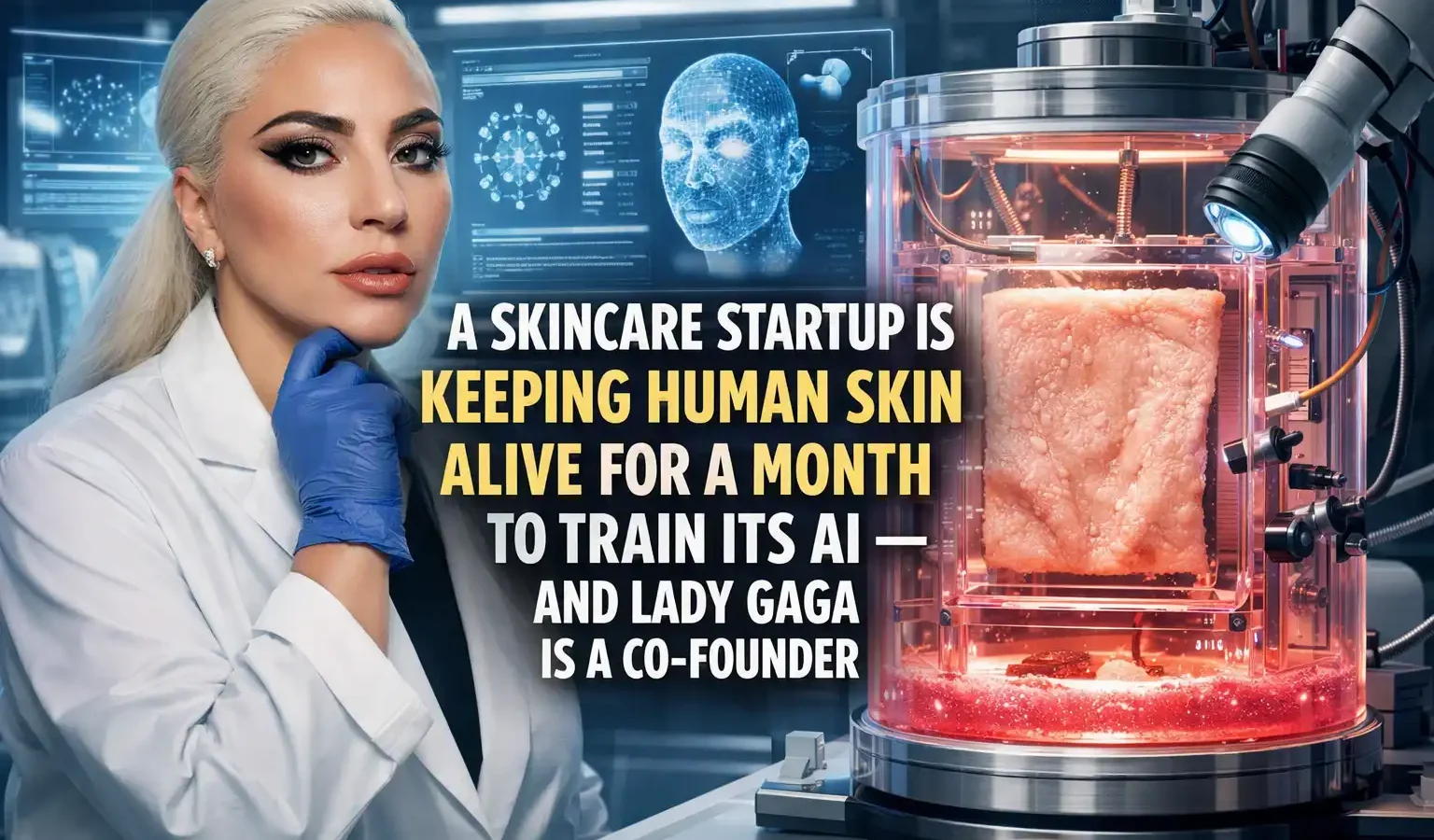
Most skincare research runs on a clock nobody likes. Human skin removed from the body for lab testing typically stays biologically useful for about a week before it degrades, which limits how long researchers can watch a compound actually work — or how an injury actually heals. A startup based just outside Cambridge, Massachusetts, called Outer Bio (legally Outer Biosciences) says it has pushed that window out to roughly a month, and it’s using the extra time to train machine learning models on skin biology that would otherwise be impossible to observe outside the body.
The company is led by Michael Polansky, a former Founders Fund and Bridgewater Associates alum who went on to run Sean Parker’s family office and later co-founded several ventures, including the biotech ArsenalBio and the investment firm Hawktail. Polansky founded Outer Bio in 2022 and serves as its CEO. Polansky is also, more publicly, the partner of musician and Haus Labs founder Lady Gaga (Stefani Germanotta) — and according to a TechCrunch profile published today, Germanotta is herself a co-founder of Outer Bio and sits on its board, a role the company had kept undisclosed until now. Outer Bio’s chief scientist, Kyung-Jin Jang, also sits on Haus Labs’ scientific advisory board, and the two companies run occasional joint projects — though they remain separate businesses. TechCrunch reports Outer Bio itself employs 19 people, based near Cambridge, Massachusetts, and has raised roughly $23 million to date from investors including Calm Capital, Brighter Capital, and Hawktail.
What “living skin” actually means here
Outer Bio’s platform, which it calls YUNA, works with full-thickness donor human skin — meaning the epidermis, dermis, multiple resident cell types, and immune-related activity are all kept intact rather than reduced to a single layer of cultured cells. According to the company, conventional ex vivo skin samples used in industry testing remain viable for about a week; Outer Bio says its system extends that to 30-plus days while preserving what it describes as the tissue’s original molecular programming.
That extra runway matters because a lot of the biology skincare companies care about — chronic inflammation, collagen remodeling, cellular senescence, wound repair — doesn’t resolve in a week. Outer Bio says the longer window lets it run injury studies that would otherwise be impossible: exposing tissue to calibrated UV damage, mechanical wounds, barrier-stripping, or irritant chemicals, then tracking the tissue’s stress and recovery response over days or weeks rather than snapshotting it once.
Where the AI comes in
The living-tissue system is only half of Outer Bio’s pitch. The company says every compound tested on its tissue generates a large set of transcriptomic, biochemical, and histological measurements, which are then used to train proprietary machine learning models — built, it says, on data from its own experiments rather than public datasets. Those models are used to pre-screen candidate compounds computationally before anything touches actual skin, with the company claiming it can evaluate hundreds of millions of candidate molecules per year this way, scoring them for likely efficacy, safety, patentability, and manufacturability before a much smaller shortlist reaches the lab.
The company frames this as a closed loop: each round of tissue testing produces data that improves the next round of predictions, in theory making the model’s shortlists sharper over time. Outer Bio has also published a preprint describing the underlying tissue platform, which the company points to as the scientific basis for the approach.
Outer Bio also emphasizes donor diversity as part of its pitch — sourcing tissue across all six Fitzpatrick skin types, multiple body regions, multiple races, both sexes, and an age range spanning roughly 20 to 75. The company argues that skincare research has historically leaned on a narrow donor pool, which can miss how compounds behave across different skin types.
Why an AI-and-biology startup has a celebrity co-founder
Polansky’s dual role — startup founder and, as reporting has described it, Lady Gaga’s creative and business partner — has drawn attention mostly because of who he is, not what the company does. Germanotta’s own cosmetics brand, Haus Labs, is a separate venture where Polansky sits on the board; Outer Bio is described as an idea Germanotta had a hand in from early on, with her board involvement kept quiet until recently. The company itself, on its own site, doesn’t foreground either name — its public materials focus on the tissue platform and its pharma, biotech, and cosmetics industry partnerships rather than its leadership’s celebrity profile.
How the business actually works
Cosmetic ingredients sit outside the FDA’s drug-approval process, which shapes Outer Bio’s whole commercial route. Rather than a formal approval, a new ingredient needs an accepted industry name and safety data that meets standards set by the OECD, an international body whose member countries mutually accept properly conducted studies from one another. Outer Bio also isn’t planning to sell shampoo or serum under its own name — the model is to hand off finished, validated ingredients to beauty and pharmaceutical companies, who build and market their own products around them.
As of the TechCrunch interview, Polansky described six ingredient candidates moving through the pipeline, with four he expects to reach commercial products. He also described the discovery rate accelerating sharply from the company’s earlier years, when finding a single promising lead could take well over a year of manual literature review — the AI-assisted approach now turns up a new candidate roughly every month and a half. Money currently comes in through paid research collaborations rather than product sales, including work with a pharmaceutical partner investigating why certain cancer drugs trigger skin rashes.
Outer Bio isn’t alone in this space. Philadelphia-based Vivodyne is chasing a related idea from a different angle — synthetic lab-grown human tissue rather than donor skin, paired with predictive AI, aimed at replacing animal testing across drug development more broadly — and has raised nearly $80 million, well ahead of Outer Bio’s roughly $23 million. The distinction Outer Bio draws between itself and that approach is real donor tissue versus engineered tissue: the company’s pitch is that biology this complex is hard to fully recreate synthetically, though that’s Outer Bio’s own framing of the comparison, not an independent assessment of either platform.
What’s still unverified
Everything above comes from Outer Bio’s own published materials and from public reporting on its leadership — not from independent lab verification. The company has not published peer-reviewed clinical results showing that compounds discovered through this pipeline outperform existing skincare ingredients in humans; its claims about tissue viability and model accuracy are, for now, the company’s own. A preprint exists, but a preprint is not the same as peer review.
Treat these as vendor claims, not settled facts. “30 days of living skin” and “750 million compounds a year” are Outer Bio’s own figures, drawn from a preprint that has not yet passed peer review. It’s reasonable to want independent replication before treating either number as established science.
My Take — Mr Wangdoo
I haven’t seen this platform in person and I’m going purely on what Outer Bio publishes about itself, so take this as a read of their materials rather than a verdict on the science. What stands out to me isn’t the celebrity angle — it’s that the bottleneck the company describes is an old one in skincare research: lab skin dies too fast to watch the biology that actually matters, so the industry ends up reformulating the same handful of known ingredients instead of discovering new mechanisms. Whether Outer Bio’s tissue actually behaves the way it claims for a month, and whether the models trained on it find anything a chemist couldn’t have found another way, are questions only independent replication can answer. Until then, I’d treat this as a promising approach to watch rather than a proven one.
Sources
- TechCrunch — on Polansky’s dual role, Germanotta’s board seat, employee count, and company location. techcrunch.com
- Outer Bio — Company technology overview. outerbio.com
- Outer Bio — YUNA platform technical details, tissue viability, and donor diversity figures. outerbio.com/technology
- Outer Bio — Foundational preprint. biorxiv.org
- Wikipedia — Michael Polansky biography. en.wikipedia.org
- Crunchbase — Outer Biosciences company profile. crunchbase.com