Tata Sierra EV: The Official Specs, and the Strategy Behind Them

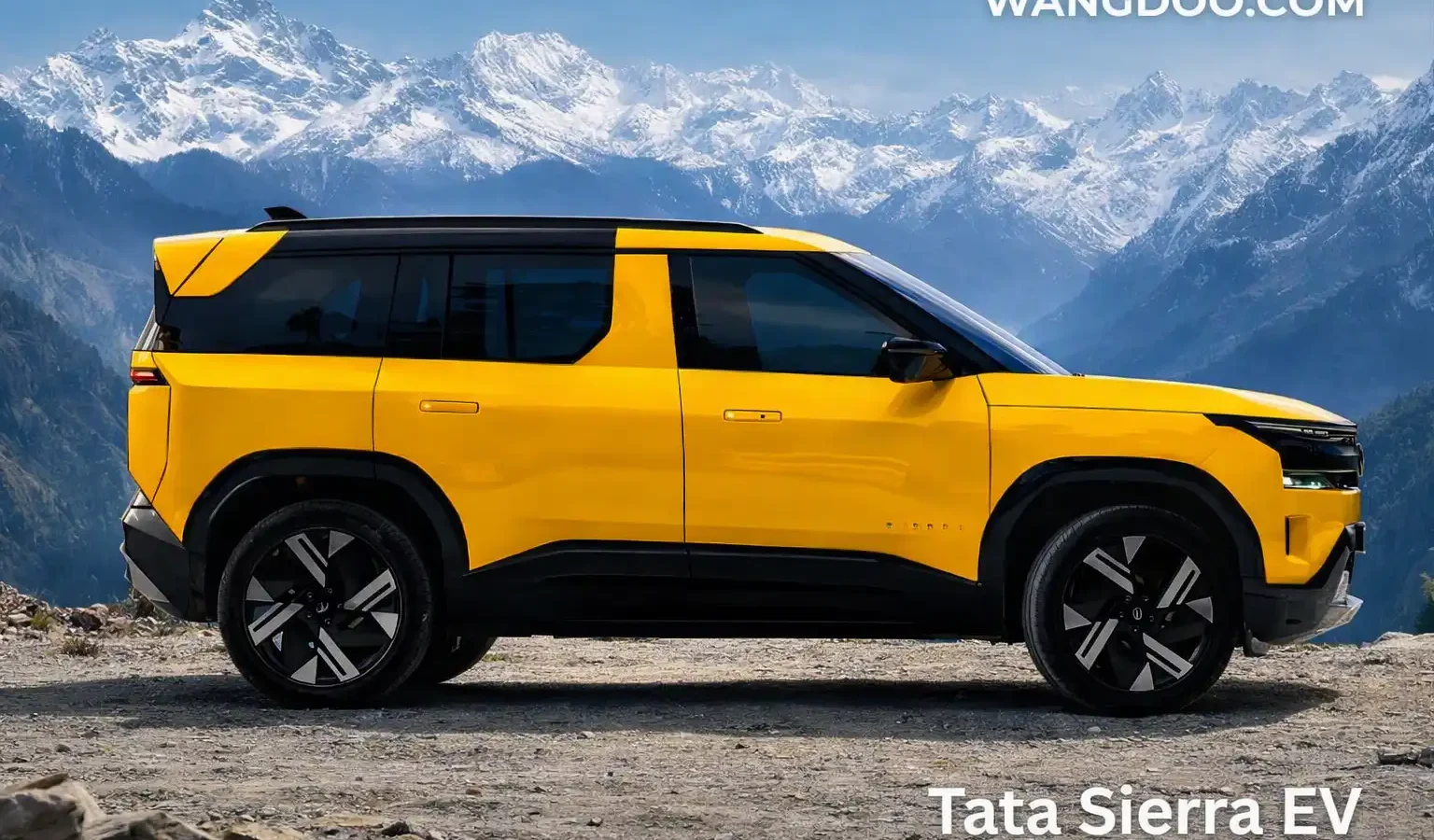
Tata Motors launched the Sierra EV on 30 June 2026 at ₹18.79 lakh, roughly €17,100 at current rates.
The top variant claims 665 km of range, dual-motor all-wheel drive, a triple-screen dashboard, L2+ driver assistance and a lifetime battery warranty. Each needs unpacking, starting with what Tata actually publishes.
What Tata officially states
| Power | 306 PS cumulative (QWD dual-motor) · 238 PS (RWD) |
| Torque | 504 Nm cumulative |
| 0–100 km/h | 5.8 seconds in Boost Mode — Tata notes this is internal testing data under test ambient conditions |
| Battery & range | 75 kWh pack, up to 665 km — ARAI certified on the MIDC Urban + Extra Urban cycle |
| Charging | 1.6C capable — up to 263 km added in 15 minutes |
| Battery warranty | Lifetime HV battery pack warranty — defined by Tata as 15 years from first registration, private registrations only, void on transfer to a third party. On ownership change it reverts to 10 years or 200,000 km |
| Driver assistance | ADAS L2+ with Intelligent Speed Assist |
| Cameras | Surround view combining a 360° system with a 180° view Tata describes as showing through the vehicle body, plus cameras that activate when turning |
| Parking | Automated parking that can park, be summoned, and retrace its own path out of a space |
| Terrain modes | Six on the AWD flagship: Normal, Grass/Snow, Mud-Ruts/Gravel, Sand, Rock Crawl, Custom. Lower variants get four |
| Boot space | 622 litres (VDA method), plus front frunk storage |
| Interior | Triple-screen dashboard — a 12.3-inch touchscreen and 10.25-inch instrument display · 12 speakers with Dolby Atmos · panoramic sunroof · ventilated front seats · augmented-reality head-up display |
| Connectivity | Connected-car system with 70 features over 5G, four years included. Tata claims an EV route planner on Android Auto that predicts battery on arrival and recommends charging stops — a first in India, by its own account |
| Power sharing | V2V up to 5 kVA · V2L up to 3.3 kVA |
| Safety | Six airbags standard, electronic stability programme, all-wheel disc brakes |
| Suspension | Independent multi-link rear with frequency-dependent dampers — unusual at this price, and the same setup as the larger Harrier EV |
| Variants | Six: Pure, Pure S, Adventure, Empowered, Empowered A, Empowered AWD A |
A note on the feature names. Tata brands most of these — the sunroof, the parking system, the suspension, the head-up display all carry trademarked names on its site. This article describes what each does instead. Branded feature names tell you nothing about capability and make cross-shopping harder, which is generally the point of them.
Not on Tata’s page. Several specifications reported widely do not appear on Tata’s own Sierra.ev pages: the 63 kWh battery option, the ₹26.48 lakh top-variant price, the ₹49,000 home charger, and the Acti.ev+ platform name. They are consistently reported by Indian automotive outlets and are probably right, but this article separates them from what Tata itself publishes.
Tata’s page contradicts itself twice. One section claims 23,000+ charging stations across India; another on the same page says 33,000+. ADAS is described as having 22 features in the feature list and 23 in the variant breakdown. Neither matters much in itself. Both are a reminder that manufacturer pages are not automatically authoritative.
Pricing in rupees and euros
| Entry variant | ₹18.79 lakh · approx. €17,100 |
| Top variant | ₹26.48 lakh · approx. €24,100 |
| Home charger (7.2 kW) | ₹49,000 optional · approx. €445 |
| Rate used | Approximately ₹110 = €1, mid-market, August 2026 |
Two things the conversion hides. Indian prices are quoted ex-showroom, which excludes registration, insurance and road tax — on-road cost typically runs 10–15% higher. And the euro figure is a currency conversion, not a European price. Import duties, homologation, VAT and different equipment levels mean a car like this would not reach a European showroom anywhere near €17,100, which is a large part of why it is not sold there.
On that 665 km figure: Tata footnotes it as ARAI certified on the MIDC Urban plus Extra Urban cycle, adding that actual figures vary with driving pattern and conditions. MIDC produces considerably more optimistic numbers than WLTP and far more than EPA, so it is a fair comparison against other Indian EVs and a misleading one against a European or American car. No independent range test has been published.
The strategy is the story
The Sierra EV is Tata’s seventh electric model, alongside the Tiago, Tigor, Punch, Nexon, Curvv and Harrier. A Safari EV enters production this month for a festive-season launch.
When it arrives, Tata will offer every SUV in its lineup in both petrol and electric form. No other carmaker anywhere is doing that.
The rest of the industry split two ways. Volkswagen, Ford and General Motors built dedicated EV platforms and separate model lines, then scaled back when demand disappointed. Toyota hedged towards hybrids. Tata took a third path: convert existing models, keep both powertrains on sale, let buyers choose, and add born-electric platforms only at the premium end — where the Avinya sub-brand is due late this year on a Gen 3 skateboard architecture.
That means Tata is currently running both strategies at once, in the same market, at the same time. It is the closest thing the industry has to a controlled experiment on whether conversion or clean-sheet design is the better transition.
Why the Sierra EV is a conversion: the platform it uses — reported as Acti.ev+, though Tata does not name it on the Sierra.ev page — is adapted from combustion architecture rather than designed around a battery. That usually costs interior packaging and efficiency. It also means far lower development cost and shared production lines, which is a large part of how the price lands where it does — and matters more than usual now that component costs are climbing across the industry.
What the numbers tell you about the market
Tata has passed 250,000 cumulative EV sales in India, and the Nexon EV became the first electric car in the country to clear 100,000 units. A smaller number matters more: Tata says about 26% of its EV buyers are first-time car owners.
In Europe and North America, electric cars are overwhelmingly replacement purchases — second or third cars for households that already drive. In India a quarter of Tata’s EV customers are entering car ownership through an electric vehicle, with no combustion habits to unlearn and no expectation that refuelling takes four minutes.
My Take — Mr Wangdoo
This is not a story about cheap range. The MIDC cycle inflates the headline, the car is a conversion rather than a clean-sheet design, and nothing has been independently tested.
What holds my attention is that Tata is about to become the only carmaker on earth offering identical model choice across both powertrains. Every other manufacturer has forced a decision — buy the EV version, which is a different car, or buy the combustion one. Tata is removing the decision. Same nameplate, same shape, same showroom, pick a drivetrain.
Nobody knows whether that works. It could be the pragmatic answer everyone else missed, or it could mean two compromised cars instead of one good one. But it is being tested properly, in a large market, against real money, and the results will be visible within a couple of years.
The first-time-buyer figure is what I would watch most closely. If a quarter of Tata’s EV customers really are people who never owned a combustion car, India may skip a transition the rest of the world is struggling through — the same way much of it skipped landlines.
Common questions
How much does the Tata Sierra EV cost?
Prices run from ₹18.79 lakh to ₹26.48 lakh ex-showroom, roughly €17,100 to €24,100 at an exchange rate of about ₹110 to the euro. Ex-showroom excludes registration, insurance and road tax, which typically add 10–15% to the on-road figure in India. It launched on 30 June 2026 and is sold in India only.
What is the real-world range?
Unknown. Tata claims up to 665 km from the 75 kWh pack, ARAI certified on the MIDC Urban plus Extra Urban cycle, and notes actual figures vary with driving pattern. A 63 kWh option with a lower claimed range is widely reported but does not appear on Tata’s own product page. MIDC figures run substantially more optimistic than WLTP or EPA, and no independent range test has been published.
Is the Sierra EV sold outside India?
No. Tata has not announced international availability for the Sierra EV. Its electric range is currently an India-market lineup.
What is coming next from Tata?
A Safari EV enters production this month for a festive-season launch, expected to be India’s first three-row electric SUV. The Avinya premium sub-brand is due late 2026 on a born-electric platform. In July, chairman N Chandrasekaran said four further electric models would arrive within 12 to 18 months.
Sources
- Tata Motors — Official Sierra.ev product page. ev.tatamotors.com
- ZigWheels — Tata Sierra EV price, range and specifications. zigwheels.com
- Autocar India — “Tata to launch three new EVs in 2026,” on the Avinya and Punch.ev roadmap and EV sales figures. autocarindia.com
- Autocar India — “Tata Safari EV planned for launch in festive season 2026.” autocarindia.com