Japan’s AI Rules Have No Fines and No Bans – Here’s the Strategy Behind That

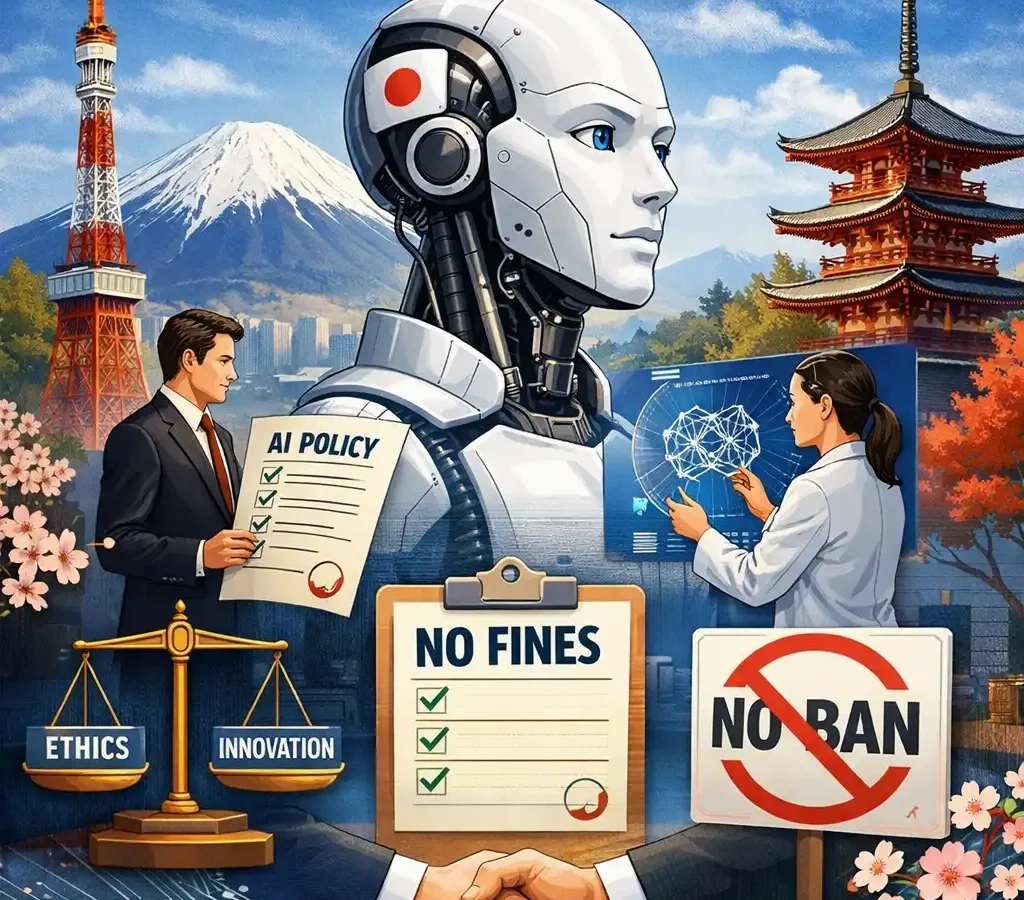
No fines. No bans. No mandatory compliance checklist. On July 7, 2026, Japan set up a new council to overhaul how it governs AI — the latest step in a regulatory approach that looks almost nothing like the EU’s. Here’s how it actually works, and why Japan built it this way on purpose.
How this was reported: This article draws on the official text and analysis of Japan’s AI Promotion Act via White & Case LLP’s regulatory tracker, the Future of Privacy Forum’s legal analysis, the International Bar Association, Bird & Bird’s comparative legal analysis, and news coverage from Nippon.com (Jiji Press) and The Japan Times. Wangdoo has previously covered Ireland’s AI Regulation Bill, which takes a very different approach worth comparing against this one.
What Actually Happened on July 7
Japan’s government decided to establish a new council tasked with a sweeping overhaul of the legal frameworks governing AI development and use. The decision was folded into Japan’s 2026 basic policy guidelines, adopted at a meeting of the country’s digital administrative and fiscal reform council, held at the Prime Minister’s Office in Tokyo. The council itself isn’t brand new — it’s a reorganisation of a digital reform body originally launched under former Prime Minister Fumio Kishida — but its mandate has been sharply refocused around what the government calls “AI transformation,” framed explicitly as a response to Japan’s population decline.
The guidelines named specific priority sectors for the reform: medical and elderly care, transportation and infrastructure, working environments, and administrative services and procedures. That list isn’t arbitrary — it maps directly onto the sectors most acutely affected by Japan’s shrinking, ageing workforce, which is the throughline connecting almost every major AI policy Japan has announced over the past year.
A discussion of how Japan’s AI regulatory approach differs from the EU’s, with legal expert Takashi Nakazaki. Independent production, not affiliated with Wangdoo.
The Law Underneath This Announcement
To understand what the new reform council is actually reorganising, you need to understand the law it sits under. Japan’s AI Promotion Act — formally the Act on Promotion of Research and Development and Utilization of Artificial Intelligence-Related Technologies — passed the Diet on May 28, 2025, and is Japan’s first law expressly directed at AI technology. Critically, legal analysis from White & Case describes it as a “fundamental law”: a category of Japanese legislation that sets out basic policies and broad principles rather than detailed technical prescriptions and prohibitions.
That’s a fundamentally different legislative philosophy from the EU AI Act, which sorts AI systems into risk tiers and attaches specific compliance obligations and penalties to each tier. Japan’s Act does something closer to the opposite: Article 7 describes general duties for AI developers, providers, and business users to make “reasonable efforts” toward improving their AI use in line with the law’s core principles — but, as White & Case’s analysis notes plainly, with no described penalty attached.
Who actually runs this
The Act establishes an AI Strategic Headquarters headed by the Prime Minister, with every Cabinet member as a participant. Underneath it sit two operational bodies: the Artificial Intelligence Strategy Promotion Council, led by a dedicated Strategic AI Minister and staffed by roughly forty government officials spanning Japan’s ministries, and the Expert Investigation Team, whose members are appointed directly by the Prime Minister from academic AI backgrounds. It’s this Promotion Council structure that the July 7 announcement reorganises and sharpens.
“Name and Shame” Instead of Fines
Here’s the part that makes Japan’s model distinct, not just softer. Since the AI Promotion Act carries no monetary penalties, enforcement runs through a different mechanism entirely: public identification of non-compliant organisations. Authorities can investigate suspected violations and publicly name the businesses involved — a lever that carries real weight in a business culture where institutional reputation and long-term stakeholder trust function as genuine structural currency, not just PR concerns.
This isn’t a hypothetical enforcement tool. In January 2026, Chief Cabinet Secretary Minoru Kihara announced the government’s first use of this power: a formal situational review into AI-generated content used in sexual deepfakes. That’s a concrete signal of where Japan’s soft-law model is actually willing to apply pressure first — not broad commercial AI use, but a specific, serious harm category.
The Basic AI Plan — Where the Actual Detail Lives
The AI Promotion Act itself is deliberately broad. The operational substance sits in a separate document it mandates: the Basic AI Plan, approved by Japan’s Cabinet Office on December 23, 2025, and organised into four chapters covering Japan’s AI policy background, three guiding principles, four basic policies, and specific government measures.
The three guiding principles are worth naming directly, because they capture the philosophy better than any summary: promoting innovation while mitigating risks, agile response, and promotion of integrated domestic and international policies. The Basic Plan is explicit that Japan sees itself lagging behind global peers in AI investment and adoption — citing Stanford’s AI Index ranking Japan around 12th globally for private AI investment — and frames the entire regulatory approach as a deliberate corrective, not caution for its own sake.
The government’s fiscal year 2026 AI budget backs that framing with real numbers: of a 502.7 billion yen AI budget, nearly 90% — 455.9 billion yen — is earmarked for strengthening Japan’s AI development capabilities, with the single largest line item, over 387.3 billion yen, going toward a multimodal foundation model for AI robots and physical AI. By contrast, implementing AI governance itself carries a budget of just 1.1 billion yen. The spending pattern makes Japan’s priorities legible in a way the legal text alone doesn’t: this is a growth policy with a governance layer attached, not a governance policy with growth as a side effect — a pattern that echoes the state-backed infrastructure push we saw in China’s own national AI strategy, even though the two countries’ regulatory philosophies otherwise differ sharply.
The Copyright Carve-Out Almost No Other Major Economy Offers
One specific provision illustrates how far Japan’s “innovation-first” framing extends in practice. Under Article 30-4 of Japan’s Copyright Act, AI developers can use copyrighted works as training data without the rights holder’s consent, provided the resulting outputs don’t reproduce the original work’s expression. Legal analysis covering this provision describes it as broader than what most other major economies currently allow — a genuine competitive differentiator Japan is using to attract AI research and development activity, alongside its light-touch regulatory posture.
Soft law doesn’t mean static law
Japan’s own Basic AI Plan explicitly reserves the right to escalate. The AI Promotion Act allows the government to introduce risk-based regulatory measures if existing laws and guidelines prove insufficient to address emerging risks. Japan’s AI Safety Institute is also actively growing — reportedly toward around 200 staff — and is beginning to publish technical standards for advanced AI systems. Those standards carry no legal force yet, but they’re shaping what “trustworthy AI” means for enterprise buyers in the Japanese market well ahead of any future hard-law shift. Businesses treating Japan’s current framework as permanently low-friction may be reading the moment rather than the trajectory.
How This Actually Compares to Ireland and the EU
Ireland’s approach — creating the AI Office of Ireland as a statutory enforcement body under the EU AI Act, with real powers including seizure and prohibition of non-compliant systems — sits at the opposite end of the regulatory spectrum from Japan’s model. Where Ireland is building enforcement infrastructure with teeth, Japan is deliberately building infrastructure without them, betting that reputational exposure and administrative coordination will shape corporate behaviour more effectively than statutory penalties, at least for now.
Neither approach is obviously correct in the abstract. The EU model gives regulators concrete tools and clear compliance benchmarks, at the cost of being slower to adapt and heavier for smaller developers to navigate. Japan’s model is faster to stand up and lighter on compliance burden, but depends entirely on reputational stakes actually mattering to the organisations it’s trying to influence — which is a reasonable bet in Japan’s specific business culture, and a much less reliable one if directly transplanted elsewhere.
My Take — Mr Wangdoo
What I find most interesting about Japan’s approach isn’t the absence of fines — plenty of countries have weak AI enforcement by accident, through slow legislative processes or political gridlock. Japan’s absence of fines is a stated, deliberate policy choice, backed by a specific theory of what actually changes corporate behaviour in a market where long-term reputation functions differently than it does in, say, the United States or much of Europe. That’s a fundamentally different starting premise from most AI regulation being written right now, and it’s worth taking seriously on its own terms rather than reading it as regulation Japan simply hasn’t finished yet.
That said, I don’t think the framing of Japan as having “no AI regulation” — which shows up constantly in casual coverage — holds up once you actually look at the structure. There’s a Prime Minister-headed Strategic Headquarters, a forty-official Promotion Council, an Expert Investigation Team defining high-impact AI categories, a Basic Plan with binding review cycles, and a demonstrated willingness to use the name-and-shame mechanism on a real case within months of the law taking effect. That’s a functioning regulatory apparatus. It just optimises for a different lever than fines.
The detail I’d watch most closely from here is the Expert Investigation Team’s Q3 2026 definition of “high-impact” AI. Until that category is actually defined with technical specificity, every company operating in Japan is making a bet about where they’ll eventually land, based on principles rather than a clear line. Soft law with an explicit escalation clause built in is not the same thing as permanently light-touch law — and the July 7 reform council, focused specifically on medical care, transportation, and administrative services, reads to me like early groundwork for exactly that kind of sector-specific tightening, not a signal that Japan intends to stay hands-off indefinitely.
Frequently Asked Questions
Does Japan actually have AI regulation, or is it unregulated?
Japan has a functioning regulatory structure — the AI Promotion Act, a Prime Minister-led Strategic Headquarters, a dedicated Promotion Council, and a Basic AI Plan with defined review cycles — but it deliberately avoids the fines and prohibitions found in frameworks like the EU AI Act. Enforcement instead relies on administrative guidance and public identification of non-compliant organisations, sometimes called a “name and shame” model. Describing Japan as having no AI regulation is inaccurate; it has a different regulatory model built around reputational rather than financial consequences.
What is the AI Promotion Act?
Formally the Act on Promotion of Research and Development and Utilization of Artificial Intelligence-Related Technologies, this is Japan’s first law specifically directed at AI, passed by the Diet on May 28, 2025. It functions as a “fundamental law” in the Japanese legal system, establishing broad principles and government structures rather than detailed technical compliance requirements. It carries no monetary penalties for non-compliance.
What does the new AI reform council announced on July 7, 2026 actually do?
It reorganises an existing digital reform body, originally established under former Prime Minister Fumio Kishida, into a dedicated council tasked with a sweeping overhaul of Japan’s legal frameworks governing AI. Its stated priority sectors are medical and elderly care, transportation and infrastructure, working environments, and administrative services — all areas closely tied to Japan’s demographic labour shortage.
How does Japan’s approach differ from the EU AI Act?
The EU AI Act sorts AI systems into risk categories with specific technical compliance requirements and financial penalties attached to each tier. Japan’s AI Promotion Act instead sets broad national principles and relies on administrative guidance, voluntary compliance, and reputational enforcement through public disclosure of non-compliant organisations, without mandatory fines or technical conformity assessments.
Has Japan’s “name and shame” enforcement actually been used?
Yes. In January 2026, Japan’s Chief Cabinet Secretary announced the first formal use of this mechanism, opening a situational review into AI-generated content used in sexual deepfakes — indicating the government’s initial enforcement priority was a specific, serious harm category rather than broad commercial AI compliance.
Could Japan move toward stricter AI regulation in the future?
The AI Promotion Act explicitly allows the government to introduce risk-based regulatory measures if existing soft-law guidelines prove insufficient to address emerging risks. Japan’s AI Safety Institute is also expanding and beginning to publish technical standards for advanced AI systems, which — while not currently legally binding — could shape the basis for future harder regulation. The current light-touch framework should be read as Japan’s starting position, not a permanent commitment.
Sources
- Japan’s first AI legislation becomes law — White & Case LLP, April 14, 2026 (primary legal analysis: Act structure, Basic AI Plan, budget figures, Article 7)
- Japan to Launch AI-Linked Reform Promotion Council — Nippon.com / Jiji Press, July 7, 2026 (primary news source: council establishment)
- Japan to launch council to overhaul legal frameworks governing AI use — The Japan Times, July 7, 2026 (priority sectors, official statements)
- Understanding Japan’s AI Promotion Act — Future of Privacy Forum (comparative analysis, Stanford AI Index context)
- Japan’s emerging framework for responsible AI — International Bar Association (soft-law legal characterisation)
- Japan AI Regulation News: No Fines, No Bans, No Mandates — MailMate (deepfake enforcement case, AI Safety Institute expansion, copyright provision)