Matter 1.6 Finally Unites Smart Homes Across Apple, Google and Amazon

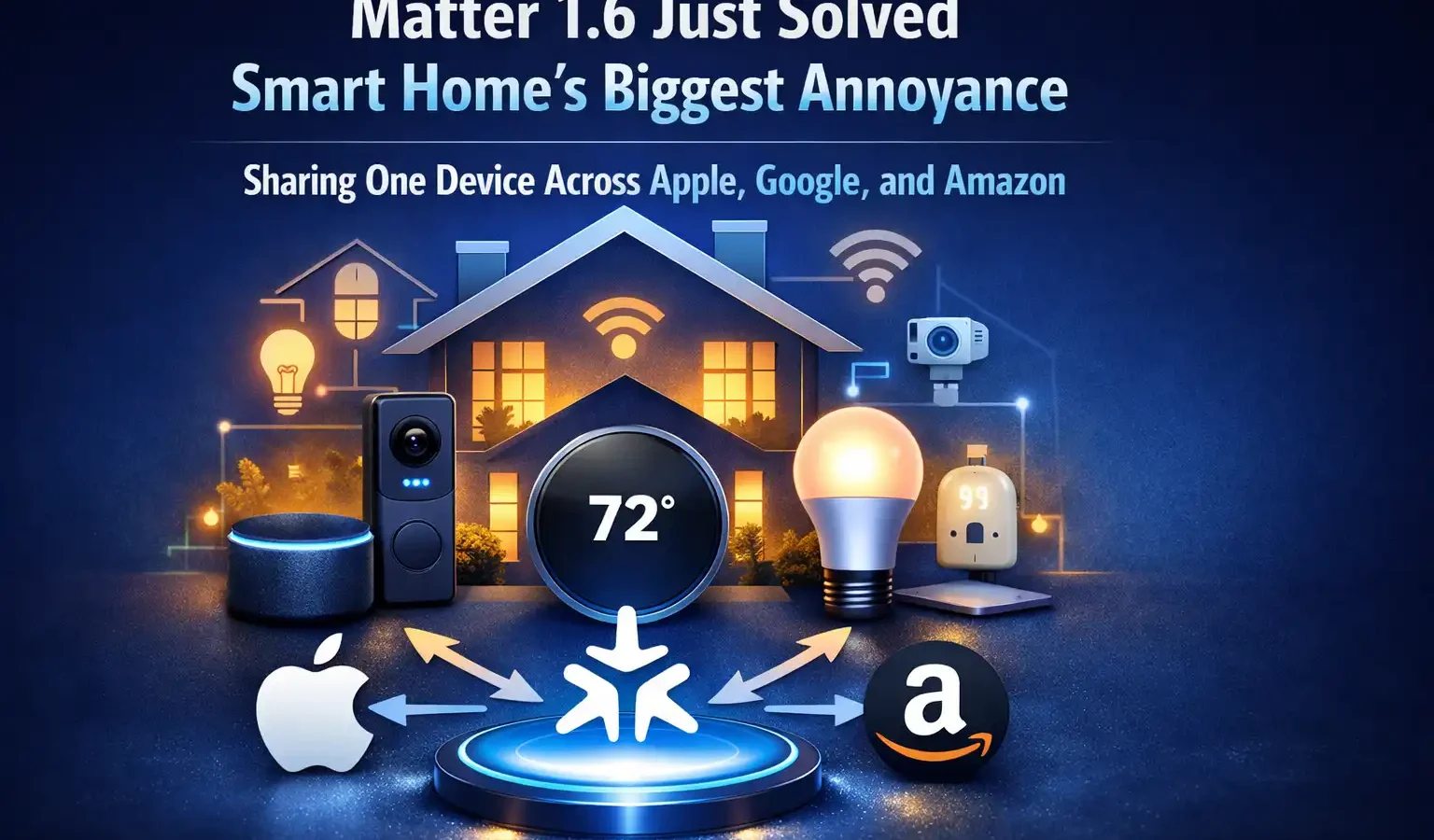
Matter 1.6 Just Solved Smart Home’s Biggest Annoyance — Sharing One Device Across Apple, Google, and Amazon
If you’ve ever set up the same light switch three separate times for three separate apps, Matter 1.6 was built for you. The Connectivity Standards Alliance’s latest update introduces “Joint Fabric” — a fundamentally different approach to the cross-ecosystem problem that has quietly annoyed multi-platform households since Matter launched.
How this was reported: This article is based on the Connectivity Standards Alliance’s official Matter 1.6 announcement published June 17, 2026, MacRumors’ and Cult of Mac’s coverage of the same release, and technical analysis from matter-smarthome.de and Matter Alpha. All feature descriptions are drawn from the CSA’s own specification materials.
A note on availability: A published specification is not the same as a working feature. As of this writing, Matter 1.6 is available for device makers and platforms to begin integrating — it is not yet broadly live in consumer apps. Timelines below reflect what has been announced, not confirmed shipping dates.
What Actually Shipped on June 17
The Connectivity Standards Alliance — the industry body behind the Matter smart home standard, whose members include Apple, Google, Amazon, and Samsung — released Matter 1.6 at its annual Unify event. Unlike the two previous major versions, this update isn’t about adding new device categories. Matter 1.5 was about cameras and doorbells. Matter 1.4 was about clean energy devices like solar batteries and heat pumps. Matter 1.6 is about fixing the parts of the existing experience that have quietly frustrated users since Matter launched in October 2022: setup friction, cross-platform sharing, and thermostats that don’t know what you just did five seconds ago.
A breakdown of what Matter 1.6 changes for smart home setup, published shortly after the June 17 release. Independent production, not affiliated with Wangdoo or the CSA.
Why “Fabrics” Have Been the Actual Problem
To understand why Joint Fabric matters, you need to understand what a “Fabric” is in Matter’s architecture — and this is the part most coverage skips over.
Every time you add a Matter device to a smart home ecosystem, that ecosystem creates its own private network layer for that device called a Fabric. If you run Apple Home and also want that same light switch controllable from Google Home, the standard approach — called Multi-Admin, introduced in Matter 1.4 — lets you share access between those two separate Fabrics. It works, but each ecosystem still maintains its own independent view of the network. Automations, permissions, and device states stay isolated between them. If Google Home and Apple Home both try to control the same thermostat at the same time, neither system knows what the other just did.
There’s also a hard technical ceiling here that rarely gets mentioned: the Matter specification requires certified devices to support a minimum of five Fabrics simultaneously. That sounds like plenty until you learn that Apple Home alone consumes two of those five slots — one for the device itself, and a second because Apple synchronizes Matter accessories through iCloud Keychain, which requires its own separate Fabric. So a household running Apple Home plus two other platforms can hit a hard device limit, not just an inconvenience.
How Joint Fabric Actually Works
Joint Fabric doesn’t try to make Multi-Admin’s device-sharing faster or cleaner. It replaces the underlying model entirely. Instead of each ecosystem keeping a separate, private Fabric and syncing access between them, Joint Fabric introduces a central shared Datastore that multiple user-authorized controllers — Apple Home, Google Home, Amazon Alexa, SmartThings, whatever combination you run — can all read from and write to together.
Any device added to a Joint Fabric becomes visible and controllable from every participating ecosystem simultaneously, and critically, its participation counts as a single Fabric slot rather than one per ecosystem — directly addressing the fabric-exhaustion problem above. A routine built in Google Home and a routine built in Amazon Alexa can reference the same light switch, with the device’s actual state kept consistent between them, rather than each platform holding its own out-of-sync picture of what that light is currently doing.
Who Joint Fabric is actually built for
The CSA specifically calls out three scenarios: new-construction handovers, where a builder, then a property manager, then eventually a homeowner all need coordinated device access as the property changes hands; households where different family members prefer different apps — one person on Apple Home, another on Google Home — without needing to set every device up twice; and professionally managed properties, like apartment buildings, where building management, on-site staff, and individual tenants all need appropriately scoped access to shared infrastructure.
Setup Without Fumbling for a QR Code
The second headline feature is NFC-Based Commissioning, and it solves a much more mundane but widely shared annoyance. Setting up most Matter devices today means scanning a QR code printed on the device or its packaging — which is fine for a smart plug sitting on your desk, and awkward in practice for a light bulb you’re about to screw into a ceiling fixture, or an in-wall switch you’re about to seal behind a faceplate.
Earlier Matter versions already supported NFC as a way to kick off setup, but Bluetooth Low Energy still handled the actual commissioning exchange. Matter 1.6 moves the entire process onto NFC. In practice, that means a light bulb can complete setup before you install it, and an in-wall switch can finish commissioning before mains power is even restored. For larger jobs — new construction, a full rental property refresh — multiple devices can be provisioned in a batch, then simply activated once each one reaches its final spot.
Thermostats That Actually Remember What You Just Did
The third significant change addresses a specific, recognisable frustration: the thermostat that gets overridden by an automation seconds after you manually adjust it.
Today, when a smart home ecosystem sends a command to a Matter thermostat, that thermostat generally just executes it — regardless of what you, or another ecosystem, did moments earlier. Matter 1.6 introduces Thermostat Suggestions, which changes that relationship. Instead of issuing a direct command, a controller now submits a time-bound recommendation tied to one of the thermostat’s supported presets. The thermostat evaluates that suggestion against your stated preferences and current conditions before deciding whether to act on it — and if it detects you adjusted the temperature by hand moments earlier, it can recognise the incoming suggestion as probably unintended and simply defer.
This has a real practical benefit beyond convenience: it protects utility demand-response programme enrollments. If you’ve opted into a savings event with your energy provider, Matter 1.6 lets the thermostat honour that commitment even when an automation from an unrelated ecosystem tries to send a conflicting instruction — closing a gap that previously let one platform accidentally undo another’s energy-saving behaviour.
Everything Else in the Release
A handful of smaller changes round out Matter 1.6, each targeted rather than headline-grabbing:
- Standardised operational limits — devices can now communicate their capabilities and constraints in a consistent format, giving controllers a more accurate picture of what a given device can actually do.
- Cross-ecosystem security event history — security sensors can share their event logs across ecosystems, rather than each platform only seeing its own slice of activity.
- Tamper detection for alarms — smoke and CO alarms can now flag when someone has physically removed them from their mounting position.
- More scalable certificate infrastructure — certificate revocation now works through smaller, independently updatable partitions, which matters as the total number of certified Matter devices keeps growing.
Alongside Matter 1.6, the CSA also released Product Security 1.1, an update to its separate device certification programme. The previous version assessed individual devices in isolation; version 1.1 expands that scope to cover complete IoT systems — including companion apps, cloud processes, and gateways — and introduces two distinct assurance tiers: a manufacturer self-assessment reviewed by an authorised lab, or full independent lab testing. It also aligns with the EU’s Cyber Resilience Act requirements and Singapore’s Cyber Security Labeling Scheme, reducing duplicate certification work for manufacturers selling into multiple regions.
It’s worth holding onto one thing here: a specification release and a working consumer feature are very different milestones. No platform ships every new Matter capability the moment it’s published, and actual availability always comes down to the specific product, firmware version, and app you’re using.
The Gap Between “Released” and “Working on Your Devices”
Here’s where most casual coverage of standards updates goes soft. Matter 1.6 is a specification and software development kit released for device makers and platform developers to build against — it is not a feature that arrives on your existing smart home devices via automatic update tomorrow.
What history tells us about rollout speed
Apple’s track record here is instructive. Matter 1.4 was announced in November 2024 — and as of mid-2026, Apple Home still doesn’t support every feature in that release. Different platforms move at noticeably different speeds: SmartThings has generally been quick to adopt new device categories, Google and Amazon cover common categories well but can lag or expose different feature subsets, and Home Assistant — the open-source option — often gives the most granular control but requires more hands-on maintenance from the user. There is no fixed timeline for when Joint Fabric specifically will be usable in the apps on your phone. Watch for announcements from your specific smart home brands, and from Apple, Google, and Amazon directly.
My Take — Mr Wangdoo
The detail that made me actually sit up while researching this piece wasn’t Joint Fabric’s headline pitch — it was the two-fabric-slot detail buried in the technical coverage. A five-fabric minimum sounds generous until you learn Apple’s iCloud Keychain sync alone eats two of them. That’s the kind of architectural constraint that explains a specific, real frustration — devices refusing to add to a third platform, or mysteriously dropping off one ecosystem when added to another — that plenty of multi-platform smart home users have hit without ever knowing why. Joint Fabric directly targets that ceiling by making shared participation count as a single slot, which is a structurally different fix than just streamlining the sharing process.
I’d also flag the Thermostat Suggestions change as more significant than it initially reads. The scenario it solves — one ecosystem’s automation silently overwriting a manual adjustment or an energy-saving commitment made through another — isn’t a hypothetical edge case. It’s the exact kind of multi-platform conflict that makes smart homes feel less “smart” and more “fighting itself,” and it’s been a structural gap in how Matter thermostats behaved since the category was introduced.
The honest caveat, and the one I’d want any reader to walk away with: none of this is live in your Apple Home or Google Home app right now. Matter’s own history — Apple still not fully supporting a 2024 release in 2026 — is the clearest evidence that a published spec and a working consumer feature can sit eighteen months or more apart. Joint Fabric is a well-designed fix for a real architectural problem. Whether it reaches your specific devices this year or next depends entirely on how quickly your specific platforms choose to build against it.
Frequently Asked Questions
What is Matter 1.6 in simple terms?
Matter 1.6 is the latest version of the Matter smart home standard, released June 17, 2026 by the Connectivity Standards Alliance. Unlike previous updates that added support for new device types like cameras or energy hardware, Matter 1.6 focuses on fixing existing pain points: how devices get set up (NFC-based commissioning), how they’re shared across multiple platforms like Apple Home and Google Home (Joint Fabric), and how thermostats handle conflicting instructions from different apps (Thermostat Suggestions).
What is Joint Fabric and how is it different from what Matter already had?
Joint Fabric is a new way for multiple smart home platforms to jointly manage the same set of devices through a shared central system, rather than each platform keeping its own separate, private network and syncing access between them (the previous “Multi-Admin” approach introduced in Matter 1.4). Under Joint Fabric, a device’s participation counts as a single network slot regardless of how many platforms can access it, and its status stays consistent across every connected app rather than each platform holding a potentially outdated view.
Can I use Joint Fabric right now?
Not yet, for most people. Matter 1.6 is currently available as a specification and development kit for device manufacturers and platform companies to build against. Individual smart home platforms — Apple Home, Google Home, Amazon Alexa, SmartThings — need to implement support for it in their own apps and services before it becomes usable by consumers. No official timeline has been announced for when that will happen on any specific platform.
Why does Apple Home use up two of my device’s five available network slots?
Matter requires certified devices to support a minimum of five “Fabrics” — essentially independent network connections — simultaneously. Apple Home uses one Fabric for standard device control, but also requires a second, separate Fabric to synchronise your Matter accessories through iCloud Keychain across your Apple devices. That means running Apple Home alone consumes two of your device’s five guaranteed slots, leaving less headroom for adding the device to other platforms like Google Home or Home Assistant at the same time.
What does NFC-Based Commissioning actually change for setup?
Previously, setting up a Matter device required scanning a QR code to start the process, with Bluetooth Low Energy handling the rest of the connection. Matter 1.6 allows the entire setup exchange to happen over NFC — meaning you can tap your phone to a device to fully commission it, even before the device has power. This is particularly useful for products that are awkward to access once installed, like ceiling light fixtures or in-wall switches, since they can now be set up before physical installation rather than after.
How long does it typically take for a new Matter feature to reach actual products?
It varies significantly and can take well over a year. Matter 1.4 was announced in November 2024, and as of mid-2026, Apple Home still hasn’t implemented every feature from that release. Different platforms prioritise different features at different speeds — there’s no standard timeline. The safest approach is to treat a Matter specification release as a roadmap for what’s coming, not a feature you can expect to use immediately.
Sources
- Matter 1.6 Enables More Intuitive Setup, Multi-Ecosystem Experiences, and Context-Driven Control — Connectivity Standards Alliance official announcement, June 17, 2026 (primary source)
- Matter 1.6 Announced With NFC Setup, Cross-Ecosystem Device Sharing, and Smarter Thermostats — MacRumors, June 17, 2026 (Apple Home implementation history)
- Matter updates improve smart-home setup, sharing and security — Cult of Mac, June 17, 2026 (Product Security 1.1 details, feature breakdown)
- Matter 1.6: Shared Fabrics and Smarter Thermostats — matter-smarthome.de, June 17, 2026 (five-fabric limit, Apple iCloud Keychain detail)
- Instead of new devices, Matter 1.6 focuses on making Matter less of a headache — Matter Alpha, June 18, 2026 (practical framing, commissioning process)