nLab: A pocket‑sized powerhouse for every electronics task.

nLab: The Pocket Electronics Lab Trying to Solve a Skills Gap AI Is Making Worse
A pocket-sized device that combines three professional lab instruments into one is currently crowdfunding on Kickstarter. The story behind it raises a real question: as AI automates more technical tasks, are the hands-on engineering skills that AI cannot replace becoming harder to learn?
Transparency note: Wangdoo has not tested or handled nLab hardware. All specifications and figures in this article come from the official nLab website (getnlab.com), Hackster.io’s independent technical coverage, and Kellogg School of Management’s published profile of founder Angie Mercurio. This article is not sponsored by or affiliated with nLab.
Angie Mercurio graduated with an A+ in her university circuits class. She had never built a circuit. Like most engineering students, she had been learning theory from textbooks and sharing a small number of expensive, bulky lab machines with dozens of classmates — a system designed in the 1970s that hadn’t changed much since. Then she came across an early prototype of nLab, and something clicked. For the first time, she could actually see electricity — how signals moved through wires, how components behaved in real time. That hands-on experience is what she credits with getting her hired at Disney Imagineering, where she worked as a robotics engineer on world-class attractions. The broader context is relevant: as AI systems are trained to perform physical tasks, the engineers who design, build, and debug the hardware those systems run on remain in short supply globally.
So she quit Disney, went back to Northwestern’s Kellogg School for her MBA, and returned to nLab as CEO. The company had already been used by over 10,000 university students before its consumer launch. nLab itself has a longer history than its consumer launch suggests — the underlying device was originally created in 2014 by Nick Marchuk, then a Northwestern engineering lecturer, and teaching assistant David Meyer, to help students do circuit experiments on their own time. It was called nScope and launched on Kickstarter in 2016. nLab is the evolved consumer version of that original design, rebuilt with an updated parts kit and tutorials. Marchuk, now a Robotics Professor at Northwestern and Mercurio’s husband, is the company’s chief product officer.
nLab’s own channel showing the device in use — exploring the oscilloscope, function generator, and power supply in a pocket-sized format. Not a Wangdoo production.
What nLab Actually Is
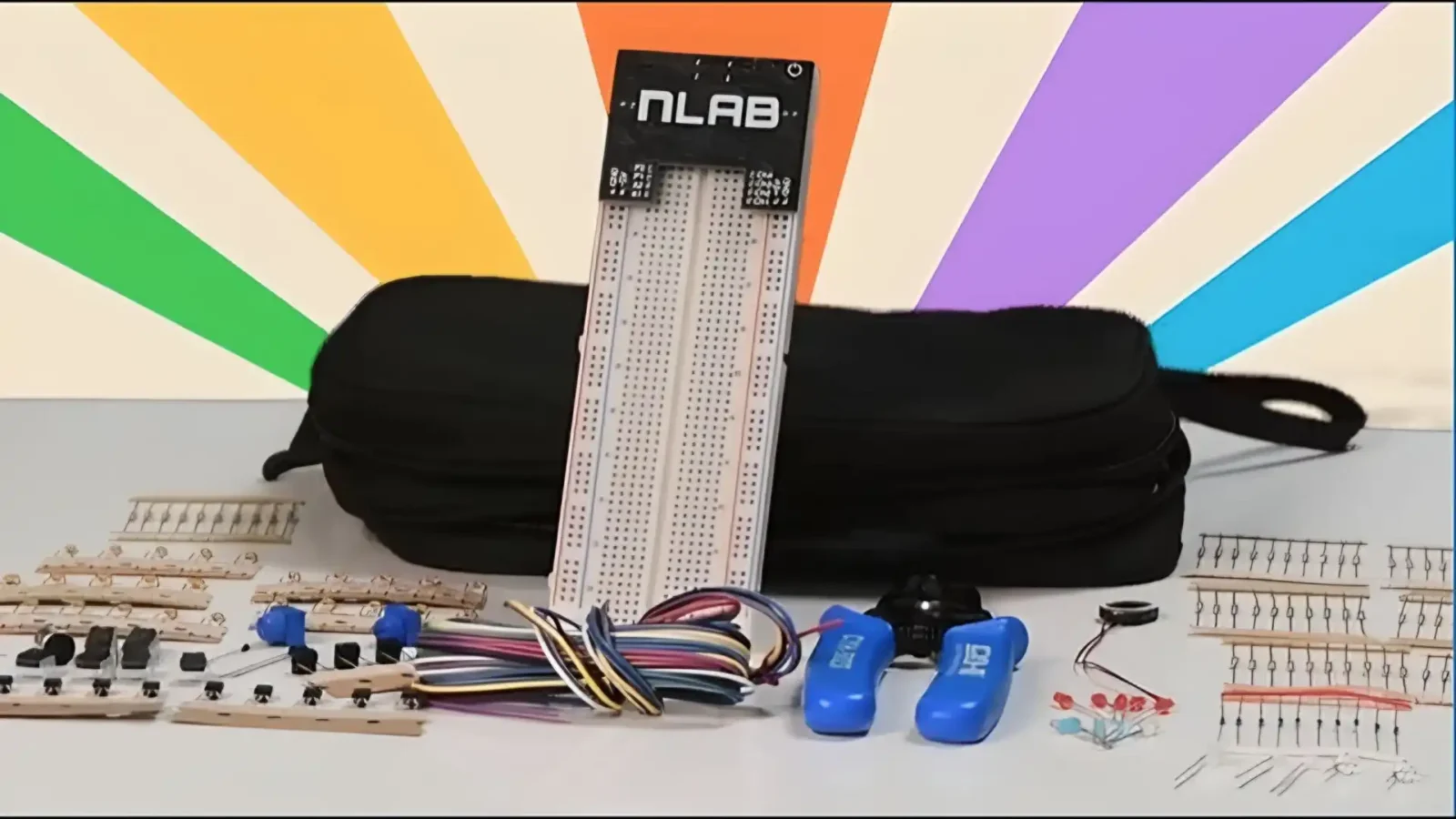
The nLab board is a 3-in-1 piece of hardware designed to sit at the head of a standard solderless breadboard. It combines three instruments that any electronics lab needs — a power supply, a function generator, and an oscilloscope — into a single pocket-sized device. Each of those instruments, bought separately as professional bench equipment, typically costs several hundred dollars. A proper entry-level bench setup of all three runs well over $1,000. The nLab consolidates all three into one compact board designed to be accessible to students and hobbyists rather than professional lab environments.
The oscilloscope is particularly significant. An oscilloscope is what lets you see electrical signals — it shows you the waveform of a voltage over time, which is how engineers diagnose whether a circuit is working, why it isn’t, and where the problem is. Without one, troubleshooting electronics involves a lot of guesswork. With one, you can literally see the signal moving through the wire. nLab’s oscilloscope function feeds live signal data to a companion app on a laptop in real time, giving students the same visual feedback that professional engineers rely on — from a device that fits in a pocket.
How It Works in Practice
The nLab board sits at the head of a standard solderless breadboard — the plastic block with rows of holes that electronics students use to connect components without soldering. The board provides power to the breadboard, generates test signals through the function generator, and reads electrical signals back through the oscilloscope channel, feeding live data to a companion laptop app. The result is that a student can wire up a simple circuit, apply a signal, and immediately see how the circuit responds — the same diagnostic loop that professional engineers use, compressed into a device that fits in a bag.
The kit includes electronic components — sensors, amplifiers, LEDs, timers — and a set of structured projects that use those components to build progressively more complex circuits. The YouTube tutorial channel aligned with those projects is free and publicly accessible regardless of whether someone buys the kit. For anyone who already has an Arduino or Raspberry Pi, a Python API allows nLab to integrate directly with those boards as an analogue measurement front end — useful for anyone doing hobby robotics or home automation projects who wants to see what is happening electrically inside their build.
The Skills Gap Argument — and Whether It Holds Up
nLab’s positioning — “gain AI-proof skills that last a lifetime” — is a marketing claim worth examining on its own terms. The underlying argument has some substance: AI is increasingly capable of generating code, writing documentation, and running simulations, but physically wiring a circuit, diagnosing a hardware fault, or interpreting a noisy oscilloscope signal are tasks that still require hands-on human experience. Whether those skills are genuinely becoming more valuable or simply harder to acquire is a fair question.
The labour market signals are mixed. Mercurio cites data suggesting 76% of US employers struggle to hire electrical engineers with practical skills — a figure attributed to industry surveys but worth verifying independently before treating as settled. The broader claim that the electrical engineering market will grow by $300 billion over five years due to AI, automation, and clean energy is directionally consistent with analyst projections on infrastructure buildout, though the specific figure is a company projection rather than independently verified data. What is less disputed: hands-on electronics education has not kept pace with theoretical instruction in most university programmes, and the gap between graduates who can pass a circuits exam and graduates who can debug a real circuit remains a documented challenge in engineering education.
The Honest Caveats
The Hacker News discussion of nLab raised a fair point: the device is not the cheapest way to get started with electronics. A basic power supply, a budget oscilloscope, and a function generator can each be sourced online individually. However, the FAQ below shows that ready-to-use budget oscilloscopes start at around $85 on their own — so assembling all three instruments separately still carries a meaningful cost, and requires knowing what to look for. The value nLab adds is integration, structured curriculum, and the removal of that research burden, which matters for some people and not for others.
Who nLab is and isn’t for
nLab is designed for people who want a structured, guided path into electronics — beginners, students, career changers, and hobbyists who don’t yet know what they need or where to start. If you already know what an oscilloscope is, already have one, and are comfortable sourcing individual components, nLab adds less value. If you have no idea what an oscilloscope is and want to understand how electronics actually work in a guided way, nLab’s integration of hardware, software, components, and tutorials into one package is its genuine differentiator.
The Gates Foundation funded nLab kits for students in Lagos, Nigeria — which is notable as an indicator of institutional interest in the product’s educational model, not as a product endorsement. The co-founders have an academic background in engineering and education research, not just hardware manufacturing, which is relevant context for evaluating the pedagogical claims.
Frequently Asked Questions
What is an oscilloscope and why does nLab include one?
An oscilloscope is an instrument that displays electrical signals as waveforms over time — it lets you see voltage changing moment to moment in a circuit. Without one, troubleshooting electronics is largely guesswork. With one, you can identify exactly where a signal is behaving incorrectly. Professional bench oscilloscopes for entry-level use start at $350–$500. nLab integrates oscilloscope functionality into its board, feeding live signal data to a companion laptop app, which provides the core diagnostic capability at a fraction of the standalone cost.
Does nLab work with Arduino and Raspberry Pi?
Yes — nLab is designed to work alongside both. When paired with an Arduino or Raspberry Pi, nLab handles the measurement and signal generation while the microcontroller handles the logic. A Python API is included for direct Raspberry Pi integration. Mercurio describes it as acting as the “eyes” for your existing board, showing the signals moving through the wires in real time.
Are there free alternatives for learning electronics without spending money on a kit?
Yes — several. The Arduino ecosystem has extensive free tutorials and starter kits available from around $30–50. Paul McWhorter’s electronics course on YouTube is widely cited as a well-structured free resource for beginners. Fritzing is free software for circuit simulation and design. For oscilloscope functionality specifically, ready-to-use budget USB oscilloscopes start at around $85 (Hantek 6022BE) — not $20 as sometimes claimed online. Build-it-yourself oscilloscope kits (DSO138) exist from around $20–30 but require soldering ability to assemble. The FNIRSI 1014D at around $150 combines an oscilloscope and signal generator in one unit. nLab’s argument is that its integration of all three instruments plus structured curriculum removes the research and assembly burden — whether that justifies the price difference depends on the individual’s starting point.
Is this suitable for complete beginners with no electronics background?
That is the stated target audience. nLab was specifically designed to be accessible to people without prior electronics experience — the 12 guided projects, companion tutorials, and real-time signal visualisation are all oriented toward making electronics understandable from the beginning rather than assuming prior knowledge. The 10,000+ university students who have used it include people at very different starting points.
Sources
- nLab official website — specifications, mission, Gates Foundation work — nLab
- “nLab Aims to Cram a Power Supply, Oscilloscope, and Function Generator Onto Your Breadboard” — Hackster.io, June 2026 (independent technical coverage)
- “A Pocket-Sized Electronics Lab” — nLab history, Marchuk’s role, 2014 origin — Northwestern Magazine
- “Sparking hands-on learning” — Angie Mercurio profile — Kellogg School of Management, Northwestern University
- “VentureCat audience favorite nLab brings the electronics lab to anyone” — The Daily Northwestern, October 2025