The AI Paradox: Ireland Polices Tech Giants While Schools Sleepwalk Through It

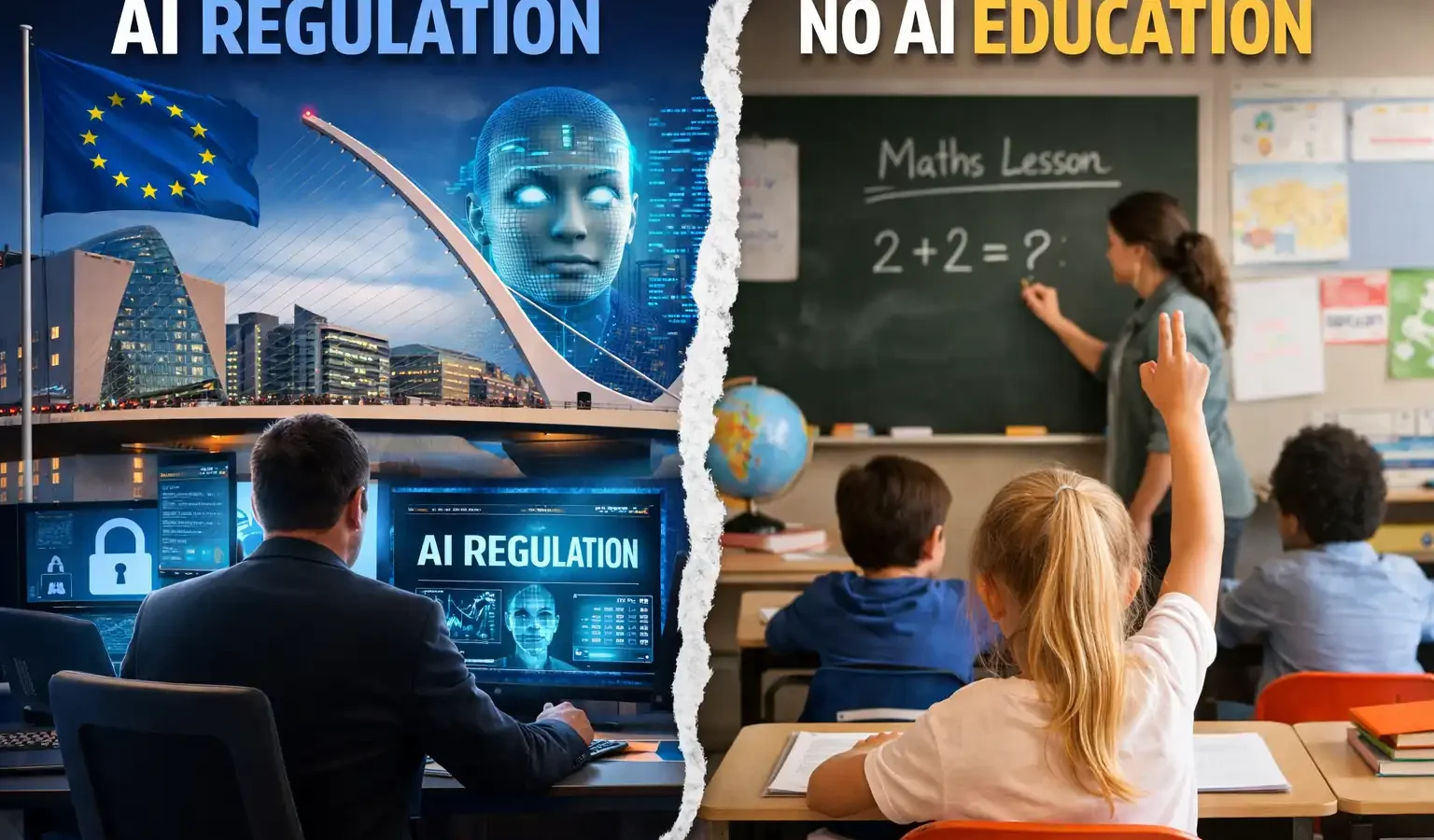
The AI Paradox: Ireland Polices Tech Giants While Schools Sleepwalk Through It
Sixteen of the world’s top twenty tech companies have their European headquarters in Ireland. Eight leading AI model providers are regulated from Dublin. Meanwhile, Irish schools are only beginning to introduce AI and digital literacy subjects. Here’s what’s actually in the curriculum — and what’s still missing.
How this was researched: curriculum details come directly from NCCA.ie (Ireland’s National Council for Curriculum and Assessment), the Department of Education’s Digital Strategy for Schools 2024–2030, and the Department of Education’s October 2025 guidance document on AI in schools. All figures about Ireland’s position as an EU AI hub come from the Irish government’s own summit documentation, cited in our Ireland AI Office explainer.
Ireland is, by any reasonable measure, at the centre of the global AI story. The companies building and deploying the most consequential AI systems in the world — Google, Meta, Apple, Microsoft, Amazon, Anthropic, and OpenAI — all have their European headquarters here. Under the EU AI Act, Ireland’s new AI Office is the primary regulator for those companies across all 27 EU member states. The country holds the EU Council Presidency until December 2026 and is hosting the International AI Summit in Dublin in October.
What is less clear is whether Ireland’s schools are preparing the next generation for the world those companies are building. The curriculum is changing — new AI-adjacent subjects have been introduced, AI guidance has been issued, and the Department of Education has a 10-year digital strategy running to 2033. But the pace of change in the classroom and the pace of change in the boardroom are not the same thing. Here is what is actually in place, and where the gaps remain.
Panel discussion from the Royal Irish Academy’s conference on AI and education, September 2025 — Irish academics and educators debating AI literacy in the classroom. Independent academic production, not a Wangdoo commission.
What Is Actually in the Curriculum Right Now
Ireland’s post-primary curriculum is managed by the NCCA through two cycles: Junior Cycle (first to third year, roughly ages 12–15) and Senior Cycle, which leads to the Leaving Certificate (fourth to sixth year, ages 15–18). The technology and digital literacy provision currently available across both cycles is as follows:
| Subject / Course | Cycle | Status | AI-specific content |
|---|---|---|---|
| Coding Short Course | Junior Cycle | Available — schools opt in | Computational thinking, algorithms — not AI-specific |
| Digital Media Literacy Short Course | Junior Cycle | Revised spec from September 2026 | Media literacy, online safety — limited AI content |
| Applied Technology | Junior Cycle | Available — schools opt in | Broader technology skills — not AI-specific |
| Computer Science (LC) | Senior Cycle (LC) | Available since 2018 — revised spec from September 2027 | Programming, algorithms — limited AI module |
| FL/AI (Fundamentals of Languages and AI) | Senior Cycle (LCA) | Available — LCA programme only | AI fundamentals — part of Leaving Certificate Applied only, not mainstream LC Established |
The FL/AI Subject — What It Is and Who Gets It
The most directly AI-relevant subject in the Irish curriculum is FL/AI — Fundamentals of Languages and AI — which was introduced in September 2025. The critical caveat is where it sits: FL/AI is a Leaving Certificate Applied (LCA) subject, not a Leaving Certificate Established subject. The LCA is a distinct two-year programme designed for students who are not following the traditional academic Leaving Certificate path — it is practical and vocationally oriented. Most secondary school students in Ireland sit the Leaving Certificate Established, not the LCA.
This means the subject most directly focused on AI fundamentals is available to a minority of students — those on a specifically vocational track. Students following the mainstream academic Leaving Certificate can study Computer Science (available since 2018, currently undergoing a specification update due for completion by September 2027), but that subject’s AI content is limited. There is no standalone AI or machine learning subject available in the mainstream Leaving Certificate as of 2026.
What the Department of Education Has Done — and When
In October 2025, the Department of Education published formal guidance titled “Guidance on Artificial Intelligence in Schools” — the first official departmental position on AI use in Irish classrooms. The guidance covers both teacher use of AI and student use, and sets out a clear principle: students must disclose any use of AI-generated content in their work. Using AI without attribution is treated as plagiarism, which is a serious academic offence.
The guidance also acknowledges that AI tools should support rather than replace student thinking, and encourages schools to develop their own AI policies within the framework provided. What it does not do is mandate specific AI literacy content across the curriculum, specify minimum hours, or set measurable outcomes for what students should know about AI by the time they leave school.
The Department of Education also published a Digital Strategy for Schools 2024–2033, which commits to integrating digital literacy — including an understanding of AI — across the curriculum over a 10-year period. The strategy acknowledges that Ireland’s students need to understand the digital world they are entering but leaves significant discretion to individual schools and teachers on how that is delivered.
The Gap: What Schools Are Being Asked to Do Without Full Support
The reality on the ground is uneven. The NCCA has acknowledged that AI literacy should be embedded across the curriculum — not confined to computer science or technology subjects. The Teaching Council of Ireland has indicated that AI literacy should form part of ongoing professional development for registered teachers. The PDST (Professional Development Service for Teachers) has begun offering workshops and webinars on AI tools for educators, though coverage remains inconsistent across the country.
The Teacher AI Integrity Problem
The introduction of the Additional Assessment Component (AAC) — which allocates at least 40% of Leaving Certificate marks to project work from September 2025 — has created a specific tension around AI. Teachers from the Teachers’ Union of Ireland (TUI) have raised “serious concerns” about the difficulty of verifying whether project work is student-generated or AI-assisted, particularly when no reliable detection mechanism exists. Some science teachers have criticised the guidelines for “ignoring the reality of generative AI.” The concern is not theoretical: in a high-stakes assessment system where project work now counts for nearly half of a student’s grade, the inability to reliably detect AI use creates genuine academic integrity challenges that neither the NCCA nor the Department has fully resolved.
This isn’t an argument against project-based learning — it’s an argument that the assessment reform and the AI guidance arrived simultaneously without sufficient support structures to manage the overlap.
The Structural Question Nobody Has Answered
Ireland is simultaneously building the regulatory architecture to govern the world’s most powerful AI systems — the AI Office of Ireland opens August 1, 2026, with oversight over OpenAI, Google DeepMind, Anthropic, and Meta — and slowly updating a school curriculum that won’t have a revised Leaving Certificate Computer Science specification in classrooms until September 2027. Those two timelines are not coordinated. They are being driven by different departments — Enterprise on the regulatory side, Education on the curriculum side — without an obvious joint strategy connecting them.
This is not a criticism specific to Ireland. Every country faces a version of the same structural challenge: the AI economy is moving faster than curriculum reform cycles are designed to. The Irish case is simply more visible because the gap between Ireland’s regulatory prominence in global AI and its classroom preparation is unusually large — by design, the same country that will fine OpenAI for non-compliance is also the country whose students won’t have a mainstream AI curriculum until at least 2027.
What Irish students and parents can do right now
- Check whether your school offers Computer Science at Junior or Senior Cycle. It is not mandatory — take-up varies significantly between schools. If it isn’t offered, ask why.
- Ask about the Digital Media Literacy short course at Junior Cycle — the revised specification starting September 2026 is more current than the previous version.
- Supplement formally. Platforms like Coding Ireland offer NCCA-aligned digital and coding content for both primary and post-primary students. Khan Academy, CS50 from Harvard (free online), and Google’s “Generative AI for Educators” are free and accessible outside school hours.
- Understand the AAC AI rules. If your child is doing project work for the new Leaving Certificate assessment structure, read the NCCA guidance on AI disclosure. The rules are clear: any AI use must be declared. Getting this wrong is treated as plagiarism.
Frequently Asked Questions
Does Ireland have an AI subject in secondary schools?
Yes — FL/AI (Fundamentals of Languages and AI) was introduced in September 2025, but only for students on the Leaving Certificate Applied track, which is a vocational programme followed by a minority of students. There is no standalone AI subject in the mainstream Leaving Certificate Established programme as of 2026. Computer Science is available as an LC Established subject since 2018 and includes some AI content, but its specification is under review and a revised version is not due until September 2027.
Can Irish students use ChatGPT or other AI tools for school work?
Yes — with disclosure. The Department of Education’s October 2025 guidance permits the use of AI tools but requires students to clearly attribute any AI-generated content in their work. Using AI without disclosure is treated as plagiarism and remains a serious academic offence. Individual schools may have their own additional policies.
What is the Digital Strategy for Schools?
The Department of Education’s Digital Strategy for Schools 2024–2033 commits to integrating digital literacy — including AI — across the Irish curriculum over a 10-year period. It acknowledges that students need to understand the digital world they are entering but leaves significant discretion to individual schools on implementation. It does not mandate specific AI content or minimum outcomes.
Why does Ireland regulate AI companies if its own students don’t study AI?
These are driven by different government departments on different timelines. The AI Office of Ireland — under the Department of Enterprise — is being established to enforce the EU AI Act, which is driven by an August 1, 2026 EU-level deadline. The school curriculum — under the Department of Education — operates on a longer reform cycle. The two are not formally coordinated, which is the structural gap this article describes.
Sources
- Digital Media Literacy Short Course — revised specification September 2026 — NCCA
- Leaving Certificate Computer Science — revised specification due September 2027 — NCCA
- Guidance on Artificial Intelligence in Schools — October 2025 — Department of Education
- Digital Strategy for Schools 2024–2033 — Department of Education
- “Teacher concerns over use of AI in Leaving Cert project work” — Teachnet.ie (TUI concerns on AAC and AI)
- “AI in Education: Guide for Irish Teachers and Educators” — BH Courses, May 2026