Why America’s Cheapest EV Costs $5,000 More Than Promised- Explained

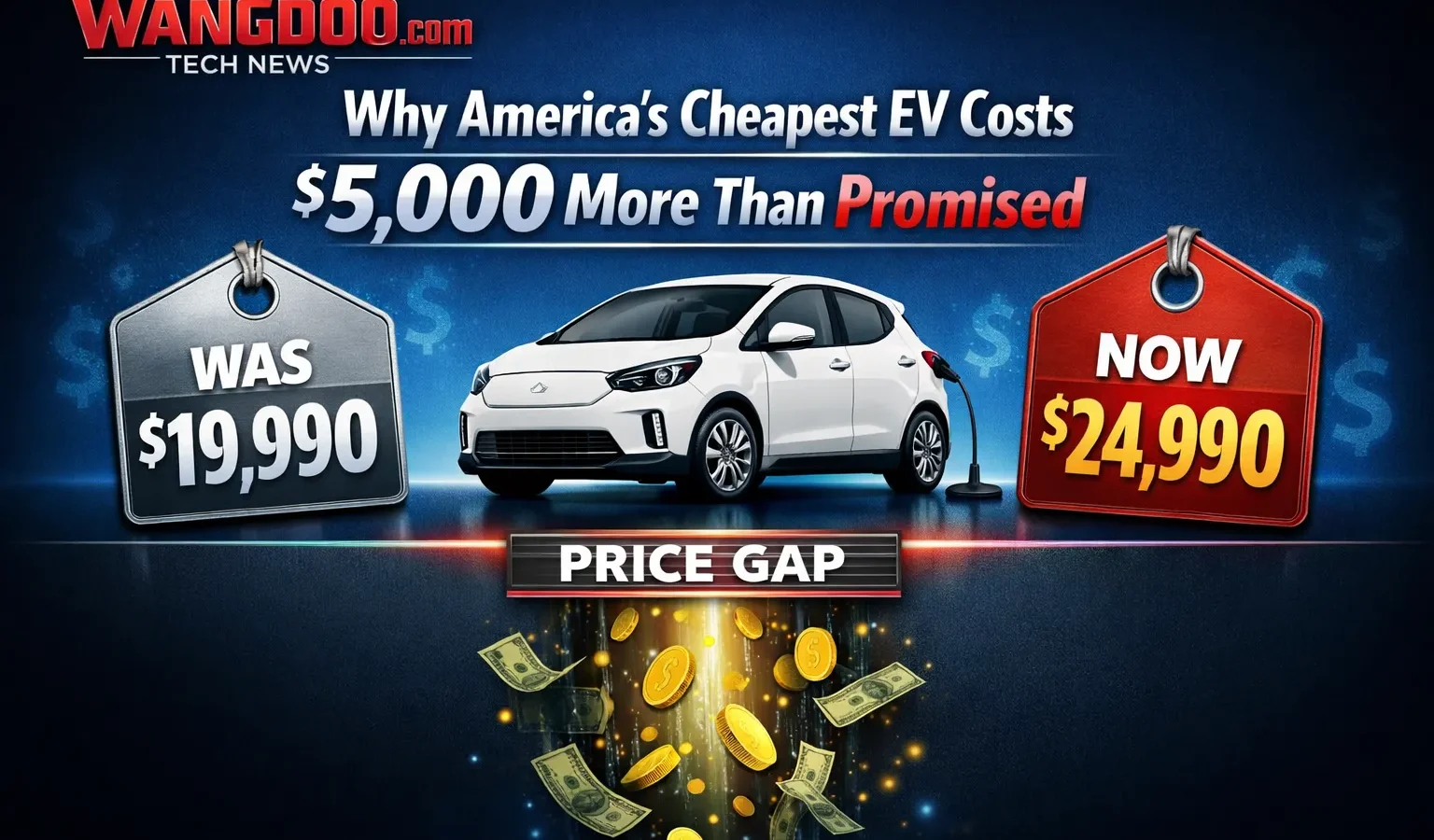
America’s Cheapest EV Was Going to Cost Under $20,000. Here’s What Killed That Number.
On June 24, Slate Auto revealed the price of the most affordable electric vehicle in America. The number was $24,950 — not the under-$20,000 figure the company had been promising since 2025. A single law explains the entire difference.
How this was researched: the Slate Auto pricing and reservation data come from official Slate communications and the preorder portal. The EV tax credit elimination is sourced from the text of the One Big Beautiful Bill Act (signed July 4, 2025), Kiplinger’s primary-source summary, and CNBC’s reporting on the Senate passage. The sales impact figures are from CarBuzz’s October 2025 sales analysis.
Slate Auto opened preorders today for the Blank Slate — a deliberately stripped-back two-door electric pickup with hand-crank windows, no paint, and a rear-mounted electric motor. The price is $24,950 for the standard-range version with 150 miles of range, and higher for the extended-range model. That price is what the truck costs right now, in 2026, without federal assistance. But for most of the four years Slate spent building this vehicle, the number that was being quoted to potential buyers was different: under $20,000, after a $7,500 federal tax credit that no longer exists. The Slate truck is now the most affordable new EV on the US market — and still costs $5,000 more than it would have a year ago.
The credit no longer exists. Understanding why — and what that means for anyone buying an EV in America today — matters beyond just this one truck.
Jay Leno got an exclusive first look at the Slate Truck in February 2026 — calling it able to do “what a lot of electric vehicles can do, just for half the price.” Independent coverage, not a Wangdoo or Slate production.
What the Tax Credit Was and How It Worked
The $7,500 federal clean-vehicle tax credit was established under the Biden administration’s Inflation Reduction Act of 2022. It applied to purchases of qualifying new electric vehicles and was worth up to $7,500 off the buyer’s federal tax bill — either claimed at the end of the year on a tax return, or, from 2024, applied directly as a discount at the point of sale. A separate $4,000 credit applied to qualifying used EVs. Income limits applied: the new-vehicle credit phased out above $150,000 for individual filers and $300,000 for married couples.
For a vehicle priced under $20,000 to be viable — which was Slate’s original promise — the credit wasn’t a bonus. It was load-bearing. Without it, that price was never going to be achievable, and Slate’s own communications made this clear: the “under $20,000” figure was always stated with the credit factored in.
When It Ended and Why
On July 3, 2025, the US Congress passed the One Big Beautiful Bill Act, which President Trump signed into law on July 4, 2025. Among its provisions: the Section 30D clean-vehicle tax credit — the $7,500 EV incentive — was eliminated for all vehicles purchased after September 30, 2025. The credits were originally legislated to run through 2032. They were cut seven years early.
The credit had been the subject of political debate for years, with critics arguing it disproportionately benefited higher-income buyers of expensive vehicles and represented an unnecessary federal subsidy for a market the industry believed was ready to stand alone. Supporters argued it was precisely the kind of demand-side incentive needed to reach the price points where EVs can compete with petrol vehicles at the mass-market level. The bill eliminated it regardless.
What the credit elimination cost the average EV buyer
$7,500The exact amount added to the out-of-pocket cost of every qualifying EV purchase after September 30, 2025
What It Did to the Market — In Real Numbers
The sales data from the months immediately following the credit’s elimination was stark. Hyundai sold 1,642 Ioniq 5s in October 2025 — a 63% year-over-year decline from October 2024, despite the Ioniq 5 having been up 36% year-over-year through September. Hyundai’s Ioniq 6 fell 53% in the same month. These weren’t vehicles on the margins of competitiveness — the Ioniq 5 had been one of the most critically praised EVs in America. The credit removal didn’t merely slow growth; it reversed it sharply, in a single month.
The downstream effects on the industry followed quickly. General Motors cancelled the BrightDrop electric van in October 2025. Stellantis eliminated the all-electric Ram 1500 REV. Kia indefinitely postponed the US launch of its Kia EV4 sedan, which had been targeting the affordable end of the market.
The Slate Numbers, Spelled Out
Slate’s situation makes the credit’s effect unusually concrete because the company’s price history is entirely public. The truck was promised at “under $20,000” with the federal tax credit applied. The credit is gone. The truck now costs $24,950 at base — with a 150-mile standard-range battery. For the extended-range version (240 miles), the price is higher. That is not a criticism of Slate’s pricing decisions, which reflect real costs: battery prices, manufacturing, and tariff exposure on components. It is simply what $7,500 of federal assistance was worth in the context of a vehicle specifically designed to be the most affordable EV on the market.
| Scenario | Slate Truck base price | EV tax credit | Out-of-pocket cost |
|---|---|---|---|
| With credit (pre-October 2025) | ~$24,950 | -$7,500 | ~$17,450 |
| Without credit (from October 2025) | $24,950 | $0 | $24,950 |
| Difference | — | — | +$7,500 |
It is worth noting that Slate has filed design patents in India and for a “Purple Reign” fastback SUV variant, suggesting the company is building beyond a single US market truck. Whether those plans proceed depends significantly on how demand holds at $24,950 without federal support.
What Buyers Can Still Access
State and local incentives still exist
The federal credit is gone but state-level EV incentives remain available in many US states — California, Colorado, New York, and others have their own programs, some of which partially offset the federal credit’s loss. These vary significantly by state, income, and vehicle type.
The EV charger installation tax credit (Section 30C) runs until June 30, 2026 — so there is a narrow window remaining on that specific incentive before it too expires.
Slate itself has confirmed that its $50 reservation fee counts toward the $300 preorder deposit, and the deposit counts toward the final purchase price. For anyone who placed a reservation, the preorder process opened today.
Frequently Asked Questions
When exactly did the federal EV tax credit end?
September 30, 2025. The One Big Beautiful Bill Act, signed by President Trump on July 4, 2025, eliminated the Section 30D clean-vehicle tax credit for all new EV purchases after that date. The credit was originally legislated to run through 2032.
Is the Slate truck the cheapest new EV available in the US now?
Based on current market pricing, the Slate truck at $24,950 base is the most affordable new EV in the US. Most comparable EVs — including the Chevy Equinox EV (from $34,995) and the Tesla Model 3 (from $38,380) — are significantly more expensive. Ford’s planned affordable EV pickup is expected around 2027 at approximately $30,000.
What happened to EV sales after the credit ended?
October 2025 data showed sharp declines across the market. Hyundai’s Ioniq 5 dropped 63% year-over-year in October, after being up 36% through September. Multiple manufacturers cancelled or paused EV programmes in the months following. The trend has continued into 2026 at a slower pace as the initial shock subsided.
Are there any US federal EV incentives left at all?
The Section 30D new-vehicle credit and the Section 25E used-vehicle credit are both gone after September 30, 2025. The Section 30C EV charger installation credit runs until June 30, 2026 — so that specific incentive has a narrow remaining window. State-level incentives remain in many states but vary significantly.
Sources
- Slate Auto official preorder portal — pricing confirmed June 24, 2026 — Slate Auto
- “How the EV Tax Credit Works for 2025” — credit end date, eligibility rules, IRS guidance — Kiplinger
- “Trump’s ‘big beautiful bill’ ends $7,500 EV tax credit” — CNBC
- One Big Beautiful Bill Act — clean energy credit provisions — Sullivan & Cromwell LLP legal analysis
- “Electric Vehicles Are In Deep Trouble After President Trump Killed Tax Credits” — CarBuzz (Hyundai sales data, October 2025)
- “Slate Leaked $24,950 Starting Price on Its Own Website” — Carscoops
- “The Slate Truck Will Cost $24,950” — The Autopian (original source code discovery)