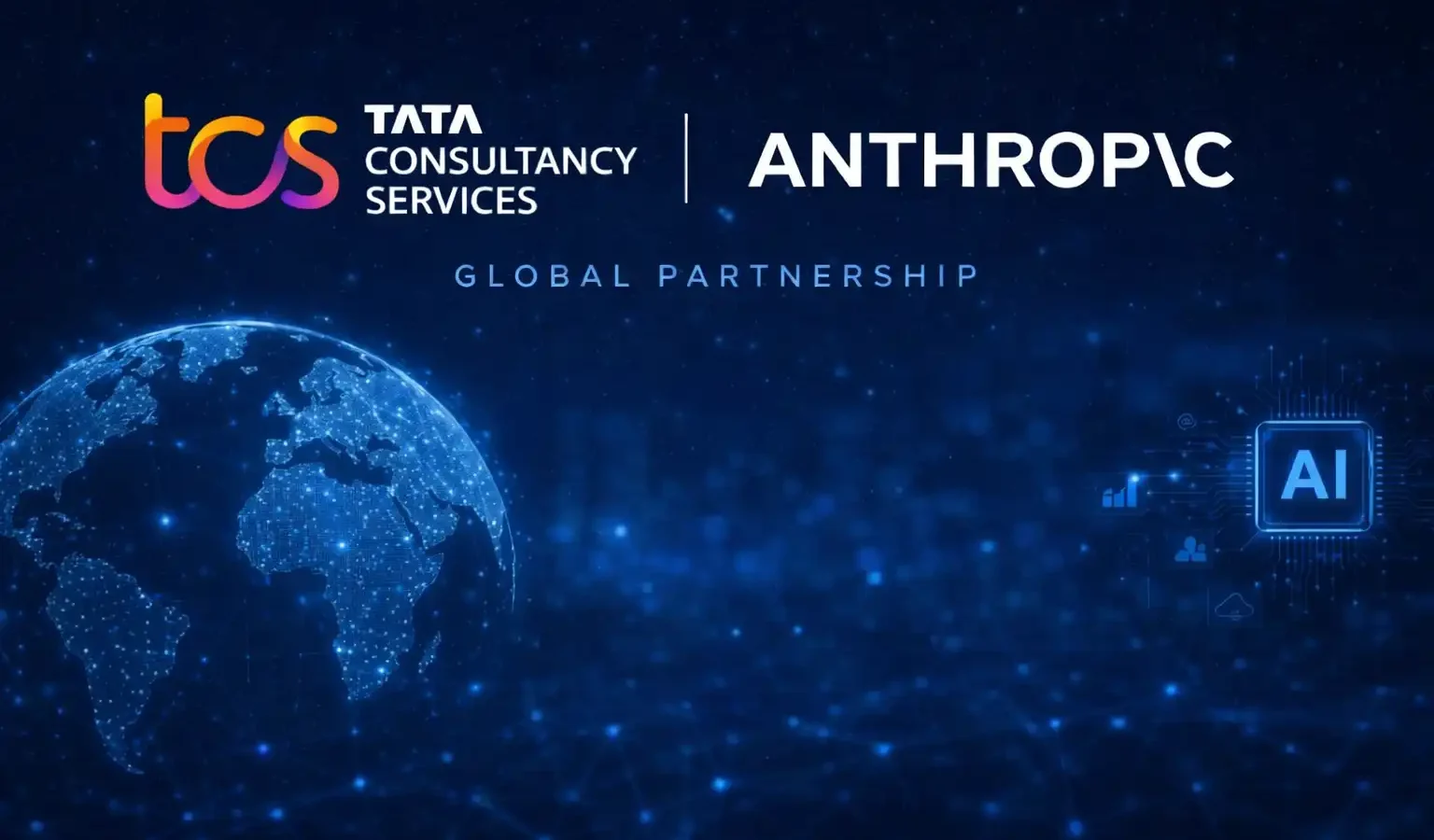
Tata Consultancy Services and Anthropic announced a new collaboration in June 2026.

TCS and Anthropic Just Partnered to Bring Claude AI Into Banks, Hospitals and Airlines — Here Is What That Means
Tata Consultancy Services — one of the world’s largest IT companies with over half a million employees — has signed a global partnership with Anthropic to deploy Claude across regulated industries. This is not a pilot programme. It is already live.
On June 11, 2026, Tata Consultancy Services and Anthropic announced a global strategic partnership that puts Claude AI into the hands of 50,000 TCS employees across 56 countries — and ultimately into the systems that banks, hospitals, insurers, airlines and governments depend on every day. The announcement came from Anthropic’s own newsroom and was filed with stock exchanges by TCS Company Secretary Yashaswin Sheth, making it one of the most formally documented AI partnerships of the year.
On the same day, DXC Technology — a separate IT services company with 115,000 employees across 70 countries — announced its own multi-year global partnership with Anthropic on identical terms. Two of the world’s largest enterprise IT companies. Same day. Both choosing Claude. That is not a coincidence, and understanding why it happened tells you something important about where enterprise AI is heading in 2026.
Why TCS is doubling down on Anthropic while other tech firms slash AI memberships — published June 2026. All rights respective owner. Source: YouTube.
Who Is TCS and Why Does This Matter?
If you have not heard of Tata Consultancy Services, that is partly by design. TCS is a business-to-business company — it does not make products you buy in a shop. What it does is run the technology infrastructure that underpins some of the largest organisations on the planet. When a major European bank needs to modernise its core banking system, it often calls TCS. When an airline needs to manage its operations technology across 40 countries, TCS is frequently involved. When a government wants to build a large-scale citizen services platform, TCS is one of the companies that builds and maintains it.
TCS is part of the Tata Group — the Indian conglomerate that also owns Jaguar Land Rover, Tata Steel, Tata Motors, and dozens of other businesses. It has over 600,000 employees worldwide, revenue of over $29 billion, and is one of the most valuable companies listed on Indian stock exchanges. When TCS endorses a technology and builds a dedicated business unit around it, the enterprises it serves pay attention.
Most enterprise AI announcements are partnerships on paper — two companies agree to explore possibilities together and issue a press release. This one is different in a specific way: TCS is acting as what Anthropic calls “customer zero.” It is deploying Claude across its own engineering, finance, legal, marketing, and sales teams first — learning what works and what does not under real operating conditions — before packaging that experience into solutions for its clients. That is a more credible and more demanding commitment than a typical partnership announcement.
What the Partnership Actually Involves
The deal has three distinct layers. The first is internal: TCS will equip 50,000 of its own employees with Claude access across its engineering, finance, legal, marketing, and sales functions. This is not a token gesture — 50,000 people is a substantial fraction of TCS’s global workforce, and it signals genuine institutional commitment to building organisational expertise around the model.
The second layer is a dedicated business unit. TCS is building a practice specifically for this partnership — consultants, engineers, and industry specialists whose job is to design and run Claude-based systems for clients. This is how large IT services firms embed a technology into their offering: not by mentioning it in sales conversations, but by building a team whose entire purpose is delivering it.
The third and most commercially significant layer is the industry solutions. TCS will package Claude into products designed for specific regulated industries — claims processing for insurers, lending advisory for banks, case management for healthcare organisations. These are not generic AI tools. They are purpose-built for the specific workflows, compliance requirements, and data structures of each sector.
What Is Already Live — Before the Ink Is Dry
One of the most striking things about this announcement is that it is not purely forward-looking. Several deployments are already operational.
Diligenta, TCS’s UK life and pensions business, is already using Claude to improve customer experience for the more than 22 million policyholders it serves. That is a live deployment in a heavily regulated financial services context — not a proof of concept but a production system serving real customers with real policies.
TCS’s banking and financial services product teams are using Claude Code to accelerate software engineering and IT operations. TCS’s engineering teams are building reusable plugins for the Claude Code ecosystem, starting with tools for claims adjudication and lending advisory. And TCS iON — which conducts over 75 million assessments each year across 1,500 cities in India — will deliver Claude training and certification at scale.
The Same Day: DXC Technology Signs an Identical Deal
What makes June 11 notable is not just the TCS announcement — it is that DXC Technology announced an almost identical partnership with Anthropic on the same day. DXC is a US-headquartered IT services company with 115,000 employees across 70 countries, operating technology infrastructure for some of the world’s largest banks, airlines, insurers, manufacturers, and government agencies.
Like TCS, DXC has been designated as a Global Premier Partner in the Claude Partner Network. Like TCS, it is building a dedicated workforce of Claude-certified engineers. And like TCS, its deployment of Claude is not theoretical — DXC has already used Claude to build its own internal platform.
DXC’s AI orchestration platform, called DXC OASIS, was built using Claude as the primary development tool. The result, according to DXC’s own reporting: software delivery accelerated by an estimated 10 times, with more than 95% of code generated by Claude before human review. OASIS launched in April 2026 and is already deployed across more than 50 customers. Claude is the default foundation model running its agentic workflows.
DXC used Claude to build its own enterprise AI platform. The result was 10x faster software delivery with over 95% of code written by Claude before human review. That platform is now live across 50+ customers. This is not a projected benefit — it is a measured outcome from a real deployment. When DXC says Claude works in regulated enterprise environments, it has the receipts.
Why Regulated Industries Are the Hardest AI Problem
To understand why both TCS and DXC are making this bet, it helps to understand what makes regulated industries different from other AI use cases.
Most AI success stories you read about involve consumer products — chatbots that answer customer questions, recommendation engines that suggest what to watch next, search tools that surface relevant content. These applications can tolerate a certain error rate. If a music streaming service recommends a song you do not like, that is a minor inconvenience. If an AI system incorrectly processes an insurance claim, that is a legal and financial problem. If a healthcare AI gives wrong guidance about a patient’s medication, the consequences are potentially life-altering.
Regulated industries also operate under compliance frameworks — GDPR in Europe, HIPAA in healthcare, Basel III in banking — that place strict requirements on what data can be processed, how it must be stored, who can access it, and how decisions must be documented and auditable. Most consumer AI tools were not designed with these constraints in mind.
This is the specific problem both TCS and DXC are trying to solve with Claude — not just deploying AI in enterprises generally, but deploying it in the environments where the stakes are highest, the rules are strictest, and the consequences of failure are most significant.
What This Means for Anthropic
Anthropic is a company preparing for an IPO — it has filed confidentially and is widely expected to go public later in 2026. The TCS and DXC partnerships, signed on the same day, are part of a clear strategic pattern: building a network of large enterprise distribution partners whose combined reach extends Claude into thousands of organisations that Anthropic could not reach directly.
The scale of TCS’s ambition with AI goes beyond this partnership. Just two days before the announcement, TCS Chairman N Chandrasekaran made one of the most striking predictions of any executive at any company so far in 2026:
TCS currently employs over 600,000 people. That statement implies a target of 600,000 AI agents within three years. Whether or not the number proves accurate, it signals the seriousness with which TCS’s leadership is treating the AI transition — and explains why a partnership of this scale was not a surprise to anyone watching the company closely.
TCS alone has relationships with thousands of global enterprises across financial services, healthcare, manufacturing, and the public sector. DXC serves the world’s largest banks and airlines directly. And TCS and DXC are not the only IT services firms Anthropic has been signing. Earlier in 2026, Anthropic teamed up with Infosys on a similar enterprise deployment arrangement. Meanwhile OpenAI has been pursuing the same strategy — partnering with both Infosys and HCLTech in parallel. The race to lock up enterprise distribution through large IT services firms is happening simultaneously across every major AI company.
Together with existing Claude partners including Amazon Web Services, Google Cloud, and Salesforce, Anthropic is assembling a distribution network that touches virtually every significant regulated industry on the planet — before its IPO valuation is formally set.
The Claude Partner Network is Anthropic’s formal ecosystem of consulting firms, systems integrators, and technology companies that build, sell, and implement Claude-based solutions for enterprise clients. Global Premier Partner status — which both TCS and DXC have received — is the highest tier. It comes with early access to new Claude models, dedicated Anthropic engineering support, joint go-to-market commitments, and the ability to build certified industry solutions. There are very few Global Premier Partners — both TCS and DXC press releases describe it as a designation held by “one of the few” companies in the network.
My Take — Mr Wangdoo
The thing that stands out to me about both of these announcements is not the scale — 50,000 employees, 56 countries, 70 countries — but the specificity. TCS is not saying it will explore Claude for future client engagements. It is deploying it now for 22 million policyholders at Diligenta. DXC is not saying Claude might accelerate development. It has already measured 10x improvement in its own operations and shipped a product built with it.
That specificity is significant because enterprise AI is littered with announced partnerships that never materialised. The fact that both TCS and DXC have live deployments before they even signed the formal partnership suggests this is a genuine operational commitment rather than a marketing exercise. The question worth watching over the next 12 months is whether the industry-specific solutions — claims adjudication, lending advisory, patient case management — deliver measurable outcomes for the enterprises that adopt them. That is when the real story of whether Claude belongs in regulated enterprise environments gets written.
Frequently Asked Questions
What is the TCS and Anthropic partnership?
Tata Consultancy Services and Anthropic announced a global strategic partnership on June 11, 2026. TCS has been designated as a Global Premier Partner in the Claude Partner Network. The deal involves three things: TCS deploying Claude to 50,000 of its own employees across 56 countries; TCS building a dedicated business unit to implement Claude-based solutions for enterprise clients; and TCS packaging Claude into industry-specific products for financial services, healthcare, insurance, aviation, telecom, and other regulated sectors. Several deployments are already live before the formal announcement.
What is TCS — is it an Indian company?
Tata Consultancy Services is an Indian multinational IT services company and part of the Tata Group — one of India’s largest conglomerates, which also owns Jaguar Land Rover, Tata Steel, Tata Motors, and Air India. TCS has over 600,000 employees worldwide and revenue exceeding $29 billion annually. It is listed on the Bombay Stock Exchange and National Stock Exchange of India. Despite being headquartered in Mumbai, it operates across 56 countries and serves many of the world’s largest banks, insurers, governments, and manufacturers. It is one of the most valuable companies in Asia.
What is the Claude Partner Network?
The Claude Partner Network is Anthropic’s formal ecosystem of consulting firms, systems integrators, and technology companies authorised to build, sell, and implement Claude-based solutions for enterprise clients. Global Premier Partner status is the highest tier — it comes with early access to new Claude models before public release, dedicated Anthropic engineering support, joint marketing commitments, and the ability to develop and sell certified industry solutions. Both TCS and DXC received Global Premier Partner status on June 11, 2026.
What is DXC Technology’s partnership with Anthropic?
DXC Technology — a US-headquartered IT services company with 115,000 employees across 70 countries — announced a multi-year global partnership with Anthropic on June 11, 2026, the same day as TCS. DXC operates technology infrastructure for the world’s largest banks, airlines, insurers, manufacturers, and government agencies. The partnership involves building a workforce of Claude-certified engineers deployed directly in customer environments. DXC has already used Claude to build its own AI platform, DXC OASIS, achieving 10x faster software delivery with more than 95% of code generated by Claude before human review.
Why did both partnerships happen on the same day?
Anthropic did not publicly explain the timing. The most plausible explanation is that Anthropic is running a coordinated enterprise distribution campaign ahead of its anticipated IPO — building a network of large-scale partners whose reach extends Claude into regulated industries it cannot enter directly. Announcing two major IT services partnerships on the same day maximises coverage and signals to the market that Claude has serious enterprise adoption. Both TCS and DXC had existing relationships with Anthropic before the formal partnerships were announced.
What does “regulated industries” mean in this context?
Regulated industries are sectors where government rules impose specific requirements on how data is handled, how decisions are made, and how outcomes are documented. The industries specifically targeted by the TCS and DXC partnerships include financial services, healthcare, life sciences, public services, aviation, telecommunications, insurance, and medical technology. These sectors face compliance frameworks such as GDPR, HIPAA, Basel III, and sector-specific aviation and medical device regulations. Most consumer AI tools are not designed to operate within these constraints — which is precisely the gap TCS and DXC are positioning Claude to fill.
- Anthropic Official Newsroom — TCS and Anthropic partner to bring Claude to regulated industries (June 12, 2026)
- TCS Official Press Release — TCS and Anthropic launch Global Premier Partnership to drive Enterprise AI scaling (June 11, 2026)
- Anthropic Official Newsroom — DXC will integrate Claude into the systems banks, airlines and regulated industries rely on (June 11, 2026)
- DXC Technology Press Release — DXC and Anthropic announce multi-year global alliance (June 11, 2026)
- TechCrunch — Anthropic taps TCS to scale its enterprise AI deployments (June 11, 2026)
- Business Upturn — TCS and Anthropic launch Global Premier Partnership — stock exchange filing details