Vastnaut One – The World’s First AI Exoskeleton for Hikers

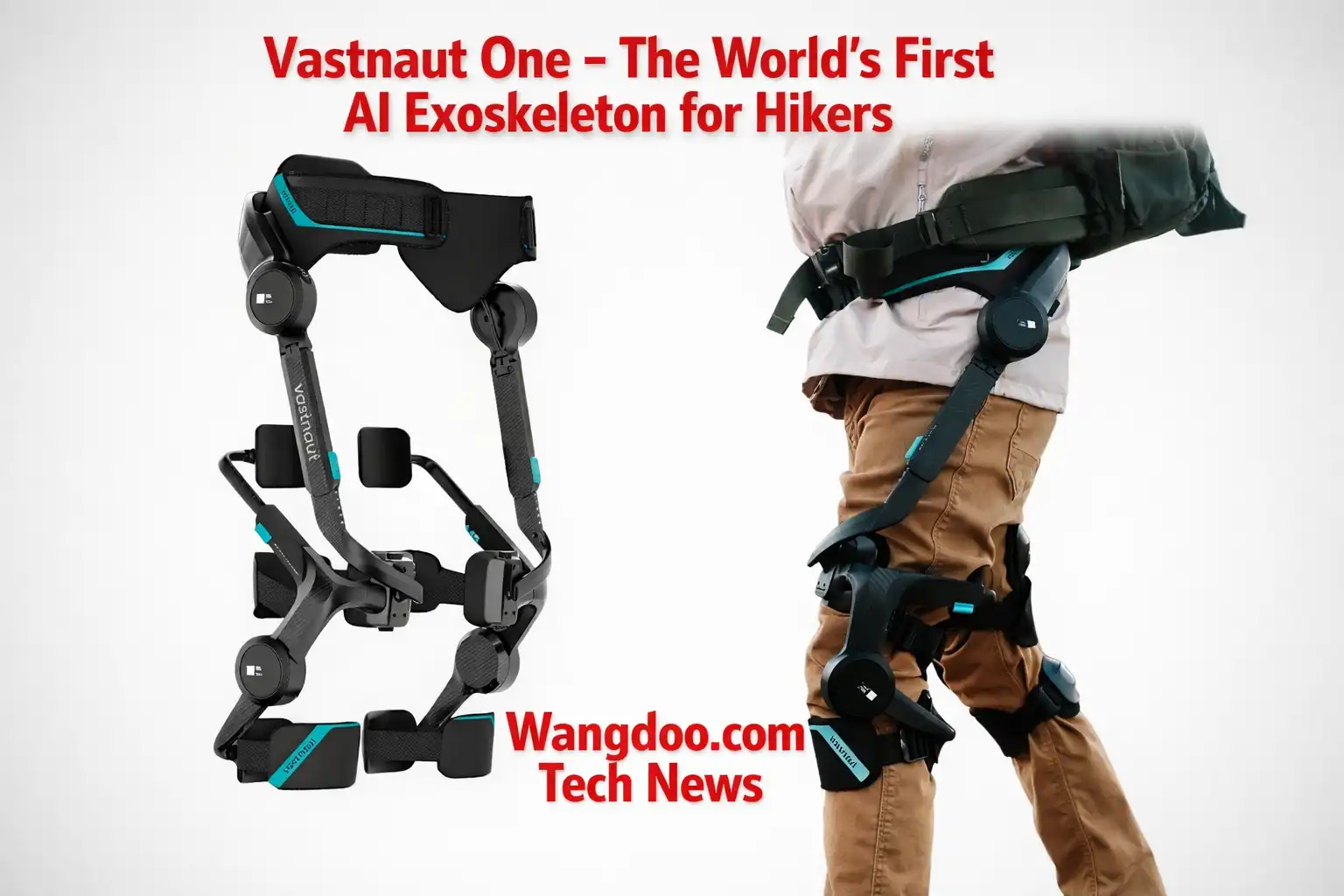
What Is the Vastnaut One? The World’s First AI Exoskeleton for Hikers — Explained
A startup just raised over $11 million on Kickstarter for a wearable robotic suit that straps to your hips and knees, reads how you move in real time, and actively pushes you up hills and absorbs the impact on your way down. Most people have no idea what a consumer exoskeleton actually is, how it works, or whether the technology is real. This article answers all of that honestly.
The idea of a powered exoskeleton has been science fiction for decades. Iron Man. Ripley’s forklift suit in Aliens. Military prototypes that cost half a million dollars and required a PhD to operate. The reality in 2026 is something quite different and far more interesting — a $1,299 carbon fibre wearable that a hiker straps on in about five minutes, weighs less than 3 kilograms, and runs for four and a half hours on a swappable battery the size of a paperback book.
Vastnaut One is not a toy and it is not science fiction. It is a real product, made by a real company, that raised over $11 million from backers on Kickstarter — more than 3,000 times its funding goal — with $11.6 million raised in the first 48 hours alone according to BackerKit Tracker. The campaign closed on June 12, 2026, with a late pledge program now open. Shipping is targeted for July 2026.
Whether it delivers on its claims is a question no one can fully answer until units are in users’ hands at scale. But the technology behind it is grounded in legitimate robotics and biomechanics research, the field testing results are credible, and the buyer confusion around what this product actually is — and who it genuinely makes sense for — is significant enough to deserve a clear explainer.
The Vastnaut One is a consumer wearable exoskeleton — a battery-powered robotic support system that straps to your lower body and actively assists your hip and knee joints while you hike, trek, or carry heavy loads across difficult terrain. It is the first consumer exoskeleton to power all four joints simultaneously — both hips and both knees — coordinated by an onboard AI engine in real time. It weighs 2.7 kg (6 lbs), is built from 86% aerospace-grade carbon fibre, is rated IP54 for weather resistance, and costs between $1,299 and $1,899 depending on the model. It is not a medical device. It is not a substitute for physiotherapy. It is a performance tool for outdoor movement.
Official Vastnaut One 4×4 introduction — Vastnaut official channel. All rights respective owner.
What a Consumer Exoskeleton Actually Is
Most people’s mental model of an exoskeleton comes from science fiction or military research — a heavy metal frame that makes you superhuman. The consumer exoskeleton category is something quite different. It is not about making you superhuman. It is about making a difficult physical activity sustainable for longer, with less damage to your joints.
Think about what happens to your knees on a long mountain descent with a 15-kilogram pack. Every step generates an impact force roughly equivalent to two to three times your body weight, transmitted directly through your knee joint. Over six hours and twenty thousand steps, that accumulates into the kind of joint stress that causes chronic injury over time — and acute pain in the short term. Your quads fatigue trying to absorb the load, your gait degrades, and every step becomes something to push through rather than enjoy.
A wearable exoskeleton addresses this not by carrying you — you still walk, still control direction, still make every movement yourself — but by actively contributing force at the joints where loading is highest. On a descent, motors at the knee engage at the exact moment your foot strikes the ground, absorbing some of the impact force before it reaches the joint. On an ascent, motors at the hip push your leg forward and upward, reducing the muscular effort required to lift your body weight step after step.
The closest analogy is electric assist on a bicycle. An e-bike does not pedal for you — you still pedal, you still steer, you still control speed and direction. But when you start climbing a hill, the motor adds torque to the pedals and the effort required drops significantly. The Vastnaut One works on the same principle applied to your legs. You walk normally — the exoskeleton reads your movement through sensors and adds torque to your hip and knee joints at the moment you need it most. On flat ground at low exertion, you barely notice it. On a steep climb carrying a heavy pack, beta testers reported that the load felt like it had been reduced by the equivalent of approximately 18 kilograms — nearly 40 pounds — of weight that simply wasn’t there.
What Makes the 4×4 Design Different
Before the Vastnaut One, most exoskeletons available to consumers or in rehabilitation settings assisted only at the hip joint — helping you lift your leg and drive it forward. That helps with uphill effort significantly. What it does not help with is the descent, which is where most long-term knee damage occurs.
The reason is biomechanical. When you descend a slope under load, the primary stress point is not your hip — it is your knee during what biomechanists call the stance phase, the moment when your planted foot is bearing your full body weight plus your pack. A hip-only exoskeleton does nothing for that. Your knee is still absorbing the same impact force it always did.
Vastnaut’s 4×4 architecture puts a dedicated 400W motor at each of the four joints — both hips and both knees — and coordinates all four simultaneously through the VastSynergy AI engine. The knee motors engage specifically during the stance phase, timed to the millisecond by onboard sensors reading your gait pattern, terrain angle, and movement speed. This is the technical differentiator that no other consumer exoskeleton currently offers — confirmed by The Gadgeteer’s independent analysis in April 2026.
“The Vastnaut One is the first commercial AI suit that takes that fact seriously and puts motors where the load lives. No other consumer AI exoskeleton on the market currently coordinates both hip and knee assist at the same time.”
The Technology Inside — How the AI Engine Actually Works
The VastSynergy AI engine is Vastnaut’s name for the real-time control system that coordinates the four motors. It is not a cloud AI — there is no internet connection required and no data is sent to external servers. Everything runs locally on the onboard processor, which is the only viable approach for a system that needs to respond in milliseconds to terrain changes.
The system takes in data from multiple sensors continuously: your height and weight (entered during setup via the companion app), your gait pattern learned over the first few minutes of use, your heart rate, the angle of incline or decline, your pace, and the load distribution across the exoskeleton frame. From this it calculates the optimal torque to apply at each joint for each individual step — a different calculation for the left knee on a rocky descent than for the right hip on a flat section with a heavy pack.
The ATD (Adaptive Torque Distribution) system handles the mechanical side of this — distributing the 1,470W of total peak system power across whichever joints need it most at any given moment, rather than applying equal power to all four joints at all times. This is what allows the battery to last 4.5 hours despite driving four 400W motors — in practice, not all four are running at peak simultaneously.
Vastnaut claims the system delivers “35% less knee impact” and “30% less uphill effort.” These figures come from Vastnaut’s own internal testing — they are not independently peer-reviewed figures. Field testing conducted in January 2026 with beta testers carrying 15kg+ packs on multi-mile hikes with serious downhill sections produced subjective reports of significantly reduced knee strain on descents, and one tester’s heart rate dropped by approximately 30 beats per minute on demanding sections while carrying 15kg of camera equipment. These are credible real-world results but they are not controlled clinical trials. The Vastnaut One has not been tested by an independent biomechanics laboratory and published in a peer-reviewed journal. Buyers should treat the headline percentages as directional indicators, not precise guarantees.
The Three Models — Which One Is Right for You
Full Specifications
| Specification | Vastnaut One 4×4 | Vastnaut One Dual-Motor |
|---|---|---|
| Joints assisted | Both hips + both knees (4 joints) | Both hips only (2 joints) |
| Motors | 4 × 400W (1,470W peak total) | 2 × 400W |
| Weight | 2.7 kg (5.95 lbs) | 1.55 kg (3.4 lbs) |
| Build material | 86%+ aerospace-grade carbon fibre | 86%+ aerospace-grade carbon fibre |
| Battery | 99 Wh — hot-swappable | Included — hot-swappable |
| Runtime | Up to 4.5 hours | Up to 8 hours |
| Range | Up to 20 km (12.4 miles) | Up to 32 km (20 miles) |
| Charging | 100W official charger | 100W official charger |
| Water resistance | IP54 — rain and splashing | IP54 — rain and splashing |
| AI system | VastSynergy AI Engine + ATD | VastSynergy AI Engine |
| App | Companion app — mode switching, battery monitoring | Companion app |
| Cold performance | Range reduced 15–25% in cold conditions | Range reduced 15–25% in cold conditions |
| Kickstarter price | From $1,299 | From $799 |
| MSRP (retail) | $1,899 | TBC |
| Shipping | July 2026 estimated | July 2026 estimated |
| Free shipping | US, Canada, Australia — $30 flat fee elsewhere | US, Canada, Australia — $30 flat fee elsewhere |
Who It Actually Makes Sense For
The Real-World Test — What Beta Testers Actually Said
Vastnaut conducted beta testing across the United States and Australia in January 2026, before the Kickstarter launch. Two groups of testers are relevant to assess: outdoor photographers and experienced exoskeleton users, who were able to compare the Vastnaut One against what they already knew.
Harrison Candlin, an outdoor photographer based in Brisbane, completed a two-day expedition carrying over 15 kilograms of camera equipment through demanding terrain. He reported that the exoskeleton significantly eased the journey — his heart rate dropped by approximately 30 beats per minute on demanding sections. That is a meaningful physiological signal, not a subjective impression.
Vastnaut also ran a three-day public Demo Day in Beverly Hills, Los Angeles, in May 2026 — an unusual move for a Kickstarter campaign. Rather than showing polished marketing videos, they invited outdoor explorers and passersby to physically strap on and test the product while the campaign was still running. Public testers reported sensations consistent with the beta test results — reduced perceived load, natural-feeling movement, and intuitive knee support on stairs.
“It totally cleared my gear without bumping into anything. And the moment I hit the stairs, it felt like the weight of the bag just vanished. It’s pretty incredible.”
These are positive signals. They are also all from people who tested the product under conditions that Vastnaut organised and controlled. Independent long-term testing — six months on real trails in varying weather — has not yet happened, because the product has not shipped to consumers at scale. The honest position is that the early evidence is encouraging and the technology is credible, but the full picture will only emerge after July 2026 when units are in backers’ hands.
The Honest Concerns — What to Think About Before Backing
The Vastnaut One is a Kickstarter campaign for a first-generation consumer hardware product from a startup. This combination carries real risk that buyers should understand clearly. Hardware products from new companies regularly ship late, ship with fewer features than promised, or in some cases do not ship at all. The Vastnaut One has a working prototype that has been publicly demonstrated and beta-tested — this places it in a significantly better position than many crowdfunded hardware products. But “working prototype” and “mass-produced consumer product shipping reliably at scale” are different things. If you back this product, you should be comfortable with the possibility of delays past the July 2026 target, and you should not back it if losing $1,299–$1,899 would cause you financial difficulty.
The weight question. At 2.7 kg, the Vastnaut One 4×4 adds nearly 6 pounds to your kit. For many serious hikers this is a significant trade-off. The calculation only makes sense if the joint protection and fatigue reduction over a full day’s hiking is worth more to you than carrying 2.7kg less gear. For shorter hikes or fit hikers with no joint issues, it probably isn’t. For multi-day expeditions where knee degradation compounds over time, it almost certainly is.
Battery life in cold conditions. Vastnaut’s own FAQ states that cold conditions — skiing, high altitude, winter hiking — can reduce battery range by 15–25%. At the lower end of the stated 4.5-hour runtime, cold weather could bring effective range down to under three and a half hours. For full-day winter hiking this requires carrying a spare battery, which adds cost and weight.
IP54 is not waterproof. IP54 means the unit is protected against dust ingress and splashing water from any direction. It is not designed for submersion, stream crossings, or sustained heavy rain. In practice most outdoor use cases are covered, but buyers planning to use this in extreme wet conditions should be aware of the limitation.
No independent clinical validation yet. The performance claims are from Vastnaut’s own testing. There is supporting academic research on the general biomechanics of knee exoskeletons — IEEE Transactions on Neural Systems and Rehabilitation Engineering has published studies showing significant reductions in knee joint force from this class of device — but that research is not specifically on the Vastnaut One.
My Take — Mr Wangdoo
What impresses me most about the Vastnaut One is not the technology itself — it is the decision to run a public Demo Day in Los Angeles while the campaign was still live. Most Kickstarter hardware campaigns live or die on slick videos and carefully controlled press coverage. Vastnaut literally invited strangers off the street to strap on and walk around in their product. That is either genuine confidence in what they have built, or one of the most effective crowdfunding marketing decisions of the year. Probably both.
The 4×4 architecture is the right call technically. Every serious hiker knows that uphill is hard but downhill is where the damage accumulates. Any exoskeleton that only solves the uphill problem is solving half the equation. Vastnaut is the first consumer product to address both, which is why The Gadgeteer — a publication that has reviewed consumer exoskeletons before — called it out specifically as a genuine differentiator.
My honest concern is the same one I have with any first-generation Kickstarter hardware: manufacturing at scale is categorically different from building working prototypes. The Vastnaut One involves four precision motors, a real-time AI system, carbon fibre structures, a battery management system, and a companion app — all of which need to work reliably together across thousands of units, in mud, rain, cold, and high altitude. That is a genuinely hard engineering problem. The July 2026 shipping target is optimistic for a product this complex. I would be surprised if all units ship on time.
None of that means you shouldn’t back it. It means you should back it with clear eyes — as an early supporter of promising technology, not as a guaranteed July delivery. If the Vastnaut One delivers on 70% of what it claims, it is still the most interesting piece of outdoor tech I have seen launched in 2026.
Frequently Asked Questions
What is the Vastnaut One and what does it actually do?
The Vastnaut One is a consumer wearable exoskeleton — a battery-powered robotic lower-body support system that straps to your hips and knees and actively assists your movement on difficult terrain. It does not walk for you — you walk normally and it adds force at your joints at the moments you need it most. On ascents it pushes your hips and legs forward and upward, reducing the muscular effort required to climb. On descents it absorbs knee impact at the exact moment your foot hits the ground, reducing the stress that accumulates into joint injury over long hikes. The flagship 4×4 model coordinates four 400W motors — one at each hip and one at each knee — in real time via the onboard VastSynergy AI engine.
How is this different from existing exoskeletons?
Existing consumer exoskeletons assist only at the hip. This helps with uphill effort — your hip flexors work less hard to lift your leg — but provides no protection for your knees on downhill sections, which is where most long-term hiking injury accumulates. The Vastnaut One 4×4 is the first consumer exoskeleton to add dedicated motors at the knee joints, coordinated simultaneously with the hip motors. The knee motors engage specifically during the stance phase — the moment when your planted foot is bearing your full body weight — timed to the millisecond by onboard sensors. No other consumer product currently does this according to The Gadgeteer’s independent April 2026 analysis.
Are the “35% less knee impact” and “30% less uphill effort” claims real?
They are Vastnaut’s own figures from their internal testing and are not independently peer-reviewed. The underlying biomechanics are credible — published research in IEEE Transactions on Neural Systems and Rehabilitation Engineering has demonstrated significant reductions in knee joint force from this class of exoskeleton device in controlled studies. The field beta testing results are also encouraging — one tester’s heart rate dropped approximately 30 beats per minute while carrying 15kg on demanding terrain. However, the specific percentages are company claims, not independently verified facts. Treat them as directional indicators rather than precise guarantees. The honest answer is: probably broadly accurate under typical conditions, but your results will vary based on terrain, load, and fitness level.
Can I use it if I have knee problems or have had surgery?
The Vastnaut One is not a medical device and is not intended as a medical treatment. It is a performance tool for outdoor movement. Vastnaut has not specifically excluded people with joint conditions from using it, and several beta testers reportedly had pre-existing knee issues and found it helpful. However, if you have an active joint condition, recent surgery, or are under medical supervision for a musculoskeletal issue, you should consult your physician before using any exoskeleton device. Do not use this as a substitute for medical treatment or physiotherapy.
What happens if the battery runs out mid-hike?
The battery is hot-swappable — designed to be removed and replaced without tools in the field. If you run out of power and have no spare battery, the exoskeleton becomes passive — it is still physically attached to your body but the motors are no longer active. At 2.7 kg, a passive exoskeleton adds dead weight to your kit, which is not ideal. For full-day hikes, Vastnaut recommends carrying a spare battery for the 4×4 model, which is included in the Explorer Combo. In cold conditions — which reduce range by 15–25% according to Vastnaut’s own FAQ — a spare battery is effectively essential for all-day use.
When does it ship and what is the risk of delay?
Vastnaut’s estimated delivery is July 2026. The product has working prototypes that have been publicly demonstrated and beta-tested. That puts it in a better position than many Kickstarter hardware campaigns. However, manufacturing complex motorised hardware at scale for thousands of units is significantly harder than building and testing prototypes, and first-time hardware companies routinely underestimate this challenge. A delay past July 2026 is plausible. A significant delay of several months is possible. Backers should be comfortable with that uncertainty before committing. The Kickstarter campaign has closed but a late pledge program is open — units are available through vastnaut.com.
How does it work with a large backpack?
Vastnaut designed the One specifically to be compatible with backpacks. The battery attaches to the back of the waist unit and for packs smaller than 35 litres sits within the pack’s footprint without conflict. For larger packs (35L+) Vastnaut recommends detaching the battery and positioning it separately to maintain balance and avoid interference with the pack frame. The waist section is slim enough that standard backpack hip belts can still be worn over it. Harrison Candlin’s beta test carrying 15kg of camera gear confirmed real-world pack compatibility — his specific note was that the system cleared his gear without bumping into anything.
Real trail test of the Vastnaut One 4×4 on Mount Lemmon. Independent creator. All rights respective owner.
- Vastnaut Kickstarter FAQ — Official Kickstarter FAQ — specifications, battery, models, pricing, shipping (April 28, 2026)
- Vastnaut Official Website — Vastnaut One product page — motor specs, AI system, design details
- PRNewswire — Vastnaut — Vastnaut One unveiled — field testing results including Harrison Candlin beta test data (April 2, 2026)
- PRNewswire — Demo Day — Vastnaut Los Angeles Demo Day results — Beverly Hills public testing May 21–23, 2026 (May 26, 2026)
- The Gadgeteer — Vastnaut One 4×4 — independent analysis confirming no other consumer exoskeleton coordinates hip and knee assist simultaneously (April 28, 2026)
- Gagadget — Vastnaut One — $11.6M raised in first 48 hours, technical analysis of ATD system (April 30, 2026)
- BackerKit Tracker — Vastnaut One funding tracker — $9M+ raised, 741 backers, average pledge $12,145 (June 2026)
- PRNewswire — January launch — Engineering towards Synergy — Vastnaut unveils the world’s first AI-powered 4×4 exoskeleton (January 5, 2026)