Lumos Sonorus Mesh Intercom Helmet with 360° Visibility

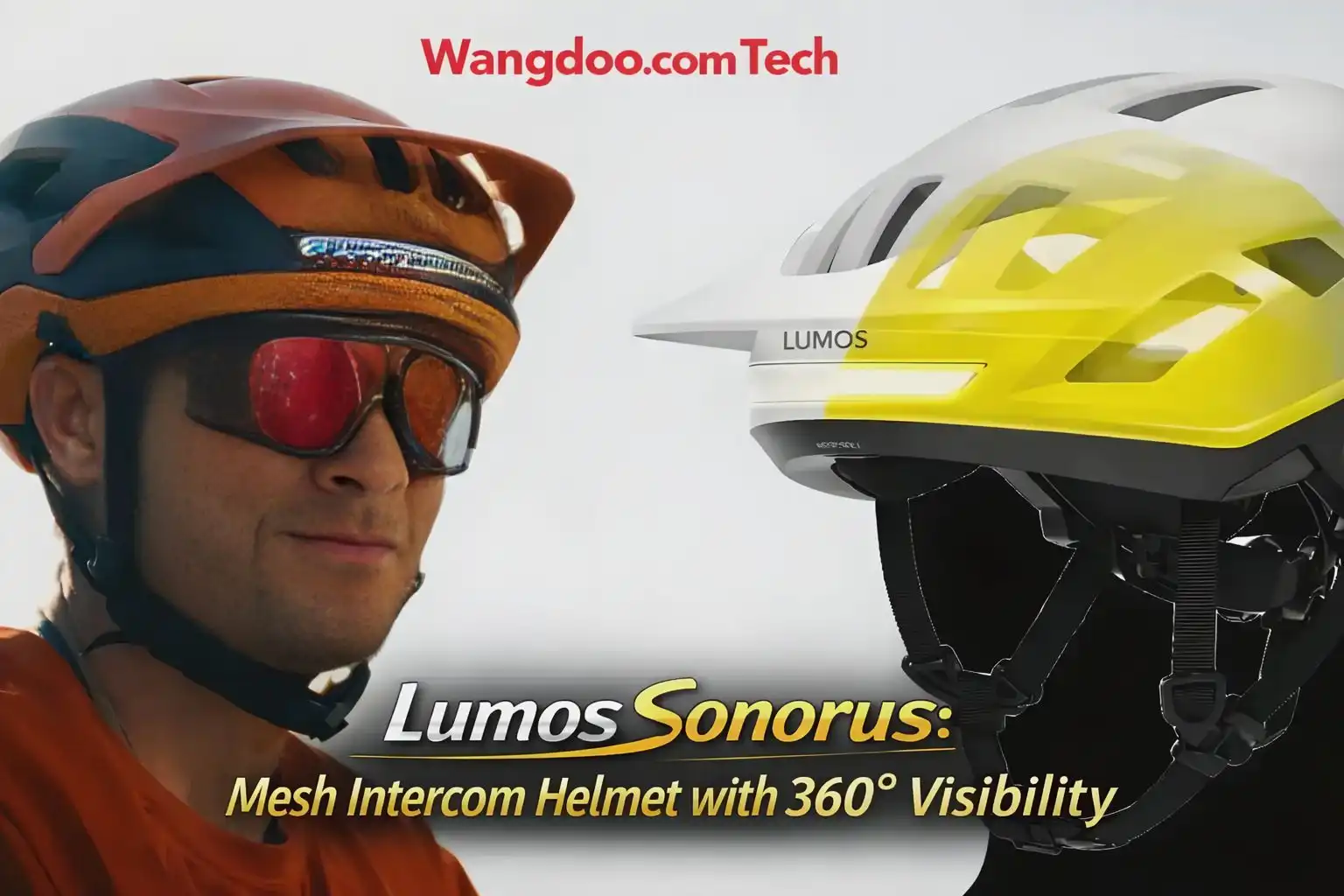
Lumos Sonorus Explained: The Smart Helmet Built for E-Bike Riders and Cyclists Who Want to Be Seen, Heard, and Connected
Most cyclists are invisible to drivers until it’s too late. Most group riders communicate by shouting into the wind. The Lumos Sonorus is a smart cycling helmet that attacks both problems at once — with 360° certified lighting, built-in mesh intercom for up to 15 riders, and e-bike-grade safety certification. Here is everything confirmed about how it works, who it is designed for, and what makes it different from every other helmet on the market.
Editorial transparency: Wangdoo.com was not paid, sponsored, or contacted by Lumos to write this article and received no compensation of any kind. This article was written independently based on Lumos’s official Kickstarter campaign, the official Sonorus product page at ridelumos.com, the official press release distributed via ACCESS Newswire on 19 May 2026, and coverage by road.cc. All facts are verified against primary sources. The Lumos Sonorus has not been physically tested by Wangdoo.com. Where any commercial relationship develops in the future, it will be disclosed clearly at the top of the relevant article.
Every time you ride a bike, an e-bike, or an e-scooter in traffic, you are dealing with a version of the same problem: drivers don’t see you until the last second. According to the US National Highway Traffic Safety Administration, not being visible is one of the top contributing factors in fatal cycling crashes, with nearly three quarters of all cyclist deaths occurring in urban areas. That’s not a freak statistic. That’s the daily reality of riding in a city.
Lumos, the Boston-founded cycling safety brand, has been building helmets with integrated lighting since 2015. Their previous campaign — the Lumos Ultra — raised nearly $3 million from almost 25,000 backers worldwide. The Sonorus is their most ambitious product yet. It doesn’t just try to make you visible. It tries to make you visible, connected, and communicative — all from a single helmet — with safety certification serious enough for high-speed e-bikes and e-scooters.
The Lumos Sonorus is a smart cycling helmet combining full-duplex mesh intercom for up to 15 riders with a 1-mile range, 360° TÜV-certified LED lighting, integrated turn signals and automatic brake light, open-ear Bluetooth audio, and MIPS + NTA 8776 safety certification for high-speed e-bike and e-scooter use. The electronics module is fully removable and transferable to a new shell. It launched on Kickstarter on 19 May 2026, has raised over £350,000 from more than 1,600 backers, and is made by Lumos — a brand with multiple million-dollar Kickstarter campaigns and a global track record of delivering hardware.
Official Lumos Sonorus introduction — mesh intercom, 360° lighting, and open-ear audio explained
Why Visibility Is Still the Biggest Unsolved Problem in Cycling Safety
Before getting into what the Sonorus does, it’s worth understanding the problem it’s trying to solve — because the numbers are genuinely alarming. The National Safety Council reports that a bike helmet reduces the risk of head injury by more than 50% — but a helmet alone doesn’t stop the crash from happening in the first place. Visibility does.
62% of cyclists killed in the United States in 2022 were not wearing helmets — but even among those who were, the crash still happened. The root cause in most urban fatalities isn’t inadequate helmet protection. It’s that the driver simply didn’t see the cyclist in time to react. That’s the gap Lumos has been targeting since day one, and the Sonorus is the most complete attempt yet to close it.
The e-bike and e-scooter dimension makes this more urgent, not less. Riders on electric assist bikes are travelling faster than traditional cyclists — often at speeds of 25 to 45km/h — which means reaction times for both rider and driver are compressed. A standard bicycle helmet is not tested for those impact speeds. The Sonorus is.
Impact protection only. No lights. No signalling. No communication. You are invisible from the rear unless you’ve separately mounted a light. You signal with your hand — which most drivers miss. You communicate with your riding group by shouting. You cannot listen to navigation without earphones that block out traffic noise.
360° certified LED visibility from all angles. Automatic brake light activates when you slow down. Turn signals triggered from a handlebar remote. Mesh intercom connects your group up to 1 mile. Open-ear audio lets you hear navigation and music without blocking out traffic. MIPS and NTA 8776 certification for e-bike speeds. All in one helmet.
What Is Mesh Intercom and Why Does It Matter for Group Riders?
The headline feature of the Sonorus that sets it apart from every previous Lumos helmet is the full-duplex mesh intercom system. This is worth explaining properly, because “mesh” intercom is fundamentally different from Bluetooth pairing — and that difference matters enormously once you’re actually riding.
Standard Bluetooth intercom systems — like those found on many motorcycle and cycling helmets — work by pairing devices in a chain. Rider A connects to Rider B, Rider B connects to Rider C. If Rider B drops out of range or loses signal, the chain breaks and Rider A can no longer communicate with Rider C. On a group ride where the pace varies and the gap between riders constantly changes, that’s a serious reliability problem.
Mesh intercom solves this differently. Each helmet communicates directly with every other helmet in the group, without relying on a central unit or a chain of connections. If one rider falls behind, the signal routes automatically through other helmets in the network. The communication range also extends as the group gets larger — because more helmets means more relay points. According to Lumos, the Sonorus supports up to 15 riders in a single mesh group with a range of up to 1 mile between individual riders.
Mesh intercom isn’t just for cyclists. E-scooter riders in cities face an identical communication problem — especially those riding in groups through urban traffic where lane splitting, sudden stops, and road hazards need to be called out instantly. The Sonorus’s open-ear design means you stay aware of traffic noise while still hearing your group. That matters more on a scooter in city traffic than almost anywhere else.
The audio system also handles music and calls via Bluetooth. Lumos has built in an automatic music ducking feature — when a rider in your group speaks through the intercom, the music lowers automatically so you don’t miss the communication. Talk time is claimed at up to 20 hours, which is long enough for even the most ambitious day rides.
The Four Core Systems Inside the Sonorus
Full-duplex means both riders can speak simultaneously without cutting each other off — unlike push-to-talk systems. Connects up to 15 riders in a single self-healing mesh network. Range extends automatically as the group grows. Up to 20 hours of claimed talk time. No central unit needed — every helmet is its own node.
Front and rear LEDs are TÜV certified for all-condition visibility — rain, fog, low light. Integrated turn signals operate via a wireless handlebar remote, so both hands stay on the bars. Automatic brake light activates when the rider decelerates. Group flash sync lets the entire riding group’s helmets pulse together, dramatically increasing collective visibility to drivers.
Built-in speakers positioned at the ears allow music, navigation prompts, and intercom audio without inserting anything into your ear canal. You remain fully aware of traffic, horns, and road noise — critical for urban riding. Music automatically ducks when intercom communication is active, then resumes. Pairs with any Bluetooth device.
The entire electronics system — intercom, speakers, lights, battery — is a single removable module. When the helmet shell reaches the end of its safe life (typically after a crash or after 5 years of use), you transfer the module to a new shell. You don’t buy the technology again. This is genuinely unusual in the smart helmet market and reduces long-term cost significantly.
What Does NTA 8776 Actually Mean — and Why Should E-Bike Riders Care?
The safety certification on the Sonorus deserves a proper explanation, because it’s one of the most important factors for anyone riding an e-bike or fast e-scooter and one of the least understood specs in the cycling safety space.
NTA 8776 is a Dutch safety standard specifically developed for speed pedelecs and high-speed e-bikes — electric bikes that provide motor assistance up to 28mph (45km/h). Standard bicycle helmets are tested for impact speeds that assume a traditional cyclist’s maximum speed. A rider on a Class 3 e-bike or a fast e-scooter is travelling significantly faster — and when a crash happens at those speeds, the impact forces are substantially greater.
The NTA 8776 standard requires helmets to be tested at higher impact speeds and to provide extended coverage of the back and sides of the head — areas that standard helmets may leave exposed. The Sonorus is engineered to exceed the NTA 8776 standard, not just meet it. It also includes MIPS — Multi-directional Impact Protection System — a low-friction layer inside the helmet designed to redirect rotational energy during an angled impact, which is the type of impact most commonly associated with serious brain injuries in cycling crashes.
E-scooter helmet regulations vary significantly by country and city. In many jurisdictions, standard bicycle helmets are legally acceptable for e-scooter use — but “legally acceptable” and “appropriate for the speeds involved” are not the same thing. If you regularly ride an e-scooter at speeds above 20km/h in urban traffic, NTA 8776-rated protection is worth serious consideration regardless of local legal requirements. The Sonorus’s certification applies to both cyclists and scooter riders operating at comparable speeds.
Who Is the Lumos Sonorus Designed For?
E-Bike Commuters
The primary target. NTA 8776 certification, turn signals, automatic brake light, and open-ear audio for navigation all directly address the specific challenges of commuting on an electric bike in city traffic at speeds where visibility and signalling matter most.
E-Scooter Riders
Fast urban e-scooter riders face identical visibility and communication problems to e-bike commuters. The NTA 8776 rating and 360° lighting apply just as directly, and the open-ear audio keeps riders situationally aware in dense traffic.
Family Group Riders
Parents riding with children, family cycling holidays, or multi-rider recreational outings where maintaining communication across different speeds and distances is genuinely difficult. Mesh intercom means the group stays connected without anyone having to stop and shout.
Mountain Bikers
Trail riding in groups where riders spread across a descent and need to communicate hazards, call for stops, or coordinate at trail junctions. Lumos’s Kickstarter imagery explicitly targets mountain bike use alongside urban commuting.
Road Cyclists in Groups
Group road riding where communication has historically been entirely hand signals and shouted warnings. Mesh intercom changes this entirely — hazard calls, pace changes, and turn decisions can be communicated clearly across 15 riders without any rider taking their hands off the bars.
Urban Cyclists at Night
Any cyclist navigating city traffic in low light where the 360° TÜV-certified LED system and automatic brake light provide the most direct safety benefit. The sync group flash — where multiple helmets pulse together — is particularly effective at attracting driver attention at junctions.
The Company Behind It — Why Lumos’s Track Record Matters
Crowdfunding campaigns live and die on one question: will it actually ship? With Lumos, that question has a concrete answer. Lumos has been making and delivering smart cycling helmets since 2015. Their original Lumos helmet campaign raised $809,000 from over 6,000 backers. Their Lumos Ultra campaign raised nearly $3 million from almost 25,000 backers. Both shipped. Both are still sold globally through retail channels today.
“Riding has always been social — whether you’re commuting with a friend, riding with family, or chasing each other down a trail. With Sonorus, we wanted to create a helmet that keeps riders connected without taking them out of the moment. It helps you be seen, be heard, and ride together with more confidence.”
— Jeff, Co-founder & CEO, LumosThe Sonorus campaign launched on 19 May 2026 and had already attracted over 1,600 backers and well over £350,000 in pledges with more than 40 days still remaining on the campaign, according to road.cc’s reporting. Delivery is planned for October 2026 for early backers. The Kickstarter Super Early Bird pricing starts at £134, with full retail pricing expected to be higher after the campaign closes.
The name “Sonorus,” as Lumos notes, continues the brand’s playful nod to the Harry Potter universe — Lumos being the light spell and Sonorus being the spell that amplifies the voice. It’s a small detail, but it’s the kind of brand consistency that reflects a team thinking carefully about their product identity, not just their specs sheet.
What the Lumos Sonorus Does Not Do
Being informative means being honest about limitations, not just listing features. A few things worth knowing before backing:
It has not shipped yet. The Sonorus is a crowdfunding campaign with an October 2026 delivery target. Kickstarter rewards are not guaranteed. Lumos has a strong delivery track record, but this is still a pre-order, not a retail purchase. If certainty matters more to you than early bird pricing, waiting for retail availability is the sensible call.
Detailed weight and exact dimensions have not been published at the time of writing. For riders sensitive to helmet weight — particularly long-distance cyclists — this is a spec worth tracking on the official campaign page before committing.
The mesh intercom requires multiple Sonorus helmets. The system’s group communication features only work if the riders you want to communicate with are also wearing a Sonorus. If you’re the only person in your group with one, you get the lighting and audio features but not the intercom.
Frequently Asked Questions
What is the Lumos Sonorus?
Is the Lumos Sonorus suitable for e-scooter riders?
What is mesh intercom and how is it different from Bluetooth pairing?
What does NTA 8776 certification mean for a cycling helmet?
Can I use the Lumos Sonorus for listening to music while riding?
How do the turn signals work on the Lumos Sonorus?
What makes the removable electronics module important?
When does the Lumos Sonorus ship and how much does it cost?
Sources & References
- Lumos Sonorus Official Kickstarter Campaign Page — kickstarter.com
- Lumos Sonorus Official Product Page — sonorus.ridelumos.com
- Lumos Official Press Release — Lumos Introduces Sonorus, 19 May 2026 (ACCESS Newswire)
- road.cc — Lumos adds talking to do-it-all helmet, May 2026 (confirms 1,600+ backers, £350,000+ raised, 20-hour battery claim, NTA 8776 detail)
- Lumos Ultra Kickstarter — 24,943 backers, $2,966,439 raised (Lumos delivery track record)
- US National Highway Traffic Safety Administration — Bicycle Safety (visibility as top factor in cycling fatalities)
- National Safety Council — Bicycle Safety Statistics (helmet reduces head injury risk by 50%+)