Ferrari Unveils the Luce — Its First All‑Electric Supercar

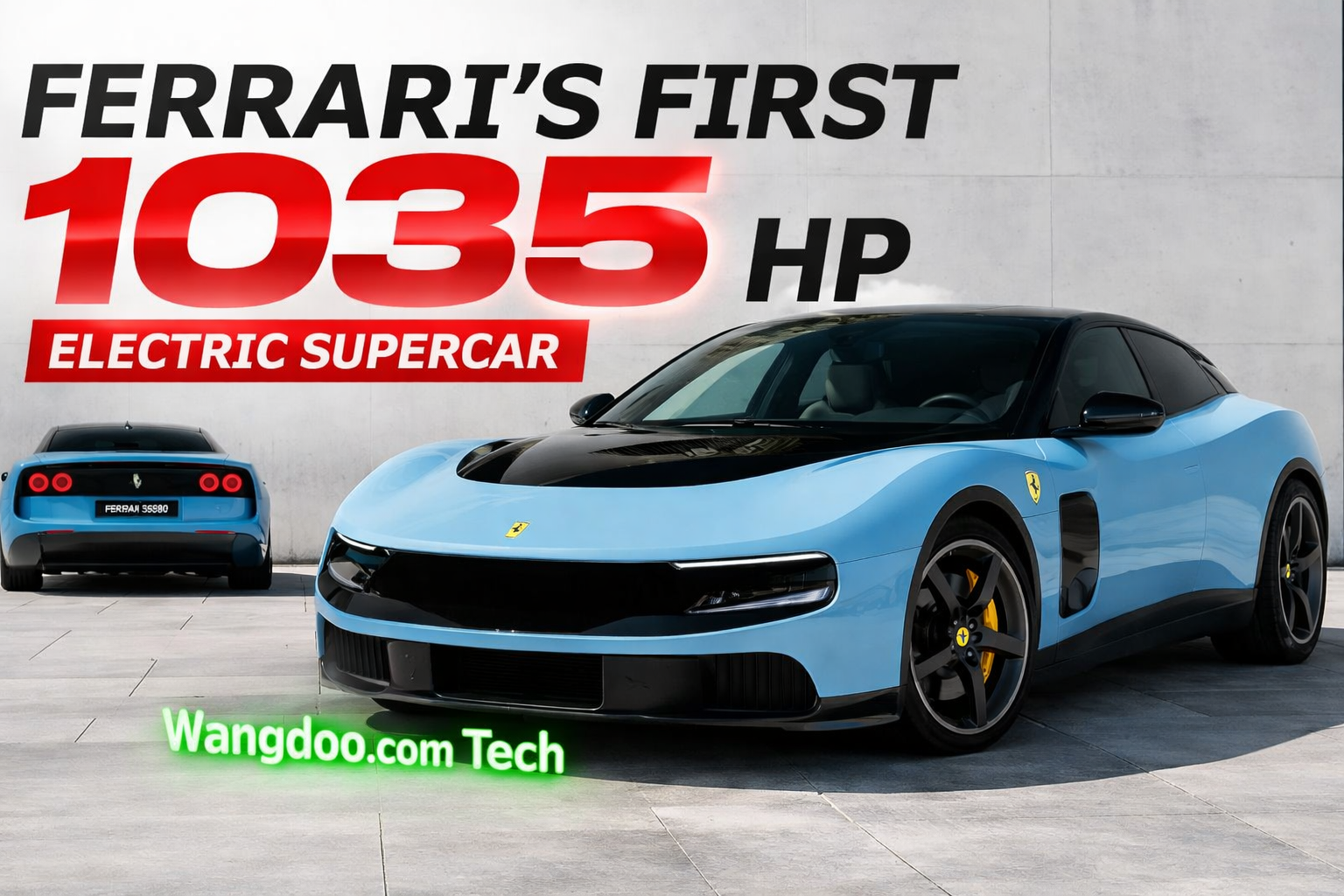
Ferrari Luce vs Tesla Model S Plaid: How Does Ferrari’s First Electric Car Actually Compare?
Ferrari unveiled its first fully electric car in Rome on May 25, 2026. The Luce costs €550,000. The Model S Plaid costs around $110,000. So why is the world comparing them — and what does the comparison actually tell us about where electric performance is heading in 2026?
The Ferrari Luce — Italian for “light” — is Ferrari’s first fully electric production car, unveiled in Rome on May 25, 2026, after five years of development. It is a four-door, five-seat electric grand tourer producing over 1,000 hp from four individual electric motors, with a starting price of €550,000 and a design unlike anything the brand has made in its 78-year history. Within hours of the reveal, automotive forums, social media, and YouTube were doing the same thing: stacking it up against the Tesla Model S Plaid. It is not an obvious comparison. One costs six times the other. One is built by a 78-year-old Italian supercar dynasty. The other was built by a Silicon Valley startup that redefined what performance EVs could be. But the numbers land so close together that the comparison is impossible to avoid.
Ferrari Luce world premiere reveal, Rome — May 25, 2026. Source: YouTube
This article is not a review of either car. It is a structured comparison of everything that has been officially confirmed about both — performance, range, charging, design philosophy, interior technology, and price. The goal is to give you a clear, honest answer to the question that has dominated automotive conversation since Sunday night: when a company with Ferrari’s heritage finally enters the EV market, how does the result actually measure up against the car that has owned the performance EV space for half a decade?
Why Is Everyone Comparing These Two Cars?
The comparison exists because of what the numbers do — they rhyme. Both cars deliver roughly 1,000 hp from an all-electric drivetrain in a large four-door body. Both are five-seaters with serious grand touring intent. Both use tri- or quad-motor all-wheel-drive setups. And both have been, at different moments, the most talked-about performance electric cars in the world.
The Tesla Model S Plaid launched in 2021 and promptly set a quarter-mile world record for a production car. It remains, five years later, one of the quickest accelerating production vehicles ever built. The Ferrari Luce was revealed less than 48 hours ago and is already oversubscribed — Ferrari CEO Benedetto Vigna confirmed the launch event was fully booked before the car was even unveiled. When the world’s most iconic supercar maker finally arrives at the EV party, the guest that has owned the dance floor since 2021 is the natural point of comparison.
Full Specification Comparison — Everything Confirmed at Launch
| Specification | Ferrari Luce (2026) | Tesla Model S Plaid (2026) |
|---|---|---|
| Body Style | 5-door liftback · 5-seat | 5-door liftback · 5-seat |
| Length | 5,020mm | 4,970mm |
| Wheelbase | 2,959mm | 2,960mm |
| Motors | 4 — one per wheel (Halbach array permanent magnet synchronous) | 3 — tri-motor AWD |
| Peak Power | 1,035–1,050 bhp (sources vary — see note below) | 1,020 hp / 760 kW |
| Peak Torque | 990 Nm (at motors) | 1,420 Nm |
| 0–62 mph (0–100 km/h) | 2.5 seconds | 2.1 seconds |
| 0–124 mph (0–200 km/h) | 6.8 seconds | Not officially published |
| Top Speed | 193 mph / 310 km/h (limited) | 200 mph / 322 km/h |
| Battery Capacity | 122 kWh gross (NMC — SK On cells) | ~100 kWh gross (96 kWh usable, NCA) |
| Battery Voltage | 800V nominal architecture (some sources cite 880V operating peak — Ferrari has not published a single unified figure) | 400V architecture |
| WLTP Range | ~330 miles / 530+ km (under homologation) | 380 miles / 611 km (confirmed) |
| EPA Range (approx.) | ~260–265 miles (real-world estimate*) | 368 miles (19-inch wheels, official) |
| DC Fast Charge Speed | 350 kW max | 250 kW max (Supercharger V3/V4) |
| 10–80% Charge Time | Under 25 minutes | ~31 minutes |
| 70 kWh Added In | ~20 minutes | Not published (different metric) |
| AC Home Charge | 22 kW | 11 kW |
| Drag Coefficient | Lowest of any Ferrari road car (not yet published) | 0.23 Cd |
| Kerb Weight | 2,260 kg | 2,197 kg |
| Weight Distribution | 47:53 front/rear | 48:52 front/rear |
| Wheel Size | 23in front · 24in rear | 19in or 21in |
| Charging Network | CCS — universal DC fast chargers | Tesla Supercharger + CCS adapter |
| Drive Modes | Range · Tour · Perfo | Chill · Sport (via software) |
| Starting Price (USD) | ~$640,000 | $109,990 (Plaid) |
| Starting Price (GBP) | ~£440,000 | ~£89,990 |
| EU / Euro deliveries | October 2026 | Available now |
| US Deliveries | Q2 2027 | Available now |
*Ferrari Luce WLTP range is manufacturer-claimed and pending official homologation. Real-world US highway range estimated at 260–265 miles in mild conditions based on standard WLTP-to-EPA conversion. Cold weather range may fall to approximately 190 miles. Source: Drive Authority, May 2026.
Performance Deep-Dive — Where Each Car Wins
Acceleration: Tesla Still Leads by a Meaningful Margin
This is the one area where the numbers cut clearly in Tesla’s favour, and it is worth understanding why — because it is not simply a matter of more power. The Tesla Model S Plaid reaches 60 mph in 1.99 seconds and 62 mph (100 km/h) in approximately 2.1 seconds, using a tri-motor setup and a torque figure of 1,420 Nm. The Ferrari Luce, with four motors and slightly more peak power, reaches 62 mph in 2.5 seconds — Ferrari’s officially published figure, and a different measurement point to Tesla’s headline 0–60 number. At the same 0–62 mph marker, the gap is approximately 0.4 seconds — still significant in the world of sub-three-second cars, and in Tesla’s favour.
The reason comes down to how each car deploys its power. Tesla’s Plaid uses a carbon-sleeved induction motor at the rear that spins to extraordinarily high rpm, paired with two permanent magnet motors at the front, optimised specifically for maximum torque delivery off the line. Ferrari’s Luce uses Halbach array permanent magnet motors — a configuration derived from its F1 power units — with rear motors spinning to 25,500 rpm and front motors reaching 30,000 rpm. Ferrari’s priority, however, is not maximum straight-line launch — it is precise torque distribution at each individual wheel, which is the basis of the car’s dynamic character rather than its drag strip credentials.
Top Speed: Tesla Edges Ahead
The Model S Plaid is electronically limited to 200 mph — a figure that requires the $24,000 Track Package and its carbon-ceramic brakes and wider wheels to access safely. The Ferrari Luce is limited to 193 mph. In both cases these are theoretical maximums that the vast majority of drivers will never encounter. But in a direct comparison, Tesla holds a seven mph advantage at the top end.
Charging: Ferrari’s 800V Architecture Is the Clear Winner
This is where the Luce takes a decisive technical lead. Its battery architecture — nominally 800V, with some sources citing an 880V operating peak — supports DC charging at up to 350 kW, meaning it can replenish 70 kWh in approximately 20 minutes under optimal conditions. A 10–80% charge takes under 25 minutes. The Tesla Model S Plaid runs a 400V architecture and peaks at 250 kW at the fastest Supercharger V4 stations, with a 10–80% time of around 31 minutes.
For anyone doing serious long-distance driving, the charging gap matters. The Luce can also charge at up to 22 kW AC at home, compared to the Plaid’s 11 kW. Understanding how these charging speed differences play out across real-world long journeys — particularly when factoring in ambient temperature and battery state — is one of the most underappreciated aspects of EV ownership. Our guide to how different EVs hold up on real-world driving range in 2026 explores exactly that dynamic in detail.
Range: Tesla Holds the Advantage — For Now
Based on currently certified figures, the Model S Plaid has the edge. Its EPA-rated range of 368 miles on 19-inch wheels is independently verified. The Luce’s claimed WLTP range of approximately 330 miles has not yet completed official homologation. Real-world estimates for the Luce on US highways put the figure at roughly 260–265 miles in mild weather — lower than the Plaid’s real-world performance at similar speeds.
Part of this comes down to weight: the Luce is 63 kg heavier than the Plaid, largely due to its larger 122 kWh battery pack. The battery is structurally integrated into the chassis — which recovers some of that weight penalty by allowing a lighter body structure — but physics still applies. A heavier car at speed consumes more energy.
Head-to-Head Comparison
| Category | Ferrari Luce | Tesla Model S Plaid | Winner |
|---|---|---|---|
| 0–60 mph (Tesla measure) | 2.4s (est. — Luce measured to 62mph) | 1.99 seconds (official) | Tesla |
| 0–62 mph / 0–100 km/h | 2.5 seconds (official) | 2.1 seconds (official) | Tesla |
| Top Speed | 193 mph | 200 mph | Tesla |
| Motor Architecture | 4 motors — one per wheel | 3-motor tri-motor | Luce (handling) |
| Battery Voltage | 800V nominal / ~880V operating (sources vary) | 400V | Luce |
| DC Charge Speed | 350 kW | 250 kW | Luce |
| 10–80% Charge Time | <25 min | ~31 min | Luce |
| WLTP / EPA Range | ~330 mi (pending homologation) | 380 mi WLTP / 368 mi EPA | Tesla |
| Real-World Range (est.) | ~260–265 mi (mild) | ~300–320 mi highway | Tesla |
| Charging Network | CCS universal | Supercharger + CCS | Tesla |
| Interior Design | LoveFrom (Jony Ive) — physical controls | Minimalist touchscreen | Luce (craftsmanship) |
| Software / OTA | Unconfirmed | Industry-leading OTA updates | Tesla |
| Kerb Weight | 2,260 kg | 2,197 kg | Tesla (slightly) |
| Price (USD) | ~$640,000 | $109,990 | Tesla (value) |
| Exclusivity / Brand Cache | Ferrari — limited allocation | Mass market premium | Luce |
| Collectability | High — first electric Ferrari | Mature generation | Luce |
Design and Interior: Where Ferrari Justifies the Price Premium
The Ferrari Luce’s exterior design was described by the Autocar team present at the Rome premiere as unlike anything Ferrari has produced — a 5.02-metre liftback with rear-hinged coach doors, a profile that has been compared to a shooting brake, and aerodynamics that Ferrari claims represent its lowest drag coefficient ever achieved on a road car. It is deliberately not trying to look like a traditional Ferrari, which is exactly why it has already divided opinion. The brand’s own marketing director, Emanuele Carando, acknowledged before the event that some customers would hate it.
Inside, the collaboration with LoveFrom — the studio founded by former Apple chief design officer Sir Jony Ive and designer Marc Newson — produced something genuinely distinctive. Vicki Butler-Henderson of DriverReviews, who had exclusive first access to the car at the Rome premiere, described the cabin craftsmanship as unlike anything she had encountered in a production vehicle. Where Tesla’s interior is defined by its enormous central touchscreen and near-complete absence of physical controls, the Luce takes the opposite philosophical position. Physical switchgear is machined from aluminium. The key is glass and leather. There are three drive modes — Range, Tour, and Perfo — selectable via a repurposed Manettino dial, Ferrari’s traditional mode selector now adapted for an electric powertrain. The steering column mounts a digital instrument cluster, and a driver-oriented touchscreen handles secondary functions. Rear passengers get a separate display and their own physical switches.
The Tesla Model S Plaid interior, by contrast, is defined by its 17-inch portrait touchscreen and the near-total absence of physical buttons. It is slick, modern, and updated continuously via over-the-air software updates — a capability the Luce’s OTA update plans have not yet been confirmed to match. Tesla’s cabin materials have been a consistent criticism from automotive journalists, who note that the hardware quality falls below what rivals like Porsche offer at comparable price points. The Plaid is a brilliant technology product that sits in a car-shaped object. The Luce is attempting to be a Ferrari that happens to have no engine.
The Charging Network Question — Real-World Practicality
One area where Tesla holds a structural advantage that no single car specification can overcome is its Supercharger network. With over 60,000 Supercharger stations globally as of early 2026, Tesla owners have access to a purpose-built, consistently reliable fast-charging infrastructure that no other manufacturer has matched. The Luce uses the CCS standard and will therefore be compatible with public chargers from Ionity, Electrify America, BP Pulse, and others — but the consistency, geographic coverage, and uptime reliability of that network does not yet match Tesla’s own.
The Luce’s 350 kW peak charging capability means that when it does find a compatible ultra-rapid charger, it will charge faster than the Plaid can. But finding a 350 kW CCS charger in many parts of the world remains harder than finding a Supercharger. This is a real-world ownership consideration that pure specification numbers do not capture.
Ferrari did not build a faster Tesla. It built the first car in its history that will be charged instead of fuelled — and it made that car feel exactly as Ferrari as it could manage without an engine.
— InsideEVs, May 26 2026Who Actually Buys Which Car
The price gap resolves most of the practical comparison question. At $110,000, the Model S Plaid competes with the Porsche Taycan Turbo, the Lucid Air Grand Touring, and the Mercedes EQS AMG. It is a realistic purchase for a successful professional who wants the quickest electric car money can reasonably buy. At $640,000, the Luce occupies a completely different commercial space — one where the buyer is also likely already on Ferrari’s existing customer list, already owns at least one other Ferrari, and is purchasing the Luce not primarily as a daily driver but as a collector piece, a milestone in the brand’s history, and a statement about the future of the marque.
Ferrari has confirmed the launch event was oversubscribed before the exterior was even shown. That tells you something important: the people buying the Luce already know they want one. They are not comparing it against a Tesla. They are buying a first-edition electric Ferrari because that is a historically significant object and they have the means to own it.
Pros and Cons — Both Cars Honestly Assessed
✅ Ferrari Luce — What It Gets Right
- 800V architecture and 350 kW charging — fastest charging of any electric grand tourer
- Four-motor per-wheel torque vectoring — a genuinely novel dynamic approach
- LoveFrom interior — the most ambitious physical cabin design in any electric car
- Lowest drag coefficient of any Ferrari road car ever built
- Battery designed and built in Maranello — Ferrari controls the full supply chain
- Historically significant: the first electric Ferrari will always be the first electric Ferrari
- AC home charging at 22 kW — double what the Plaid supports
❌ Ferrari Luce — The Honest Limitations
- Slower 0–62mph than a car costing one-sixth the price
- Lower certified range than the Model S Plaid — WLTP figures still pending homologation
- 2,260 kg kerb weight — heaviest production Ferrari ever built
- CCS charging network less reliable globally than Tesla Supercharger
- No OTA update roadmap confirmed — Tesla updates its cars continuously over the air
- Price effectively excludes 99.9% of the global market
- US deliveries not until Q2 2027 — over a year away for American buyers
✅ Tesla Model S Plaid — What It Gets Right
- Sub-2-second 0–60mph — still the fastest accelerating production car you can buy
- 368-mile EPA range — more certified real-world range than the Luce
- Global Supercharger network — unmatched in coverage and reliability
- Continuous OTA updates — the car improves after you buy it
- $110,000 starting price — extraordinary performance per dollar
- Available now — no waiting list for most markets
- Proven reliability across millions of fleet miles globally
❌ Tesla Model S Plaid — The Honest Limitations
- 400V architecture limits charging to 250 kW — behind the Luce’s 350 kW
- Interior material quality criticised by automotive press for years
- No physical controls — divisive all-touchscreen cabin approach
- 2026 is confirmed as the final model year for this generation of Model S
- No per-wheel individual motor torque vectoring
- Brand lacks Ferrari’s cultural and collectability weight
If you want the quickest electric car, the longest certified range, the most capable charging network, and you have $110,000 — buy the Tesla Model S Plaid. It is an astonishing machine and it remains the benchmark for electric performance cars five years after launch. If you want a Ferrari — and specifically the first Ferrari to run entirely on electricity, with an interior designed by the man who designed the iPhone, in a body that looks like nothing from Maranello before it — the Luce exists on a completely different axis. The comparison is genuinely interesting. But the buyers are not competing with each other. Ferrari built a car for people who already have a Plaid.
Frequently Asked Questions
Is the Ferrari Luce faster than the Tesla Model S Plaid?
What is the Ferrari Luce price in USD, GBP and Euro?
What is the real-world range of the Ferrari Luce?
How does the Ferrari Luce charge and how fast is it?
Who designed the Ferrari Luce interior?
When will the Ferrari Luce be available to buy?
Is the Ferrari Luce worth it compared to the Tesla Model S Plaid?
Does the Ferrari Luce have four-wheel drive?
📚 Sources & References
- Ferrari Official — Ferrari Luce — official product page and Capital Markets Day 2025 technical disclosure
- Autocar — Ferrari Luce revealed — 1,036bhp, 329 miles, £440k (May 26, 2026) — launch day specs including charging curve and weight distribution
- Top Gear — Meet the Ferrari Luce — Maranello’s first fully electric car (May 26, 2026)
- InsideEVs — Ferrari Reveals $640,000 Luce EV With 1,035 HP, 329-Mile Range (May 26, 2026)
- DriverReviews — Ferrari Luce First Look Review 2026 — world premiere first access (May 26, 2026)
- EVKX.net — Ferrari Luce full specifications database and Tesla Model S Plaid full specifications (MY2026)
- Tesla Official — Tesla Model S Plaid official specifications — tesla.com
- Drive Authority — Ferrari Luce — real-world range analysis and WLTP conversion methodology (May 2026)
- Go-Electra — Ferrari Luce — charging specifications and 800V architecture detail
- Wikipedia — Ferrari Luce — production details, battery supplier (SK On), body dimensions