Sonify Shield Review: The Device That Blocks Neighbour Noise Before It Enters Your Room

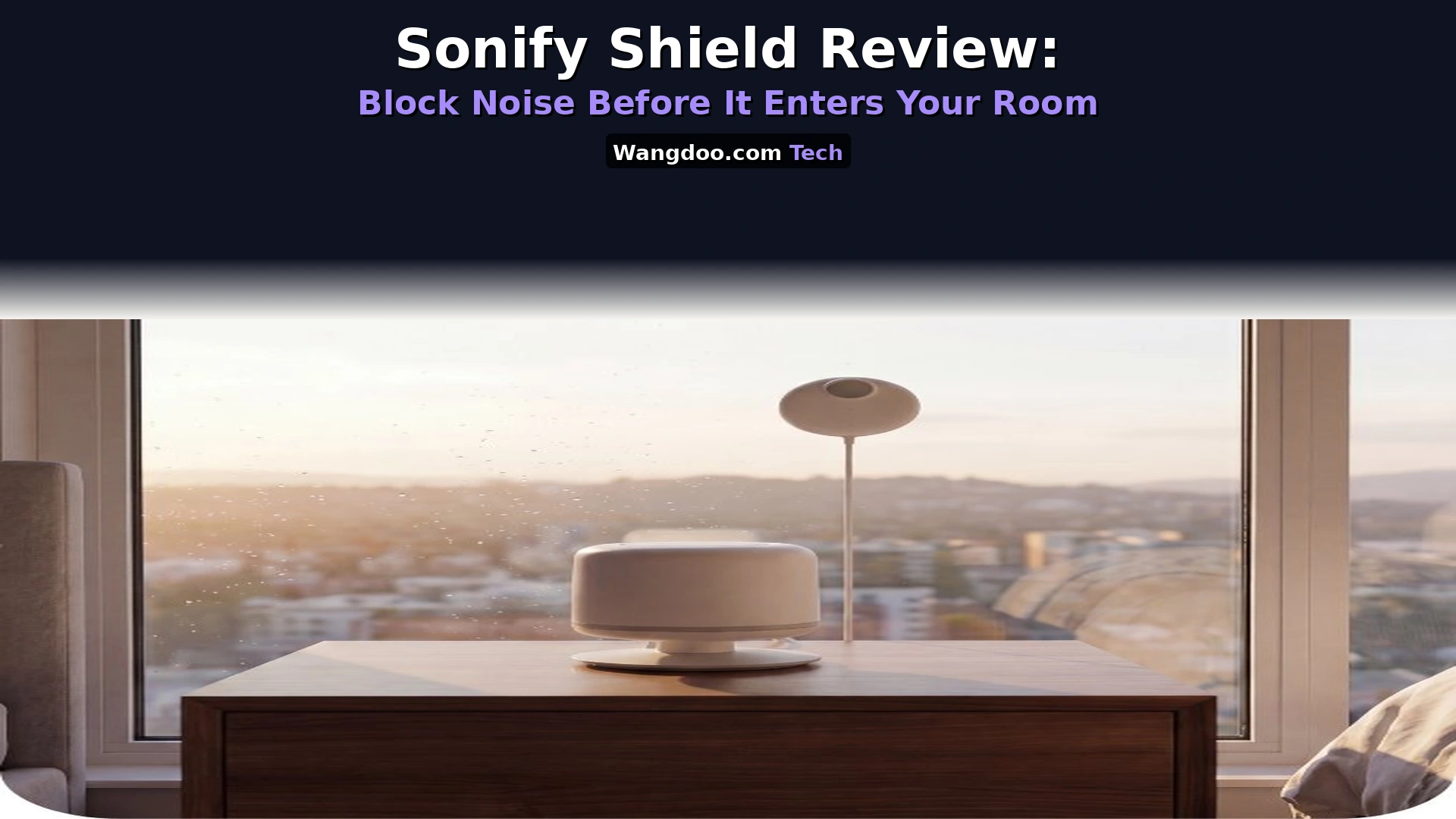
How to Block Noise in an Apartment Without Drilling a Single Hole — 2026 Guide
Neighbour noise is not just irritating — according to the World Health Organisation, chronic exposure to environmental noise is the second largest environmental health risk in Europe after air pollution. Upstairs footsteps, paper-thin walls, traffic at 3am — for the estimated 50 million apartment dwellers across the UK, Ireland, and Europe who deal with this daily, the options have always been either expensive structural soundproofing that requires a landlord’s permission, or white noise machines that mask the problem rather than solving it. A new category of product is emerging in 2026 that tries to do something genuinely different: turn your walls and ceilings into active noise shields using the same physics that powers noise-cancelling headphones — scaled up to room level.
📋 In This Guide
The Noise Problem — Bigger Than You Think
Most people treat noise from neighbours as an inconvenience. The science says it is significantly more than that. The European Environment Agency estimates that nearly 7 million people across the EU experience significant sleep disturbance from long-term exposure to transport noise alone — and that figure does not include noise from neighbours, which is the leading complaint among apartment and flat renters across every major urban survey.
📹 The Sonify Shield — how it works and what it aims to solve. Published May 2026.
“Nighttime noise carries a significant disease burden. Even relatively low noise levels — around 40 decibels at night, roughly the level of a quiet conversation — can interfere with sleep quality.”
— WHO Environmental Noise Guidelines, corroborated by University of Pennsylvania / Environmental Health Perspectives, 2022The health consequences are not theoretical. A 2025 peer-reviewed cross-sectional study published in Bioinformation journal, which evaluated 125 urban residents aged 20–55, found that individuals exposed to high noise levels experienced significantly poorer sleep quality, more frequent headaches, dizziness, and irritability. Chronic exposure also activates the sympathetic nervous system, leading to elevated cortisol levels and increased cardiovascular risk even during sleep — the body is responding to noise without the person being consciously aware of it.
The WHO recommends that nighttime noise levels in bedrooms stay below 30 decibels for quality sleep. To put that in context, the hum of a quiet room is roughly 30dB. Upstairs footsteps register at 50–60dB. A busy street at night: 60–70dB. Most apartment walls reduce external noise by 30–40dB at best — which means a 70dB street environment still delivers 30–40dB to your bedroom. You are, essentially, sleeping on the threshold.
The Science Behind Blocking Noise at the Source
To understand what the Sonify Shield is attempting, you need to understand how noise actually travels through apartment walls — and why traditional solutions only partially solve it.
Passive vs Active Noise Control
There are two fundamentally different approaches to noise reduction. Passive isolation uses physical mass and density to block sound waves — thick walls, double glazing, acoustic panels. It works, but it requires permanent structural changes or heavy materials, both impractical for renters. Active noise cancellation (ANC) uses a completely different principle: microphones detect incoming sound waves, a processor generates a mirror-image wave that is precisely out of phase with the original, and when the two waves meet they cancel each other out through destructive interference.
Why Room-Level ANC Is Hard
Applying this technology at room scale is genuinely more complex than in headphones. In headphones, the speaker and your ear are millimetres apart — the cancellation wave has almost no distance to travel before it reaches its target. In a room, the physics become far more complicated: sound travels from multiple sources, reflects off every surface, and arrives at different points in the room at different times. This is why previous attempts at whole-room noise cancellation have been expensive, research-grade systems — and why Sonify’s claims deserve careful scrutiny.
Researchers at NTT have developed spatial ANC systems using GPU computing power, described by PC Gamer in November 2025 as “designed for use in conference rooms and hotels where it can manage complex acoustic reflections.” That system remains commercial-grade and expensive. Sonify’s approach uses surface exciters — devices that cause the wall or ceiling itself to vibrate as the cancellation source — which is a different and more practical architecture for a consumer product.
Old Solutions — And Why They Fall Short
What Is the Sonify Shield?
VIP Special: $179 · Launch Day Special: $199 · Early Bird: $219. Two-pack: $399. Three-pack: $599. Campaign runs May 5 – June 4, 2026.
The Sonify Shield is not a white noise machine. It does not play sound to cover up other sound. Instead, it uses surface exciters — small electromechanical devices that physically vibrate a surface — to turn your existing walls, ceilings, and windows into active noise shields. The exciters are driven by a signal that is the acoustic inverse of the noise entering the room: when that anti-noise wave propagates through the wall, it interferes with and cancels the incoming noise before it reaches you.
The system pairs with a base station that houses microphones, a processor, and Sonify’s patent-pending adaptive algorithm. The processor analyses incoming noise in real time, calculates the inverse waveform, and drives the exciters — all without storing any recordings. According to Sonify’s official campaign materials, all sound processing happens locally on the device and is deleted immediately, with no audio data transmitted externally.
How the Sonify Shield Works — Step by Step
Mount the Exciter on the Noise Surface
The exciter attaches directly to any flat surface — a shared wall, ceiling, or window — using a renter-safe adhesive that removes cleanly. Sonify states it installs “securely and removes cleanly without marks left behind.” You place it where the noise enters: directly on the surface through which your neighbour’s footsteps, music, or traffic is travelling.
Position the Base Station
The base station sits in the room — placed at the location you want to be quietest. This is where the system’s microphones live. They continuously monitor the acoustic environment inside the room, detecting what noise is actually reaching you after passing through the wall.
Tap the Button — System Activates
A single button press starts the Sonify Shield’s adaptive algorithm. According to the campaign page, “Sonify adapts in real time to create a more pleasant environment.” The processor analyses the incoming noise, calculates the anti-noise signal, and immediately begins driving the surface exciter. Sound recordings are processed locally and immediately deleted.
Surface Becomes an Active Shield
The wall or ceiling now vibrates with the anti-noise signal. When the external noise wave meets the anti-noise wave propagating through the structure, destructive interference reduces the acoustic energy reaching you. The system continuously adjusts — adapting to changing noise sources in real time rather than using a fixed cancellation pattern.
Key Features
Adaptive Real-Time Processing
The algorithm continuously monitors and adjusts — not a fixed pattern but a dynamic response to changing noise sources throughout the day and night.
Renter-Friendly Installation
No drilling, no permanent fixtures, no landlord permission required. Attaches to surfaces and removes cleanly — designed specifically for renters who cannot modify their space.
Local-Only Audio Processing
Sound is processed entirely on-device and deleted immediately. No recordings are stored or transmitted. Privacy-by-design architecture.
Works on Any Flat Surface
Walls, ceilings, windows, doors — the exciter attaches to any flat surface that noise is passing through, making it flexible for different apartment configurations.
Future Features in Development
According to Sonify’s campaign, guided meditation, sleep apnea tracking, and voice-to-notepad features are being developed for future firmware updates — though none are available at launch.
One-Button Operation
Single button press activates the full system. The base station positions at your desired quiet zone — the system targets noise reduction at your location, not across the room uniformly.
Who Is This For?
🏢 Apartment Renters With Noisy Neighbours
The primary audience — and the largest one. If you share walls, floors, or ceilings with neighbours whose footsteps, music, or conversations are disrupting your sleep or work, this is exactly the scenario Sonify designed for. The renter-friendly installation (no drilling, removes cleanly) is a genuine practical advantage over almost every other meaningful noise reduction solution.
🏠 Shared Houses and HMOs
Anyone sharing a house with other occupants they didn’t choose faces the same challenge. A shared house with thin internal walls, a roommate on a different schedule, or a living situation where you can’t control the noise is a strong use case — one exciter on the shared wall, base station at your desk or bed.
🏨 Short-Term Rental Guests and Frequent Travellers
If you stay regularly in hotels, Airbnbs, or temporary accommodation, the Sonify Shield is described as portable — removable without marks. This makes it potentially useful for temporary spaces where you have no control over the building or neighbours.
🖥️ Home Office Workers
Post-pandemic, a significant percentage of the population now works from home full-time. External noise during video calls and concentration tasks is a documented productivity issue. A surface exciter on the window facing a busy road addresses that specific noise pathway without requiring any permanent modification.
Who It Is Probably NOT For
Specifications & Pricing
Detailed technical specifications including frequency response range, attenuation figures, and battery life have not been published by Sonify at the time of writing. The following reflects what is confirmed from the official Kickstarter campaign and official website.
Kickstarter Pricing Tiers
Lowest available price
Best current availability
Standard early backer price
$199.50 per unit
$199.67 per unit
Honest Caveats — Read This Before Backing
BackerClub’s own analysis notes: “This is Sonify, Inc.’s first Kickstarter campaign, so there’s no track record to lean on yet.” Unlike BLUETTI (millions of units shipped), or established brands with proven fulfilment, Sonify is a first-time campaigner. The technology is compelling and the campaign traction is genuine — but backers are accepting the risk that comes with any first-time hardware team.
At the time of writing, Sonify has not published independent third-party acoustic measurements showing how many decibels of noise reduction the Shield achieves across different frequency ranges. Claims are based on the physics of the technology (which is sound) and the company’s own marketing materials. Before backing, it is reasonable to ask Sonify directly — via the Kickstarter comments — for any lab data, prototype testing results, or beta tester feedback they can share. The absence of this data is not necessarily a red flag, but its presence would significantly increase confidence.
As confirmed by independent acoustic research, active noise cancellation is most effective on steady, continuous, predictable noise. Sudden unpredictable sounds — a dog barking once, a single door slam, a shout — are harder to cancel because the system needs time to detect and respond. If your primary noise problem is sudden impact noise rather than continuous sound, manage your expectations accordingly. This is a physics constraint, not a product flaw — it applies to all ANC systems including headphones.
Sonify’s official website lists guided meditation, sleep apnea tracking, and voice-to-notepad as features being developed. These are not part of the product you are backing today. Back it for the noise cancellation it delivers at launch, not for features that have not been confirmed with a delivery date.
Raising over $186,000 — 1,860% of its $10,000 goal — with 758 backers and an average pledge of $245 (BackerClub / BackerTracker, May 2026) is strong traction for a first-time hardware campaign. The question is whether the team can deliver at scale — something only time will answer.
✅ Reasons to Back
- Genuinely different approach — active blocking, not masking
- Renter-friendly — no drilling, removes cleanly
- Works on any flat surface (walls, ceiling, windows)
- Local-only audio processing — privacy-by-design
- One-button simplicity
- $179–$219 entry price is accessible
- $322K raised — strong genuine backer demand
- Patent-pending technology
❌ Reasons for Caution
- First Kickstarter — no delivery track record
- No independent attenuation data published
- Limited technical specs available
- ANC less effective on sudden impact noise
- Future features not included at launch
- Delivery timeline not confirmed
- No established brand history to lean on
- Wangdoo has not tested this product
Noise Solutions Compared
| Solution | Blocks Noise? | Renter-Friendly? | Works on Low-Freq? | Active or Passive? | Cost |
|---|---|---|---|---|---|
| Rugs / Soft Furnishings | Partial | ✓ | ✕ | Passive | Free–£200 |
| Acoustic Panels | ✕ (absorption only) | ✓ | ✕ | Passive | £50–£500 |
| White Noise Machine | ✕ (masking only) | ✓ | Partial | Passive | £30–£150 |
| Soundproof Curtains | Partial | ✓ | ✕ | Passive | £80–£300 |
| Mass-Loaded Vinyl | ✓ | ✕ (permanent) | ✓ | Passive | £150–£600 |
| Structural Acoustic Work | ✓✓ Best | ✕ (owner only) | ✓ | Passive | £1,000+ |
| Sonify Shield | ✓ (if works as claimed) | ✓ | ✓ (ANC strength) | Active | $179–$219 |
🔇 Wangdoo Research Verdict — A Compelling Concept With Unproven Delivery
The Sonify Shield addresses a genuine, large-scale problem with a scientifically sound approach that no renter-friendly product has successfully delivered before at this price point. The physics work. The concept is correct. The campaign traction is real. The caveats are also real: no independent test data, no delivery track record, and technical specs that remain sparse. Wangdoo has not tested this product. We recommend backing it only if you can afford the Kickstarter risk of a first-time hardware team, and only if your primary noise problem is steady-state (traffic, music, HVAC) rather than sudden impact noise. If this delivers what it promises, it is the most useful renter noise solution ever built. We’ll be watching.
Where to Back It
The Sonify Shield is live on Kickstarter until June 4, 2026. VIP Special $179 · Launch Day Special $199 · Early Bird $219 · Two-pack $399 · Three-pack $599. Full technical specifications and delivery timeline should be confirmed directly with Sonify via the Kickstarter comments section before backing.
Frequently Asked Questions
Does the Sonify Shield actually block noise or just mask it?
Will it work against upstairs footsteps?
Is it safe for renters? Will it damage walls?
Is the Sonify Shield’s Kickstarter legitimate?
What type of noise does active cancellation work best on?
Is my audio being recorded?
When does the campaign close and when does the product ship?
Sources & References
- Kickstarter — Sonify Shield official campaign page (verified May 2026)
- BackerClub — Sonify Shield project analysis
- BackerTracker — Sonify Shield campaign data ($322,654 raised, ~75.9 backers/day, May 2026)
- Sonify official website — product overview and feature documentation
- Faizal et al. — “Impact of urban noise pollution on sleep disorders and neurological symptoms,” Bioinformation 21(11), November 2025 (peer-reviewed)
- EVS Institute — “The Health Impacts of Noise Pollution: From Hearing Loss to Hypertension,” February 2026
- Smith et al. — “Environmental Noise and Effects on Sleep: An Update to the WHO Systematic Review,” Environmental Health Perspectives, July 2022 (peer-reviewed)
- UC Davis Center for Occupational and Environmental Health — “How Noise Pollution Quietly Affects Your Health,” June 2025
- PC Gamer — “Researchers have developed spatial active noise cancellation,” November 14, 2025
- Aeco Sound — “Soundproofing Ceiling in a Rental Apartment,” December 17, 2025
- ApartmentList — “12 Damage-Free Ways to Soundproof an Apartment,” September 2025
- SoundproofLiving — “How to Set Up a Noise-Canceling System for Your Home,” August 2024