
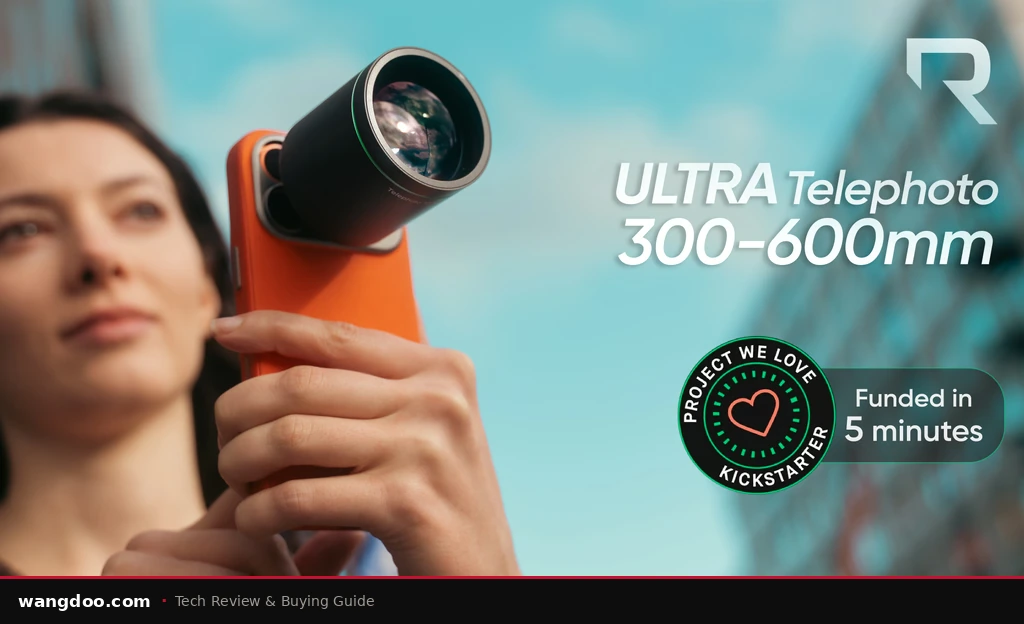
The Problem With Smartphone Telephoto
If you have ever tried to photograph a distant bird at the far end of a lake — or capture a fleeting moment of stadium action from the upper tier — you already know the sting of smartphone disappointment. You pinch to zoom and the result is a pixelated mess. The fundamental physics of fitting glass into a 6mm chassis has always imposed a hard ceiling on how far you can reach.
The best iPhones and Samsung Galaxy Ultra models have made enormous strides. The iPhone 17 Pro now carries a native 4× tetraprism telephoto capable of 8× in-sensor optical-quality zoom, and the Galaxy S26 Ultra pushes to 10×. But those 100mm-equivalent lenses are still a very long way from the reach wildlife photographers and sports shooters demand.
REEFLEX — a European company pushing mobile optics since the iPhone 12 era, whose app was named Apple’s App of the Day and featured as Best of Kickstarter 2025 and Best of CES 2025 — thinks the answer is not to wait for smartphone makers to catch up, but to bring professional glass to the party right now.[1]
What Is the REEFLEX Ultra Telephoto 300–600mm?
The REEFLEX Ultra Telephoto is a precision optical attachment that mounts directly in front of the native telephoto camera on compatible flagship smartphones — specifically the periscope or tetraprism telephoto module, not the wide lens. It is a 3× optical multiplier, tripling the effective focal length of whichever telephoto camera it sits in front of.[3]
What the “300–600mm” name actually means
This deserves honest clarity, because the marketing can mislead. There is no zoom mechanism inside the barrel. The range reflects how different shooting modes and device combinations produce different effective focal lengths. On an iPhone 17 Pro with its native 4× telephoto, the REEFLEX multiplier delivers a 300mm equivalent at full 48MP resolution. Engage Apple’s in-sensor crop (pixel binning to 12MP) and reach doubles to 600mm. You are trading resolution for reach at the long end — a genuine trade-off worth knowing before you commit.[3][4]
“Even 300mm is a huge step up from the 100mm that iPhone users are used to. Just don’t expect miracles at the long end.”
— Early reviewer, GSMGoTech [4]Compatible Devices & Real-World Reach
The lens is specifically engineered for tetraprism telephoto systems in recent iPhone Pro and Samsung Galaxy Ultra models. REEFLEX officially confirms support from iPhone 15 Pro onwards, with the lens also compatible with earlier 3× telephoto cameras via the standard 17mm thread mount — though the company’s confirmed device list begins at the 15 Pro generation.[3]
On the Samsung side, support spans Galaxy S23 Ultra through S26 Ultra. Note that the S26 Ultra’s slightly longer native telephoto pushes base reach to 345mm, a step above the 330mm achieved on the S23–S25 Ultra generation — a detail REEFLEX’s own marketing tends to gloss over.[3][5]
Build Quality & Optics
The barrel is machined from aerospace-grade aluminium alloy, giving it a solid, premium feel that reads as serious hardware rather than a mobile toy.[5] At the optical core are four lanthanum glass elements, specifically chosen to minimise chromatic aberration and maintain sharpness across the frame — a material more typically found in professional DSLR prime lenses than smartphone accessories.[3]
The trade-off is mass. The lens weighs approximately 308–310g without the cap — sources vary marginally between 308g (Notebookcheck) and 310g (Epic Tutorials) — meaning the REEFLEX attachment alone is heavier than the iPhone 17 Pro it mounts onto. With phone and case, the total rig approaches 600g, drawing direct comparisons to a compact mirrorless camera body.[4][5] Physical dimensions: 70mm long by 55mm in diameter.[6]
In side-by-side comparisons documented by Notebookcheck, the iPhone 17 Pro with the REEFLEX Ultra Telephoto held its own against a Sony α7 IV paired with a 100–400mm GM lens — a setup costing $4,000–$5,000+. The full-frame Sony still edges ahead on dynamic range and absolute image clarity, but the gap was described as “shockingly” narrow for a ~$280 lens on a $1,099 smartphone.[6]
Full Technical Specifications
| Specification | Detail |
|---|---|
| Optical design | 4-element lanthanum glass |
| Magnification factor | 3× optical (mounts over native telephoto sensor) |
| Effective focal range | 231mm – 660mm (device-dependent) |
| Max reach — iPhone 17 Pro | 300mm @ 48MP / 600mm @ 12MP in-sensor crop |
| Max reach — Galaxy S26 Ultra | 345mm @ 50MP / 660mm @ 12MP |
| Max reach — Galaxy S23–S25 Ultra | 330mm @ 50MP / 660mm @ 10–12MP |
| Minimum focus distance | 6.8 metres (22 ft) to infinity |
| Body material | Aerospace-grade aluminium alloy |
| Dimensions | 70mm long × 55mm diameter |
| Weight | ~308–310g (without cap) |
| Thread mount | Standard 17mm — REEFLEX cases and compatible 3rd-party mounts |
| Filter system | ReeMag magnetic (CPL, VND, ND, Black Mist, Gold & Blue Streak) |
| Confirmed iPhone models | iPhone 15 Pro / Pro Max → iPhone 17 Pro / Pro Max |
| Samsung models | Galaxy S23 Ultra → S26 Ultra |
| Astronomy use | Yes — explicitly designed for this |
| Video use | Yes — tripod or gimbal strongly recommended at 300mm+ |
| Kickstarter early-bird price | From €239 (~$280 USD) — price varies by pledge tier |
| Planned retail price | €380 (~$445 USD) |
| Estimated shipping | June 2026 |
Pricing: What You Will Actually Pay
Kickstarter pledge pricing varies by tier and timing. The Super Early Bird rate is quoted at €239 / ~$280 by PetaPixel, while New Atlas reported €249 / ~$291 — reflecting different tiers active at different points during the campaign. The best price depends on which tiers remain open when you back it.[2][3] The planned post-campaign retail price is confirmed at €380 / ~$445 across multiple independent sources. Every Kickstarter reward includes the lens and a compatible mounting case for your specific device.[6]
Demand has been exceptional: the campaign hit its $11,717 funding goal in just five minutes after launch on 28 April 2026, and had raised over $546,000 from more than 1,500 backers by early May 2026.[7]
Software & Shooting Technique
Raw glass alone does not guarantee great results at 300mm+. REEFLEX recommends pairing the lens with their Reeflex Pro Camera app on iOS (or MotionCam Pro on Android), which applies full manual control and forces the phone to use the correct telephoto sensor — preventing camera software from defaulting to digital zoom on the main wide module.[5]
For stills, the built-in OIS of the iPhone 17 Pro and Galaxy Ultra telephoto cameras manages reasonably at 300mm. For video at 300mm or the 600mm crop, a tripod or gimbal is near-essential — micro-vibrations are dramatically magnified at extreme focal lengths.[5] The Epic Tutorials pre-launch review recommends enabling Aggregate Burst Shots in the app — capturing 10+ rapid frames and selecting the sharpest — as the most effective handheld technique. For format: ProRAW at 48MP for maximum detail at 300mm, and Bayer RAW at 12MP when pushing to 600mm reach.[5]
Moon & Astronomy Photography
This is one of the clearest use cases for the Ultra Telephoto. REEFLEX explicitly positions the lens for astronomy, and early media testers confirm it delivers — bringing the moon into sharp, detailed focus in a way that has historically required a telescope attachment or a heavy DSLR rig.[8] At 600mm on the iPhone 17 Pro, mounted on a tripod with full manual control, the lens reveals lunar craters and surface texture in a way that feels genuinely remarkable from a device that fits in a jacket pocket.
Who Is This Really For?
Let us be direct: this is not a general-purpose everyday lens. At ~310g, with a 6.8m minimum focus distance and a requirement for a dedicated mount case, it is a purposeful specialist tool.[4] The ideal buyer is someone who regularly needs extreme reach — birdwatching, wildlife, sports from the stands, distant architecture, or lunar photography — and who currently either accepts poor digital zoom results or carries a separate camera bag. For casual shooters wanting a bit more zoom at a gig or on holiday, this is overkill.
- ✓Genuine 3× optical magnification — no digital processing at 300mm
- ✓4-element lanthanum glass controls chromatic aberration impressively
- ✓Aerospace aluminium build quality that outclasses typical mobile accessories
- ✓ReeMag magnetic filter ecosystem adds real creative control (ND, CPL, VND)
- ✓Confirmed support for iPhone 15 Pro through 17 Pro Max and Galaxy S23–S26 Ultra
- ✓Moon and astronomy performance praised by pre-launch testers
- ✓Kickstarter pricing well below planned retail
- ✕~310g body is heavier than the phone itself — full rig approaches 600g
- ✕600mm reach requires dropping from 48MP down to just 12MP
- ✕Requires a dedicated REEFLEX or 17mm-thread case — existing cases will not fit
- ✕Tripod or gimbal effectively mandatory for stable video at 300mm+
- ✕6.8m minimum focus distance rules out portraits and close-up work entirely
- ✕Not yet shipped — crowdfunding fulfilment risk always applies
Wangdoo’s Pre-Launch Verdict
The REEFLEX Ultra Telephoto 300–600mm is a rare thing in mobile accessories: a product with genuine ambition backed by real optical engineering and materials serious enough to earn the price tag. At 300mm the pre-launch results from tested samples are impressive and the optical quality is real — not computational trickery. At 600mm you trade megapixels for reach, an honest compromise the marketing undersells. Know that going in.
The weight and bulk will disqualify it for casual use. But for the birdwatcher, the sports fan in the upper tier, the amateur astronomer, or the travel photographer who refuses to check a camera bag — this lens opens a door that was previously shut. Against the Kickstarter price, that door is very much worth opening.